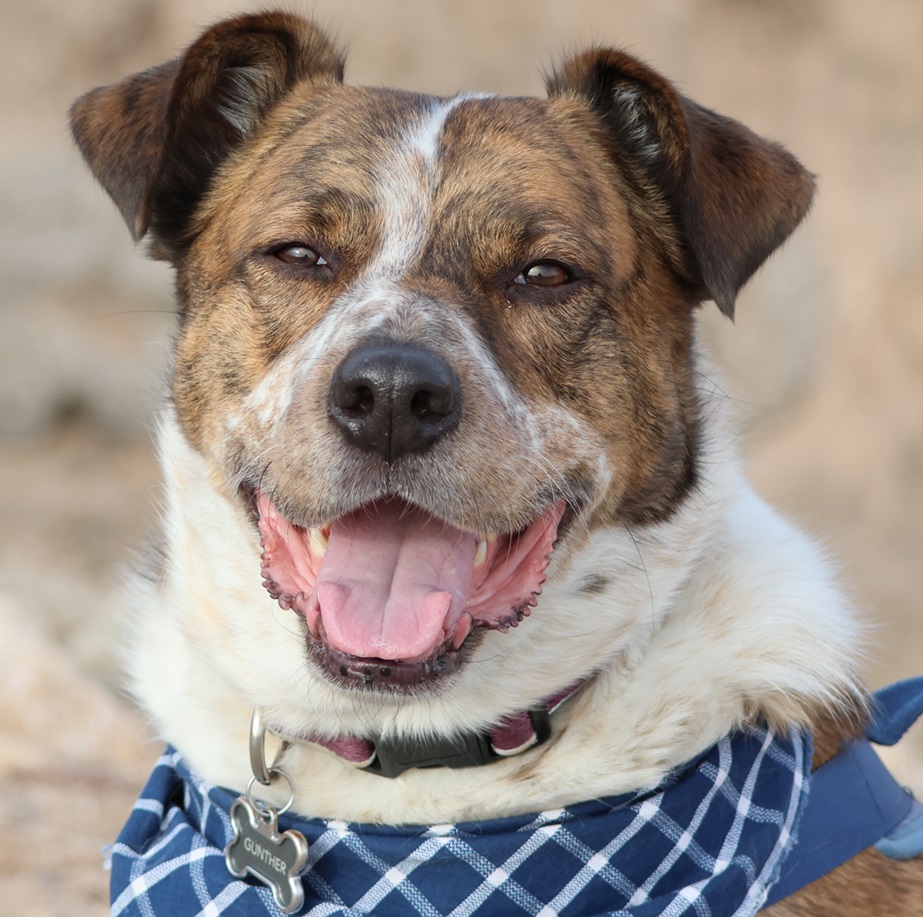
Nancy, Gunther, Rusty, and I are wintering in Las Vegas, Nevada. We arrived here at the beginning of November 2024, with plans to depart in early spring of this year. There are worse places to spend the winter than Las Vegas: the campground at which we’re staying is surprisingly inexpensive with friendly folks and lots of activities, there are a lot of good restaurants and entertainment options relatively nearby, and, as we found out last winter (we spent five months here), there are a unexpectedly large number of hiking and birding opportunities very close to the city.
Gunther, Nancy, and I took advantage of one of those birding opportunities during the waning days of 2024 with a visit to Clark County Wetlands Park, located just a few minutes’ drive from our campground. The Las Vegas Wash, which I described in last year’s posting about the Owl Canyon Hiking Trail at Lake Mead National Recreation Area, creates the wetlands aspect of the park. Those of you who have spent much time in the desert city of Las Vegas might be surprised to see that a decent-sized creek runs through the east side of the metropolitan area. Las Vegas Wash is bigger at times, especially after heavy rains, than others. For those used to even small-sized creeks and rivers, it’s probably not a very impressive waterway. However, the Las Vegas Wash is absolutely critical for the health and sustainability of this area; the water in it is collected wastewater and runoff from the city’s hotels, golf courses, and other businesses, as well as residential wastewater and stormwater runoff, on a 12-mile journey (including through wastewater treatment plants) to the Lake Mead impoundment east of Las Vegas. Ninety percent of the water used in the Las Vegas metropolitan area is drawn from Lake Mead (the rest is from groundwater sources), so it’s imperative that as much water that’s used in the city gets returned to the reservoir as possible.
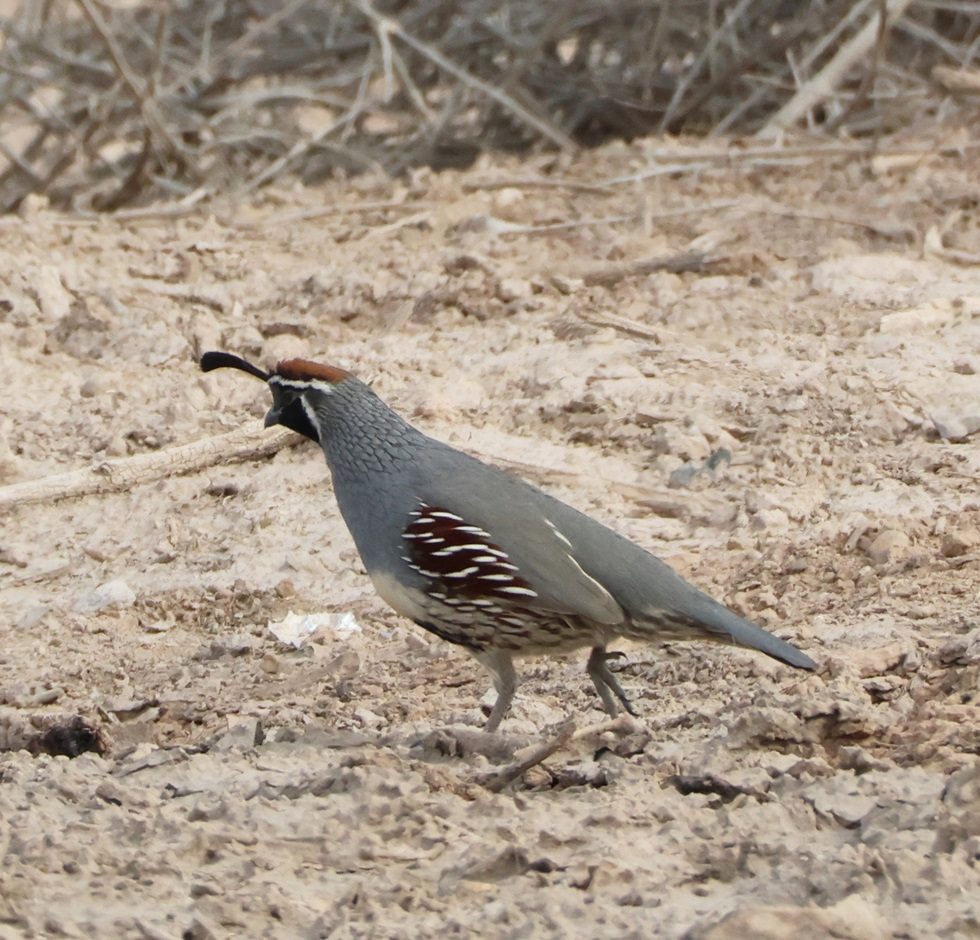
We’re currently close enough to the Golden State that I thought this might be a California quail as opposed to a Gambel’s quail (Callipepla gambelii), but it is indeed the latter. It, along with three or four more of its kind, was hunting on the ground just off the trail shortly after we started our walk. In addition to southern Nevada, this bird’s range includes regions of California, Arizona, New Mexico, and Utah, as well as little parts of western Colorado.
Whether it’s moving, still, salty, fresh, or freshly treated, water makes a huge difference in supporting wildlife populations; without the wash, many species of birds, lizards, and mammals simply wouldn’t be in this place. That fact was made clear to us on the day that we visited. Like most avid birders, I keep a record of each bird species we see during the year. Before we began the five-mile loop walk through the wetlands, we’d seen 50 different bird species in 2024; by the time the three of us climbed back into the Goddard’s six-wheeled towing unit to drive back to the campground, we’d seen 18 additional species, 12 of which were species not yet seen in 2024, and four of which we’d never seen before. In other words, nearly a quarter of the bird species we saw in 2024 were seen on the on the 363rd day of the year during this 2 1/2-hour hike just outside of Las Vegas.
Much of the 2,900-acre (4.5 square-mile) Wetlands Park is a nature preserve, into which Gunther (very understandably) can’t go. However, there’s a very fine concrete trail that skirts the outer perimeter of the preserve and also goes over a bridge that crosses the wash. It was from that bridge that we saw three of the four “lifers,” or bird species we hadn’t ever seen before.
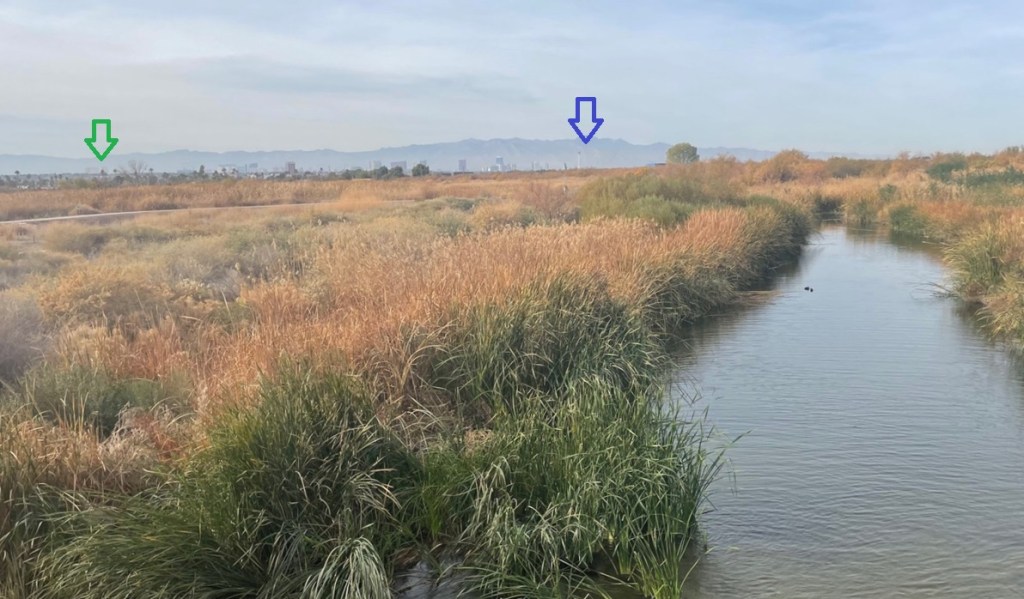
This is a view from the Las Vegas Wash looking west toward Las Vegas Boulevard, or “The Strip.” It was an overcast and hazy day in the Las Vegas Valley, but you can just barely make out some of the structures on The Strip. Mandalay Bay Resort and Casino, the southernmost casino on The Strip and indicated by the green arrow, is about nine miles directly west of this position. The Stratosphere Hotel, Casino and Tower (I think it’s just going by The STRAT now) is indicated by the blue arrow and is located about six miles to the north of Mandalay Bay. (Incidentally, at 1,149 feet the Stratosphere’s observation tower is the tallest in the United States and is second in the Western Hemisphere only to Toronto’s CN Tower at 1,815 feet – but that’s a conversion from metric so who knows what’s really going on?) Anyway, the Spring Mountain Range is on the horizon, and in between Las Vegas Boulevard and the mountains is Red Rock Canyon National Conservation Area, which we visited last winter. Those are American coots swimming in the Las Vegas Wash on the right.We’ve seen lots of little white-crowned sparrows (Zonotrichia leucophrys) since becoming full-time RVers, especially in New Mexico and Arizona, but it’s always a pleasure to see (and hear) them again. Of all the little brown birds (LBBs), they are one of the easiest o identify. Small but mighty, these birds are exceptional migrators and have been tracked flying as many as 300 miles in one night.
Prior to becoming full-time RVers and when we still lived in Denver, Nancy and I visited Las Vegas at least once a year. Like most visitors, we arrived via airplane at Harry Reid International Airport (née McCarran International Airport), and took a cab to our hotel, either on The Strip, or, later and more regularly, in downtown Las Vegas. We’d spend a few fun-filled days, some more profitable than others, and then take a cab back to the airport and return home. A lot of people don’t realize that when they fly into Harry Reid International Airport, spend a few days recreating on The Strip then return to the airport to go back home, they’re not ever actually in Las Vegas – unless they go to the Stratosphere (I don’t care what it’s going by now; I’ll still call it the Stratosphere because I just got used to not calling it Bob Stupak’s Vegas World) or to downtown Las Vegas. Otherwise, each of the roughly 40 hotels and casinos, including places like The Bellagio, Caesar’s Palace, New York New York, The Luxor, The Wynn Las Vegas, and dozens more) along Las Vegas Boulevard, with the exception of the Stratosphere, is in unincorporated Clark County (as is the airport). Those hotels have a total of nearly 89,000 rooms (The Wynn Las Vegas alone has almost 4,800 rooms); compare to, say, downtown Denver which has about 11,000 hotel rooms and the biggest one, the Sheraton Denver Downtown, has 1,231 rooms). The point is, there are a lot of hotel rooms in Las Vegas (and tens of thousands more in unincorporated Clark County), and all of them have bathrooms with showers and flushing toilets, and all of that water needs to go somewhere.
Where it needs to go is into Lake Mead, and how it gets there is via the Las Vegas Wash. Wastewater treatment plant facilities clean up the water as it makes its way to the reservoir; during our visit to the wetlands on December 28, I was reminded of walking and biking on the Cherry Creek Regional Trail in Denver because of the unmistakable (and not entirely unpleasant – certainly more pleasant than it had been before) smell of wastewater under the process of being treated.
Anyhow, and as someone once wrote, back to the birds.
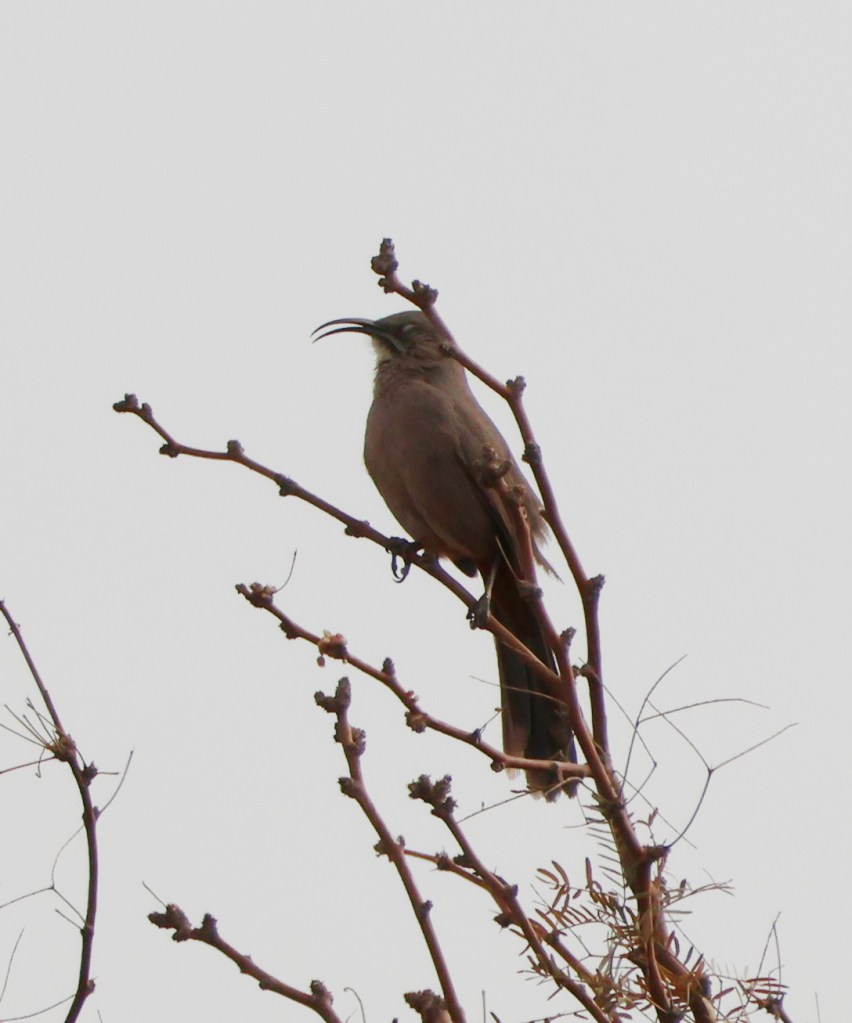
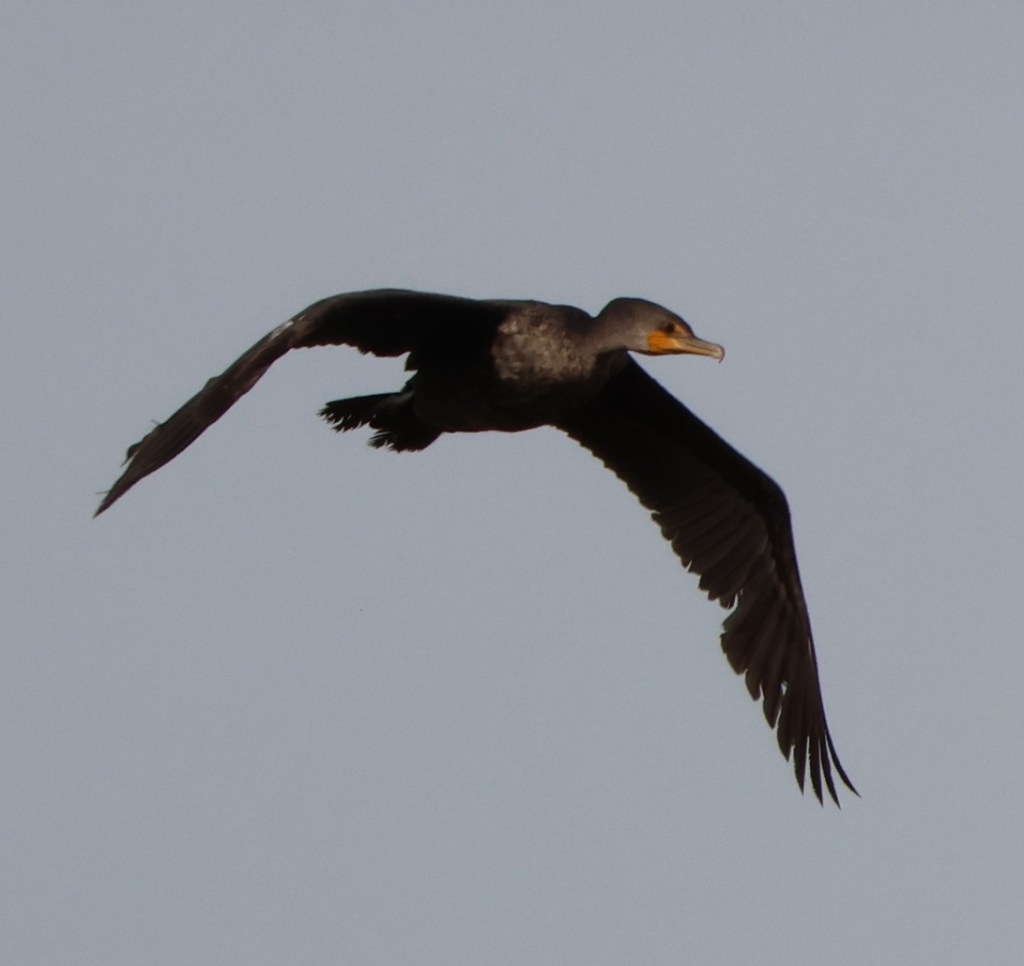
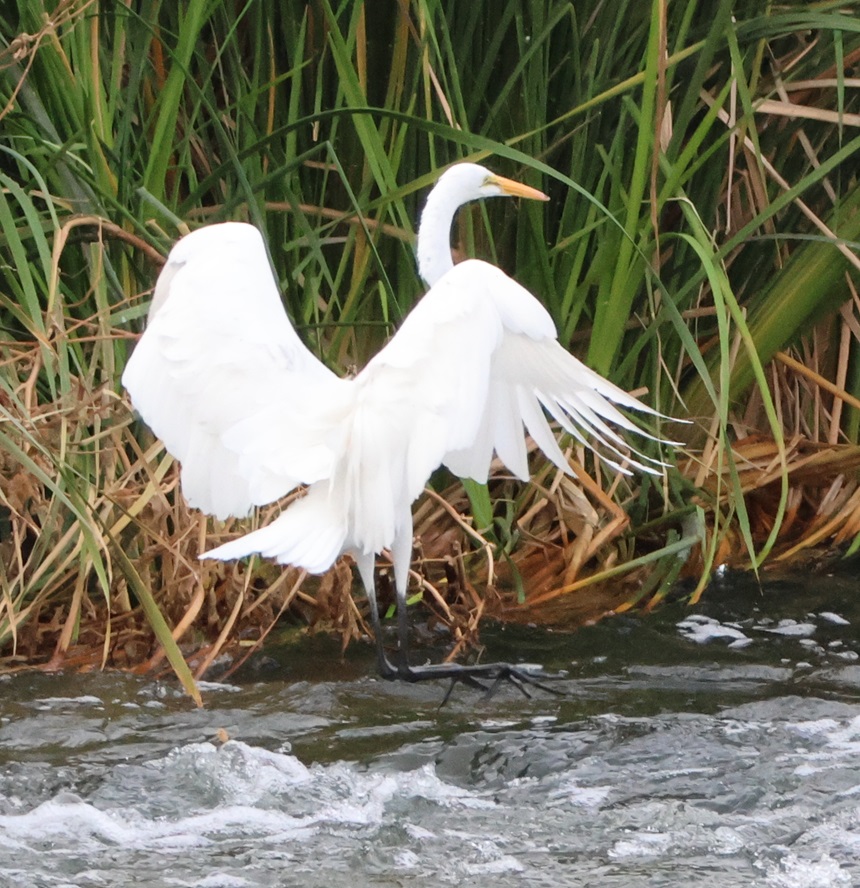
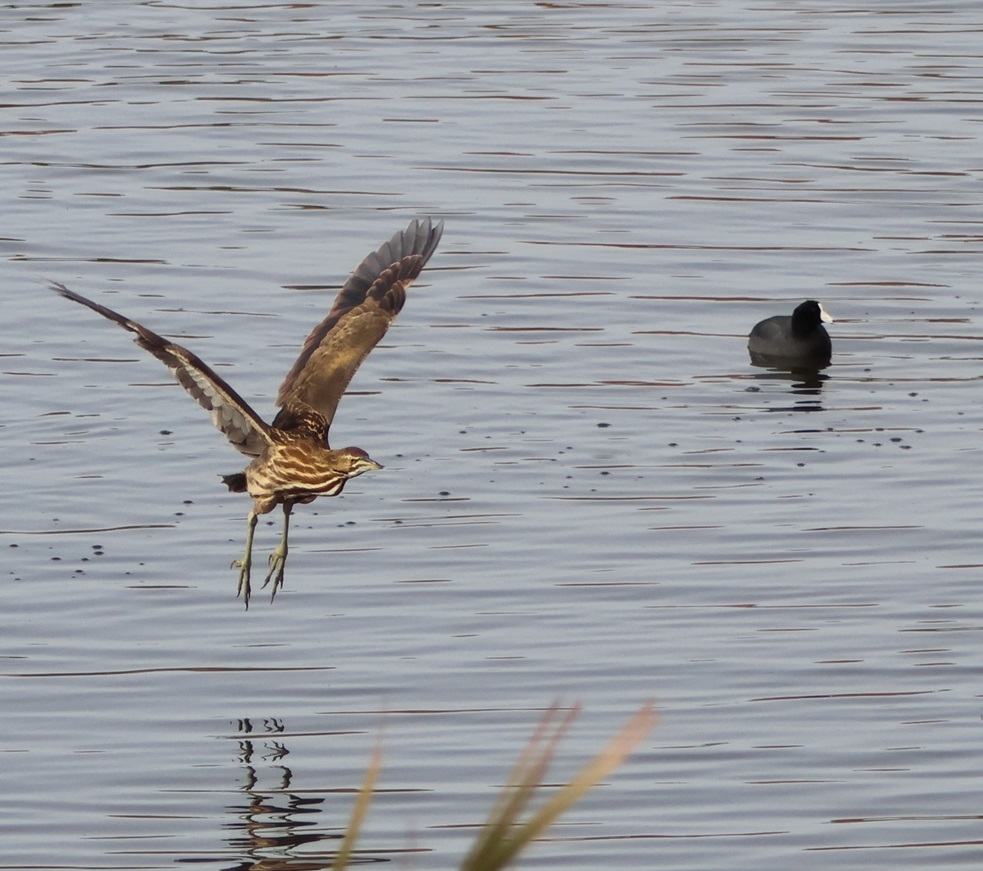
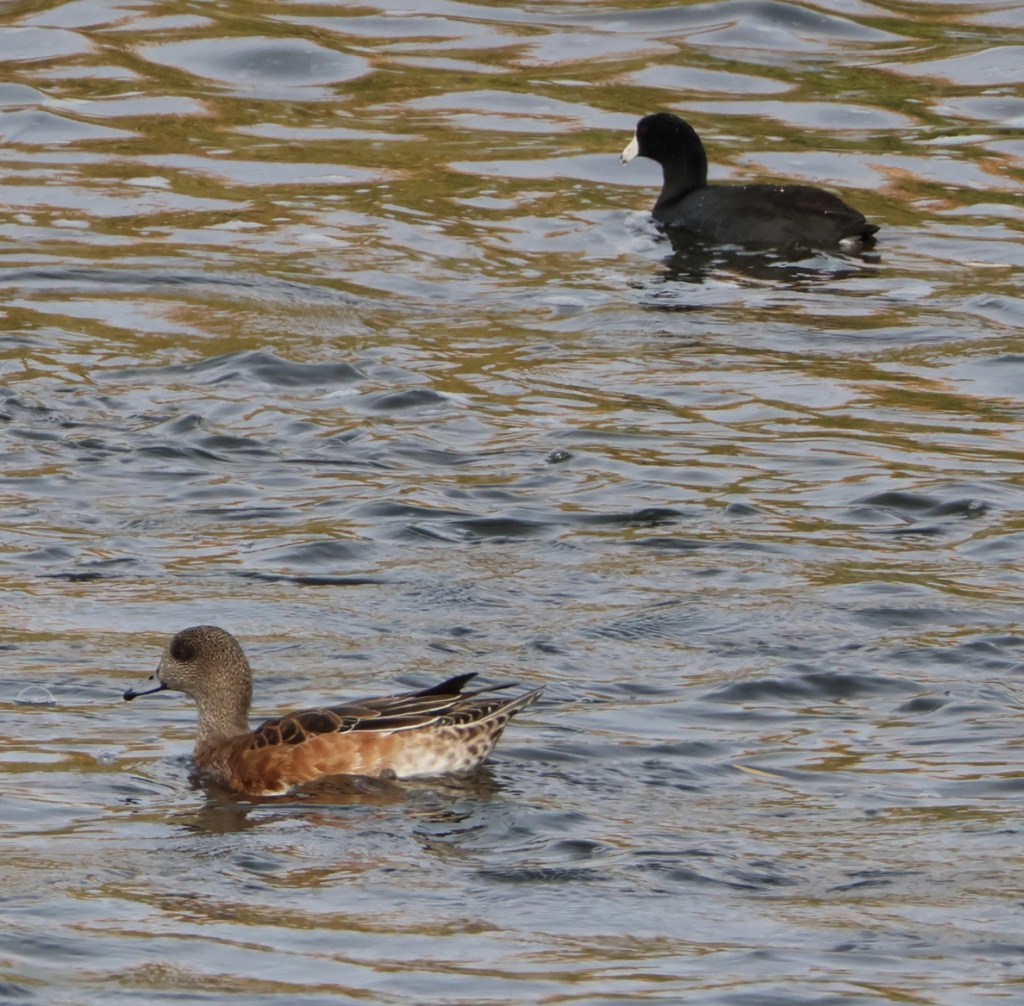
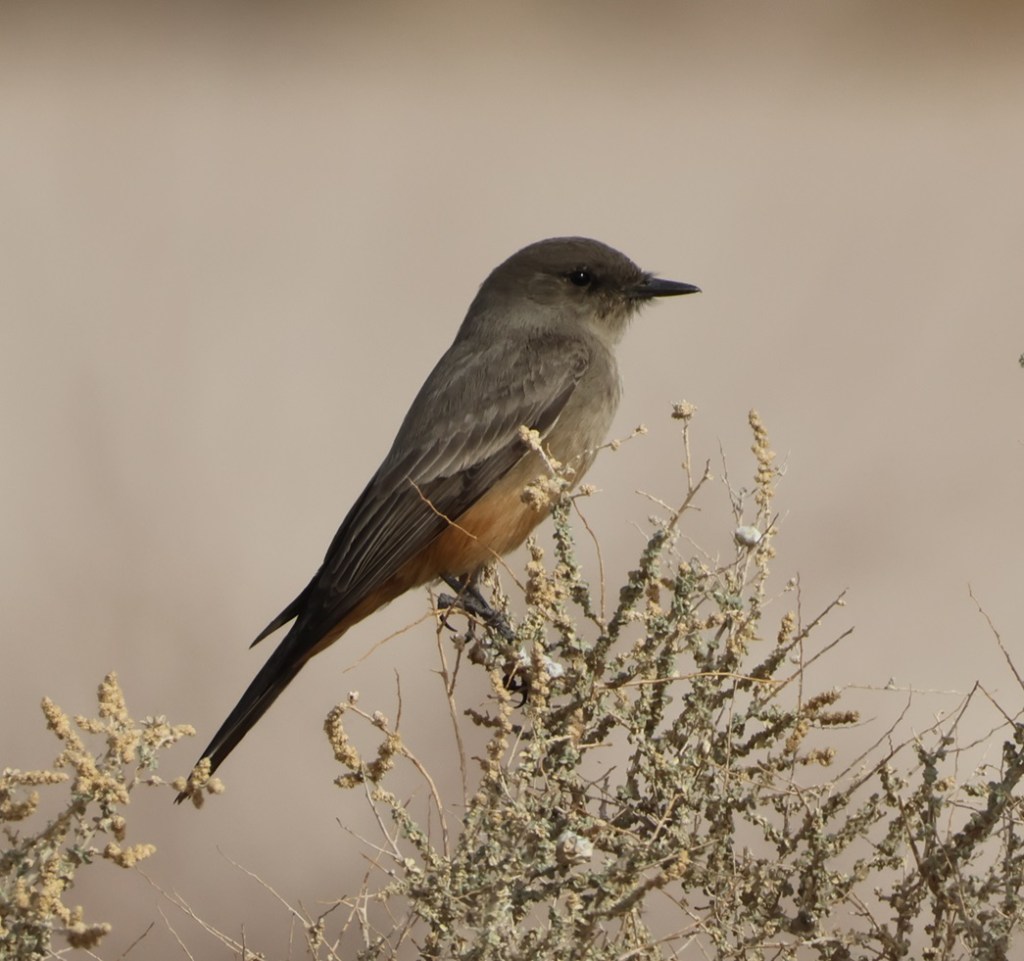
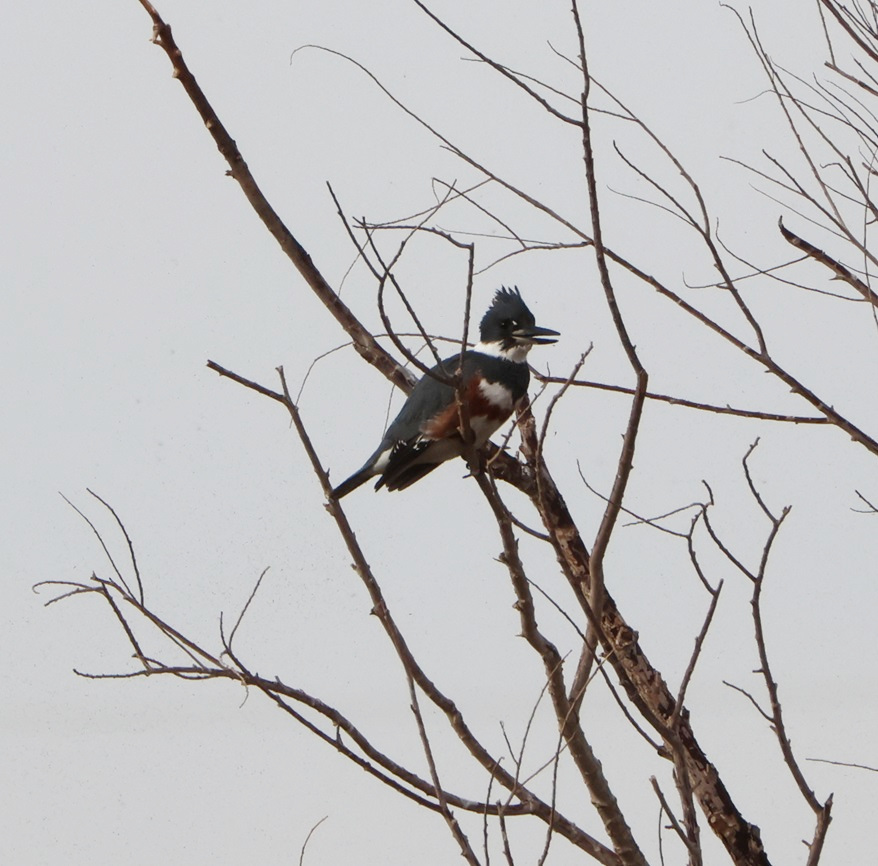
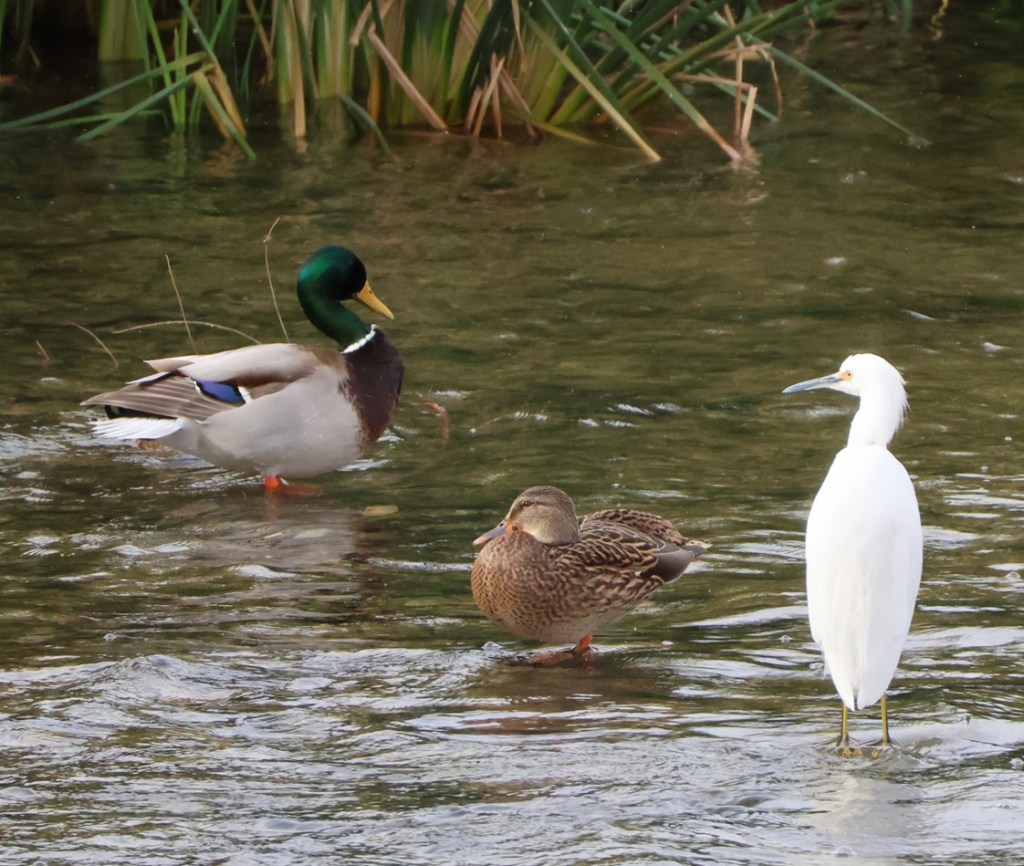
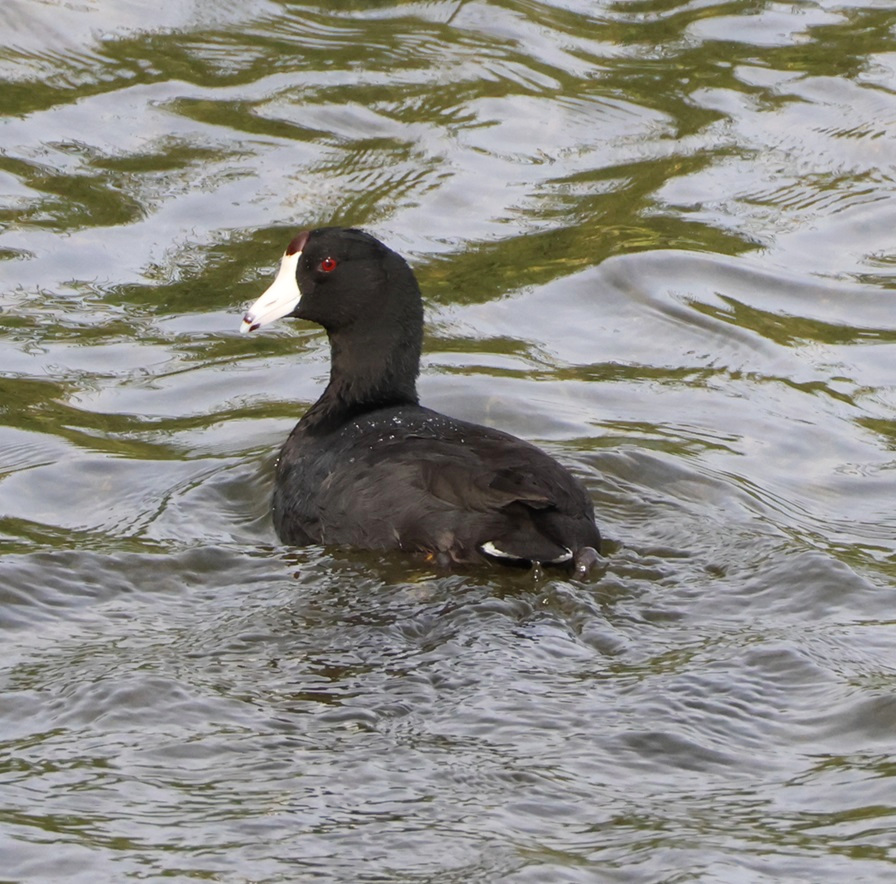
Here’s the first of the never-before-seen-by-us species: the Crissal thrasher (Toxostoma crissale). It’s very similar to a curve-billed thrasher, but the Crissal’s beak is even longer (and more curved, I think). This particular species prefers to stay on the ground, foraging for food, rather than fly about to fill its belly. In the United States, this bird is found only in the southern parts of California, Nevada, Arizona, New Mexico, and far western Texas. I usually avoid editing my pictures, other than cropping and re-sizing, but I decided to adjust the contrast on this one to bring out the bird better. The overcast conditions on the day we visited weren’t the best for photography, and many of the birds were far away (in the nature preserve, where, thanks to Gunther, we weren’t allowed. Thanks again, Gunther.)Happily, the sun happened to be out a bit more when we were on the bridge in Wetlands Park, and I got what I think are some pretty good photos. These ducks were far enough away that I didn’t know what species they were until we got back home and I could have a closer look at the images. This is another new-to-us species, the ring-necked duck (Aythya collaris). As is sometimes the case, the identification feature that’s in the name of this species isn’t really helpful in identifying it: the ring on the neck is very faint, and was probably more visible to early naturalists on captured birds. As a migrator, this species is found throughout North America in different parts of the year; during the fall, Minnesota lakes supporting beds of wild rice can sometimes have flocks of ring-necked ducks numbering in the hundreds of thousands. In this species, as with many other ducks, the male (right) and female (left) genders have remarkably different coloration most of the year (note the extreme difference even in their eye color). As was pointed out to me a few days ago by a full-time resident of this campground, the females of many bird species have to stay more camouflaged to protect the young hatchlings (in that case, we were talking about hummingbirds, but it’s true for many bird species). We’ve had the opportunity to see plenty of double-crested cormorants (Nannopterum auritum), especially at St. Vrain State Park in northern Colorado, but they were usually swimming. For some reason, there were a lot of cormorants on the wing this day at Wetlands Park. This one is showing off its wingspan, which can get to four feet long. Interestingly, despite being a water bird, cormorants do not have waterproof feathers – it’s why they’re often seen on shore with their wings spread. I recently listened to a very interesting audiobook about the Cretaceous-Paleogene Extinction Event, in which an asteroid struck the Earth 66 million years ago and brought the Age of Dinosaurs (mostly) to an end. The author consistently mentioned, though, that only non-avian dinosaurs, or those reptiles that couldn’t take to the air, were made extinct. I’ve mentioned it before, but double-crested cormorants (the white crests appear above the eyes of adult birds only during the breeding season) are one of the best reminders that, in an indirect way, avian dinosaurs still populate the earth.I’ve long been struck by how majestic and powerful most birds look when viewed from the side, or perhaps a three-quarter angle, and how they don’t look at all majestic and powerful when viewed face-on. This is a great blue heron (Ardea herodias), which spent a considerable amount of time among the reeds on the hunt for small fish.The angle makes all the difference: same exact bird. Great blue herons are a lot of fun to watch – they’re very patient while hunting and move almost imperceptibly, but then strike lightning-quick to pull fish from the water. If you look away for a moment, you may have missed all of the action. GBHs grow to a height of almost 4.5 feet and can weigh 5.5 pounds, with wingspans measuring more than 6.5 feet.I originally thought this was a snowy egret (and thus a lifer), but when editing the photo for this posting I realized that its beak is all yellow and its legs are all black (and it’s overall bigger than a snowy egret, which have black beaks and yellow legs). Thus, it’s a great egret (Ardea alba), which we’ve seen plenty of times elsewhere but are still very gratifying to watch. This bird is the symbol of the National Audubon Society, which was created to save this species and others from extinction. Because of their white brilliance, the feathers of great egrets were once valued as decorative accessories for people. This one was just taking off from creekside of the Las Vegas Wash, affording a good view of its feet just above the water. Again, this bird was far enough away while I was photographing it that I wasn’t really sure what species it was, but upon getting home and reviewing it on a bigger screen I discovered that it is an American bittern (Botaurus lentiginosus). This, the third of the “lifer” birds for this walk, was flying about the wash looking for a good place to land. They weigh between 13 and 17 ounces (just over a pound), with a three-foot wingspan. In true Vegas style, we were lucky to see this bittern while on the wing; this species is somewhat rare to observe in the wild because it takes advantage of that striping pattern on its neck and chest to hide motionless among reeds and other tall waterside plants while hunting. American bitterns, also migrators, are found from central and southern Canada down into Mexico at different parts of the year. During the winter months in North America, this species is found only in the extreme southern parts of the southern states and along the eastern and western seaboards. That’s an American coot on the right. We’ve seen American wigeons (Mareca americana) before as well, most memorably near Willcox, Arizona, but it was good to see another one near Las Vegas. We didn’t see any wigeon drakes; only this hen; drakes have a green head and a white crown. Wigeons’ bills are shorter and more goose-like than those of other dabbling ducks, and for that reason more of their diet is plant-based than those of other duck species. That’s an American coot on the right.Compare this egret to the great egret pictured above: notice the black beak and the yellow feet of this one? That’s right: it’s a snowy egret (Egretta thula), and thus the final lifer of the day! Another difference between the two species is their size: great egrets can grow to a height of just over 40 inches and a weight of 35 ounces, while snowy egrets only grow to about 26 inches and a weight of 13 ounces. Regrettably, and although I waited for what seemed like a reasonable time, no American coots made their way into the background of this photo.The “wetlands” aspect of Wetlands Park ends pretty abruptly; in fact, within just a few feet of the water’s edge, the landscape reverts back to extraordinary desolation. The Las Vegas area is in the extreme northeast corner of the Mojave Desert, 54,000 square miles of a dry and sparsely vegetated area that also includes Death Valley. The desert gets between 2 and 6 inches of rain each year, and summertime temperatures regularly climb into the 120-degree-Fahrenheit range. Still, there’s plenty of opportunity for my favorite desert plant, creosote, to grow (although these are, by far, the lowest-growing creosote bushes I’ve ever seen). We’re facing away (east) from the Las Vegas metropolitan area in this view. Yonder, about 20 miles beyond those picnic shelters, lies Lake Mead.Nancy was the first to spot this Say’s phoebe (Sayornis saya) as it flitted about in the shrubbery to our left (well, if Gunther saw it first, he sure didn’t point it out to me). The bird seemed to want to follow us down the trail for a while, giving me plenty of opportunities to snap its picture. These birds are found only in the western United States and Canada, and most of Mexico. They’re actually fairly gregarious, as birds go, and will often roost in buildings. Their diet consists mostly of insects. It’s possible that their name will change sometime in the future: there’s a movement in the birding community to re-name all birds that are named after individuals because it turns out that some of the individuals for whom birds have been named after were not themselves very nice people. Dunno if that’s the case for American naturalist Thomas Say (1787-1834); I do think that individual names are on their way out just for consistency’s sake.The walk that Nancy and Gunther and I were on was a balloon loop, in which you start walking and sooner or later make a left or right turn, then keep walking until you get back to the point at which you made a turn (completing the loop) and then walk back to the start of the hike (completing the “string” of the balloon). This allowed us to make a repeat visit to the bridge under which the Las Vegas Wash ran, and gave us another opportunity to see birds attracted by what the water makes possible – basically, fish and bugs and waterplants. The overcast and hazy conditions of the day were already pretty bad, and the mid-afternoon sun was fading, too, but I did get a few pictures of this belted kingfisher (Megaceryle alcyon) perched over the wash. This photo, too, has been edited to bring out the contrast and colors of the bird. This photo still isn’t that great; the white spot above the kingfisher’s bill is just that: a white spot, and its eyes are black and above and just behind those spots. We’ve seen exactly two belted kingfishers, which is a flying marvel of a waterbird, since we became full-time RVers a little over three years ago. Both of them were seen in Las Vegas, which averages about four inches of rain each year (we saw the other one last winter at another wildlife preserve in Las Vegas proper; I’ll get around to writing about that super-cool place someday). Water really is a crucial aspect of wildlife diversity. We were highly fortunate to see this one actually fishing; it’s an laccomplished flyer and is capable of quickly diving down to the water to catch fish and crawdads with that magnificent bill.We’re nearly to the other end of the bridge now, and running out of water in which to see waterbirds. The ducks to the left, of course, are mallards (Anas platyrhynchos), including the drake at far left and the hen in the middle. Mallards are found all over North America, Europe, and parts of Asia and even Africa. I read recently that domestic ducks (the familiar white ducks of many a barnyard) are domesticated from the mallard species, and the mallard genome is so prevalent in ducks that it’s prone to cross-breeding in wild populations that some species struggle to remain distinct. This lovely couple gives a good size perspective on the snowy egret at right – they’re really not very big, are they?Alright, alright … one more bird before we leave the waterway. This is the fabulous American coot (Fulica americana), which, although it floats like a duck is more closely related to sandhill cranes than anyone in the duck family. I wasn’t going to include this, but there were (obviously) about three kajillion coots on the Las Vegas Wash that day and it doesn’t seem right to exclude an exclusive photo. This is, incidentally, the best picture of a coot I’ve ever taken; their black color and tendency to hide amongst water plants makes them difficult to photograph well. This was probably the biggest bird we saw during our walk. It’s hard for me to resist taking pictures of aircraft flying overhead, even while enjoying the serenity of nature. This is a Boeing 737 Max 8, registration number N17341 and operating as United Airlines Flight 1981, shortly after its scheduled departure from LAS (Harry Reid International Airport) at 2:05 PM Pacific time, with scheduled arrival at EWR (Newark Liberty International Airport in New Jersey) at 9:59 PM Eastern time. N17341 saw a lot of the country on December 28: it left Charleston International Airport (CHS) in South Carolina at 6:00 AM Eastern, flying first to EWR, then flew cross-country to LAS, then had this flight back to EWR. More than 1,050 flights arrive at and depart from LAS every day; it’s the country’s eighth-busiest airport.
The next couple of photos aren’t from the Las Vegas Wetlands Park walk – they’re ones I took in our campground in which we’ve been staying the winter. There’s not necessarily a lot of variety of birds here, but they’re still fun to keep an eye out for.
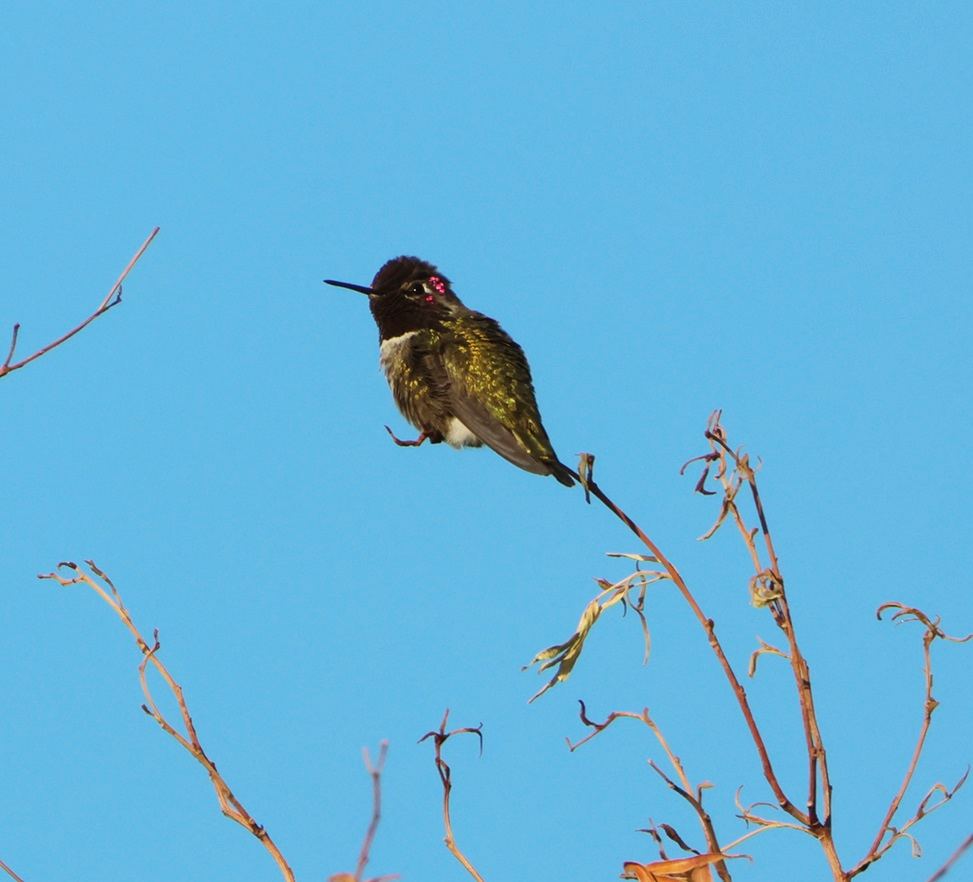
I often see this little dude, a male Anna’s hummingbird (Calypte anna), when Gunther and I are visiting our campground’s dog park in the mornings. While Gunther is attending to his business, I look to this same little branch on this same little tree, and about half the time he’s there, just about 10 yards from the dog park’s fence. The legs of all hummingbirds are so small that the birds can neither walk nor hop on the ground or on a branch. They, like all hummingbirds, are tiny: Anna’s have all the volume of a ping-pong ball and the all the mass of a shiny U.S. nickel (between a tenth and two-tenths of an ounce). As small as they are, they’re powerful fliers: males can soar up to 130 feet in the air. This species of hummingbird, one of 360 in the world, is found year-round in the Las Vegas area, as well as the western halves of California, Oregon, and Washington. Say, that reminds me: I’ve recently learned the German word for “pineapple” is “Ananas,” so the imperativ (command) for “Anna, eat pineapple!” in German is “Anna, esse Ananas!”Here’s another reminder that we share this planet with dinosaurs’ descendants: imagine the slashing terror of these razor-sharp talons, the brute strength of these powerful claws, the raw crushing horror of …… a rock pigeon (Columba livia), which is found year-round all over North, Central, and South America, and the campground in which we are spending the winter.Gunther thanks you for joining him (and Nancy and me) on this Las Vegas Wash adventure, and hopes you have a healthy and happy 2025 filled with lots of fun walks!
Here’s a list of the birds (not all are pictured above) we saw at Wetlands Park; it was one of the more successful birding walks we’ve ever enjoyed, and just a fun way to spend an afternoon in The Entertainment Capital of the World.
The Bear River, at 350 miles long, is the country’s longest river that doesn’t eventually reach an ocean – but it is the largest river that flows into the Great Salt Lake of northern Utah. It starts in northeastern Utah, flows into southwestern Wyoming and southeastern Idaho, then makes its way back into Utah and into the Great Salt Lake.
I took this photo looking east from an observation platform along the Bear River, a few miles before it enters the Great Salt Lake. The Wasatch Mountain range, forming the western edge of the Rocky Mountains, is on the horizon; Box Elder Peak (elev. 11,101 feet) and Willard Peak (9,763 feet) are two of the prominent mountains in this part of the Wasatch range. As in many areas of the west, the 2022-2023 snow season was quite robust in the Bear River drainage and provided plenty of water flowing into the lake in mid-July. More on that later, though.
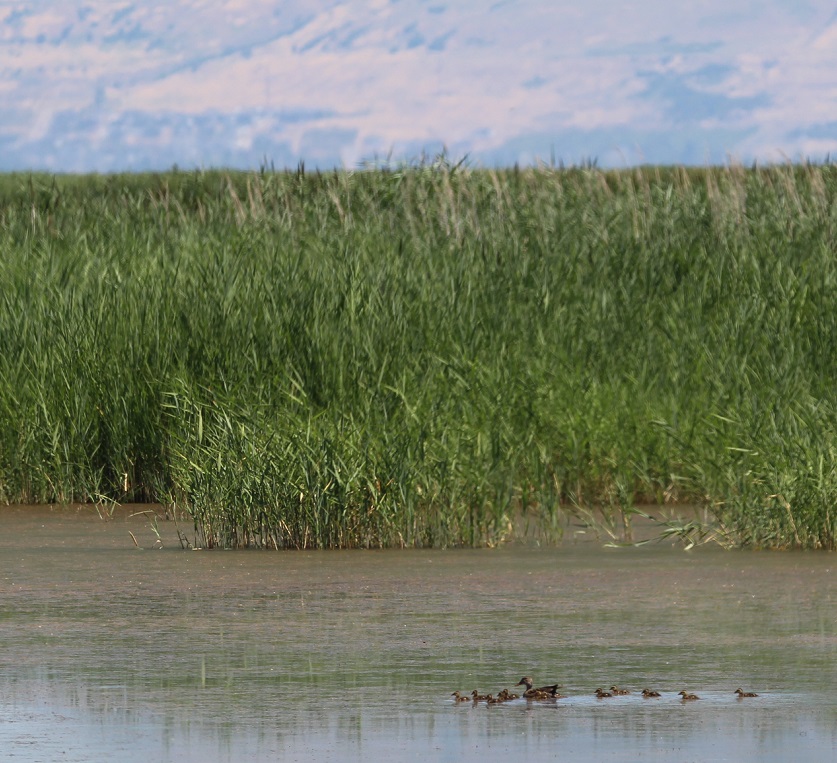
This family of gadwalls (Mareca strepera), a species of duck that, thanks in no small part to the establishement of wildlife refuges, has been growing in numbers since the 1980s, is making its way down the Bear River. Female gadwalls closely resemble female mallard ducks, but their heads and bills are shaped differently. This mom is tending to at least 11 ducklings; gadwalls can lay up to a dozen eggs in one clutch. In the fall months, 500,000 ducks and geese can be found at the refuge during their migration southward. Imagine all of that quackin’ and honkin’!
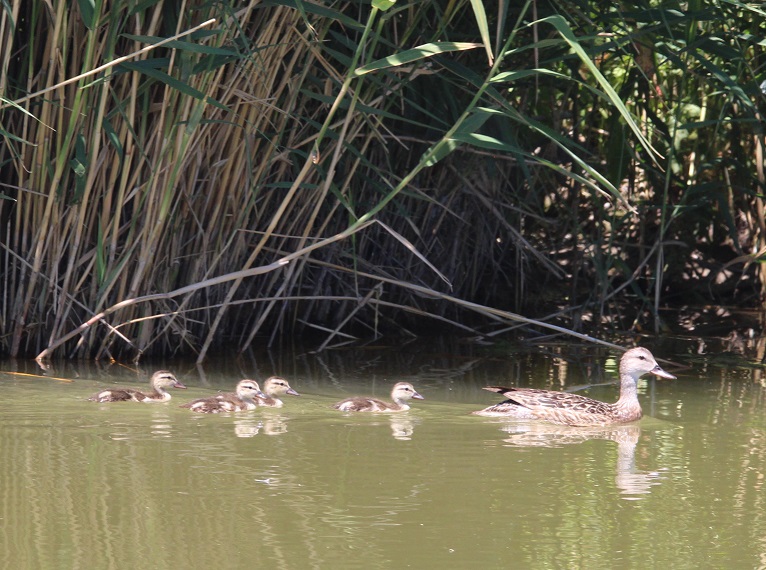
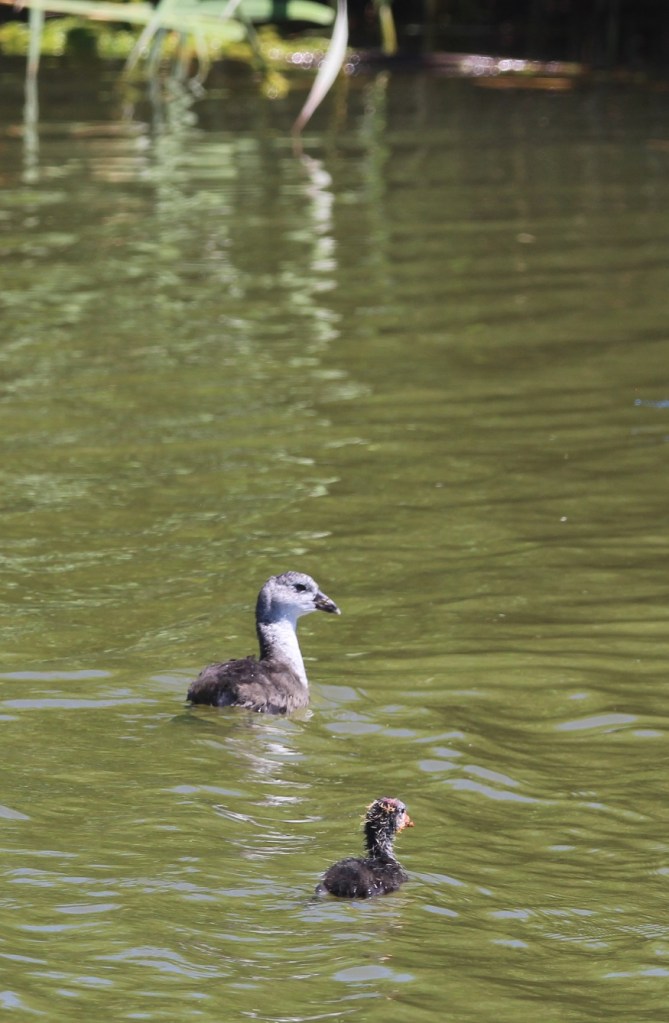
Here’s a closer look at another, and perhaps more reasonably sized, gadwall family. The gadwalls weren’t the only bird species looking after young ones at the Bear River refuge: there were baby waterfowl and shorebirds aplenty.To wit: this western grebe (Aechmophorus occidentalis) and two fledglings (grebelings?). Like many waterfowl, young grebes will often hop on a parent’s back to take a break from paddling. A volunteer at the refuge’s visitor center had suggested that we keep an eye out for the freeloading young grebes, and we were happy to see this family. The plumage of western grebes and that of their closely related cousins, Clark’s grebes, is very dense and their hides were used to make waterproof garments in the 19th century. Thankfully, the popularity of the style dropped and populations of both species, which had declined, soon recovered.More baby waterfowl, this time an American coot (Fulica americana). I had only ever seen black coots before and assumed that the lighter colored ones (like the one at the top of this photo) were females. In fact, both male and female adult coots are black, and so the larger coot here is either mother or father to the cootling but has not yet matured out of its juvenile color pattern. Coots were everywhere in the refuge: I’m going to guess that we saw about 70 kajillion coots that day.
The delta at which the Bear River flows into the Great Salt Lake is where the 74,000-acre Bear River Migratory Bird Refuge was established in 1928. The refuge provides critical breeding and nesting habitat to more than 250 species of birds and other wildlife. Nancy, Gunther and I visited the refuge in mid-July, enjoying a short hike, a 12-mile auto tour, and the company of thousands upon thousands of birds.
We’d seen white-faced ibis (Plegadis chihi) only once before, at St. Vrain State Park in northern Colorado, and that was a flock in flight and so far up in the sky that I thought they were Canada geese until I took a closer look at the photo. There were plenty of these beautiful birds on the ground at Bear River National Wildlife Refuge. They use their distinctive curved bills to dig in the wet dirt around waterways in search of earthworms and other invertebrates. I look forward to getting better pictures of white-faced ibiseses(es) sometime: their purple, green, and bronze plumage is really pretty.
The Bear River Migratory Bird Refuge is located where two of the country’s major migratory flyways, the Pacific and the Central, overlap. Because of its connection to the ecosystem of the Great Salt Lake, the refuge is a critical stopover for migratory birds of all sizes.
Administered by the U.S. Fish & Wildlife Service, the National Wildlife Refuge system includes more than 550 refuges in all 50 states and territories. In all, more than 150 million acres (almost 235,000 square miles, or more than twice the size of Colorado) are protected to support more than 700 bird species and 220 mammal species, along with hundreds of amphibian, reptile, and fish species.
Due to the loss of habitat from population growth, as well as a botulism outbreak, Utah citizens and conservation organizations asked Congress to protect this area, and the national refuge was created in 1928.
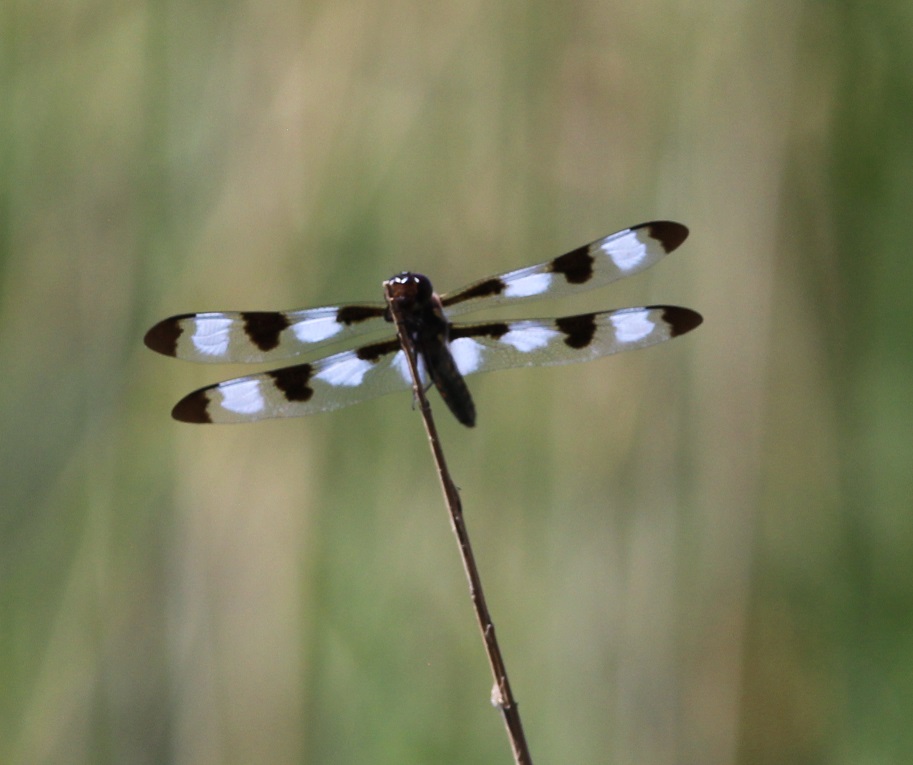
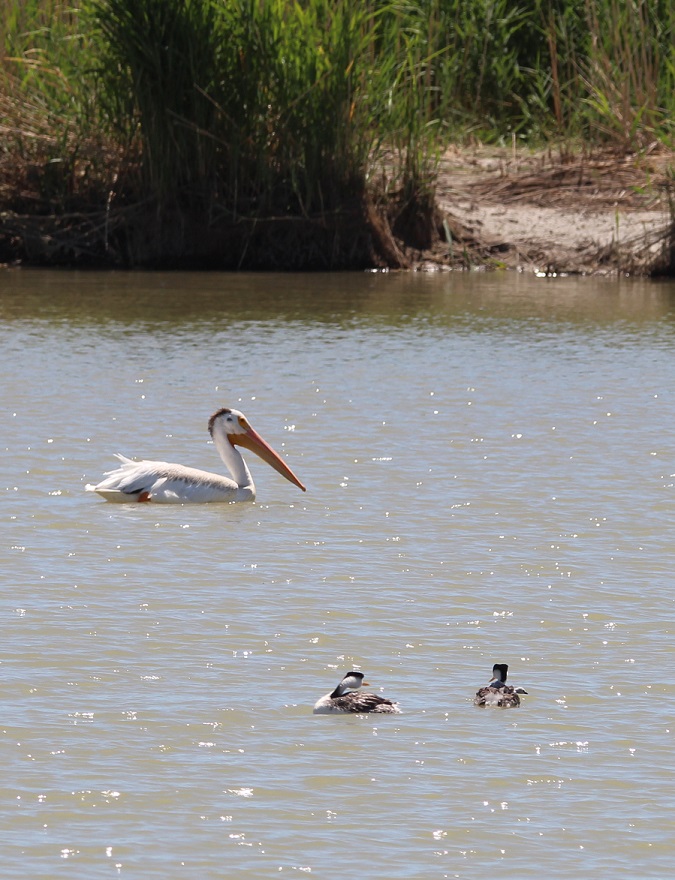
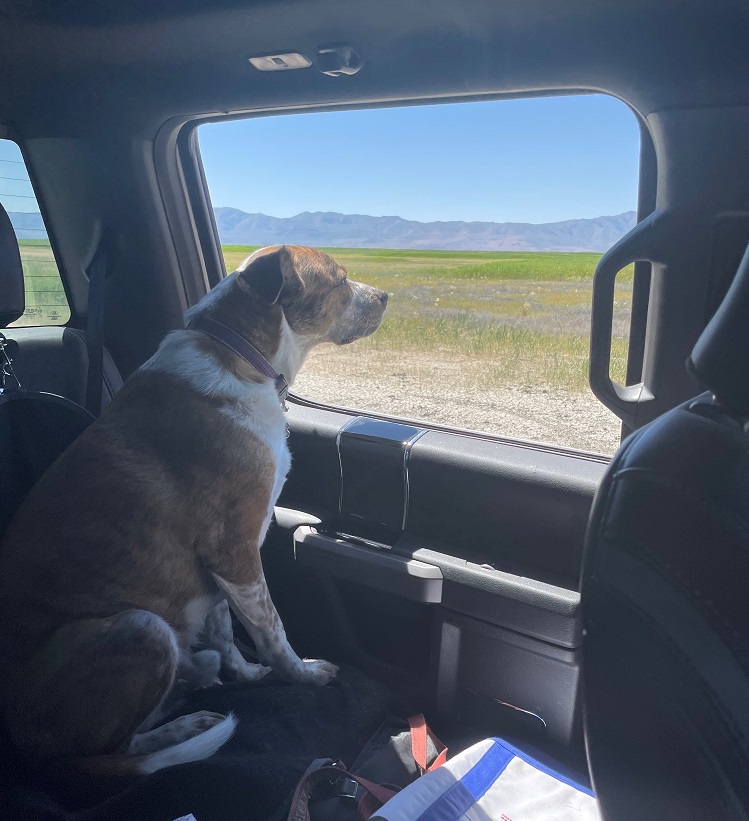
This black-necked stilt (Himantopus mexicanus) was yammering away while on the hunt for something good eat on the shoreline. The refuge is home to 65,000 black-necked stilts in the fall months. This species is closely related to American avocets, and, although it’s rare, the two can create hybridized offspring called “avo-stilts.”Ready for a break from birds? How ’bout a bug? This is a twelve-spotted skimmer (Libellula pulchella), a type of dragonfly. It was resting on a reed in a marsh next to the refuge’s visitor center. This is a very common dragonfly and is found in all 48 of the contiguous states. If you only count 10 spots, that’s okay – they’re also called ten-spotted skimmers. They’re one of the bigger dragonfly species, at up two two inches long and with an even longer wingspan. Insects like this are, of course, a major component of a wildlife ecosystem. Dragonflies eat smaller insects, and they themselves are eaten by birds and reptiles.To wit (again): this house sparrow (Passer domesticus) with a late breakfast on the visitor center’s roof (it looks like it has an unfortunate grasshopper rather than an unfortunate dragonfly in its beak, but you get the idea). The most common birds in the United States – house sparrows, rock pigeons, and European starlings – are all introduced species. None are native to this country, but they did remarkably well for themselves once they got into the wild.Here’s a native sparrow species, the song sparrow (Melospiza melodia). This species is found from Alaska’s Aleutian Islands to the country’s east coast. The coloration of their feathers varies depending on the conditions in the local population’s habitat.The variation in bird species we saw was pretty remarkable. Here are two western grebes pondering an American white pelican (Pelecanus erythrorhynchos), one of the largest birds in North America. We didn’t see many pelicans during our visit, and those we did see were pretty far away. This photo was taken in the delta area of where the Bear River enters the Great Salt Lake.Here’s another big white bird: the snowy egret (Egretta thula). During the breeding season, snowy egrets develop very thin feathers on their necks. These feathers were once highly valued by the fashion industry: in the 1880s, they had a per-ounce value twice that of gold. Naturally, the numbers of snowy egrets dropped precipitously, but conservation efforts, including the establishment of national wildlife refuges, helped restore the population. Check out those yellow feet! This egret was kickin’ it with a small herd of cattle, probably looking for insects and other invertebrates disturbed by the bovines. Back to bugs, briefly. There are about 3,000 known species of dragonflies in the world, and we saw three of them at the wildlife refuge. This one is a blue dasher (Pachydiplax longipennis), and like other dragonflies, is capable of eating hundreds of smaller insects every day.One more dragonfly; this is a variegated meadowhawk (Sympetrum corruptum). This species, native to North America, has been found migrating south to Honduras and as far as eastern Asia.Of the 256 photos I took at the refuge (I’m not kidding), this one is my favorite and it might be my favorite that I’ve taken this year. It’s an American avocet (Recurvirostra americana), and I took this picture after crawling slowly and steathily through a half-mile of stinking wet marshland in an attempt to unobtrusively approach this bird. I’m just kidding iwth you right now: I took this photo from the passenger seat of the Goddard’s six-wheeled towing unit while the avocet was walking down the side of the road. Avocets use their gently curved bill to sweep through shallow water in search of invertebrates. The plumage on their head and neck darkens to this beautiful russet during the summer, and then retreats to white and gray during the winter. They grow to about 18 inches tall. What an elegant bird.Here’s another photo I took from the passenger seat of our pickup. Gunther has enjoyed several auto tours with us this year, and we were happy to have him along at the wildlife refuge. He’s taken a special interest in seeing horses from the back seat.
About the water issue I alluded to at the beginning of this post: while the Bear River seemed to be flowing at or near the capacity of its banks thanks to a great snow season in the Rocky Mountains, the Great Salt Lake is undergoing an historic multi-decade drought that has shrunk the lake to just 37 percent of its former volume. It’s something that’s happening all over the western United States: higher temperatures coupled with decreased annual precipitation levels, exacerbated by growing populations of people, are creating smaller river flows and diminishing bodies of water. What’s happening at the Great Salt Lake specifically is a crisis that, in my mind, isn’t getting nearly enough attention: in addition to the critical wildlife habitat that would be lost, a dry Great Salt Lake bed would create a huge volume of toxic dust directly adjacent to Salt Lake City. It’s a metropolitan area of 1.3 million people, and one that is growing quickly.
The consequences of losing the Great Salt Lake are difficult to imagine, and I don’t even want to consider what life around Salt Lake City would be like. Conservation efforts, meant to reduce the amount of water taken (mostly for agricultural purposes) from the Great Salt Lake’s three tributaries prior to entering the lake, are underway. The Church of Jesus Christ of Latter-day Saints, one of the west’s biggest land- and water-rights holders, has taken the unprecedented step of donating a sizable amount of its water to the lake, and is encouraging its adherents to conserve as much water as they can, but it may be a case of “too little, too late.” The 20,000 acre-feet of water donated by the Mormons, while a significant amount on its own, is enough to replace only about 2 percent of the lake’s lost volume.
We saw 19 different bird species in about four hours while at the refuge. All of those species, and all of the other birds and other animals at the refuge, are dependent on healthy waterways to breed and raise their young – in other words, to continue as a species. I hope that happens, for all of them.



















 Tales of The Goddard