If asked to name your favorite Rex Allen movie, which film comes to mind first? If you’re like Nancy and me, you’d probably be somewhat reluctant to name one, because you couldn’t name one. The simple truth is, we’d never heard of him. But, as we were to find out, we’d certainly heard him.
Willcox, Arizona, is the hometown of Rex Allen (1920-1999), known as “The Arizona Cowboy” as well as “The Last of the Silver Screen Cowboys.” Allen began his movie career as the public’s love affair with Westerns was turning away from the big screen and transitioning to the newfangled televisions in their living rooms.
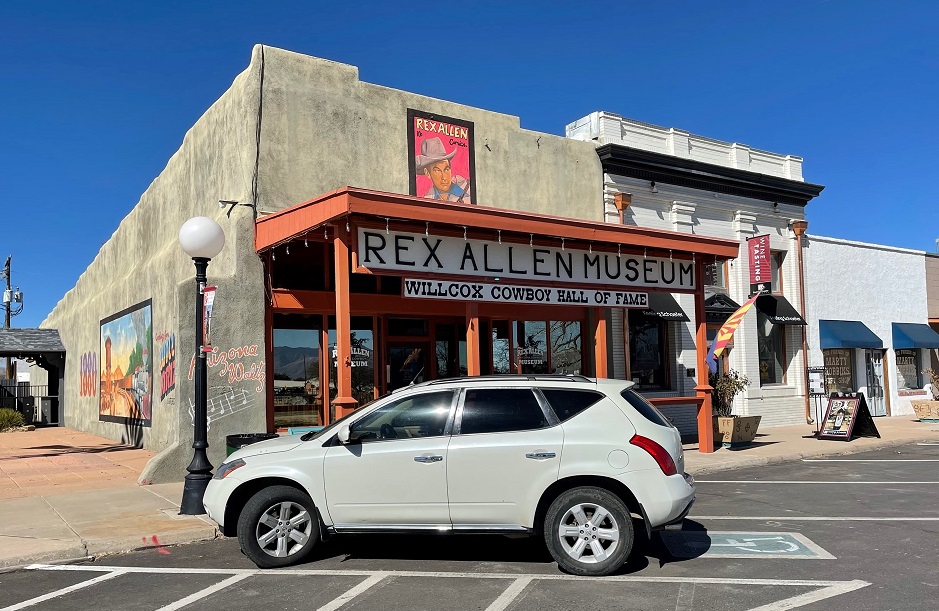
The Rex Allen Museum opened in 1989 as a showcase for Allen’s career as a live performer, recording artist, actor, and film narrator. It has many of Allen’s personal belongings dating back to his childhood in Willcox all the way up to his Hollywood career.
I finally managed to take a photo of a car parked outside a museum we visited (I don’t know why I didn’t just walk to the other side of the building and take a photo from there). The Rex Allen Museum is in one of the oldest commercial buildings in Willcox. The adobe building was constructed in the early 1890s and was later home to the Schley Saloon from 1897 to 1919. The museum still has the saloon’s original wooden floor. The Willcox Theater, next door to the museum, was built in 1935 and was where Rex Allen made his singing debut. Roy Rogers, later to be a friend of Allen, also sang at the theater early in his career.
Allen’s family homesteaded on a ranch about 40 miles from Willcox. He played guitar while his father fiddled for audiences in Willcox; after graduating from Willcox High School, Allen joined the rodeo circuit and toured the southwest.
Allen found life as a performing entertainer less painful than that of a rodeo star, and Allen got his singing career started at a Phoenix radio station. Soon after, he made his debut on a show called “National Barn Dance” on Chicago radio station WLS. This is the fiddle Allen used on the show. Note the tooled leather guitar case behind the fiddle.
Allen would have a 35-year singing career with Decca Records, and had a gold record with his version of “Crying in the Chapel.” With singing cowboys such as Roy Rogers and Gene Autrey being very popular with moviegoers in the late 1940s, Republic Pictures signed Rex Allen to a contract in 1949. He would go on to star in 19 Hollywood movies, usually as a character with the very authentic Western name of “Rex Allen.”
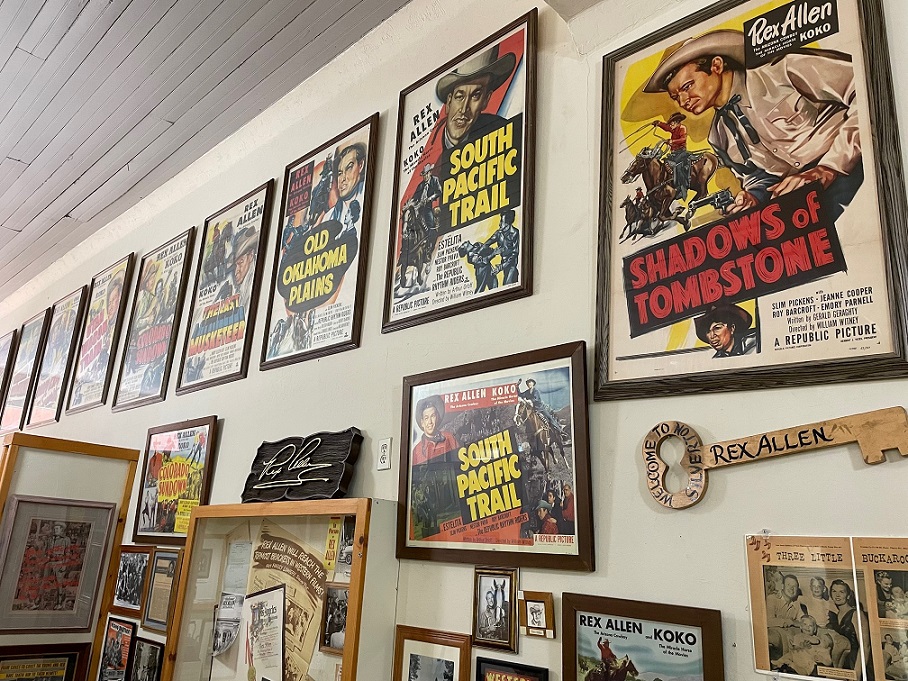
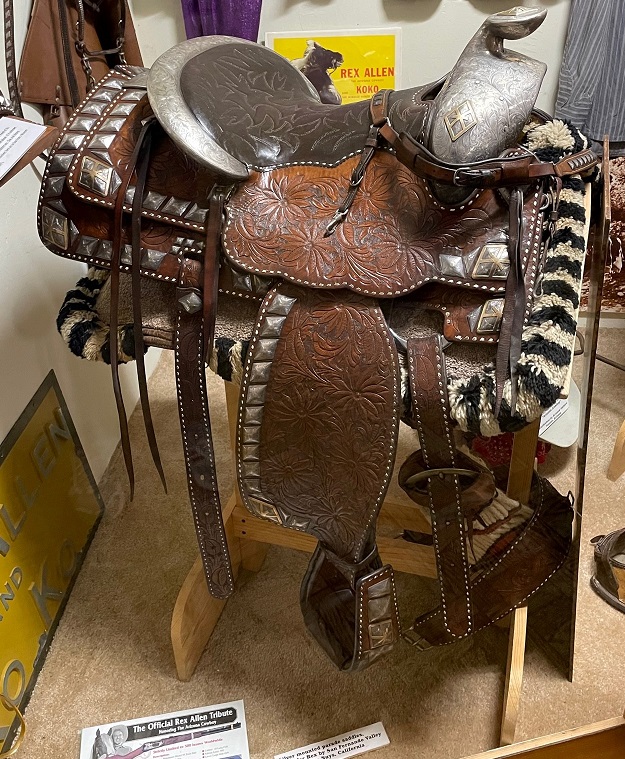
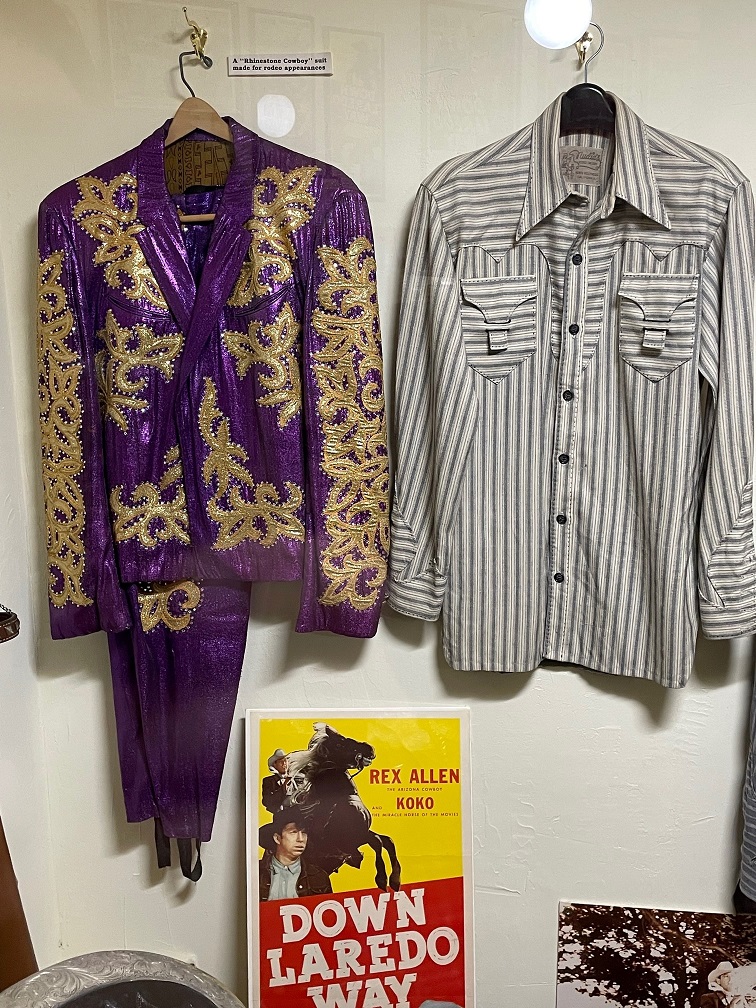
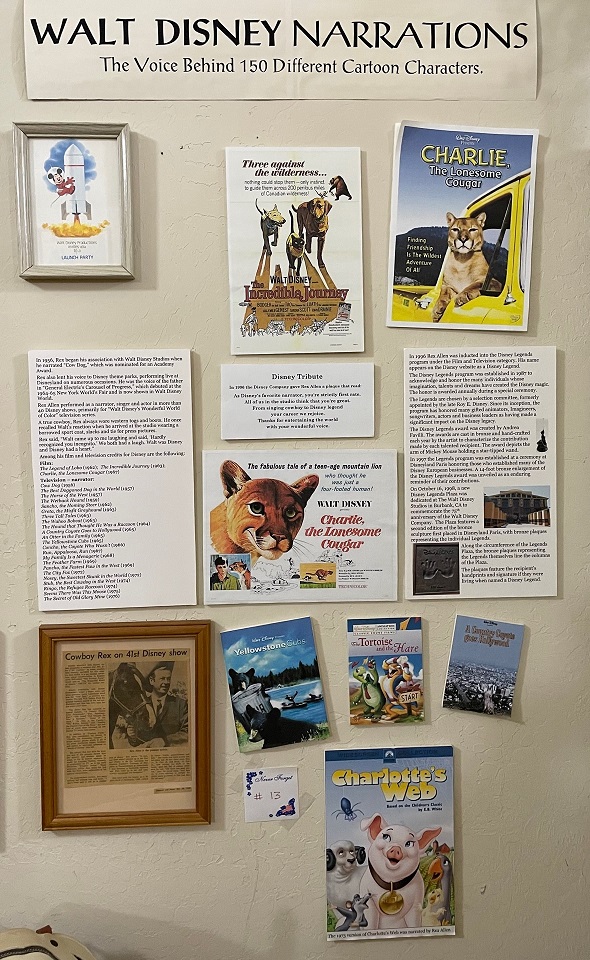
The museum has posters from many of the movies that Allen starred in between 1950 and 1954. Every movie cowboy needs a tremendously talented horse, and Allen’s was Koko the Wonder Horse. Koko usually received billing equal to Rex Allen in publicity for their pictures. Every movie cowboy also needs a sidekick; Allen was pardners with Buddy Ebsen and, later, Slim Pickens in various pictures.Allen was a top-ten box office attraction in his day, and his exploits carried from the big screen to other media like comic books. When you make it big as a Western performer, you get to wear Nudie suits: clothing made by Nuta Kotlyarenko, a Ukraine-born tailor whose professional name was Nudie. He made his mark making rhinestone Western-themed wear for both men and women. Nudie suits were worn by entertainers like Roy Rogers and Dale Evans, Hank Williams, Porter Wagoner, and Elvis Presley. The leather hat box in the lower right is also a Nudie design; it held Allen’s white Stetson while he was on tour.San Fernando Saddlery in Van Nuys, California, made this very pretty silver-mounted parade saddle used by Allen.On the left is another Nudie suit that Allen wore in parades. It’s pretty flashy. On the right is a custom-made shirt; note the closures on the chest pockets. Allen didn’t like buttons on his shirt pockets.This was an “a-ha” moment for me. Did you ever see those live-action Disney films from the 1960s and 1970s, particularly the ones set in the American West, that featured a very relaxing narrator’s voice that had just a hint of a drawl? Rex Allen was the narrator of movies like “Charlie, the Lonesome Cougar,” and “The Incredible Journey,” and more than 40 other Disney films and television programs. Allen’s voice was also that of 150 different Disney cartoon characters. His Western voice, instantly recognizable, narrated the animated adaptation of “Charlotte’s Web” (which was a Hanna-Barbera production rather than Disney).In addition to lending his voice to a number of television productions, Allen lent his likeness to promote Ford tractors, Purina animal feed, Tony Lama boots, and other products.Speaking of Tony Lama, here’s a pair of cowboy boots custom modified for use on the golf course. They’re next to an autoharp given to Rex Allen by June Carter Cash, wife of Johnny Cash.Speaking of Johnny Cash, here’s a wall of memorabilia featuring people who knew and worked with Rex Allen, including country music superstar Tanya Tucker (under the Man in Black’s illustration), who also grew up in Willcox, Arizona. Next to Tanya’s photo is a picture of John Wayne with Allen, and above that is a picture of The King, and to the right of Elvis is a signed photo of Ken Curtis, who played Festus Hagen in “Gunsmoke.” Speaking of “Gunsmoke,” Allen was a cousin of Glenn Strange, who played Sam the barkeep in Dodge City from 1961 to 1974.The museum building is also home to the Cowboy Hall of Fame. One of the Hall of Fame exhibits is this display of barbed wire dating from 1874 to 1884, so you know it’s okay in my book.
Willcox still shows a lot of love for its most famous native son. “Rex Allen Days” began in 1951 as an event benefiting the local hospital. It continues each year to this day, attracting Western film aficionados from around the world, and includes a rodeo and the annual Cowboy Hall of Fame induction. One of Willcox’s main streets is called Rex Allen Drive.
This larger-than-life bronze statue of Rex Allen is situated in a park directly across the street from the museum. Koko the Wonder Horse is buried nearby, and Allen’s ashes were scattered in the park upon his death. (The sun, as it is wont to do sometimes, wasn’t cooperative so the lighting isn’t the best.)
Between 1949 and the late 1960s, more than 100 different Western TV series aired on television networks – which was great for fans of “Gunsmoke” and “Have Gun, Will Travel” and “Wagon Train,” but not so good for stars of big-screen Western movies. Allen did star in his own short-lived TV series, “Frontier Doctor,” in 1961, but his time as a big-screen star was over. However, he continued to do very well doing off-camera work for Disney and other production houses.
After we visited the museum, Nancy and I could do little else than retreat that evening to The Goddard and watch a Rex Allen movie. We selected “Colorado Sundown” (1952), and do you know what? We liked it a lot. It had a pretty intriguing storyline and some great action crammed into its 67 minutes, and it gave an opportunity for Rex Allen to sing a bit as well. As of now, it’s our favorite Rex Allen movie. Honestly, we’d love to watch another one sometime.
Riparian areas, or habitat on or near flowing rivers, have historically constituted only 2 percent of the state of Arizona’s landmass. According to the Bureau of Land Management, in the last 200 years almost 95% of that meager acreage has disappeared due to human development from grazing, farming, and diversion projects
The Gila Box Riparian National Conservation Area, located between Safford and Clifton in southeast Arizona, was established in 1990 to protect 23,000 acres (about 36 square miles) of wildland river habitat and the surrounding area.
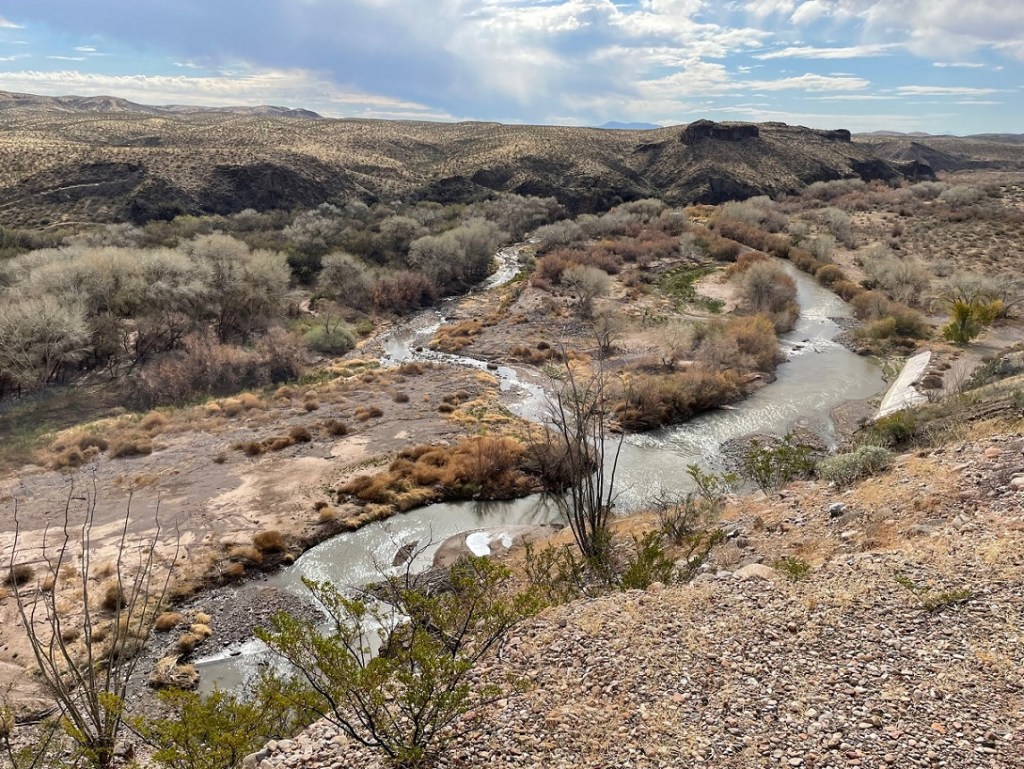
This photo is from an overlook above the Gila River as it briefly splits before rejoining downriver, looking to the southeast. The Gila Box Riparian National Conservation Area has plenty of very long vistas of natural spaces. The section of the Gila River that runs through the NCA is a very popular destination for kayakers, canoeists, and rafters during high-flow season, and there are several developed areas along the river for putting in and taking out watercraft.
The word “Gila” is found in many, many placenames and other references in New Mexico and Arizona, and it’s thought to be derived from a Spanish contraction of “Hah-quah-sa-eel,” which is a Yuma Native American word that means “running water which is salty.” The river starts near Gila Cliff Dwellings National Monument and flows almost 650 miles along an watershed of nearly 60,000 square miles in the two states before emptying into the Colorado River near Yuma, Arizona, where the Colorado forms the state’s western border with California..
The Gila Box Riparian NCA includes more than 20 miles of the Gila River as well as sections of three other waterways that flow year-round in southeast Arizona. Gila Box is one of only two riparian NCAs in the United States; the other is San Pedro Riparian NCA, located in extreme southeastern Arizona along the border with Mexico.
The waterways provide food, shelter, and water for a huge variety of wildlife, including fish, mammals, and birds as well as invertebrates.
The importance of preserving these lands can be seen in the variety of animals that call Gila Box home, including at least:
175 permanent and migratory bird species
42 mammal species, including bighorn sheep, black bear, javelina, mountain lion, and cougar
24 reptile species
17 fish species, including the endangered Gila chub and razorback sucker
and 10 amphibian species.
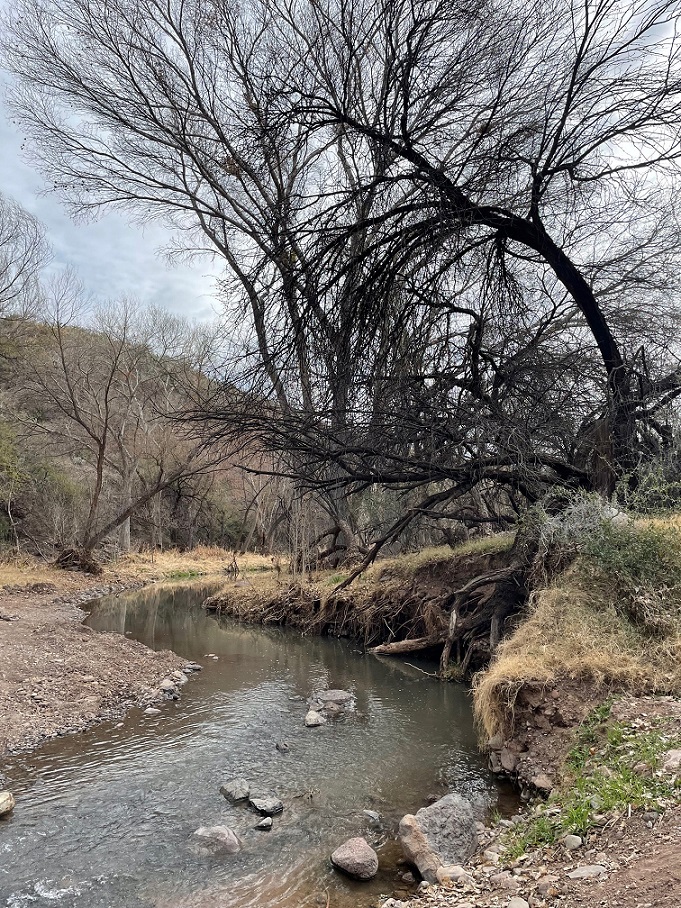
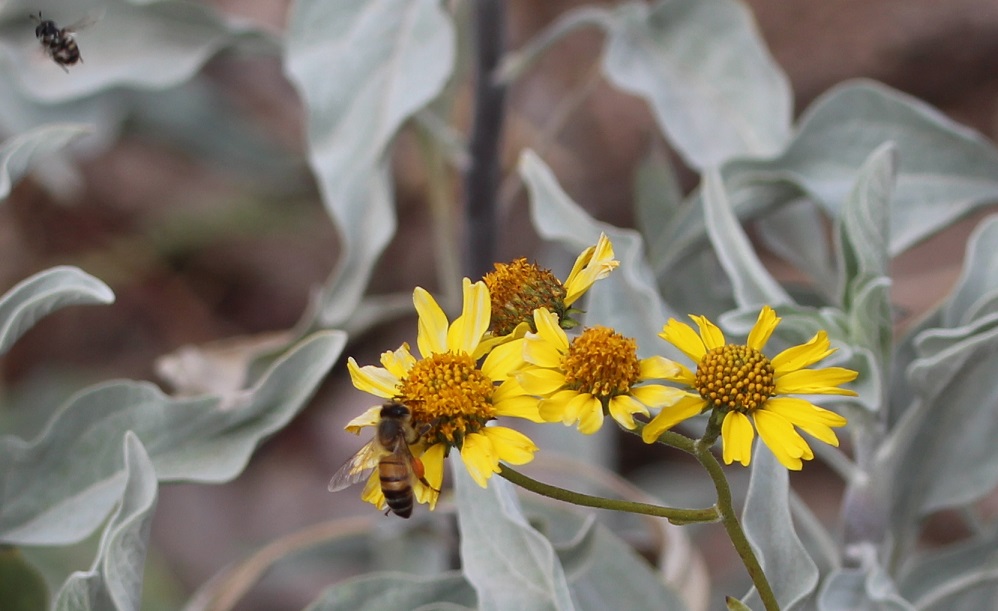
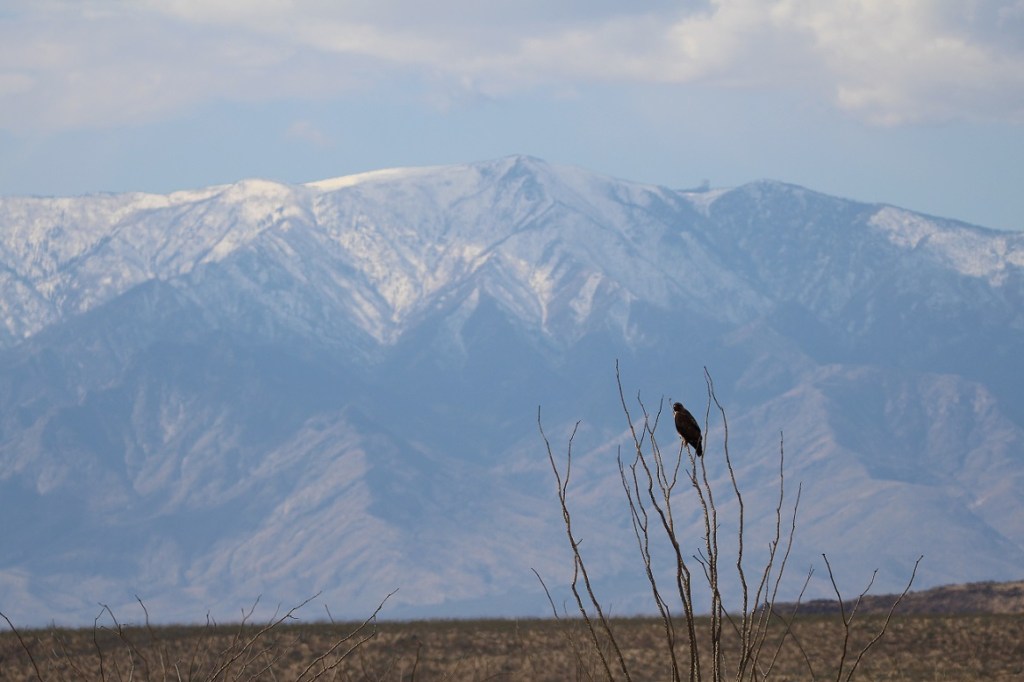
This is Bonita Creek, which flows southeast from the San Carlos Apache Reservation, now home to about 10,000 Apache, northwest of the National Conservation Area to enter the Gila River near the NCA’s western edge. This riparian environment is certainly atypical habitat for the mostly desert state of Arizona: Fremont cottonwood, Goodding’s willow, and Arizona sycamore trees are prevalent along with uncommon large bosques of mesquite, which is a very common tree/shrub in the drier areas of the desert but there grows in sparser groupings.One of these days I’ll stop being surprised at seeing blooming flowers in January, but today was not that day. This is a plant called brittlebush (Encelia farinosa), which has several interesting characteristics: it derives its name from having very fragile stems; depending on where in the stem the sap is collected the sap can be used as a glue or as a resin to hold seal pottery vessels; or the sap can be melted to use as a varnish. There were a lot of bees collecting pollen from this plant.It’s difficult to be sure, but I’m fairly certain this raptor is a redtailed hawk perched on an ocotillo. A few minutes after this photo, the bird took off and immediately rose a hundred feet in the air to soar over the desert. The mountain in the background is Mount Graham (elev. 10,724 feet), the southernmost peak in the continental United States to exceed 10,000 feet. Mount Graham dominates the landscape in southeastern Arizona: it’s visible from nearly everywhere. It and other tall mountains are referred to as “sky islands” in the American southwest because their different elevation zones support a number of varied habitats for wildlife and plants. Beyond this bird and the bees, we didn’t see much in the way of wildlife on our visit to Gila Box; we’d especially hoped to encounter Gila monsters, which we’d been advised by Arizonans were common in the NCA.Here’s another view of Mount Graham taken at a different time of day in the NCA, with part of the city of Willcox seen at its base. It’s barely visible in the previous photo with the raptor, but this image better shows a box-like structure in a mountain saddle at the right: that’s one of several telescopes maintained in the Mount Graham International Observatory (MGIO), which is operated by the University of Arizona along with other partners. The one viewable here is the Large Binocular Telescope; the other two MGIO telescopes are the Vatican Advanced Technology Telescope (the “Pope ‘Scope,” if you will, and maybe you won’t) and the Submillimeter Telescope. The clear skies due to the high elevation and sparse populations in the immediate area lend themselves to excellent telescope operations. The Large Binocular Telescope is about 30 miles from this viewpoint; it is indeed large. Regrettably, the MGIO only conducts tours from mid-April through mid-October because of road conditions so we weren’t able to check it out. We had a great view of Mount Graham from our campsite, and enjoyed seeing the changing weather conditions across the mountainside during our stay.The abundant water of the Gila Box area (by Arizona’s standards, at least) supported ranching operations, including by the Apache, beginning in the 1870s. Cattle, sheep, and goat production peaked in the 1880s and early 1890s as the Southern Pacific Railway was completed across this part of Arizona, but later droughts and land mismanagement led to a near-total collapse of the industry. Ranchers may still graze stock on the NCA, which is overseen by the Bureau of Land Management, but must restrict their herds to upland parts of the area and no grazing is permitted on public lands near the riparian areas. This structure’s roof has seen better days.From a geology point of view, there’s a lot going on in these cliffs about 100 yards away from the Gila River. Between 25 and 16 million years ago, volcanic eruptions created lava flows that resulted in layers of basaltic rock. Later eruptions formed layers of sedimentary and conglomerate rocks, all of which the Gila carved through to make a spectacular canyon over millions of years. These cliffs are probably about 100 feet high.And here is that canyon, which is the Gila Box. This is a few miles upstream from the overlook where I took the first photo of this posting. I really wish the sun had been shining on the canyon walls when we were there, but canyons and sunlight rarely have good timing together. The color of the rocks is still spectacular. Water is an amazingly destructive force, especially given enough time: this is the other side of the canyon formed by the cliffs in the previous photo, which are at least 100 yards west of this standpoint. Nancy and I were somewhat frustrated with the lack of established hiking trails in the NCA, but we did enjoy a short walk along the banks of the Gila River and experiencing this canyon wall, several hundred feet high, was especially rewarding. Gunther wasn’t able to join us next to the river; he kept getting spooked by something in the underbrush as we approached the river – it could only have been a lair of writhing, snapping Gila monsters, we believe – so we took in this sight individually while the other held the leash of our big baby.
Despite not being able to find any trails on which to stretch our legs (and it’s very possible that trails exist in parts of the NCA we didn’t see), we did enjoy the visit to Gila Box Riparian National Conservation Area. It would be really interesting to see it in spring, when the water’s really flowing. Maybe we’ll find Gila monsters somewhere else in Arizona.
After spending November and December 2021 and most of January 2022 in New Mexico, the Goddard made its way to Safford, Arizona, in late January, where we stayed for two weeks. Our first destination, not including a couple of very good Mexican restaurants in Safford and nearby Solomon, was the Eastern Arizona Museum in Pima, Arizona, which is a few miles west of Safford. The museum is located in the former Bank of Pima, which opened on May 19, 1916, with $30,000 in capital, as well as a couple of other adjoining buildings that were built separately but have since been connected. Like the museum in Deming, I neglected to get a photo of the exterior of this museum as well, but it’s an impressive building.
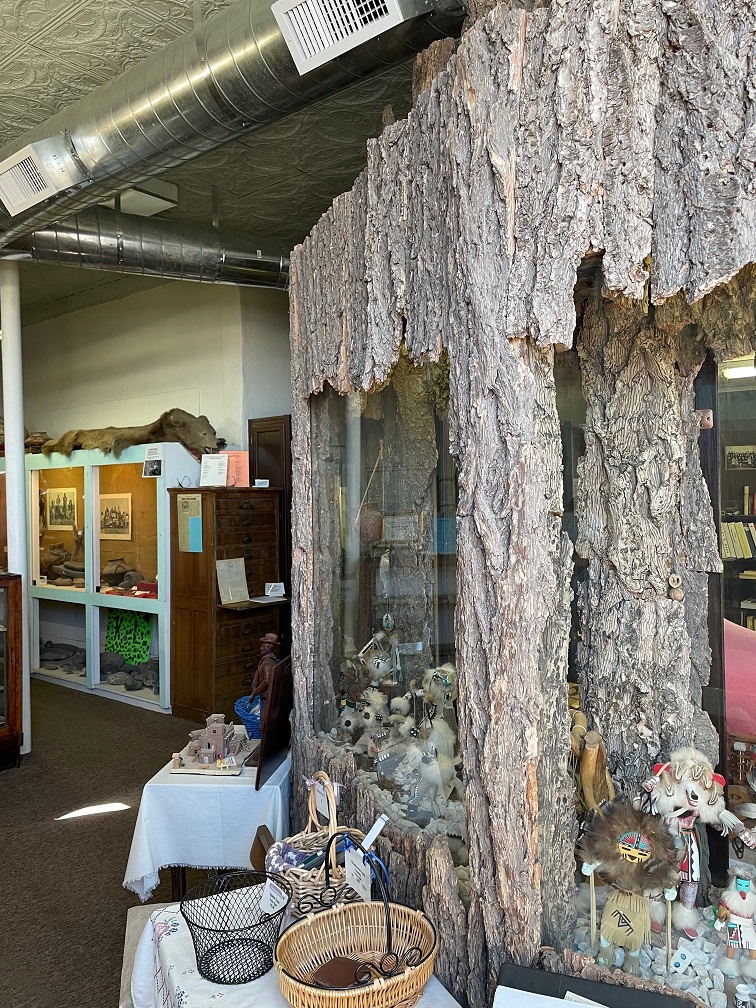
It’s hard to ignore the structure on the right: it’s pine bark that’s enclosing the museum’s office. I’m uncertain when, but some decades ago a Pima town employee used prison labor and the city’s dump truck to collect several loads of pine tree bark from the nearby Graham Mountains. They cleaned up the bark and then fumigated it under plastic to kill the insects, and then used the bark to construct display cases for the museum. In 1997 most of the display cases were remodeled like the ones on the left, but the bark remains around the museum’s office.
The town of Pima was founded on April 8, 1879, by a group of Mormon pioneer families on a site south of the Gila River (the same watercourse Nancy and I saw when we visited the Gila Cliff Dwellings north of Silver City, New Mexico, earlier in the month). The original settlers were joined later that year by several other families, and today the town has about 2,500 residents.
The museum has an impressive collection of Native American pottery and stone tools found in the area. It also features a wide variety of donated collections of tools, housewares, and other items dating back to the 1880s.
Here’s a large collection of old farm and ranch tools. Nancy noted that the person who wielded the sheep shears (to the right of the curry comb and bullet mold at center left) probably had impressive forearms. The shears date to the early 1900s.
Much of the museum’s collection is in a building called Cluff Hall, which is the oldest building in Pima. It has been connected to the former bank building just to its south as part of the museum. Moses Cluff constructed the building from limestone in 1882. It served as Pima’s cultural center, hosting plays, concerts, political debates, dances, and meetings of the Latter Day Saints (although it was never formally dedicated as a house of worship). The first kindergarten class in the Gila Valley was held in Cluff Hall in 1901, with tuition of five cents a day. In 1912, two immigrant brothers from Lithuania opened a clothing store but their endeavor was ended by the country’s entry into World War I a few years later. The two brothers later opened a department store in Safford that was in business until the 1960s. As with many old buildings, Cluff Hall was home to a huge variety of businesses and activities.
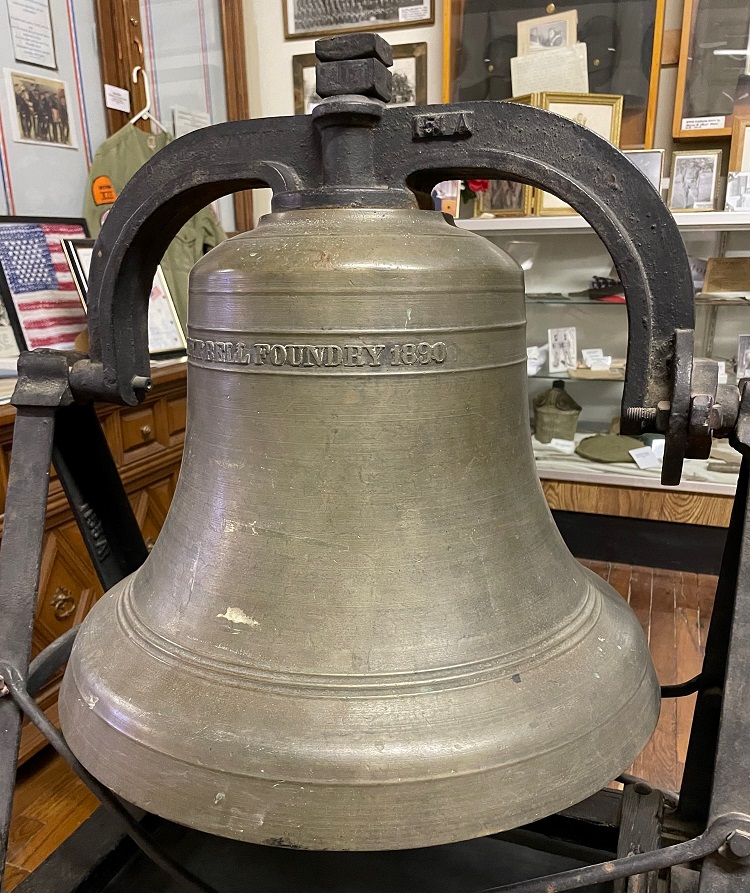
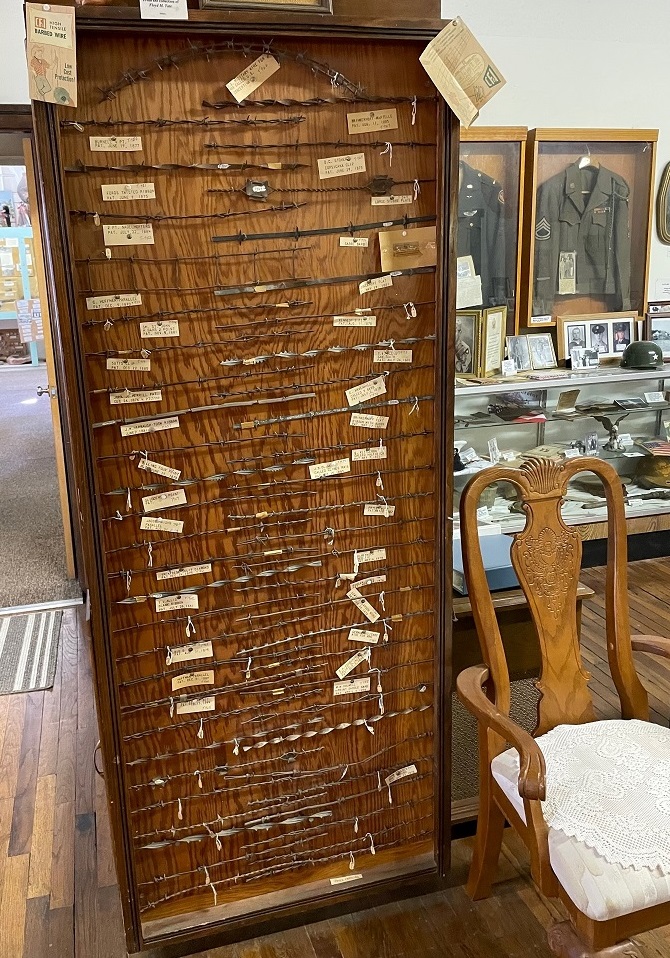
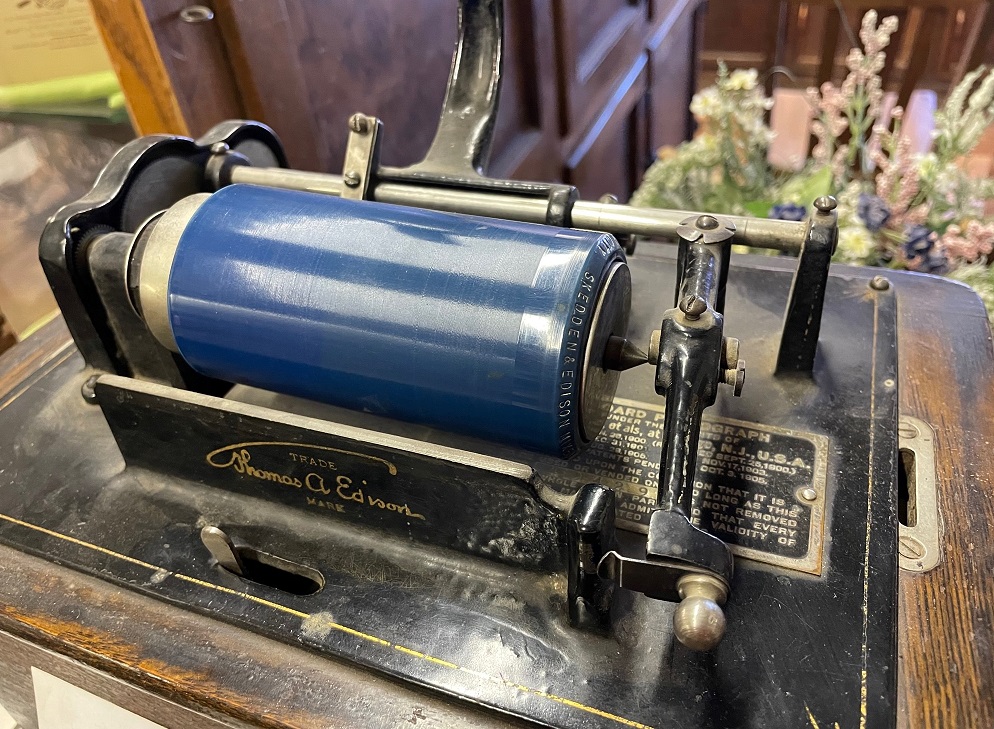
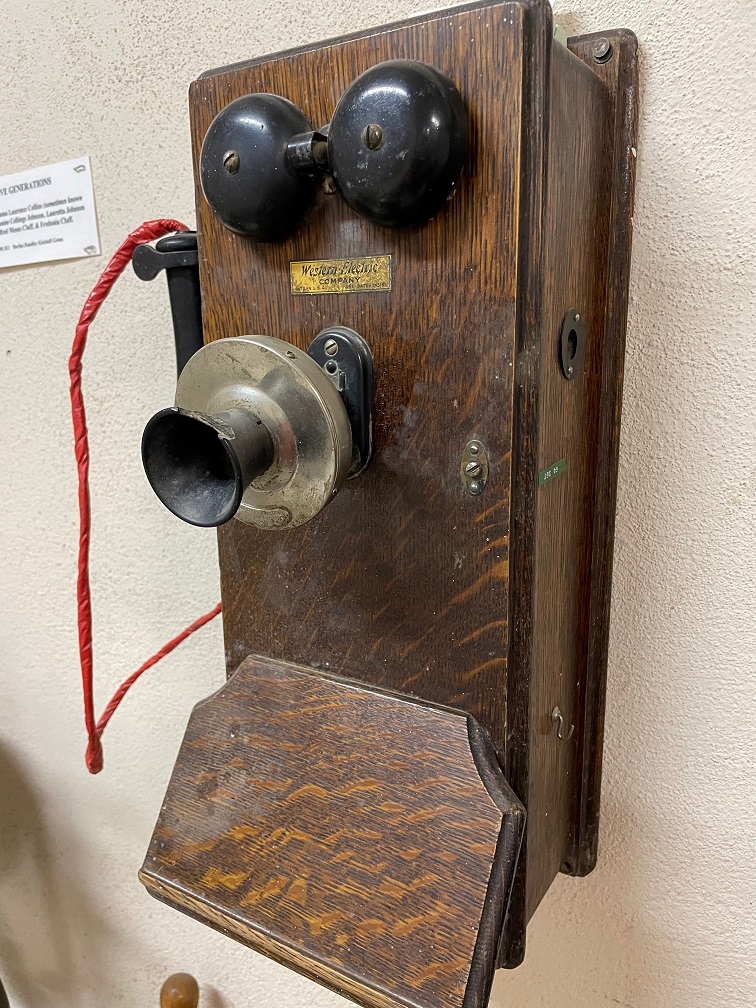
This bell, forged in 1890, was installed in a brick Latter Day Saints church that had been built in Pima in 1888. It’s perhaps two feet tall. A placard nearby has a recollection from 1981 of the bell by a resident of Pima, Laura McBride Smith, who was present when the bell was first rung 90 years earlier: “When that church bell in that building gave its first taps, I heard it. I climbed upon a big double gate where teams and people went in and out across the street west of the Pima Church house, and that is where I first heard the lovely sweet tones and it was first broadcast all over Pima. It was the first bell in the Gila Valley. It rang ’till the sun went down. It is something I have never forgotten. I am sure there isn’t another person alive today who heard that bell first ringing in 1891. Folks, its tone is just as sweet today as always, and to me, when this bell was poured hot in its case they poured a portion of ‘witchery’ into it and closed up the opening while hot and it could not get out and that ‘witchery’ potion will always be there. My children and everybody knew how much time they had to get to church or school the year around. What a blessing that old bell was to the whole community!”Any museum in the western United States worth its salt will have a display of historic barbed wire, and on this point the Eastern Arizona Museum does not disappoint. This case, about six feet tall, includes information about the manufacturer, style, and date of each example.I really like the simple burlap and wood presentation of this exhibit, which is located on top of the larger case seen above. I used to have a DYMO label maker when I was a kid – I never forgot what the things in my bedroom were called back then because everything was labelled.Still more examples of barbed wire from the 1870s and 1880s. Some of these styles look like they were quite a lot of work to manufacture, especially in the quantities needed to fence the American west. I’m just happy that everyone shares my appreciation of barbed wire.Let’s, with regret, set aside our examination of barbed wire for a bit. Here’s a phonograph that belonged to Thomas Hollis Dodge, who was born in Pima in 1897. This phonograph was the first one in the Gila Valley. The recordings on the wax cylinders didn’t have the names of the artists until 1910. As I’m writing this, I’m listening to music being transmitted into the Goddard from satellites positioned more than 22,000 miles above Earth and I have access to 95% of the catalog of human song recording, including the one on this blue cylinder if only we knew what it is. For now, I’ll have to be happy with “Be My Baby” (The Ronettes, 1963). And I am.The placard on this manual foot-pump organ states that it was purchased by Adiel Sanchez and Reyes Colvin Sanchez in 1915 and used many years in a church in Sanchez, a town about 20 miles west of Pima, and later used in their home. I love the wear marks on the pedals, and I’m sure the people playing this organ made beautiful music.The placard for this item notes that its first owner, W.W. Pace, “had to put up his own lines to have this telephone.” It’s one of the first telephones installed in Thatcher, which is a town just west of Safford on the way to Pima. Nancy’s family will note that this phone is a fine Western Electric product. I took all of these photos at the Eastern Arizona Museum with my phone, which doesn’t have the beautiful wooden construction of the model shown here.Here’s something I found really interesting: this is the wedding photo of Albert M. Haws and Alice Cluff Haws from October 30, 1911. They’re a very handsome couple. A trunk on the floor under the photo contains Alice’s wedding dress and clothes worn by some of their later children. The interesting part is …… next to the 1911 photo above is this program from the celebration of the couple’s fiftieth wedding anniversary on October 28, 1961. Albert and Alice were married for six years before the United States entered World War I, and celebrated their 30th anniversary a few months before the bombing of Pearl Harbor. They were married eight years after the Wright Brothers’ first powered flight at Kitty Hawk, and, a few months before their 50th anniversary, the Soviet Union and, later, the United States sent men via rockets into space for the first time. Still a very handsome couple, and I appreciated that the family shared its history with museum visitors.
The Eastern Arizona Museum is a great example of a community historical institution that continues to serve its community. There are plenty of resources for families with roots in the area to continue genealogical research, and there’s a huge variety of exhibits that nearly anyone will find of interest. And, as the Haws family shows us, museums can put personal family gatherings in the historical context of larger world events. Especially when the museums are in historic buildings, one has an opportunity to wonder about all of the people who stepped through those doorways in the many decades before, and who may have used the objects now on display: farmers, bankers, mothers, young students … what were their lives like in the 1890s or the 1910s or the 1960s? What made them laugh, and what made them stay up sleepless at night? We can all learn a lot from history, and great community institutions like the Eastern Arizona Museum are a perfect place to do just that.













 Tales of The Goddard