We’ve just made our retreat from winter quarters in Las Vegas, Nevada, and now, in the first week of March 2026, find ourselves in Kingman, Arizona – just 100 miles down the road. I’ve written before about the many reasons we spend the winter months in Las Vegas, but it mostly comes down to these two:
The warmer temperatures of the Mohave Desert make the winter months both more comfortable and more practical. Cold-weather campers who stay in truck campers, travel trailers, and fifth-wheels like The Goddard know that it’s a pain – a necessary one, but still a pain – to disconnect water supplies from your RV if the temperature drops much below freezing. It’s critical to keep your water hoses, valves, and other equipment from breaking because of the frozen-water expansion. In three years totaling more than 12 months in Las Vegas, we had to disconnect from the water supply five times, and at least two of those were out of an abundance of caution.
If you run out of things to do in the literal Entertainment Capital of the World, that’s kind of on you.
There are other reasons, too, of course: frequent departures and arrivals from and to Harry Reid International Airport, through which 58.5 million people passed in 2024, allows for plenty of flights to see friends and family, there are restaurants featuring pretty much any kind of cuisine in the world, and (maybe this should be in the bullet list above) there are birding opportunities a-plenty.
Nancy and I had been to Las Vegas many times prior to selling our home in Denver and becoming full-time RVers, but our experiences in the city were pretty much limited to flying in to the airport, being transported to a hotel/casino, being entertained, and then being transported back to the airport so we could return to Denver. Having the opportunity to effectively live in Las Vegas for a quarter of the year gives us a much different perspective: people actually live, work, and raise families there – did you know that? Buying groceries, having your vehicle’s tires rotated, going to a park to escape the city noise: all of the things that people do every day in other cities are done by Las Vegans every day.
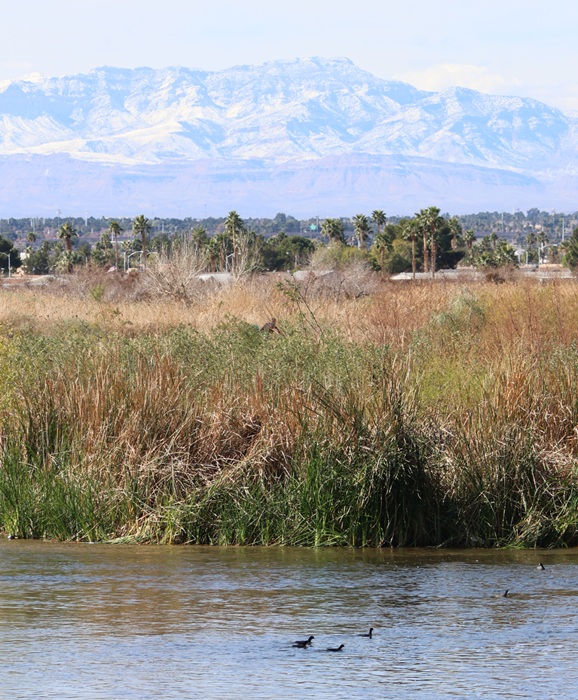
American coots swimming in the Las Vegas Wash were a familiar sight all four months we visited Clark County Wetlands Park. The city of Las Vegas (or, rather, the unincorporated towns of Paradise and Winchester; incorporated Las Vegas is itself a really small part of the metropolitan area) is on the other side of the tall grasses, and the snow-dusted mountains in the background, situated west of the metro area, show that it really was wintertime.
Maybe it’s not such a revelation to you, but, as someone who previously didn’t think about what people who actually live in Las Vegas do (you can’t make a living playing cards and going to shows, or at least not consistently), it certainly was to me.
Two of the places that we spend a lot of time while in Las Vegas are also home, or at least serve as a temporary stopover, to a number of different birds. I’ve written before about both Clark County Wetlands Park and the Springs Preserve, and they were once again sites to which we returned in the winter of 2025-2026.
I probably took about 500 pictures of birds over the winter (I’m not exaggerating), and here, in alphabetical common-name order, are 10 species that I really enjoyed watching (I enjoyed watching all of them and I didn’t get pictures of some that I really, really enjoyed watching, like an osprey hurtling into a stream in pursuit of a fish, or an American white pelican gliding over the desert).
Anna’s hummingbird
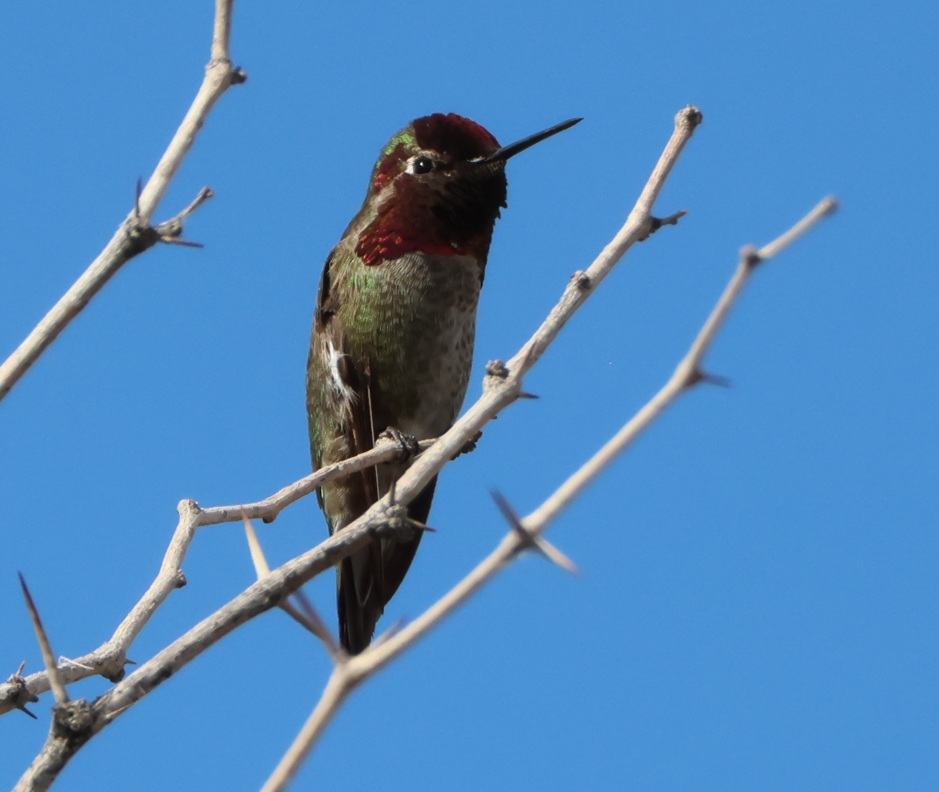
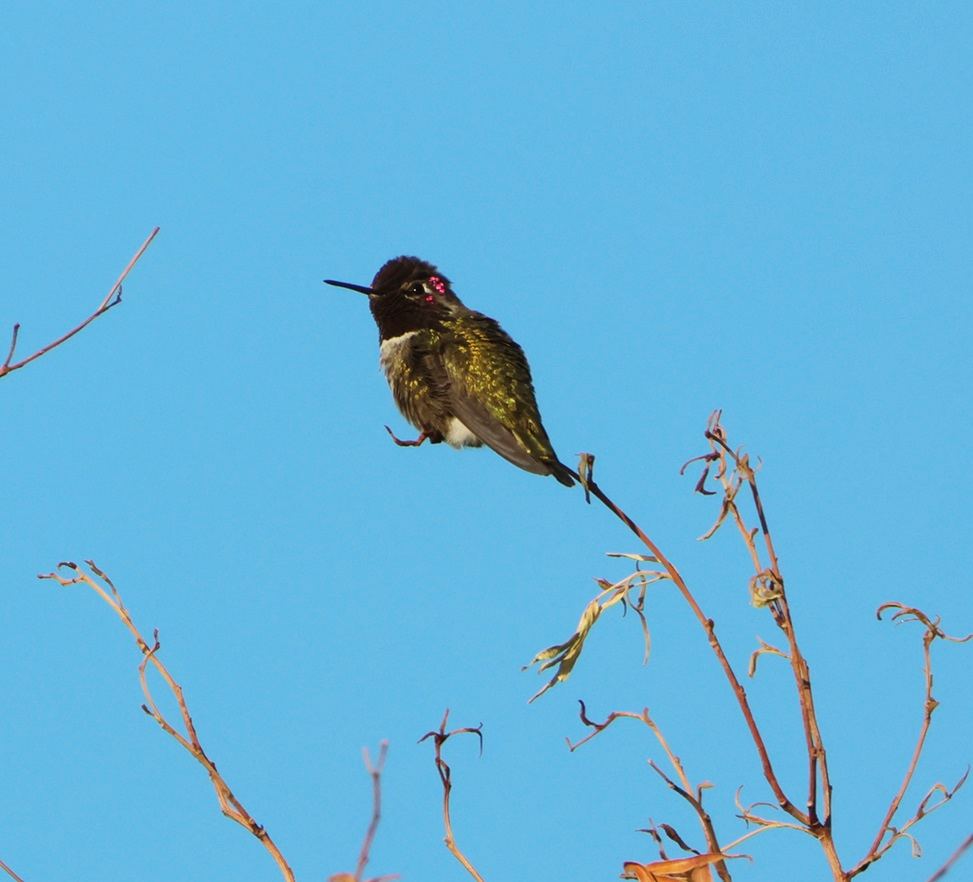
Primarily because of its warm climate, Las Vegas is a year-round home, or nearly so in some instances, to four different hummingbird species. The most common is the Anna’s hummingbird (Calypte anna). These little birds have a wingspan of 4.7 inches (12 cm) and weigh only up to 0.2 oz (5.7 g). Their bodies have the volume of a ping-pong ball and the mass of an American nickel. I took this picture at Springs Preserve on February 28 near the ciénega (Spanish for “swamp”), the manmade wetland feature that recreates the original water springs around which the original townsite of Las Vegas developed. Northern mockingbirds were by far the most common birds we saw at Springs Preserve, but we saw many Anna’s hummingbirds, as well as a couple of possible other hummingbird species, that day.
We’ve stayed at the same campground in the Las Vegas area the last three winters, and there’s a dog run there with a nearby tree that usually has an Anna’s hummingbird (not the one pictured, unless it decided to fly 11 miles to this different tree) perched at its top in the mornings. Seeing that little guy is always a great way to start the day.
Common merganser
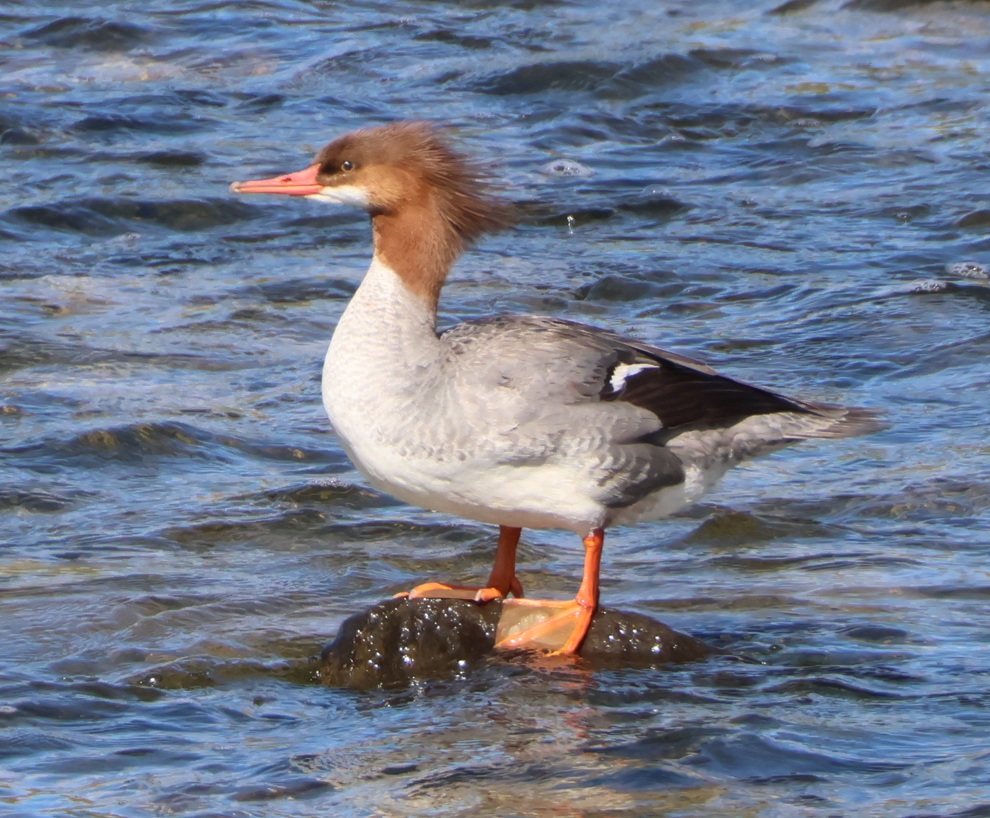
Nancy and I saw our first common merganser (Mergus merganser) two years ago in Pagosa Springs, Colorado, when one of these ladies (the drakes have dark-green head plumage) plopped down into the San Juan River flowing next to the restaurant at which we were dining al fresco. I got a really bad picture of it with my iPhone, but I could still tell that it was a common merganser (and a hen) because of the distinct reddish-brown head. We saw our second common merganser (another hen) paddling about the Yellowstone River during our first evening in Wyoming’s Yellowstone National Park last fall. This pretty lady pictured was one of five or six mergansers in the Las Vegas Wash on the morning of February 13. These birds have wingspans of 30-38 inches (78-97 cm) and weigh up to 4 pounds, 10 ounces (2.1 kg). All mergansers have serrated bills, which help them catch and hold on to fish. This species is found across the northern hemisphere at least part of the year; they are year-round residents of areas with ice-free water.
Crissal thrasher
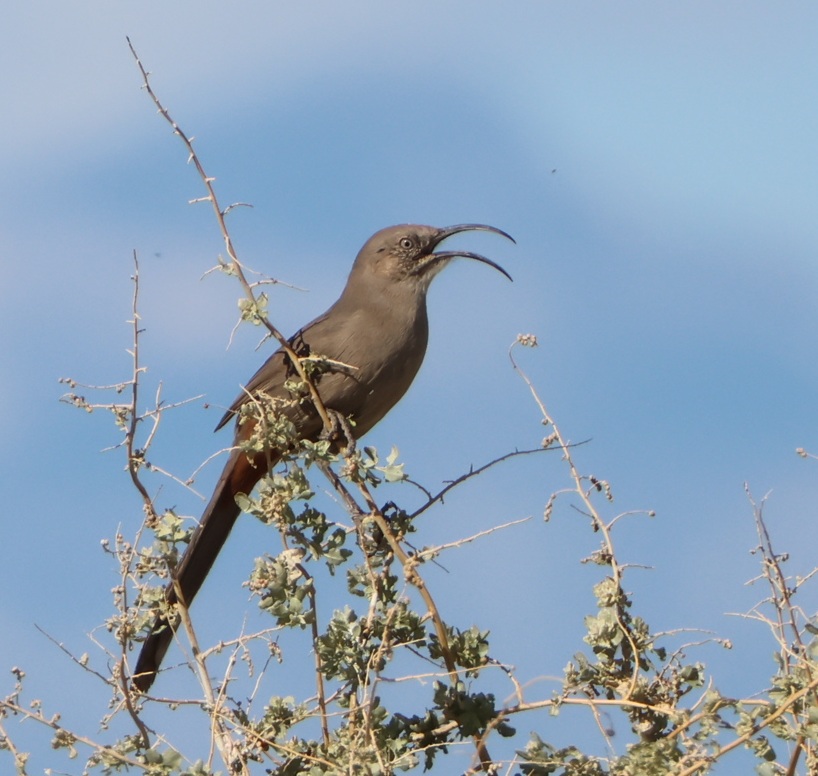
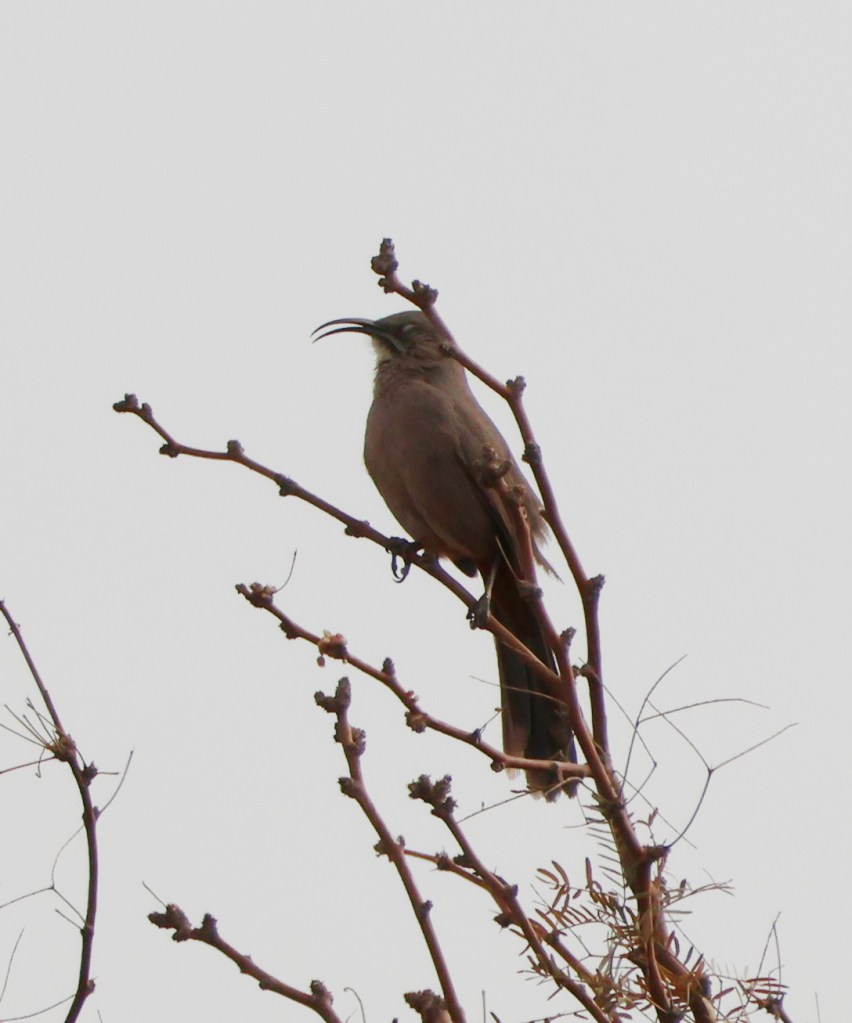
I saw my first crissal thrasher (Toxostoma crissale) last winter at Clark County Wetlands Park, and I saw a few more there this winter; I’ve only seen them there. These birds have bodies ranging from 10.5 to 12.5 inches (27-32 cm). I’ve been a somewhat serious bird enthusiast for perhaps five years, and I’m still amazed at their diversity. Crissal thrashers’ beaks evolved into this shape to allow them to capture insects in the leaf litter at the bases of trees and shrubs. Compare this thrasher’s beak and its diet with those of the merganser (which eats fish) and hummingbird (primarily flower nectar) above. A different thrasher species, Toxostoma curvirostre, has the common name of curve-billed thrasher (we’ve seen them in Arizona and New Mexico); its bill is indeed curved, but not nearly as much as that of a crissal’s. Inexplicably, my copy of the National Audubon Society’s Field Guide to Birds has a photo of the crissal thrasher facing the camera, so the effect of that wondrous bill is completely lost.
House finch
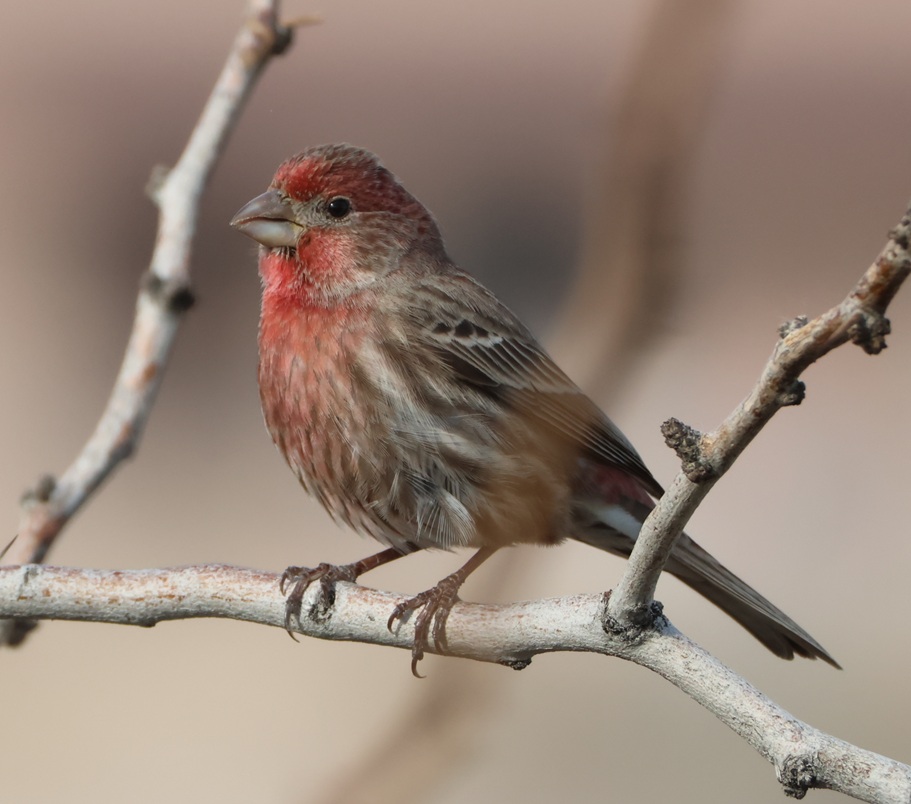
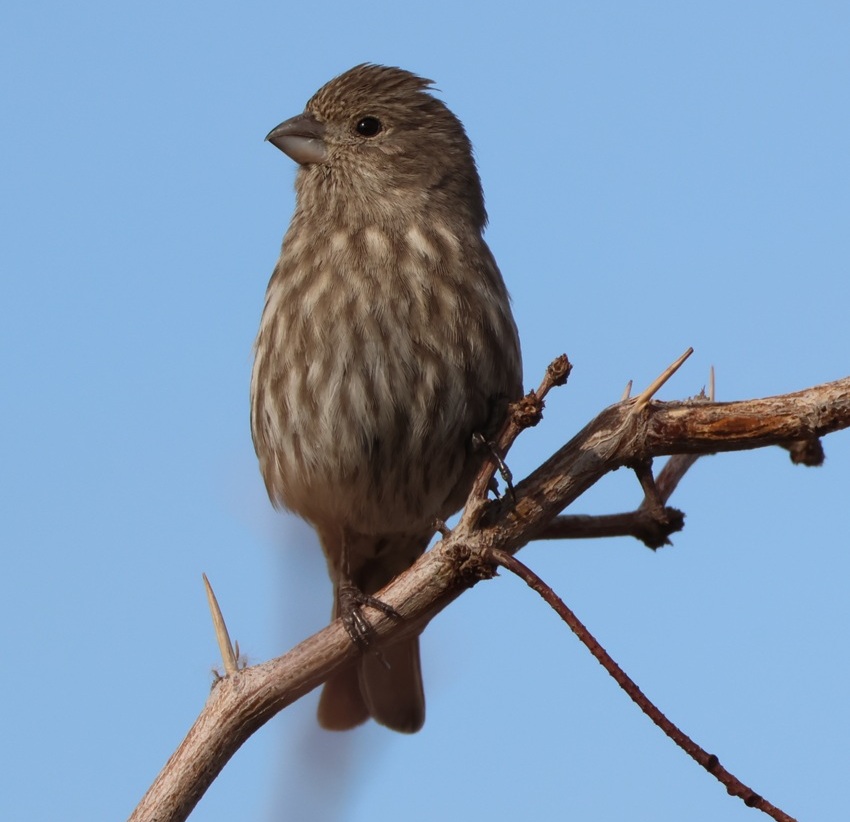
Continuing the comparisons of birds’ beaks and what they eat, have a look at these male (top) and female house finches (Haemorhous mexicanus) I photographed at Clark County Wetlands Park on January 7. For relatively small birds [5-6 inches (12.5-15 cm) in length, with an 8- to 10-inch (20-25 cm) wingspan], those are pretty stout beaks; they’ve evolved to crack open grains, nuts, and seeds with ease. Male house finches, as is the case with many (not all) birds, are more colorful than females; the red color comes from their diet. I’ve also seen orange- and yellow-colored male house finches; we saw a couple of orange ones at Springs Preserve in late February. House finches have very cherry calls and songs. As indicated by their scientific name, house finches are native to Mexico and the American Southwest. Populations were taken to the East Coast at the turn of the 20th century with the intention to be kept as house pets, but that was illegal so the owners let the birds into the wild and now the species is found over most of the United States.
Great blue heron
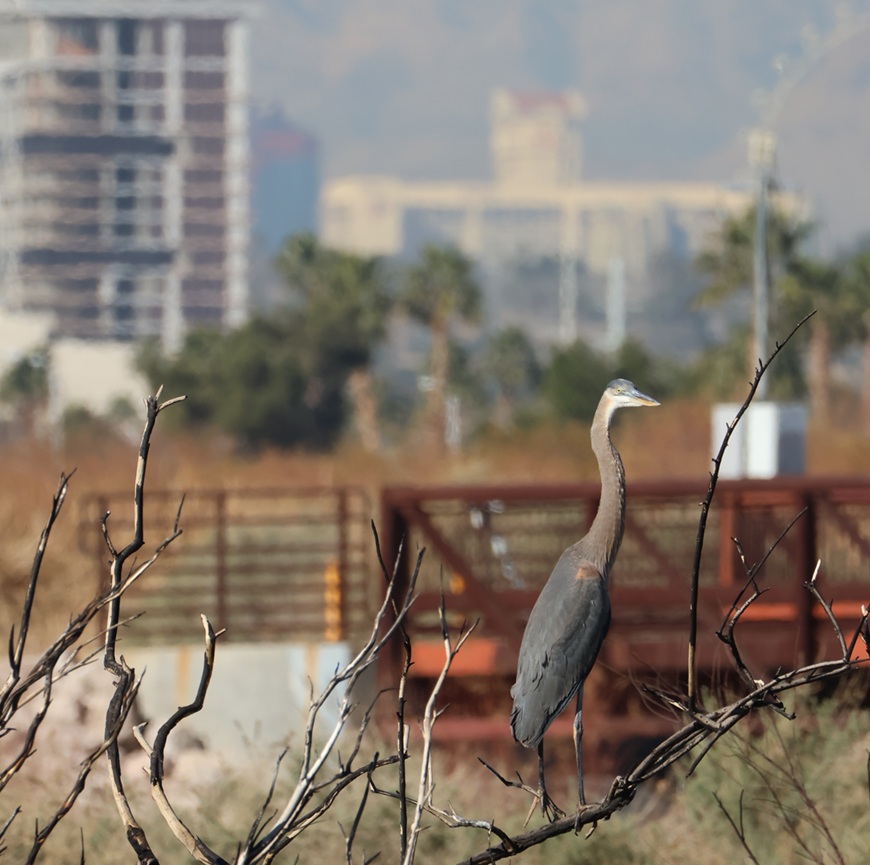
They’re usually seen standing silently on the bank of a river or lake while hunting fish, but it’s not terribly unusual to see great blue herons (Ardea herodias) find a perch (a place to rest, not a type of fish) in a tree. This particular perch was perhaps 3 feet off the ground, so I don’t think that this 45- to 54-inch-tall (115-138 cm) bird found much advantage in this position, but I’m not one to question such decisions. These are the largest herons found in North America; their wingspans measure 66-79 inches (167-201 cm). Great blue herons are found from throughout Canada down through the United States, Mexico, and South America. They are an apex predator of wetlands, where their diet includes small mammals, reptiles, and invertebrates, in addition to fish.
Some incidental notes about this photo: the brown railed structure in the background is part of the bridge that crosses the Las Vegas Wash. Most of the photos of ducks and other waterbirds in the river were taken from that bridge. The Las Vegas Wash (“wash” in the American Southwest refers to a usually intermittent riverbed) runs from the city all the way to Lake Mead about 30 miles downstream, transporting treated wastewater and runoff along the way. The water from Lake Mead finds its way back to Las Vegas via pumping stations and other infrastructure to be used again. At the top left corner is the Eastside Cannery, a 16-story hotel and casino at Boulder Highway and Nellis Boulevard, just south of the campground where we spend the winters. The 307-room property was built at a cost of $250 million and completed in 2008. The property was purchased by Boyd Gaming (owner and operator of many gaming properties around Las Vegas and the United States) in 2016. The Eastside Cannery casino and hotel closed due to COVID-19 in March 2020 and never reopened; it is set to be imploded two days from this writing (that is, on March 5, 2026).
And so it goes.
Not a bird
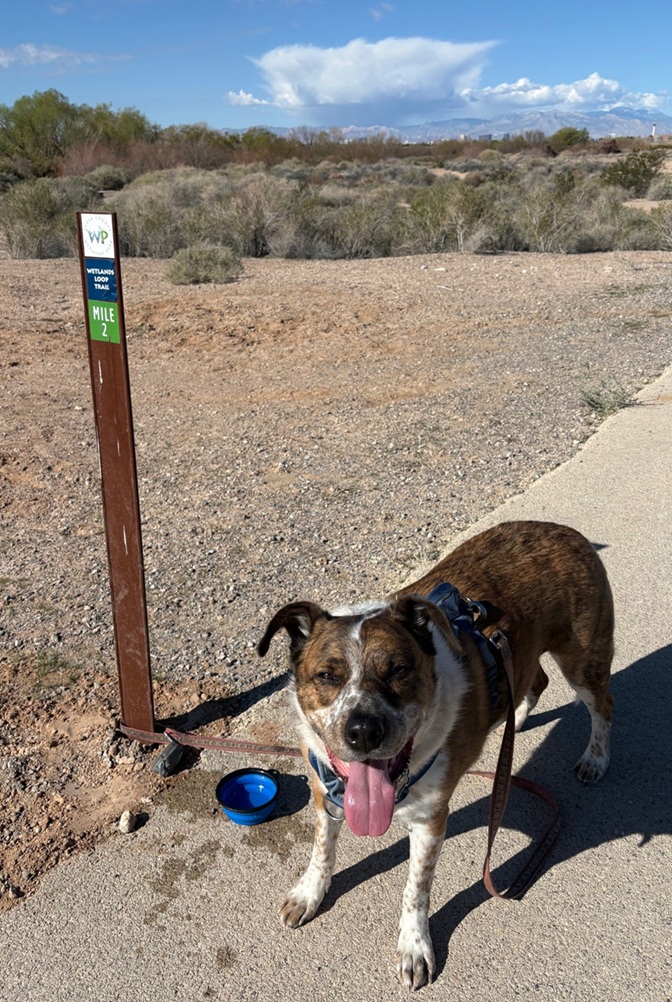
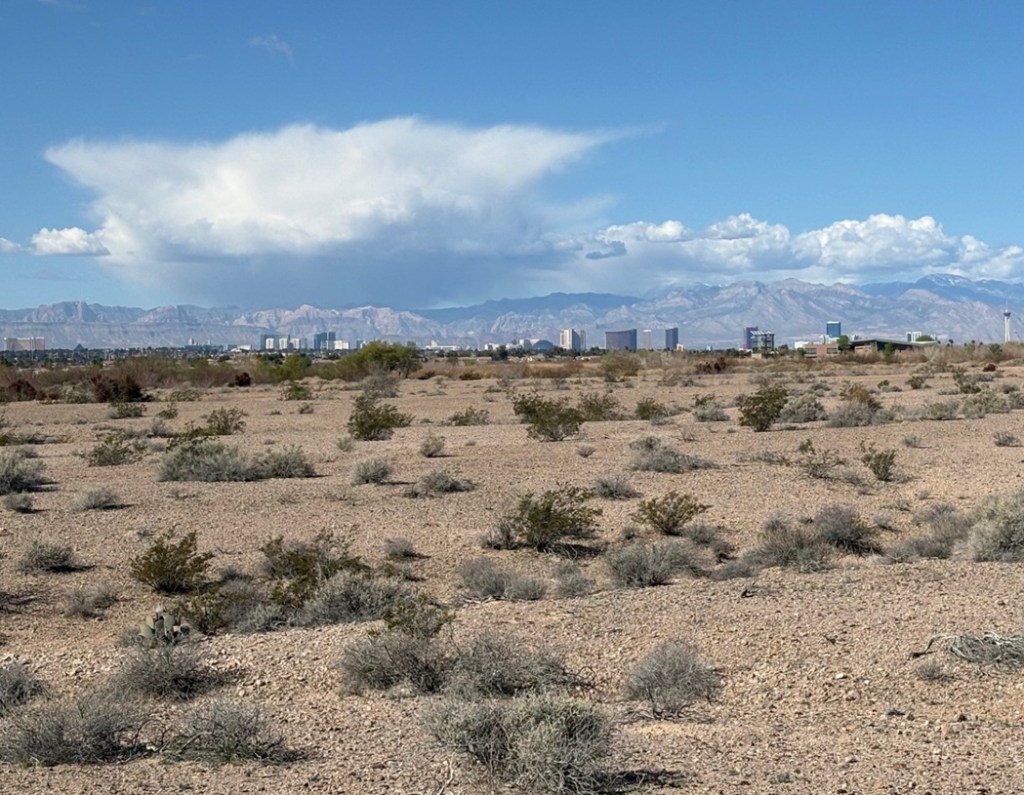
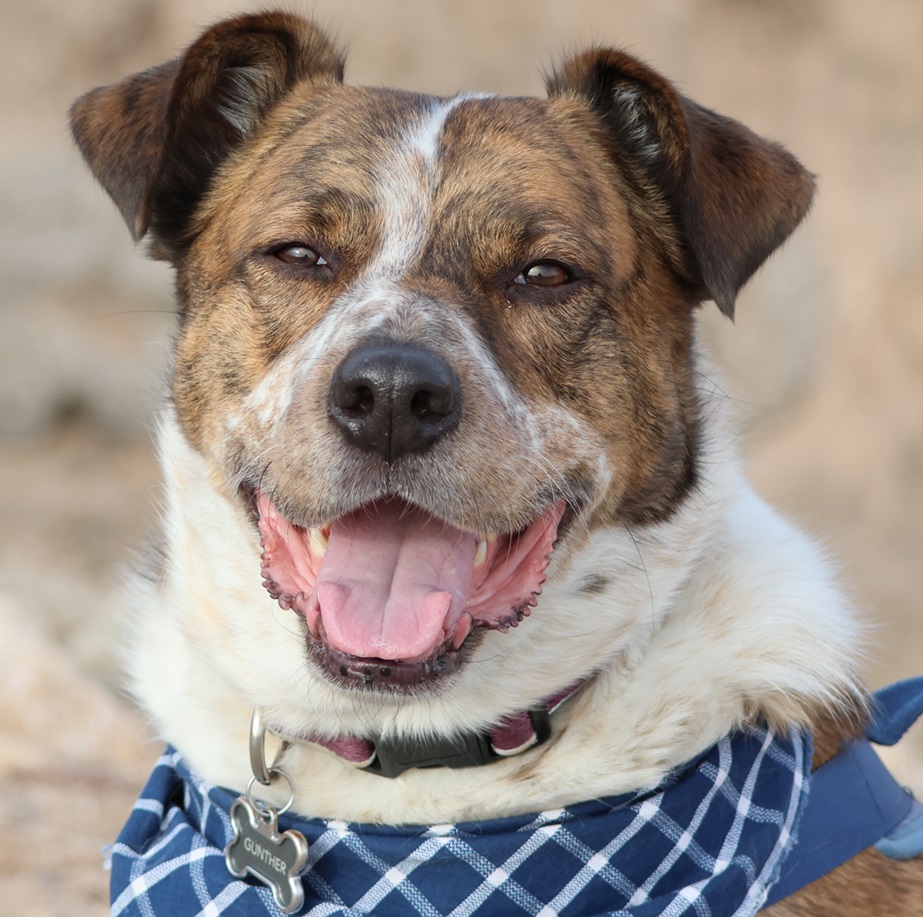
Halfway through – time for a water break! This is actually the halfway point on the Wetlands Loop Trail that Gunther and I enjoyed a couple of times this past winter. Gunther probably got at least as much water in him as he did on the sidewalk. The buildings just this side of the mountains are on Las Vegas Boulevard (“The Strip”); that’s the 1,149-foot-tall (350 m) white tower of The Strat (formerly The Stratosphere) at the right edge of the photo. It is the tallest observation tower in the United States. Readers of a certain age will remember Vegas World, a property owned by Bob Stupak that opened in 1979; some of that casino and hotel was refurbished into The Stratosphere, which opened on April 30, 1996.Here’s another photo of The Strip, taken a little later in our walk (notice the cumulonimbus cloud at left) and showing some of the Mohave Desert terrain typical of Clark County Wetlands Park when you’re not next to the water provided by the Las Vegas Wash. This viewpoint is about 10 miles east of The Strip. The white tower of The Strat is at far right; the beige Mandalay Bay is at far left (the pyramid of the Luxor Hotel & Casino is just to Mandalay Bay’s right) and about five miles south of The Strat. All of the other Strip properties, like Caesar’s Palace, Paris, The Bellagio, the MGM Grand Las Vegas, The Flamingo, The Wynn – there are 30 in all – are in between. Incidentally, the biggest hotel on the strip, the MGM Grand Las Vegas, has 4,762 rooms – more than a third of the total number of hotel rooms in all of downtown Denver. Mandalay Bay is the southernmost large hotel and casino on The Strip; The Strat, five miles north, is located within the city limits of Las Vegas and therefore, according to Clark County, not technically on The Strip.
And so it still goes.
Greater roadrunner
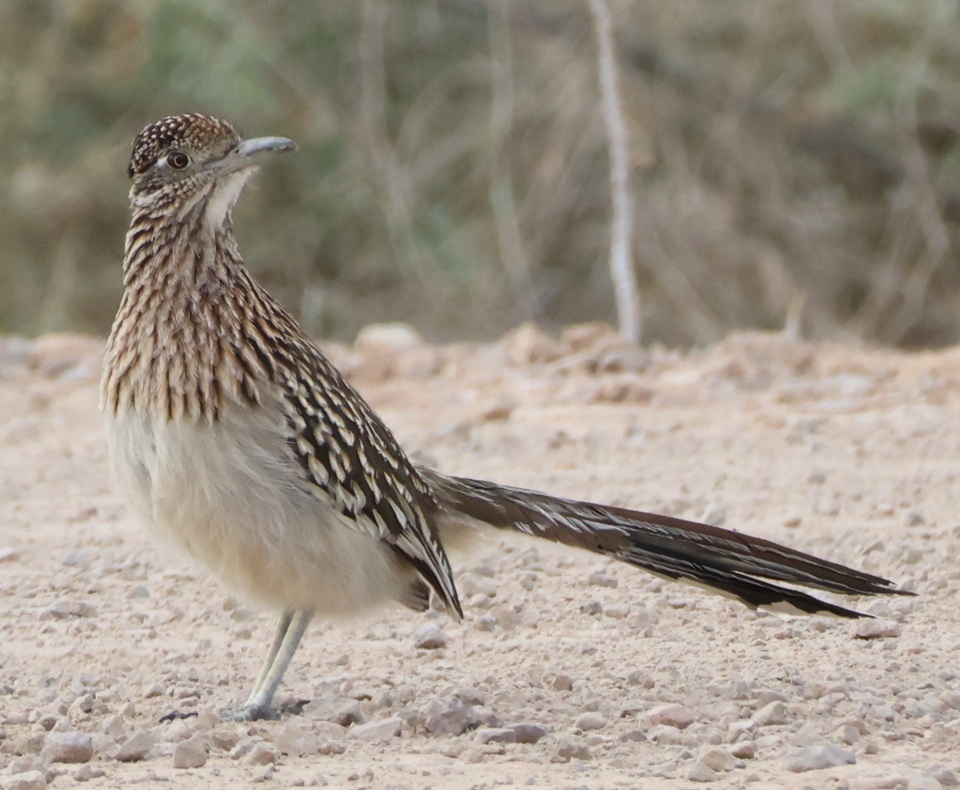
Let’s get back to birds, with this photo I took on Jan. 23, 2026. One of the reasons I include the scientific names of birds in these postings is because they’re just fun to say. This is Geococcyx californianus, the “Californian earth-cuckoo.” The only other member of the Geococcyx genus is the Geococcyx velox (that, too, is fun to say), the lesser roadrunner, which is found only in Central America. Standing 9 3/4 to 11 3/4 inches (25-30 cm) tall, the greater roadrunner is the largest cuckoo on the American continent. Roadrunners have zygodactyl feet, meaning they have two toes in the front and two toes in the back of the foot [as opposed to most birds, which have three toes in the front and one toe in the back (anisodactyl)]. Osprey, too, are zygodactyl: the configuration allows them to carry their fish prey in the air facing forward, rather than side-to-side, for better aerodynamics. I saw this greater roadrunner while it was running on a road; it was great.
Mallard
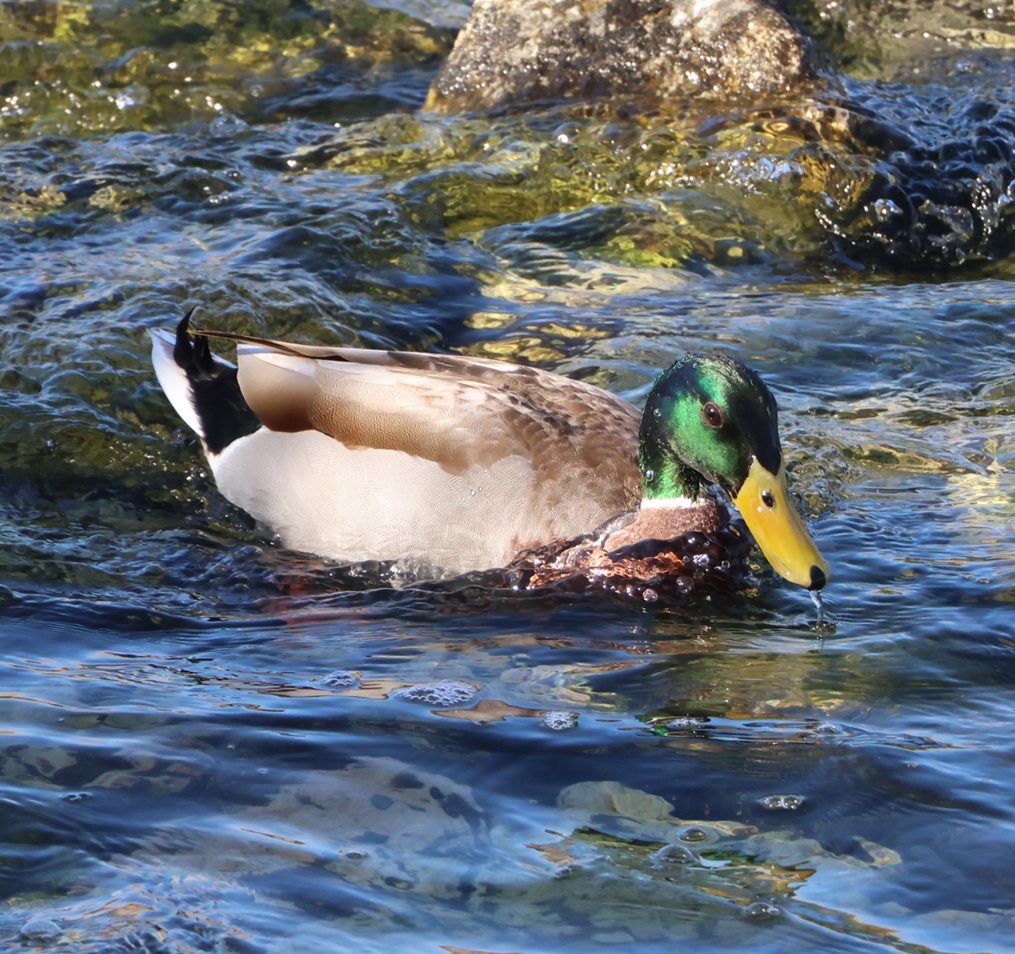
Most readers will recognize this handsome fellow as a mallard (Anas platyrhynchos) which is one of the largest species of dabbling ducks, or ducks that feed mostly on the top of the water rather than diving down for their prey (like, say, a common merganser). Mallards are 20 to 26 inches (50-65 cm) long, with wingspans measuring 32 to 39 inches (81-98 cm). The drakes have these gorgeous green heads while hens have more restrained brown overall coloration. I’ve taken lots and lots of photos of ducks in general and mallards specifically over the last four or five years. I’ve never been as close as I was to this one when I took this on Feb. 13, 2026, from the Las Vegas Wash bridge. I’m happy with how this photo turned out. Look at that duck dabble!
Ring-necked duck
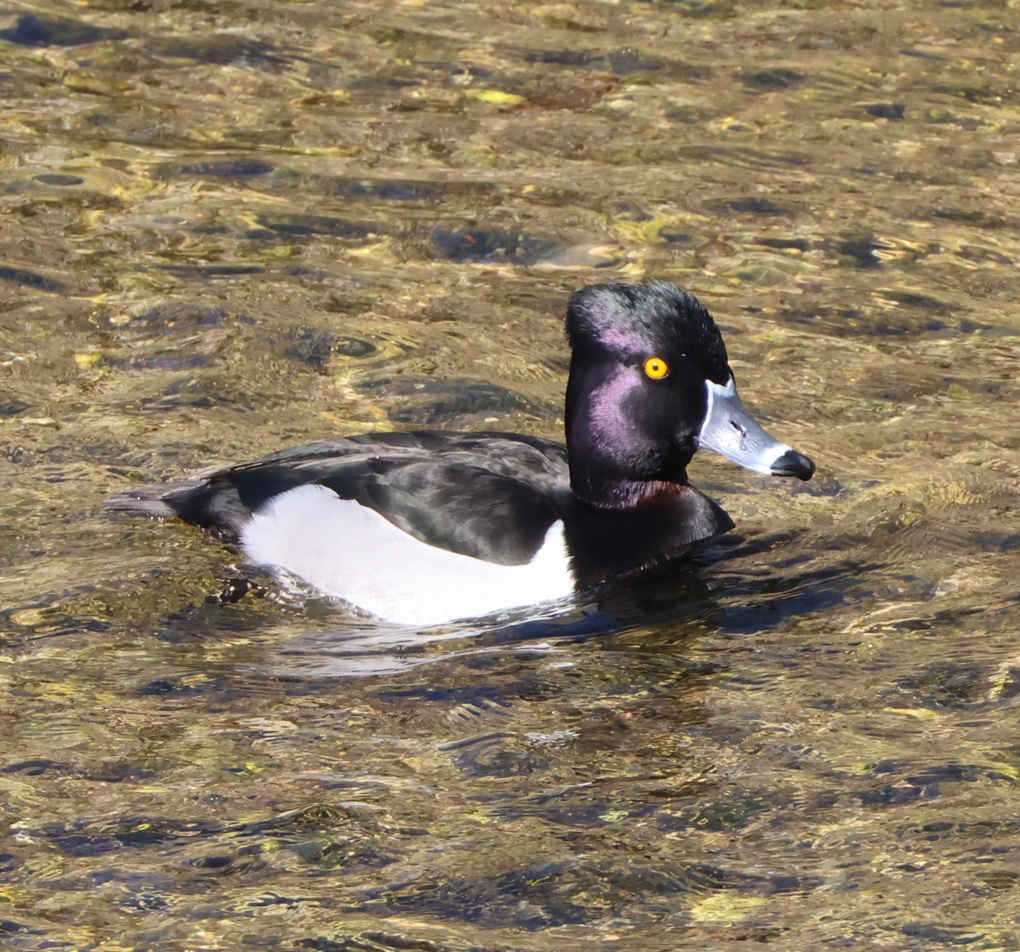
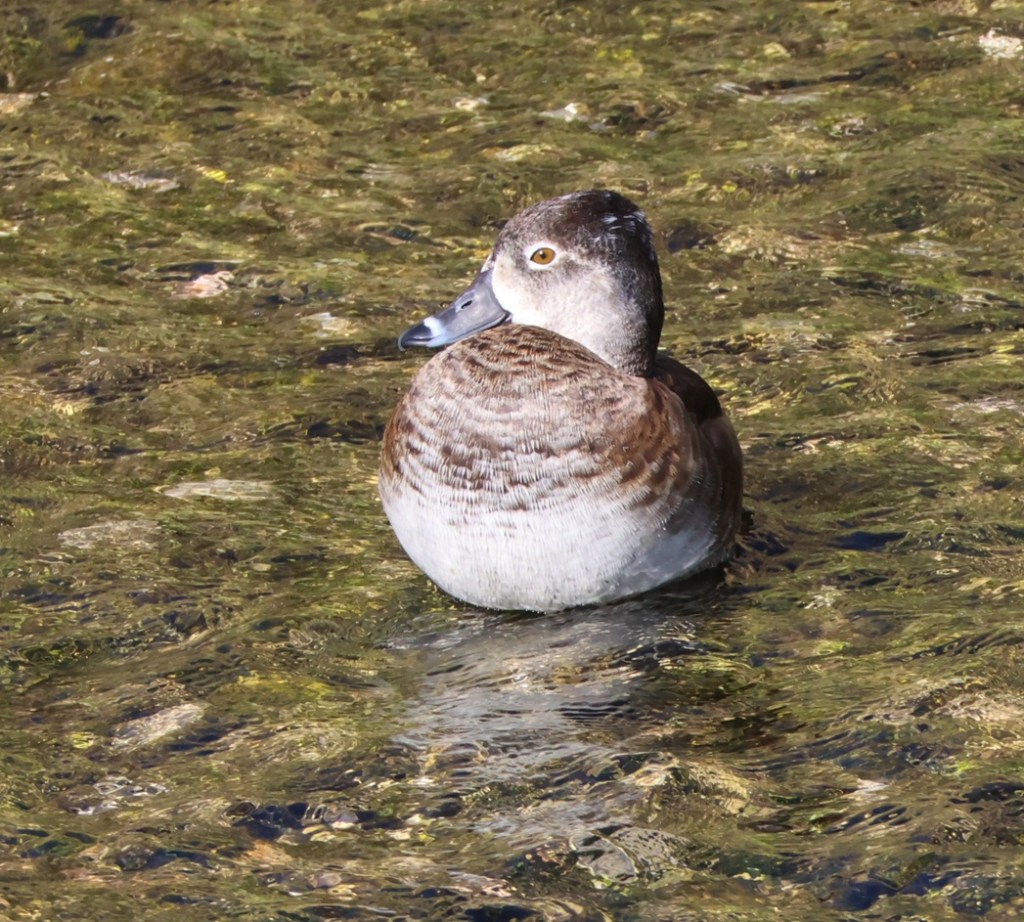
Doubling down on ducks: these are ring-necked ducks (Aythya collaris), a drake (top) and a hen. This species is a diving duck, which, appearances aside, significantly differentiates it from a dabbling duck like the mallard. Genetic research shows that, while diving ducks and dabbling ducks may look similar in body style (morphology), they are different enough that it’s likely they evolved separately. For instance, the feet on diving ducks are placed further back on their bodies than those on dabbling ducks to help propel them underwater – but for that reason, a dabbling duck is better able to walk about on land. Don’t bother looking for the rings on these ducks’ necks: they’re very difficult to discern. This species is sometimes called a ringbill because the rings on the bills are distinct. Just look at that hen. Doesn’t she have a calming presence?
Not a bird, again
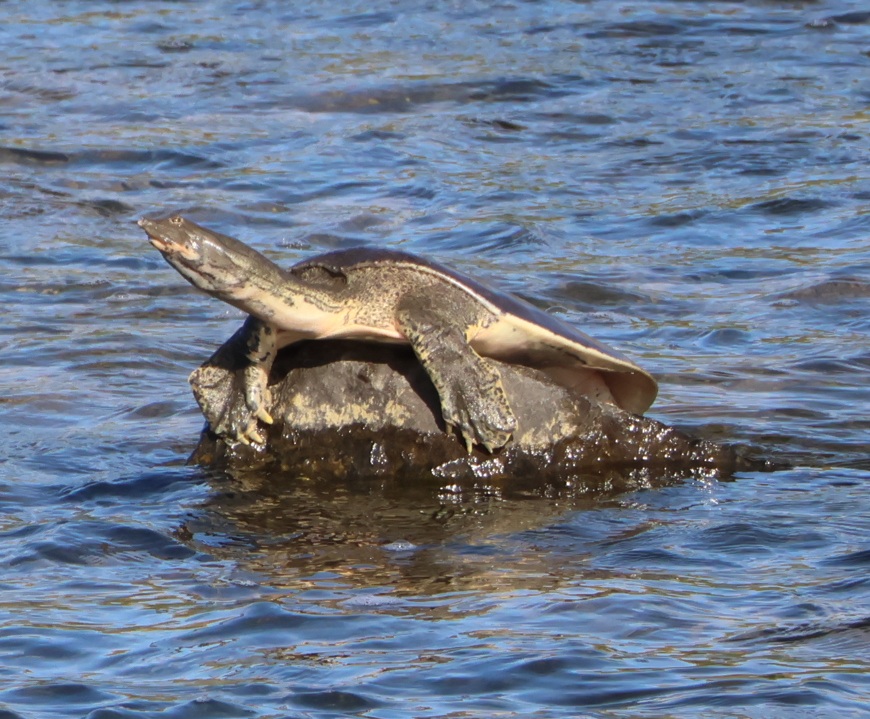
A little over a year ago, I got a new camera and lens that allow me to take photos of fairly far-away birds. With a teleconverter attached, it’s effectively around a 500mm telephoto lens. Sometimes the birds are so far away that I can’t really tell what kind of bird it is that I’m photographing. For instance, when I took the earlier photos of the crissal thrasher, I was 95% sure that it was a northern mockingbird until I got home and looked at the photos closer to full-size. Same thing happened with a loggerhead shrike this winter: I thought it, too, was a northern mockingbird until I got home. Well, this thing in the Las Vegas Wash, photographed on Feb. 13, 2026 from maybe 75 yards (68 m) away, looked to my eyes like some kind of bird so I took its picture. I was wrong. It is, as the heading indicates, not a bird. This is a Texas spiny softshell turtle (Apalone spinifera emoryi), a non-native species to the Las Vegas Wash. This is most likely a female, because a female Texas spiny softshell turtle has a carapace (something akin to a shell) measuring about two feet (61 cm) long. The species is naturally found in the Rio Grande and Pecos river drainages of Texas and New Mexico, but someone (likely) released this species into the Las Vegas Wash some time ago and now they’re pretty well established. This is yet another reason that I will never dip my toe in the Las Vegas Wash.
Verdin
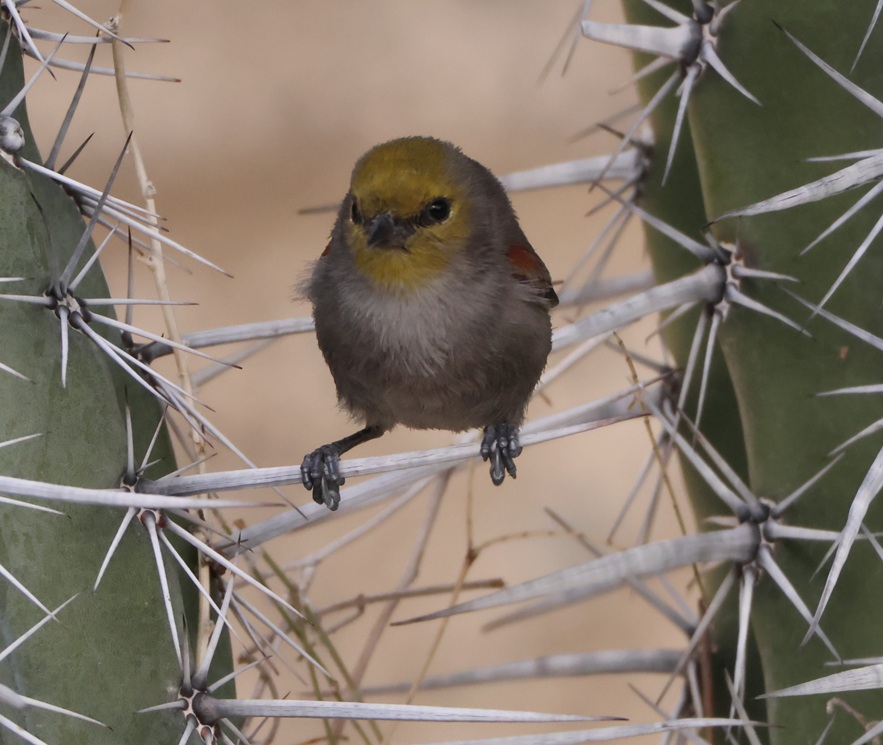
Let us turn away from turtles and return once again back to birds. This was one of the last birds I photographed in our winter in Las Vegas. It was one of four or five verdins (Auriparus flaviceps – that one’s fun to say, too) at Springs Preserve on Feb. 28, 2026, that were flitting back and forth between a tall tree and this good-sized pipe organ cactus. I was finally able to get a couple of decent photos when this one settled for a bit on a cactus thorn. That’s a good-sized thorn: a verdin is only 4 1/2 inches (11 cm) in length. I got some decent pictures of verdins over the winter at Clark County Wetlands Park, but I’m happy with this photo (and I’m also well-aware that it is 95 percent luck). We saw several of these beautiful little birds entering and exiting their nests while at Springs Preserve: it’s an exciting time of year!
White-crowned sparrow
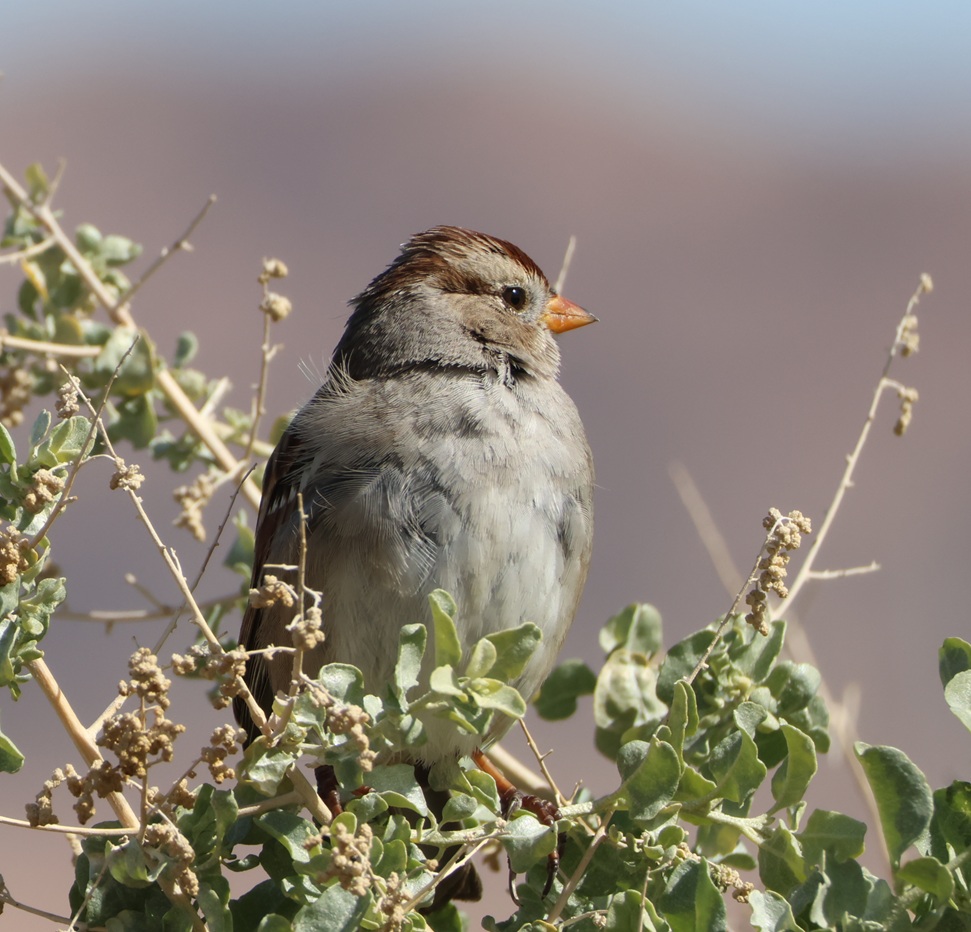
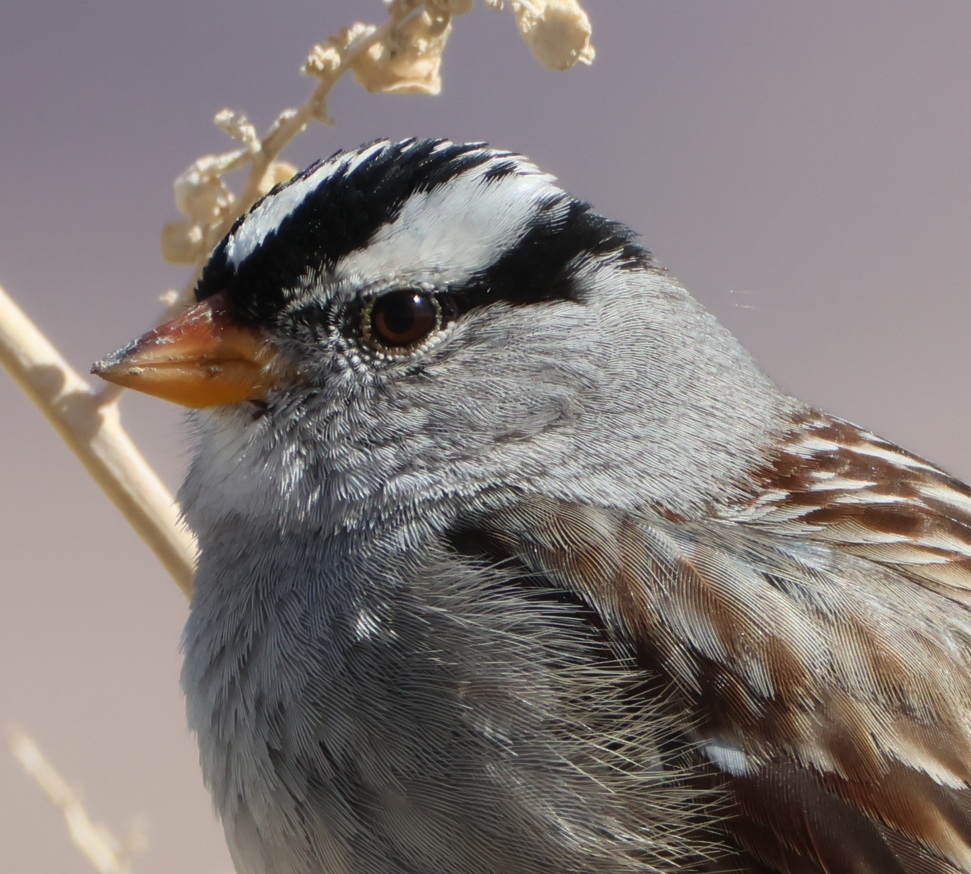
As I noted above, I have a camera that lets me get photos of far-away subjects. It also works pretty well when the birds are relatively close. At the trailhead of the Wetlands Loop Trail at Clark County Wetlands Park, the sidewalk goes by a lot of shrubs called four-wing saltbush. Those shrubs provide a favored perch for white-crowned sparrows (Zonotrichia leucophrys), who usually let Gunther and me walk on by, without taking off, when we’re on the trail. I was able to photograph a juvenile (top) and adult from a very close perspective. White-crowned sparrows are among the most gregarious wild birds I know, and the ones that hang out next to the Wetlands Loop Trailhead are perhaps the most sociable I’ve ever seen. Maybe it’s all the foot and bike traffic they see during the day, but it was great to be able to get these detailed photos for a close look at their feathers and coloration.
One of the things that really appeals to be about birdwatching is being able to see the similarities and differences between species: the coloration (some species have wildly different color patterns between males and females, for instance); the differences in size and shape of beaks/bills, wings, and tails; even noting that in some species, like ring-necked ducks, the drakes have bright yellow eyes and the hens have beautiful brown eyes. All of the birds in this posting were photographed within no more than 15 miles of each other: the riparian habitat at Clark County Wetlands Park brings a lot of birds to Las Vegas that wouldn’t normally stop there, and there’s great diversity even between the native desert birds like crissal thrashers and hummingbirds.
I keep a list, beginning on Jan. 1 of each year, to keep track of how many different bird species I see during that year. My goal is always 100 different species, and I’ve never met it (I got to 94 in 2023, 62 in 2024, and 96 in 2025). In the first two months of 2026, I’ve recorded 36 different species, all of which were observed in either Clark County Wetlands Park or the Springs Preserve in Las Vegas. With a 3,000-mile trip scheduled through the American Southwest, Midwest, and Upper Midwest, along with a 3,000-mile trip back to Las Vegas in the fall, I’m feeling pretty good about my chances of meeting my goal of 100 observed bird species this year. I hope my little Anna’s hummingbird pal is back on top of his tree next to the dog run when we return to Las Vegas in December.
Bird species observed in the Las Vegas, Nevada, area in January and February 2026
Nancy, Gunther, Rusty, and I are wintering in Las Vegas, Nevada. We arrived here at the beginning of November 2024, with plans to depart in early spring of this year. There are worse places to spend the winter than Las Vegas: the campground at which we’re staying is surprisingly inexpensive with friendly folks and lots of activities, there are a lot of good restaurants and entertainment options relatively nearby, and, as we found out last winter (we spent five months here), there are a unexpectedly large number of hiking and birding opportunities very close to the city.
Gunther, Nancy, and I took advantage of one of those birding opportunities during the waning days of 2024 with a visit to Clark County Wetlands Park, located just a few minutes’ drive from our campground. The Las Vegas Wash, which I described in last year’s posting about the Owl Canyon Hiking Trail at Lake Mead National Recreation Area, creates the wetlands aspect of the park. Those of you who have spent much time in the desert city of Las Vegas might be surprised to see that a decent-sized creek runs through the east side of the metropolitan area. Las Vegas Wash is bigger at times, especially after heavy rains, than others. For those used to even small-sized creeks and rivers, it’s probably not a very impressive waterway. However, the Las Vegas Wash is absolutely critical for the health and sustainability of this area; the water in it is collected wastewater and runoff from the city’s hotels, golf courses, and other businesses, as well as residential wastewater and stormwater runoff, on a 12-mile journey (including through wastewater treatment plants) to the Lake Mead impoundment east of Las Vegas. Ninety percent of the water used in the Las Vegas metropolitan area is drawn from Lake Mead (the rest is from groundwater sources), so it’s imperative that as much water that’s used in the city gets returned to the reservoir as possible.
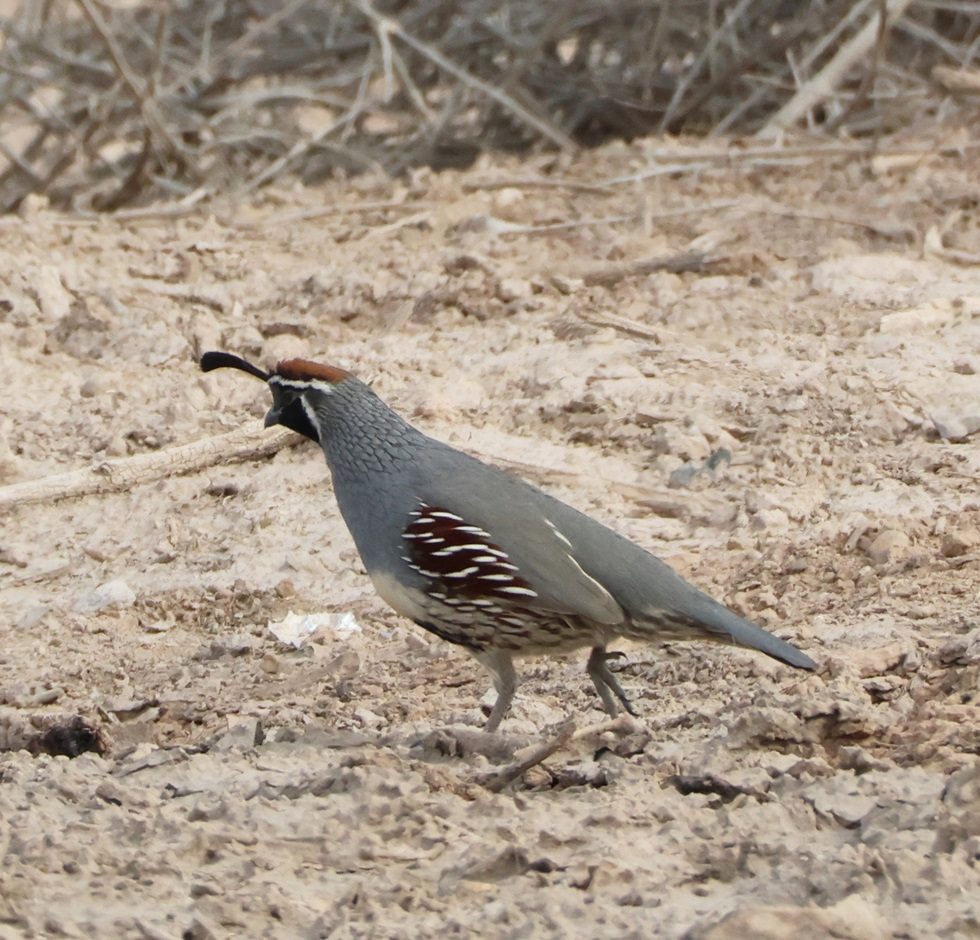
We’re currently close enough to the Golden State that I thought this might be a California quail as opposed to a Gambel’s quail (Callipepla gambelii), but it is indeed the latter. It, along with three or four more of its kind, was hunting on the ground just off the trail shortly after we started our walk. In addition to southern Nevada, this bird’s range includes regions of California, Arizona, New Mexico, and Utah, as well as little parts of western Colorado.
Whether it’s moving, still, salty, fresh, or freshly treated, water makes a huge difference in supporting wildlife populations; without the wash, many species of birds, lizards, and mammals simply wouldn’t be in this place. That fact was made clear to us on the day that we visited. Like most avid birders, I keep a record of each bird species we see during the year. Before we began the five-mile loop walk through the wetlands, we’d seen 50 different bird species in 2024; by the time the three of us climbed back into the Goddard’s six-wheeled towing unit to drive back to the campground, we’d seen 18 additional species, 12 of which were species not yet seen in 2024, and four of which we’d never seen before. In other words, nearly a quarter of the bird species we saw in 2024 were seen on the on the 363rd day of the year during this 2 1/2-hour hike just outside of Las Vegas.
Much of the 2,900-acre (4.5 square-mile) Wetlands Park is a nature preserve, into which Gunther (very understandably) can’t go. However, there’s a very fine concrete trail that skirts the outer perimeter of the preserve and also goes over a bridge that crosses the wash. It was from that bridge that we saw three of the four “lifers,” or bird species we hadn’t ever seen before.
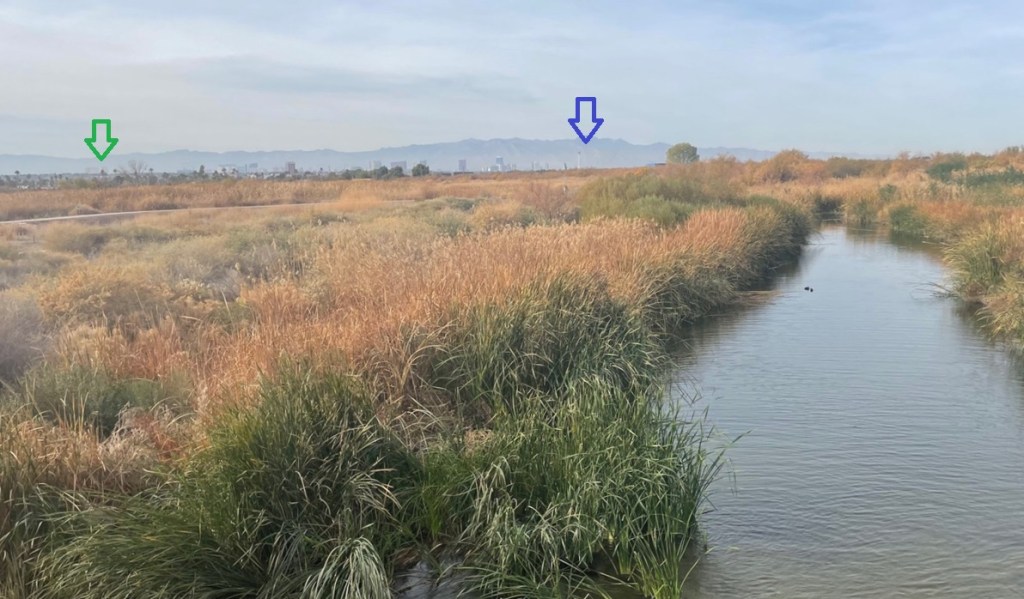
This is a view from the Las Vegas Wash looking west toward Las Vegas Boulevard, or “The Strip.” It was an overcast and hazy day in the Las Vegas Valley, but you can just barely make out some of the structures on The Strip. Mandalay Bay Resort and Casino, the southernmost casino on The Strip and indicated by the green arrow, is about nine miles directly west of this position. The Stratosphere Hotel, Casino and Tower (I think it’s just going by The STRAT now) is indicated by the blue arrow and is located about six miles to the north of Mandalay Bay. (Incidentally, at 1,149 feet the Stratosphere’s observation tower is the tallest in the United States and is second in the Western Hemisphere only to Toronto’s CN Tower at 1,815 feet – but that’s a conversion from metric so who knows what’s really going on?) Anyway, the Spring Mountain Range is on the horizon, and in between Las Vegas Boulevard and the mountains is Red Rock Canyon National Conservation Area, which we visited last winter. Those are American coots swimming in the Las Vegas Wash on the right.We’ve seen lots of little white-crowned sparrows (Zonotrichia leucophrys) since becoming full-time RVers, especially in New Mexico and Arizona, but it’s always a pleasure to see (and hear) them again. Of all the little brown birds (LBBs), they are one of the easiest o identify. Small but mighty, these birds are exceptional migrators and have been tracked flying as many as 300 miles in one night.
Prior to becoming full-time RVers and when we still lived in Denver, Nancy and I visited Las Vegas at least once a year. Like most visitors, we arrived via airplane at Harry Reid International Airport (née McCarran International Airport), and took a cab to our hotel, either on The Strip, or, later and more regularly, in downtown Las Vegas. We’d spend a few fun-filled days, some more profitable than others, and then take a cab back to the airport and return home. A lot of people don’t realize that when they fly into Harry Reid International Airport, spend a few days recreating on The Strip then return to the airport to go back home, they’re not ever actually in Las Vegas – unless they go to the Stratosphere (I don’t care what it’s going by now; I’ll still call it the Stratosphere because I just got used to not calling it Bob Stupak’s Vegas World) or to downtown Las Vegas. Otherwise, each of the roughly 40 hotels and casinos, including places like The Bellagio, Caesar’s Palace, New York New York, The Luxor, The Wynn Las Vegas, and dozens more) along Las Vegas Boulevard, with the exception of the Stratosphere, is in unincorporated Clark County (as is the airport). Those hotels have a total of nearly 89,000 rooms (The Wynn Las Vegas alone has almost 4,800 rooms); compare to, say, downtown Denver which has about 11,000 hotel rooms and the biggest one, the Sheraton Denver Downtown, has 1,231 rooms). The point is, there are a lot of hotel rooms in Las Vegas (and tens of thousands more in unincorporated Clark County), and all of them have bathrooms with showers and flushing toilets, and all of that water needs to go somewhere.
Where it needs to go is into Lake Mead, and how it gets there is via the Las Vegas Wash. Wastewater treatment plant facilities clean up the water as it makes its way to the reservoir; during our visit to the wetlands on December 28, I was reminded of walking and biking on the Cherry Creek Regional Trail in Denver because of the unmistakable (and not entirely unpleasant – certainly more pleasant than it had been before) smell of wastewater under the process of being treated.
Anyhow, and as someone once wrote, back to the birds.
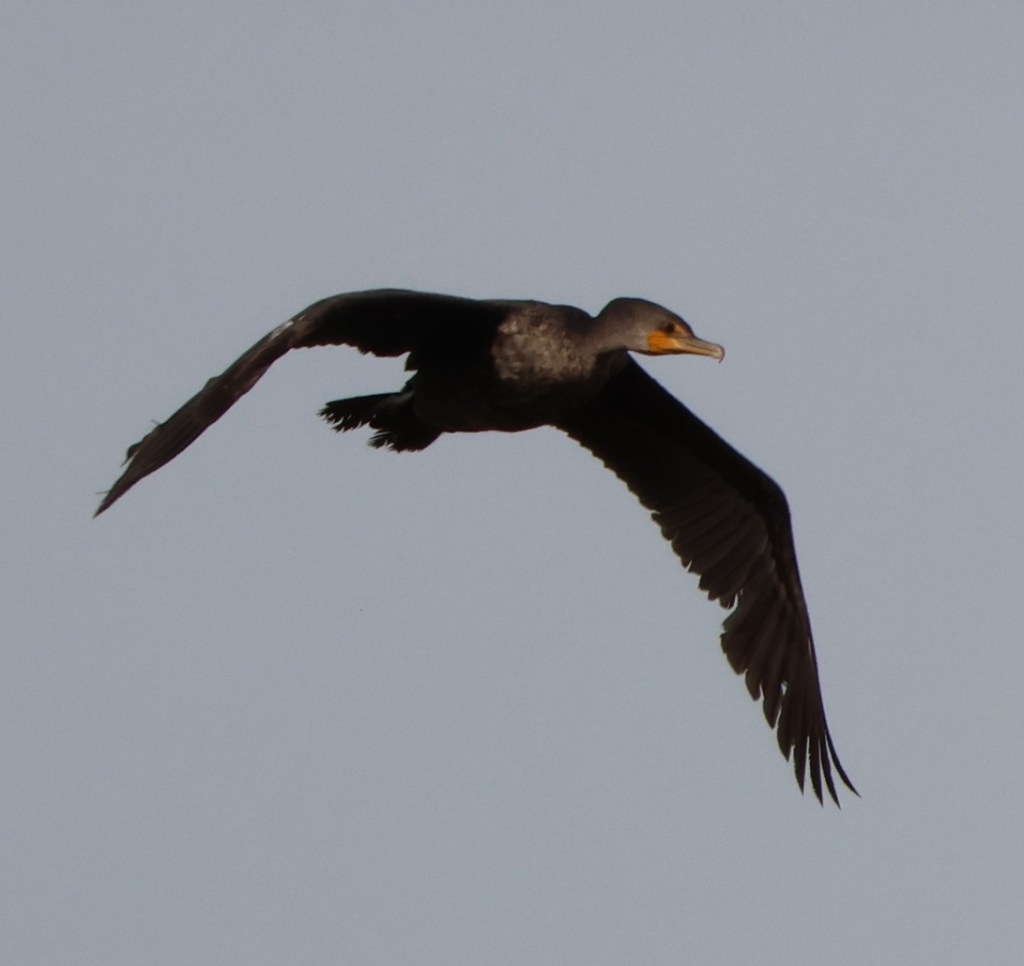
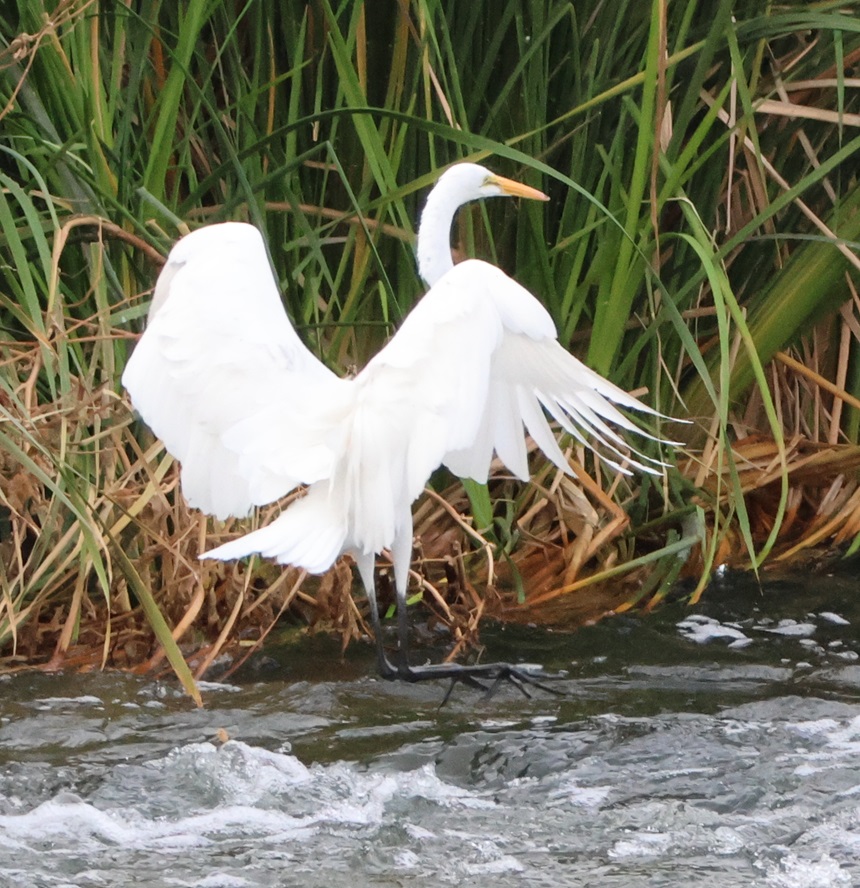
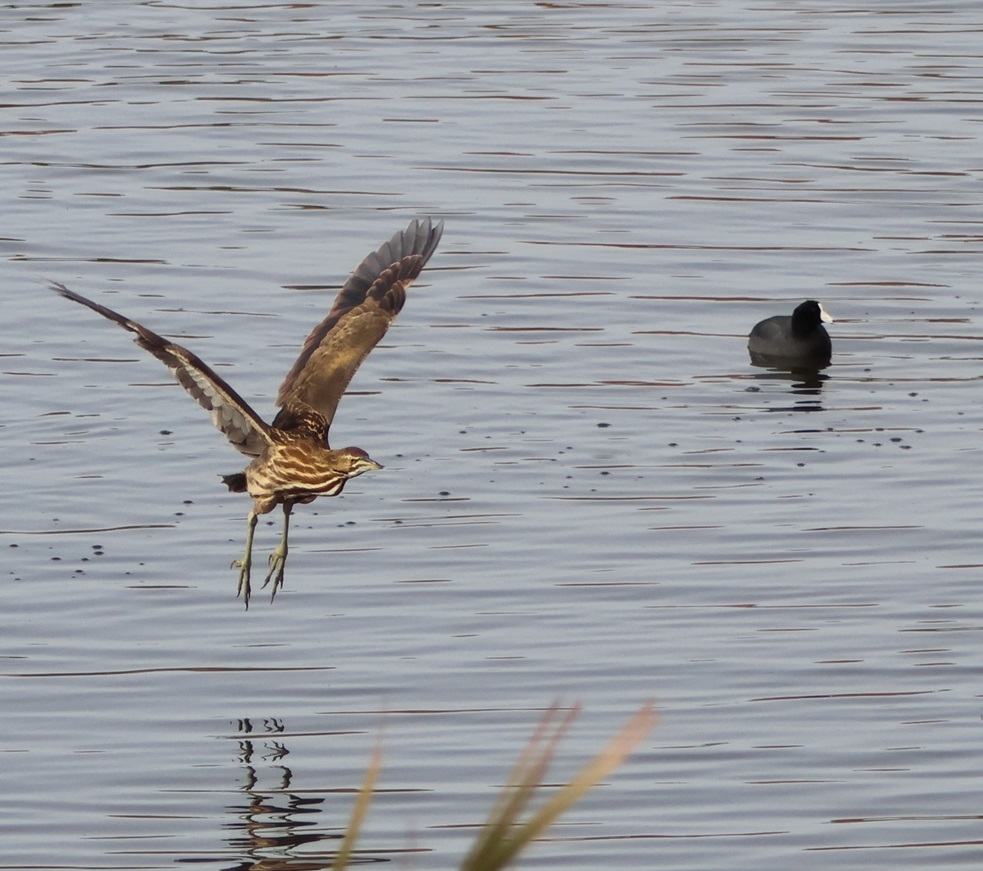
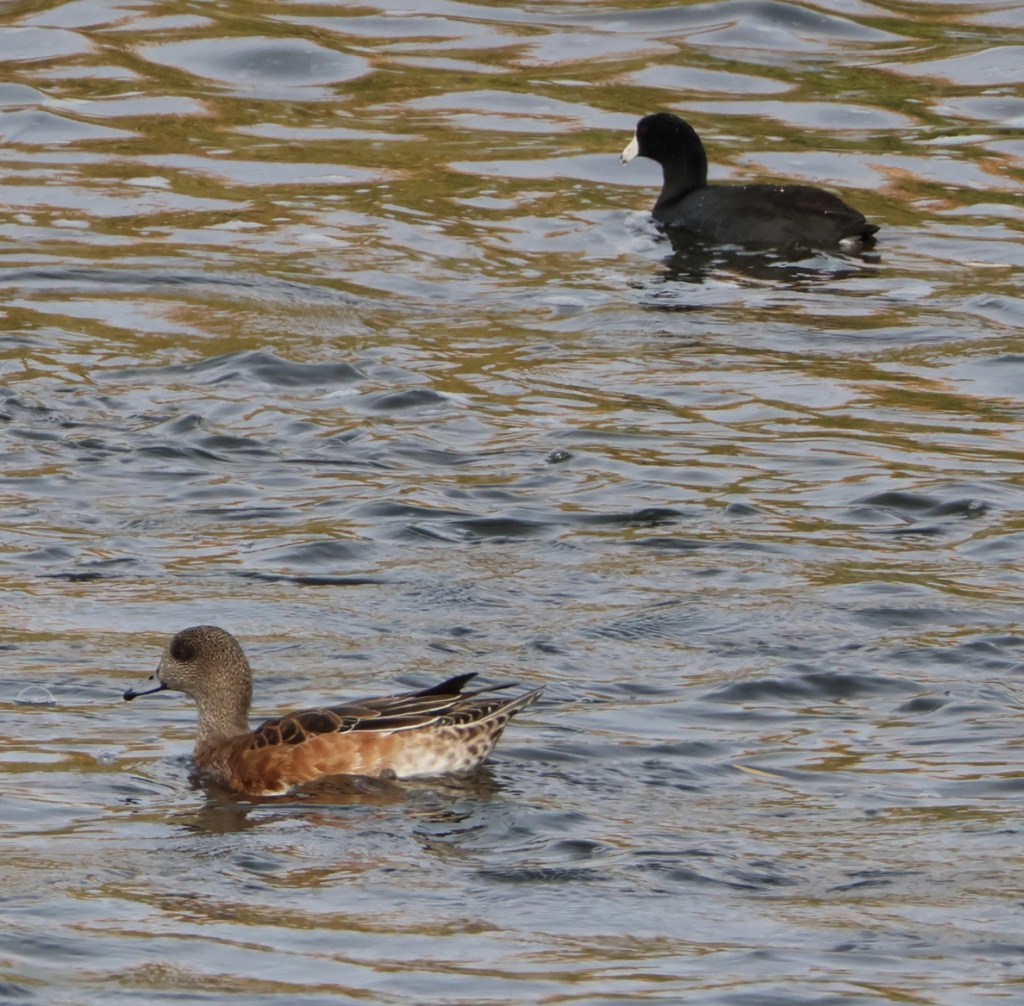
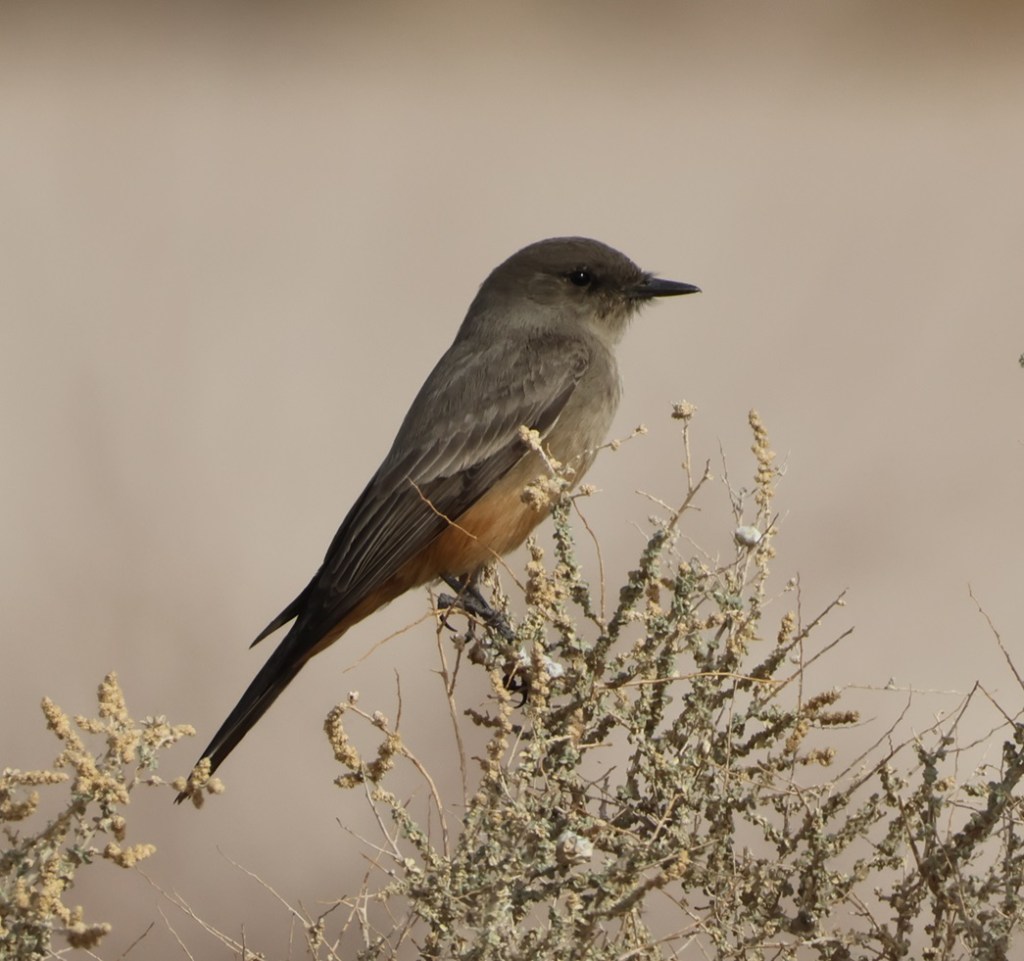
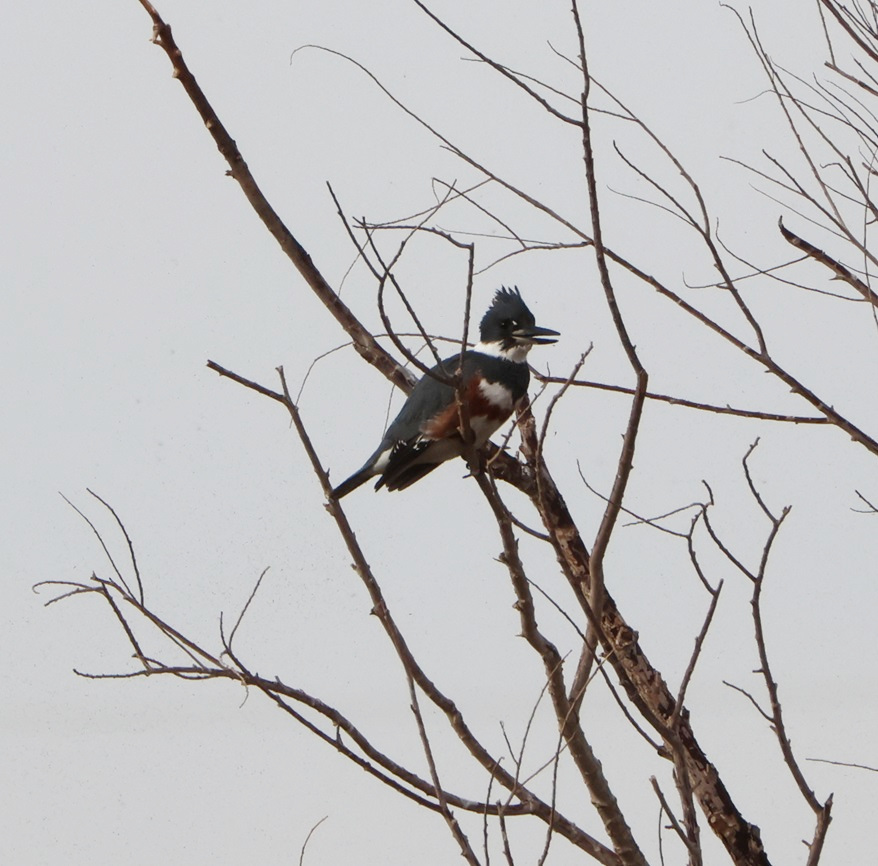
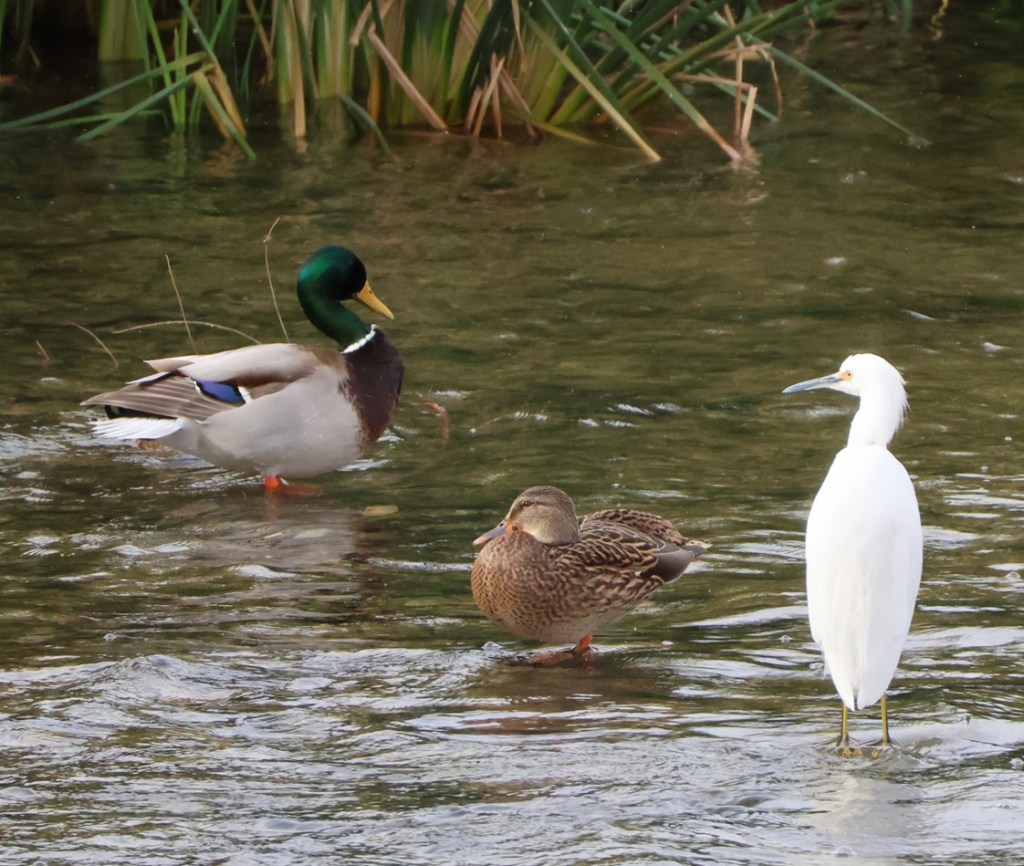
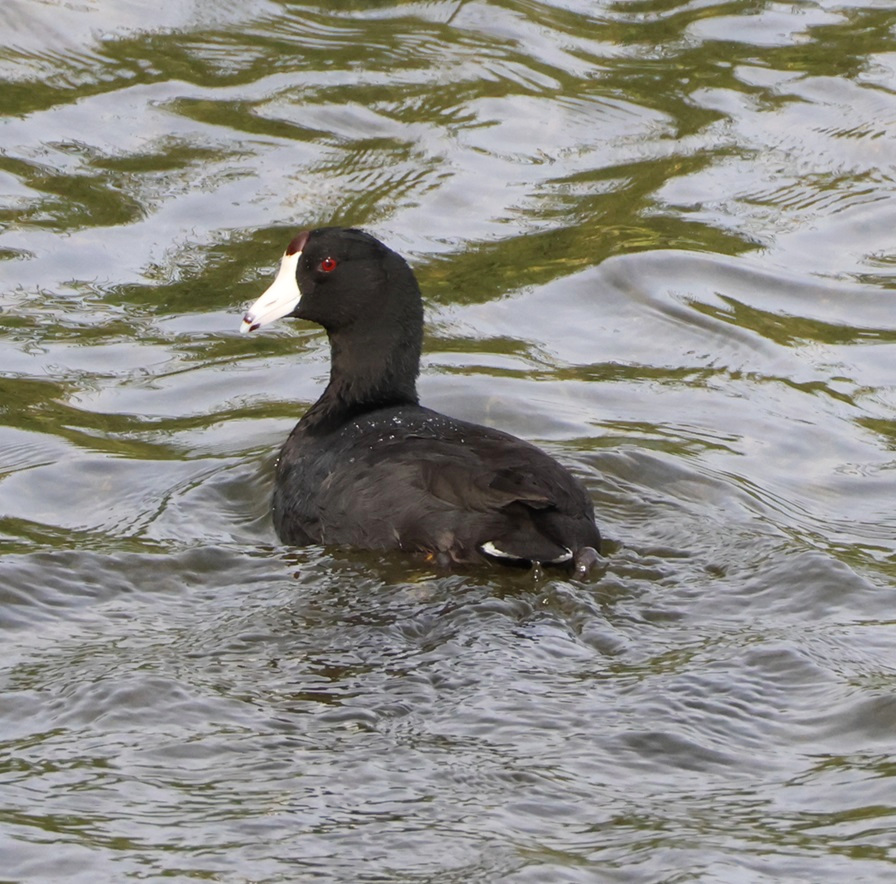
Here’s the first of the never-before-seen-by-us species: the Crissal thrasher (Toxostoma crissale). It’s very similar to a curve-billed thrasher, but the Crissal’s beak is even longer (and more curved, I think). This particular species prefers to stay on the ground, foraging for food, rather than fly about to fill its belly. In the United States, this bird is found only in the southern parts of California, Nevada, Arizona, New Mexico, and far western Texas. I usually avoid editing my pictures, other than cropping and re-sizing, but I decided to adjust the contrast on this one to bring out the bird better. The overcast conditions on the day we visited weren’t the best for photography, and many of the birds were far away (in the nature preserve, where, thanks to Gunther, we weren’t allowed. Thanks again, Gunther.)Happily, the sun happened to be out a bit more when we were on the bridge in Wetlands Park, and I got what I think are some pretty good photos. These ducks were far enough away that I didn’t know what species they were until we got back home and I could have a closer look at the images. This is another new-to-us species, the ring-necked duck (Aythya collaris). As is sometimes the case, the identification feature that’s in the name of this species isn’t really helpful in identifying it: the ring on the neck is very faint, and was probably more visible to early naturalists on captured birds. As a migrator, this species is found throughout North America in different parts of the year; during the fall, Minnesota lakes supporting beds of wild rice can sometimes have flocks of ring-necked ducks numbering in the hundreds of thousands. In this species, as with many other ducks, the male (right) and female (left) genders have remarkably different coloration most of the year (note the extreme difference even in their eye color). As was pointed out to me a few days ago by a full-time resident of this campground, the females of many bird species have to stay more camouflaged to protect the young hatchlings (in that case, we were talking about hummingbirds, but it’s true for many bird species). We’ve had the opportunity to see plenty of double-crested cormorants (Nannopterum auritum), especially at St. Vrain State Park in northern Colorado, but they were usually swimming. For some reason, there were a lot of cormorants on the wing this day at Wetlands Park. This one is showing off its wingspan, which can get to four feet long. Interestingly, despite being a water bird, cormorants do not have waterproof feathers – it’s why they’re often seen on shore with their wings spread. I recently listened to a very interesting audiobook about the Cretaceous-Paleogene Extinction Event, in which an asteroid struck the Earth 66 million years ago and brought the Age of Dinosaurs (mostly) to an end. The author consistently mentioned, though, that only non-avian dinosaurs, or those reptiles that couldn’t take to the air, were made extinct. I’ve mentioned it before, but double-crested cormorants (the white crests appear above the eyes of adult birds only during the breeding season) are one of the best reminders that, in an indirect way, avian dinosaurs still populate the earth.I’ve long been struck by how majestic and powerful most birds look when viewed from the side, or perhaps a three-quarter angle, and how they don’t look at all majestic and powerful when viewed face-on. This is a great blue heron (Ardea herodias), which spent a considerable amount of time among the reeds on the hunt for small fish.The angle makes all the difference: same exact bird. Great blue herons are a lot of fun to watch – they’re very patient while hunting and move almost imperceptibly, but then strike lightning-quick to pull fish from the water. If you look away for a moment, you may have missed all of the action. GBHs grow to a height of almost 4.5 feet and can weigh 5.5 pounds, with wingspans measuring more than 6.5 feet.I originally thought this was a snowy egret (and thus a lifer), but when editing the photo for this posting I realized that its beak is all yellow and its legs are all black (and it’s overall bigger than a snowy egret, which have black beaks and yellow legs). Thus, it’s a great egret (Ardea alba), which we’ve seen plenty of times elsewhere but are still very gratifying to watch. This bird is the symbol of the National Audubon Society, which was created to save this species and others from extinction. Because of their white brilliance, the feathers of great egrets were once valued as decorative accessories for people. This one was just taking off from creekside of the Las Vegas Wash, affording a good view of its feet just above the water. Again, this bird was far enough away while I was photographing it that I wasn’t really sure what species it was, but upon getting home and reviewing it on a bigger screen I discovered that it is an American bittern (Botaurus lentiginosus). This, the third of the “lifer” birds for this walk, was flying about the wash looking for a good place to land. They weigh between 13 and 17 ounces (just over a pound), with a three-foot wingspan. In true Vegas style, we were lucky to see this bittern while on the wing; this species is somewhat rare to observe in the wild because it takes advantage of that striping pattern on its neck and chest to hide motionless among reeds and other tall waterside plants while hunting. American bitterns, also migrators, are found from central and southern Canada down into Mexico at different parts of the year. During the winter months in North America, this species is found only in the extreme southern parts of the southern states and along the eastern and western seaboards. That’s an American coot on the right. We’ve seen American wigeons (Mareca americana) before as well, most memorably near Willcox, Arizona, but it was good to see another one near Las Vegas. We didn’t see any wigeon drakes; only this hen; drakes have a green head and a white crown. Wigeons’ bills are shorter and more goose-like than those of other dabbling ducks, and for that reason more of their diet is plant-based than those of other duck species. That’s an American coot on the right.Compare this egret to the great egret pictured above: notice the black beak and the yellow feet of this one? That’s right: it’s a snowy egret (Egretta thula), and thus the final lifer of the day! Another difference between the two species is their size: great egrets can grow to a height of just over 40 inches and a weight of 35 ounces, while snowy egrets only grow to about 26 inches and a weight of 13 ounces. Regrettably, and although I waited for what seemed like a reasonable time, no American coots made their way into the background of this photo.The “wetlands” aspect of Wetlands Park ends pretty abruptly; in fact, within just a few feet of the water’s edge, the landscape reverts back to extraordinary desolation. The Las Vegas area is in the extreme northeast corner of the Mojave Desert, 54,000 square miles of a dry and sparsely vegetated area that also includes Death Valley. The desert gets between 2 and 6 inches of rain each year, and summertime temperatures regularly climb into the 120-degree-Fahrenheit range. Still, there’s plenty of opportunity for my favorite desert plant, creosote, to grow (although these are, by far, the lowest-growing creosote bushes I’ve ever seen). We’re facing away (east) from the Las Vegas metropolitan area in this view. Yonder, about 20 miles beyond those picnic shelters, lies Lake Mead.Nancy was the first to spot this Say’s phoebe (Sayornis saya) as it flitted about in the shrubbery to our left (well, if Gunther saw it first, he sure didn’t point it out to me). The bird seemed to want to follow us down the trail for a while, giving me plenty of opportunities to snap its picture. These birds are found only in the western United States and Canada, and most of Mexico. They’re actually fairly gregarious, as birds go, and will often roost in buildings. Their diet consists mostly of insects. It’s possible that their name will change sometime in the future: there’s a movement in the birding community to re-name all birds that are named after individuals because it turns out that some of the individuals for whom birds have been named after were not themselves very nice people. Dunno if that’s the case for American naturalist Thomas Say (1787-1834); I do think that individual names are on their way out just for consistency’s sake.The walk that Nancy and Gunther and I were on was a balloon loop, in which you start walking and sooner or later make a left or right turn, then keep walking until you get back to the point at which you made a turn (completing the loop) and then walk back to the start of the hike (completing the “string” of the balloon). This allowed us to make a repeat visit to the bridge under which the Las Vegas Wash ran, and gave us another opportunity to see birds attracted by what the water makes possible – basically, fish and bugs and waterplants. The overcast and hazy conditions of the day were already pretty bad, and the mid-afternoon sun was fading, too, but I did get a few pictures of this belted kingfisher (Megaceryle alcyon) perched over the wash. This photo, too, has been edited to bring out the contrast and colors of the bird. This photo still isn’t that great; the white spot above the kingfisher’s bill is just that: a white spot, and its eyes are black and above and just behind those spots. We’ve seen exactly two belted kingfishers, which is a flying marvel of a waterbird, since we became full-time RVers a little over three years ago. Both of them were seen in Las Vegas, which averages about four inches of rain each year (we saw the other one last winter at another wildlife preserve in Las Vegas proper; I’ll get around to writing about that super-cool place someday). Water really is a crucial aspect of wildlife diversity. We were highly fortunate to see this one actually fishing; it’s an laccomplished flyer and is capable of quickly diving down to the water to catch fish and crawdads with that magnificent bill.We’re nearly to the other end of the bridge now, and running out of water in which to see waterbirds. The ducks to the left, of course, are mallards (Anas platyrhynchos), including the drake at far left and the hen in the middle. Mallards are found all over North America, Europe, and parts of Asia and even Africa. I read recently that domestic ducks (the familiar white ducks of many a barnyard) are domesticated from the mallard species, and the mallard genome is so prevalent in ducks that it’s prone to cross-breeding in wild populations that some species struggle to remain distinct. This lovely couple gives a good size perspective on the snowy egret at right – they’re really not very big, are they?Alright, alright … one more bird before we leave the waterway. This is the fabulous American coot (Fulica americana), which, although it floats like a duck is more closely related to sandhill cranes than anyone in the duck family. I wasn’t going to include this, but there were (obviously) about three kajillion coots on the Las Vegas Wash that day and it doesn’t seem right to exclude an exclusive photo. This is, incidentally, the best picture of a coot I’ve ever taken; their black color and tendency to hide amongst water plants makes them difficult to photograph well. This was probably the biggest bird we saw during our walk. It’s hard for me to resist taking pictures of aircraft flying overhead, even while enjoying the serenity of nature. This is a Boeing 737 Max 8, registration number N17341 and operating as United Airlines Flight 1981, shortly after its scheduled departure from LAS (Harry Reid International Airport) at 2:05 PM Pacific time, with scheduled arrival at EWR (Newark Liberty International Airport in New Jersey) at 9:59 PM Eastern time. N17341 saw a lot of the country on December 28: it left Charleston International Airport (CHS) in South Carolina at 6:00 AM Eastern, flying first to EWR, then flew cross-country to LAS, then had this flight back to EWR. More than 1,050 flights arrive at and depart from LAS every day; it’s the country’s eighth-busiest airport.
The next couple of photos aren’t from the Las Vegas Wetlands Park walk – they’re ones I took in our campground in which we’ve been staying the winter. There’s not necessarily a lot of variety of birds here, but they’re still fun to keep an eye out for.
I often see this little dude, a male Anna’s hummingbird (Calypte anna), when Gunther and I are visiting our campground’s dog park in the mornings. While Gunther is attending to his business, I look to this same little branch on this same little tree, and about half the time he’s there, just about 10 yards from the dog park’s fence. The legs of all hummingbirds are so small that the birds can neither walk nor hop on the ground or on a branch. They, like all hummingbirds, are tiny: Anna’s have all the volume of a ping-pong ball and the all the mass of a shiny U.S. nickel (between a tenth and two-tenths of an ounce). As small as they are, they’re powerful fliers: males can soar up to 130 feet in the air. This species of hummingbird, one of 360 in the world, is found year-round in the Las Vegas area, as well as the western halves of California, Oregon, and Washington. Say, that reminds me: I’ve recently learned the German word for “pineapple” is “Ananas,” so the imperativ (command) for “Anna, eat pineapple!” in German is “Anna, esse Ananas!”Here’s another reminder that we share this planet with dinosaurs’ descendants: imagine the slashing terror of these razor-sharp talons, the brute strength of these powerful claws, the raw crushing horror of …… a rock pigeon (Columba livia), which is found year-round all over North, Central, and South America, and the campground in which we are spending the winter.Gunther thanks you for joining him (and Nancy and me) on this Las Vegas Wash adventure, and hopes you have a healthy and happy 2025 filled with lots of fun walks!
Here’s a list of the birds (not all are pictured above) we saw at Wetlands Park; it was one of the more successful birding walks we’ve ever enjoyed, and just a fun way to spend an afternoon in The Entertainment Capital of the World.
I’ve been reading “Riders of the Purple Sage,” one of Zane Grey’s early books that helped shape the Western novel formula. Publishing the book in 1918, Grey (1872-1930) was inspired to write a Western story after reading Owen Wister’s “The Virginian” (1902). It would be the most popular of Grey’s 90 books (it’s estimated that he wrote 9 million words in his career). Later prolific western authors like Max Brand and Louis L’Amour were heavily influenced by Grey; L’Amour himself wrote 89 novels and 14 collections of short stories. “Riders of the Purple Sage” has been adapted for film five times: in 1918 and `1925 (both were silent movies), 1931, 1941, and a 1996 TV movie starring Ed Harris and Amy Madigan (who have been married to each other since 1983).
Although I’ve read “The Virginian” and lots of Louis L’Amour’s books, I’ve never read a Zane Grey novel (my only point of reference to Grey was knowing that Colonel Sherman Potter of the 4077th Mobile Army Surgical Hospital was a big fan). I’ve been struck how, in “Riders of the Purple Sage,” Grey deftly describes the canyons, mesas, and flatlands of southern Utah, the setting of the book. The characterization and dialog in the book are definitely of their time, but the story itself is pretty exciting and Grey was quite skilled at painting, in words, how the incredible scenery of the region appears.
Reading “Riders of the Purple Sage” reminded me of when we were in southern Utah and northern Arizona for an extended visit in 2023. We’d planned to stay in Fredonia, Arizona, for four weeks so that we could visit a couple of national parks and monuments in the region. Mechanical issues with The Goddard, our fifth-wheel trailer, extended our stay for an additional week. We were unable to lower the front jacks of our trailer, which meant that it had to stay hitched to the six-wheeled towing unit. A very competent RV technician was able to help us manually lower the jacks and we were able to unhitch our F-350, and he later fixed the jack-lowering issue (turns out a rodent probably chewed through a wire while we were camping at the south rim of the Grand Canyon; lesson learned is to never go to the Grand Canyon again). At any rate, our extended stay while waiting for RV parts was a fortunate one as we were able to visit the north rim of the Grand Canyon, which, due to snow, didn’t open until early June that year.
This post, however, is not about either rim of the Grand Canyon but rather a manmade lake in Utah. Our campground was in Fredonia, Arizona, about four miles south of the Arizona/Utah border. We spent quite a bit of time in Kanab, Utah (itself about four miles north of the border), partly because we found a reservoir near Kanab that offered great hiking and birding opportunities. We visited the lake three times in late May and early June, and this post has pictures from all of those excursions. We saw lots of different species of birds, and we were fortunate to have timed our visit for some pretty impressive displays of blossoming plants.
The average depth of Jackson Flat Reservoir is only 28 feet. It’s primarily a holding reservoir for irrigation water, but the lake receives plenty of non-motorized boating, hiking, swimming, fishing, and stargazing enthusiasts. The sage in this photo isn’t purple like in the Zane Grey book, but maybe it’s due to the time of day that I took the picture.
Jackson Flat Reservoir, located between Kanab and the state line, had been in its planning stages for nearly two decades when construction began in 2010. The reservoir meets local agricultural irrigation needs, and is also a wonderful boating, swimming, and hiking destination for Kanab residents. Built to a capacity of 4,228 acre-feet, the reservoir attracts a large number of waterfowl and other birds to southeast Utah.
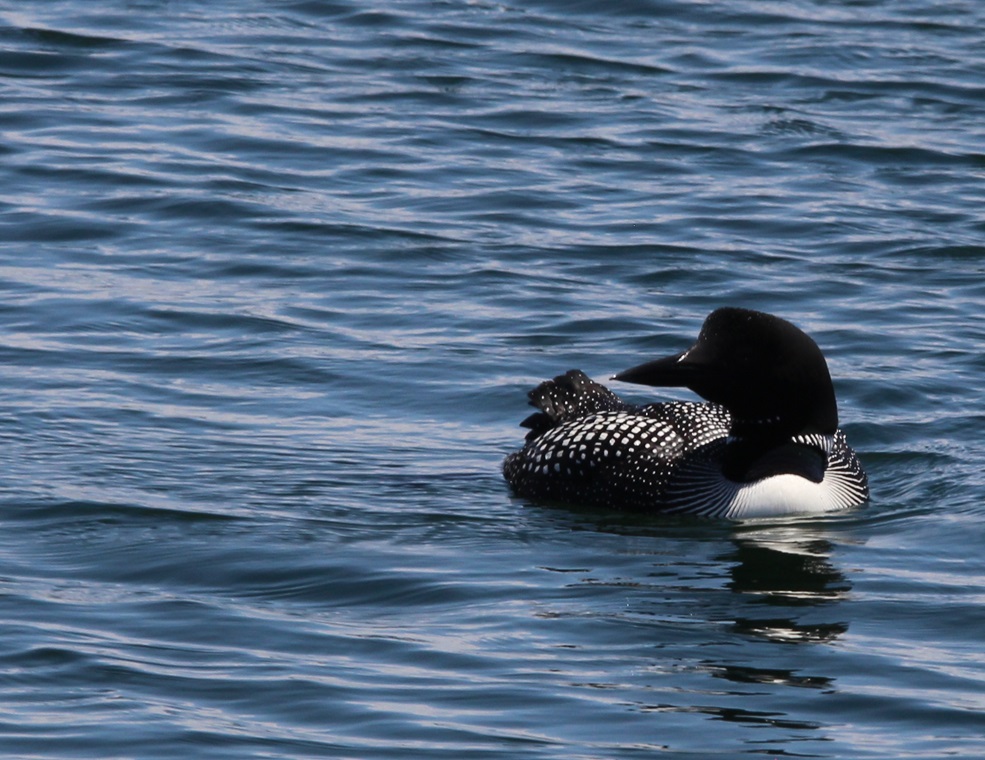
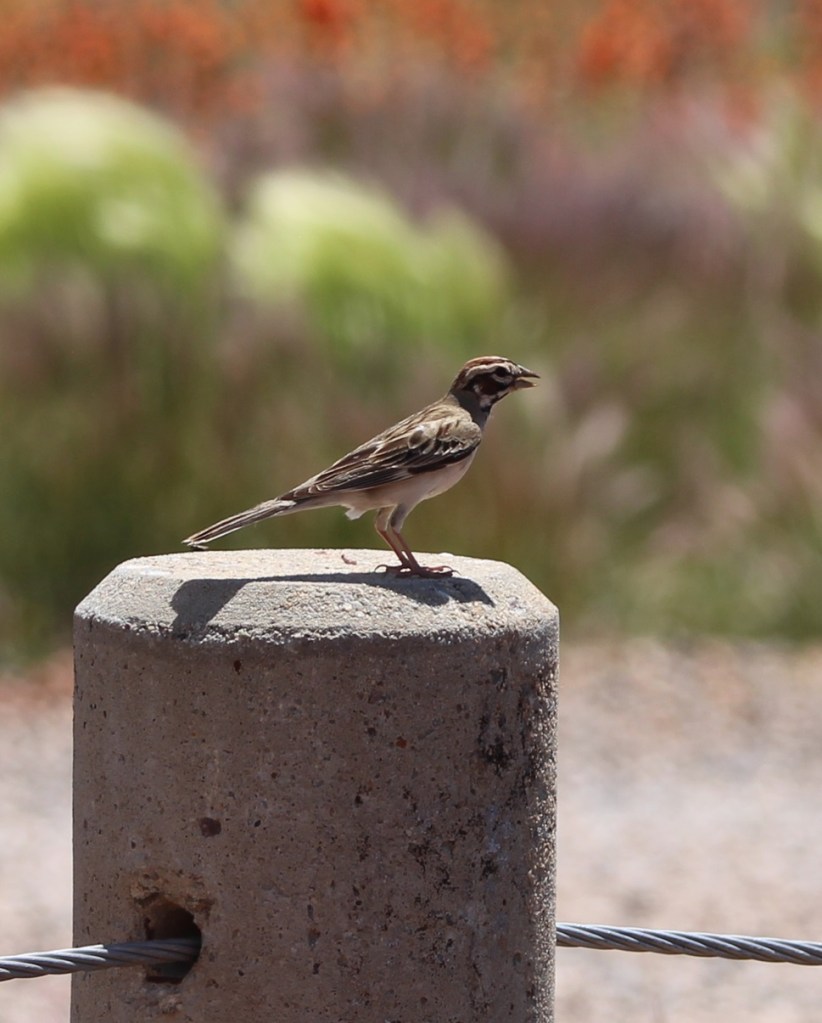
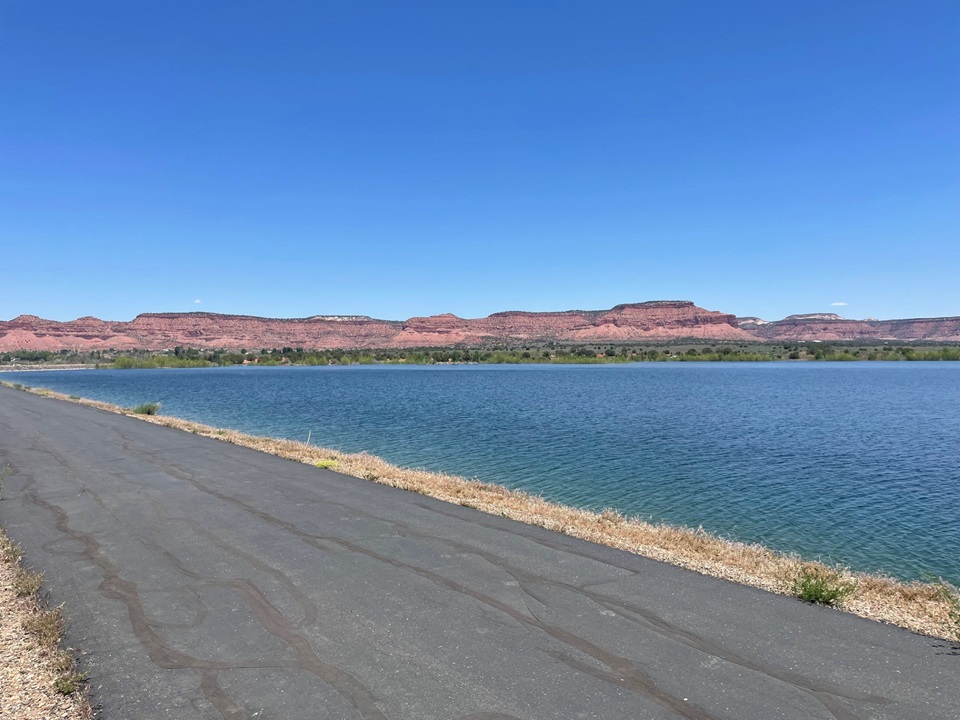
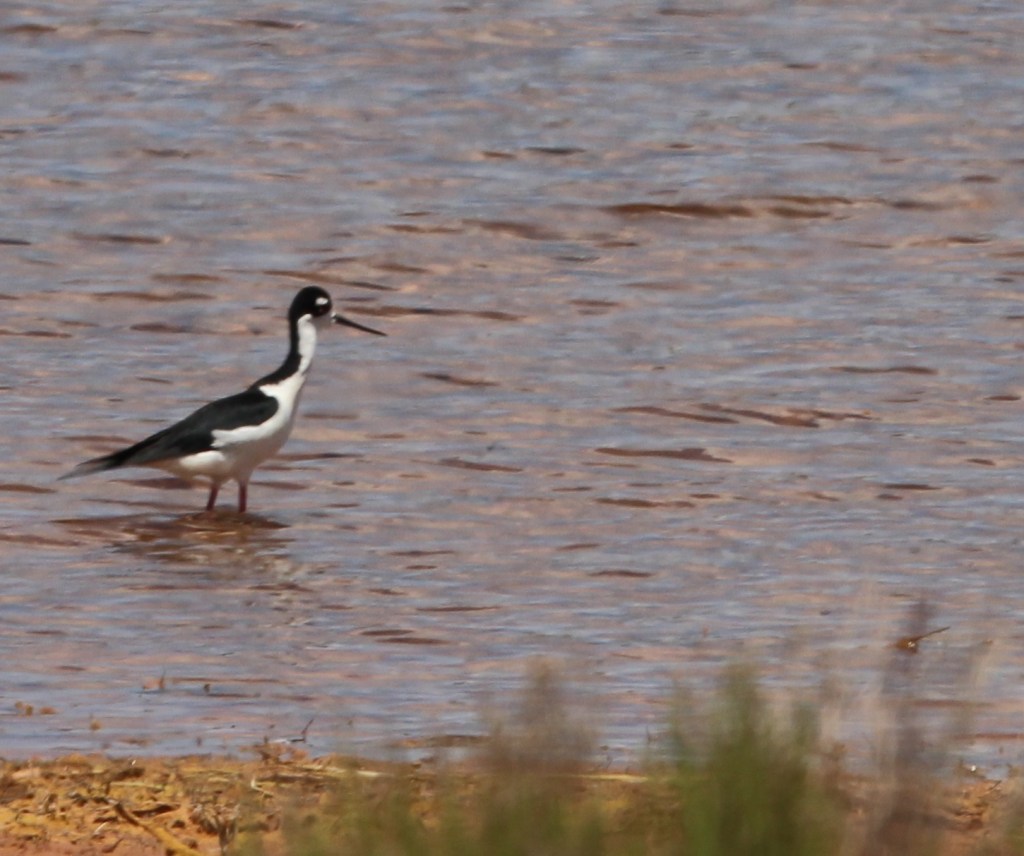
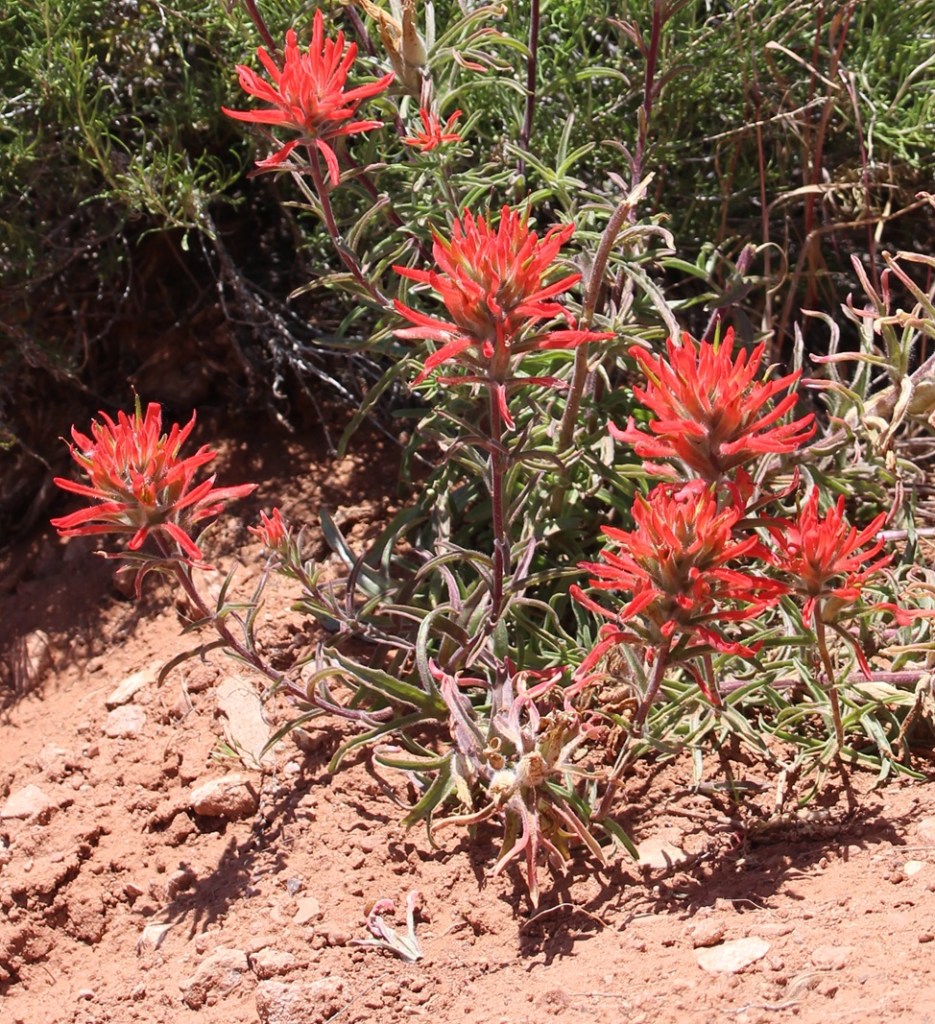
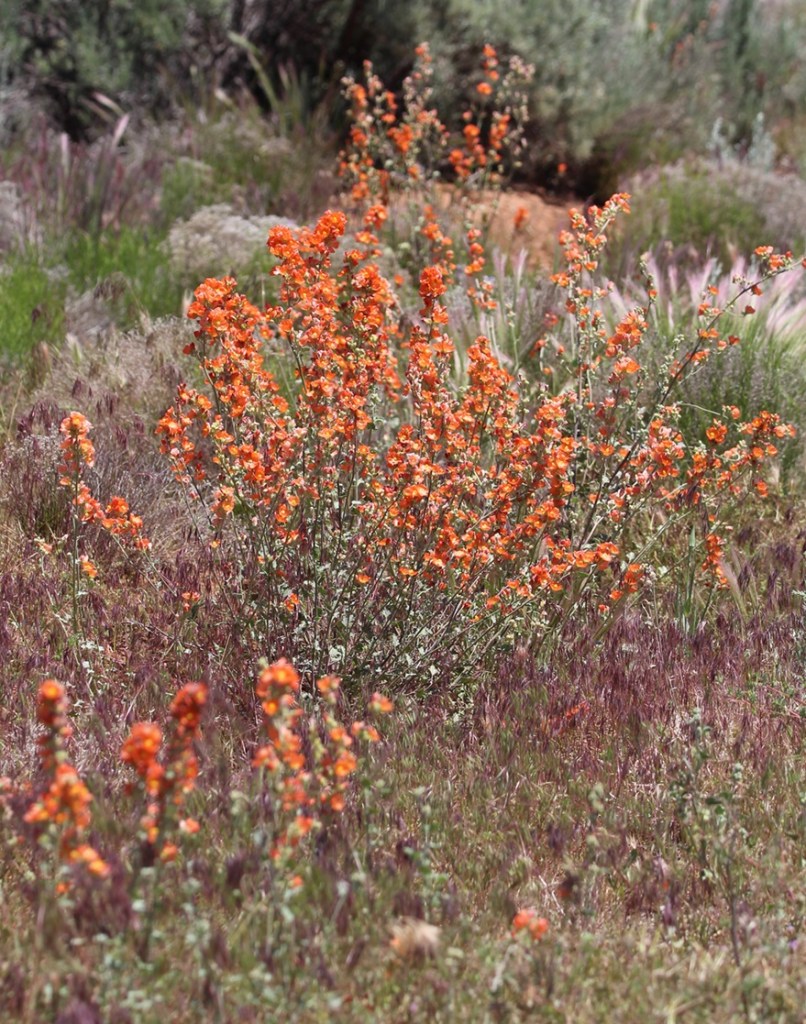
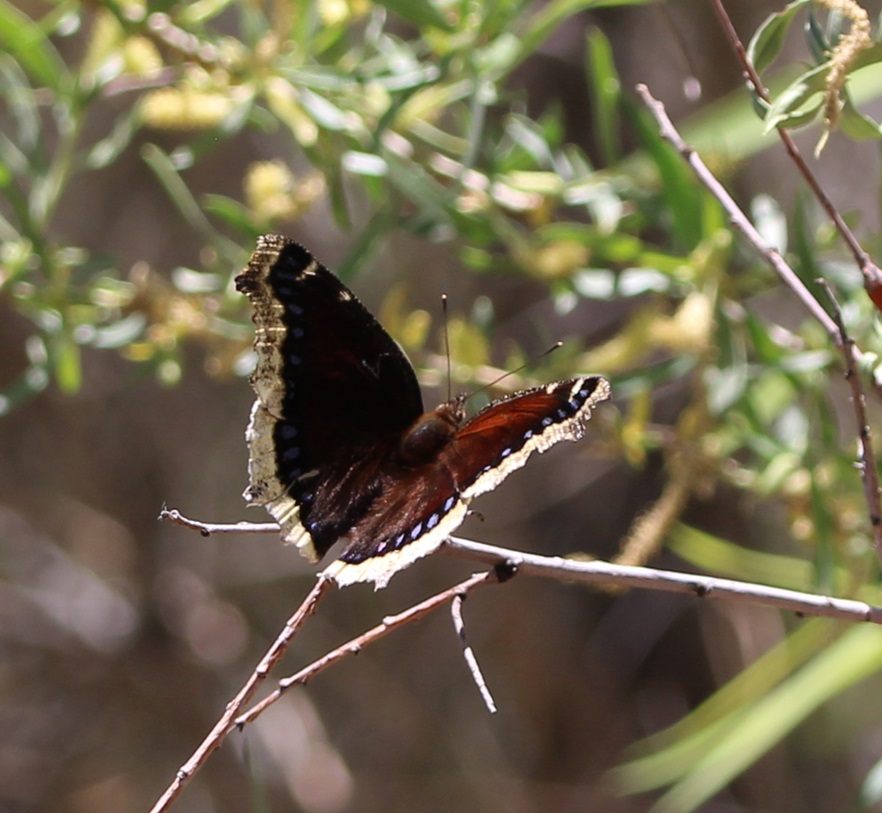
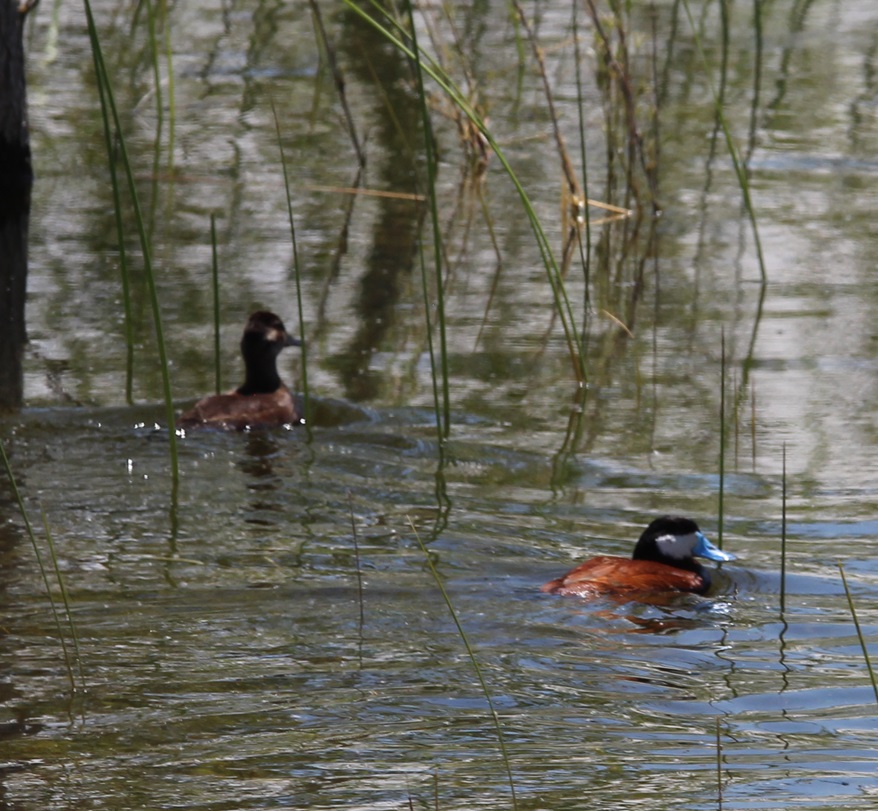
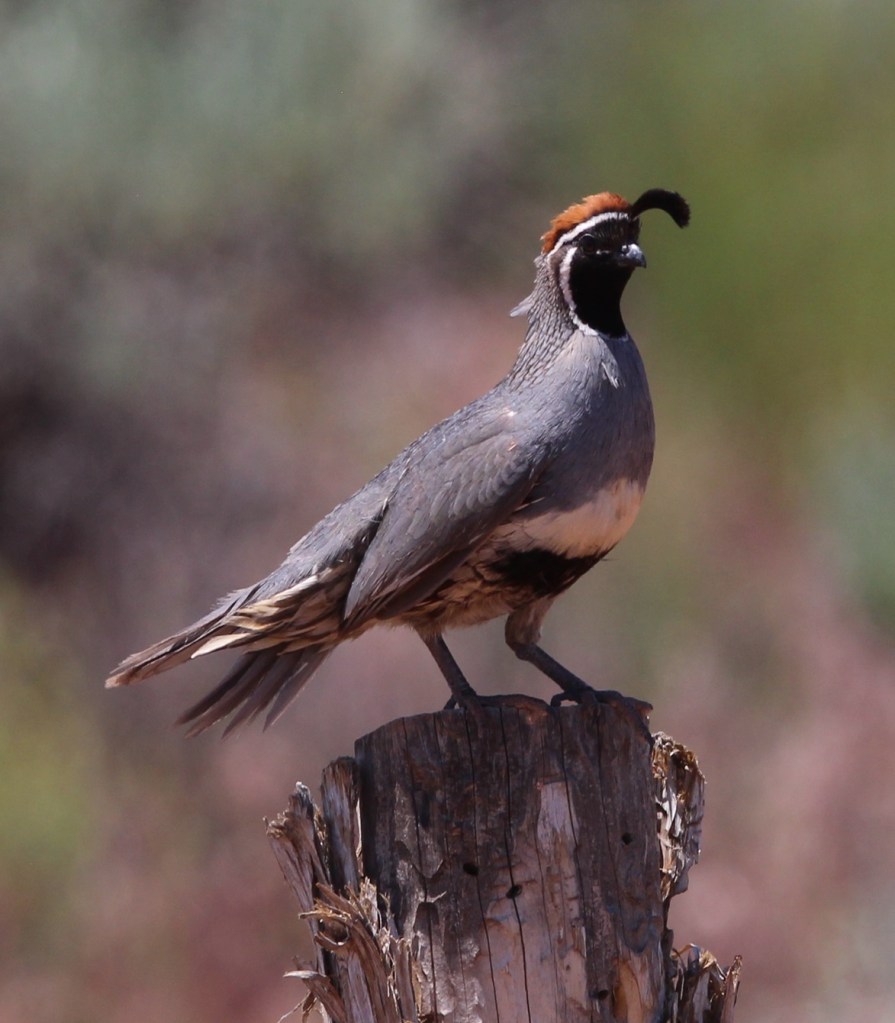
Birds with predominantly black coloration are frustratingly difficult to photograph unless the lighting is just right; I really like the pattern on this common loon (Chondestes grammacus) so I decided to include the picture in this posting. Nancy and I watched this bird for quite some time; it would disappear under the water for up to a minute at a time, and it was kind of fun to guess where he’d pop back up. Their diet consists mostly of crustaceans and small fish. Common loons are found all over the United States – it’s likely how they got their name.Writing of “common,” here’s a common raven (Corvus corax) behind a juniper bush, looking much like a Muppet. True to their name, these birds are the most common of corvids (a family of birds that also includes crows, magpies, and jays), and, weighing in at 3.2 pounds at maturity, they are the largest of the passerine order (basically birds that perch, about half of the species on the planet). On our walks around the lake, we saw several ravens being chased in the air by red-winged blackbirds that were presumably defending their nests.Writing of which, here’s a red-winged blackbird (Agelaius phoeniceus) patrolling water’s edge. “But Ken,” you might think to yourself, “this bird is neither red-winged nor black.” I would agree with you, and likely add that it looks like one of the 70 million species of brown-colored sparrows. This is, however, a female red-winged blackbird, which do not have the black color and red wing markings of the males of the species. You can differentiate a female red-winged blackbird from a sparrow by looking at the beak: it’s much more pointed and angular than say, …… the beak of this brown-colored sparrow. This is a lark sparrow (Chondestes grammacus), a species we seemingly see sparingly, but is actually fairly common and distributed throughout most of the United States and Mexico. To remind us that we were in an arid desert environment, there were several varieties of cactus growing around the reservoir. This is tulip prickly pear (Opuntia phaeacantha) featuring riotously vibrant colors on its blossoms. Whenever I see bright colors like this on flowers, or a bird, or a tropical fish, I think, “There’s a color not found in nature.” But they are literally found in nature. This is the road over the dam of Jackson Flat Reservoir, with the cliffs of southern Utah in the distance. The Grand Staircase-Escalante National Monument’s western border is just to the right edge of this photograph. The reservoir’s dam contains 800,000 yards of dirt and rocks. One thing I like to do when seeing a reservoir’s dam is to cry out “Dam!” I wonder if Nancy ever gets tired of me doing that. I should probably ask her sometime. We see a lot of dams.Some of the waterfowl we saw were far away from the trail that goes around the reservoir. This was a new species to us, so I decided to include it even though it’s a terrible photo. This is a black-necked stilt (Chondestes grammacus). It’s found in the western United States and down into Mexico, and in quite a bit of South America as well. They are about 15 inches tall, with long pink legs and a wingspan of close to 30 inches. Like other shorebirds, black-necked stilts use their long bills and beaks to feed on freshwater shrimp, as well as crayfish and small fish. Species like these have no business being in the arid desert of southern Utah, except for the existence of Jackson Flat Reservoir – it’s a great benefit to area residents to be able to see birds like this.Indian paintbrush has long been one of my favorite wildflowers. There are more than 200 species of this plant; I’m pretty sure this is Wyoming Indian paintbrush (Castilleja linariifolia), which is the state flower of … Wyoming.THIS IS A TALES OF THE GODDARD LIZARD ALERT. Movement at the side of the trail around the reservoir attracted our attention to this western fence lizard, a very common reptile in the western United States. Note the blue patch on his throat; that blue shading also extends to his stomach (I’m guessing; I didn’t pick this rascal up to check) and leads to another name for the lizard: the bluebelly. There are five subspecies of western fence lizards; they have a SVL (snout-vent length) of 2.25 to 3.5 inches.As I wrote earlier, we happened to time our visits to Jackson Flat Reservoir when many flowering plants were blossoming. The flowering of this plant, desert globemallow (Sphaeralcea ambigua), lasted throughout our entire stay in the region: it was everywhere. It generally grows to a height of three feet, and is host to the caterpillar stage of a number of butterfly and moth species.Writing of which, here’s a butterfly species called the mourning cloak (Nymphalis antiopa). This butterfly is found in both North America and Europe. Because it feeds on sap from trees and shrubs, it’s not a significant pollinator.Back to birds: here is a couple of double-crested cormorants (Nannopterum auritum), contemplating a cooling dip in the waters of Jackson Flat Reservoir. Although they are definitely water birds, their feathers are not waterproof and they are often seen standing on the shore with their wings spread out in order to dry off. Their diet is exclusively fish-based.One of the facets of birding that I really like is the opportunity to see pairs of a particular species. The males and females of many species are often seen close together, and you get the opportunity to see how the two genders differ in appearance. This is a pair of ruddy ducks (Oxyura jamaicensis), easily identified by the male’s bright blue bill which only appears that way during the summer months (it’s gray the rest of the year).There are a number of really distinctive-looking birds of which I’d only seen pictures or video footage of, but never in real life until Nancy and I started full-time RVing. I’ll never forget seeing a wood duck in real life for the first time (at a state park in Albuquerque, New Mexico), or a scarlet tanager (at a campground in Tucson, Arizona), a common loon (on a lake in western Michigan), a northern cardinal (at a campground in Oklahoma) or a greater roadrunner (at a campground in Albuquerque). I’ve now seen all of those species several times in the last three years, but it’s always a thrill to see them again. The Gambel’s quail (Callipepla gambelii) is another of those birds: I first saw them at a regional park outside of Phoenix, Arizona, and I’ve seen them many times since then, but it’s still really fun to encounter them because of their distinctive appearance. This species is native to the American Southwest, and is also found in parts of Colorado and Texas.Gunther found this lovely stand of desert mallow on a walk near our campground in Fredonia. During our stay in northern Arizona, we saw about 50 kajillion of these flowers; at times, the landscape looked like a sea of pink-orange coral. But “Riders of the Pink-Orange Desert Mallow” doesn’t really have the right zing, and Zane Grey was probably right to title his novel the way he did.



















 Tales of The Goddard