13 miles south of Bowie, Arizona – February 6, 2022
Apache Pass is a natural low geologic divide in southeast Arizona separating the Dos Cabezas (Spanish for “two heads”; see more below) Mountains from the much larger Chiricahua (pr. “cheer-uh-cah-wah”) mountain range. Apache Spring, a year-round source of flowing water near the pass, is the main reason many thousands of people traversed the pass beginning in 1848 through the end of the U.S. Army’s conflicts with Native Americans in the mid-1880s. Horses and people needed water to keep moving, and Apache Spring was the only dependable source of water for many miles. From the end of the Mexican War in 1848 through the end of the Apache Wars (1862-1886), Apache Pass provided a corridor for travelers between El Paso and Tucson. Once the southern route of the intercontinental railroad was completed in 1880, the pass became less important for travelers and commerce since trains weren’t as dependent on water as horses were. Until then, Apache Pass was an important point in the expansion of the American west: many thousands of people and great tonnages of goods found their way to the West by traversing the pass.
Chiricahua Apaches lived in this area for many years prior to other cultures entering the Apache Pass region. The pass was identified by both Spanish and, later, Mexican forces during their respective control of the area in the 18th and early 19th centuries.
Many Anglos first used Apache Pass on their way to the California gold fields in 1849. In 1858, the U.S. Congress authorized the development of an overland mail route, operated by the Butterfield Overland Mail Company. In operation between 1851 and 1861, the Butterfield route took advantage of Apache Spring to water its horses.
Apache Pass was also the site of the Bascom Affair, a conflict between Chiricahua leader Cochise’s band of Apaches and the U.S. Army in 1861. The Bascom Affair was the beginning of a decade of conflict between the Chiricahua and the Army, and led to the development of Fort Bowie to protect travelers using the pass and spring.
In 1872 the U.S. government struck a peace accord with the Apaches, establishing the Chiricahua Apache Reservation. For four years things went pretty smoothly, but the Apaches began to flee the reservation and conduct raiding parties into Mexico; the military presence in the pass subsequently increased. Geronimo eventually surrendered to the Army in 1886. Between the removal of the Native Americans and the completion of the railroad, the need for the U.S. military in the pass disappeared. Fort Bowie’s last garrison left the fort in 1894.
Fort Bowie National Historic Site, declared a National Historic Landmark in 1960 and located about 35 miles from Willcox,, preserves some of the building ruins and other features of a U.S. Army outpost built in the 1860s to protect travelers using Apache Pass from Native American attacks. In addition to fort ruins, this 1,000-acre site also features a number of other interesting historical areas, all of which are accessible by a 1.5-mile hike from the parking lot to the site’s visitor center.
Nancy and Gunther and I visited Fort Bowie National Historic Site in early February. It was an immensely rewarding experience, from both a historical perspective as well as a natural history view.
The site is unique in that visitors are encouraged to hike 1.5 miles to the visitor center rather than simply driving to a visitor center parking lot and then hiking from there; it’s certainly possible to drive to the center and park, but you’d miss out on a lot of natural and historical points of interest.
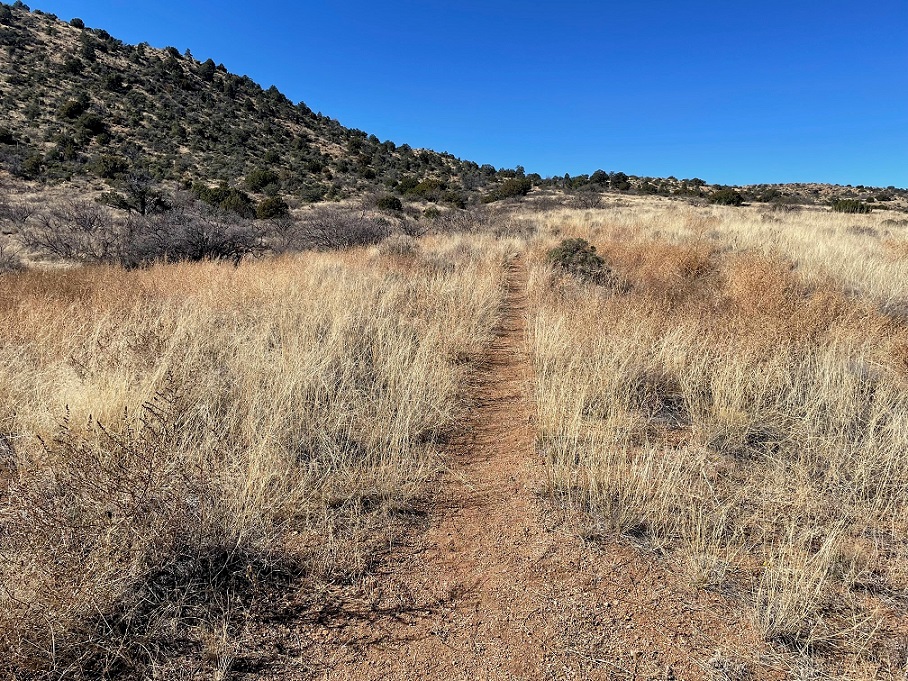
One of the first historic stops on the trail is this view of the camp site for a survey party led by Lt. John Parke of the Topographical Engineer Corps in March of 1854. The party, searching for an all-weather route for a transcontinental railroad, had marched 55 miles through the desert prior to reaching Apache Pass and the spring. The men rested at this spot for two days, enjoying both easy access to water and the companionship of the then-friendly Apaches. Parke would find an easier route for a railroad to the north of the pass, and the rail line was completed in 1880. The route, which passes between present-day Willcox and Bowie, is still in use today; there was puh-lenty of railroad traffic passing through Willcox while we stayed there.
The Bascom Affair
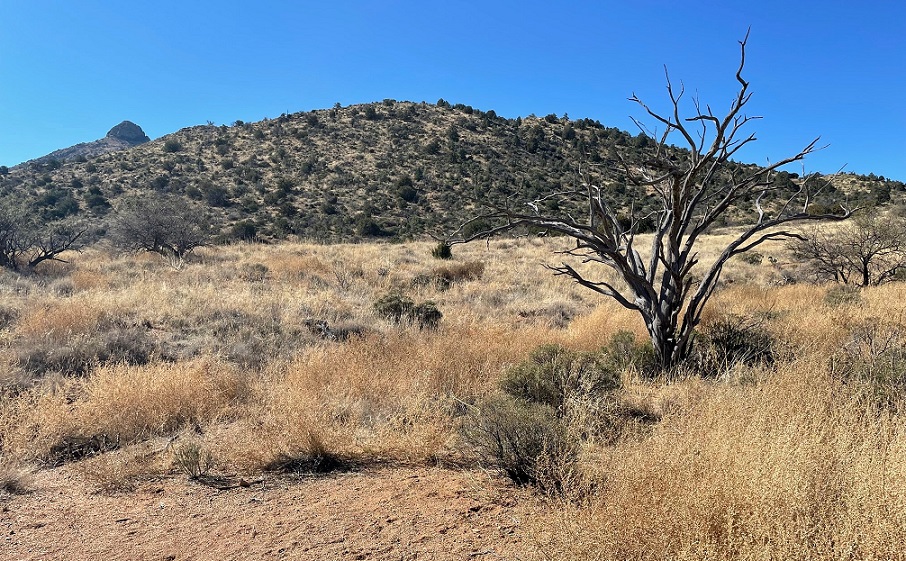
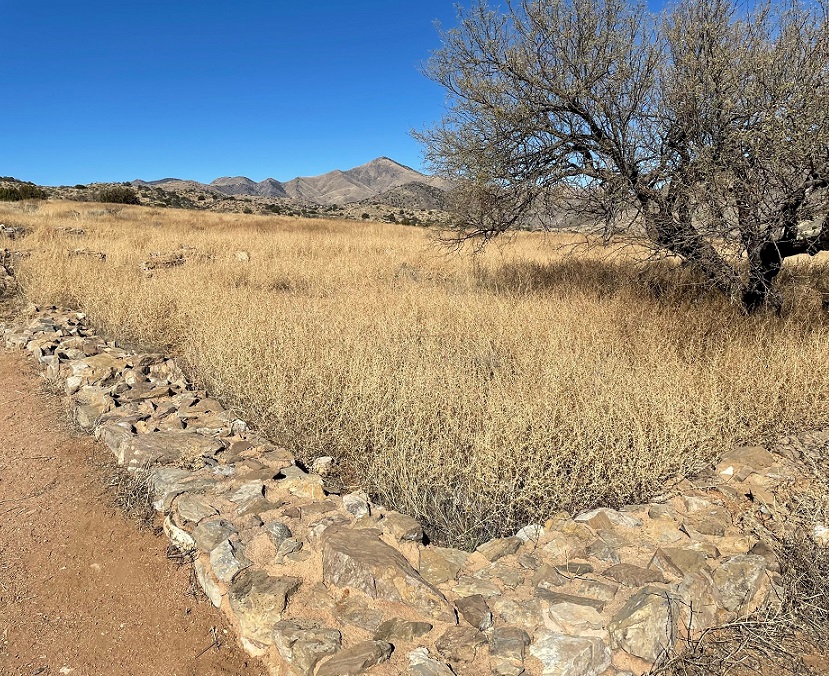
The next significant event, from an Anglo perspective, in the Apache Pass region occurred in January, 1861. A boy named Felix Martinez Ward was kidnapped by Apaches when the Native Americans raided the Ward family ranch. Lieutenant George Bascom was put in charge of the U.S. Army’s effort to find the boy. Bascom arrived in the Apache Pass area on Feb. 4, 1861, with a detachment of 54 men and camped in the area shown above. Cochise, the famous Chiricahua Apache chief, was invited to meet with Bascom. The young lieutenant accused Cochise of kidnapping Felix Martinez Ward, and Cochise denied the claim. Nevertheless, Bascom ordered that Cochise and his party be held hostage.The Bascom camp was just on this side of the hill shown above. Cochise escaped from the tent in which he’d been held and ran up the hillside. Cochise used a knife that he’d hidden to cut through the tent’s fabric; Cochise’s action is still remembered as “Cut the Tent” by the Apache today. The other Chiricahua, including members of Cochise’s family, were recaptured by U.S. forces. Bascom moved his detachment to a stage station nearby and fortified that building, apprehensive about what might occur during the night.These are the ruins of the Butterfield stage stop where Bascom and his soldiers sought refuge. Built in July 1858, the station had walls that reached up to 8 feet high. The morning after Cochise escaped, Apache warriors approached the station and told Bascom that Cochise wanted to talk. The meeting progressed for about half an hour before ending abruptly; one of the station workers had been captured by the Native Americans. Shots were fired and in the following weeks Cochise took more captives, attempting to exchange them for his family and other warriors held by the U.S. Army. Those talks failed as well, and Cochise killed the hostages; the Army retaliated by killing the Apaches in their custody.
The Bascom Affair ignited more than 20 years of conflict between the Chiricahua Apache and the United States government. Significantly, Felix Martinez Ward had indeed been kidnapped by Apaches but not by Cochise’s Chiricahua. He was raised among the White Mountain Apache and, as an adult, became a scout and interpreter for the U.S. Army.
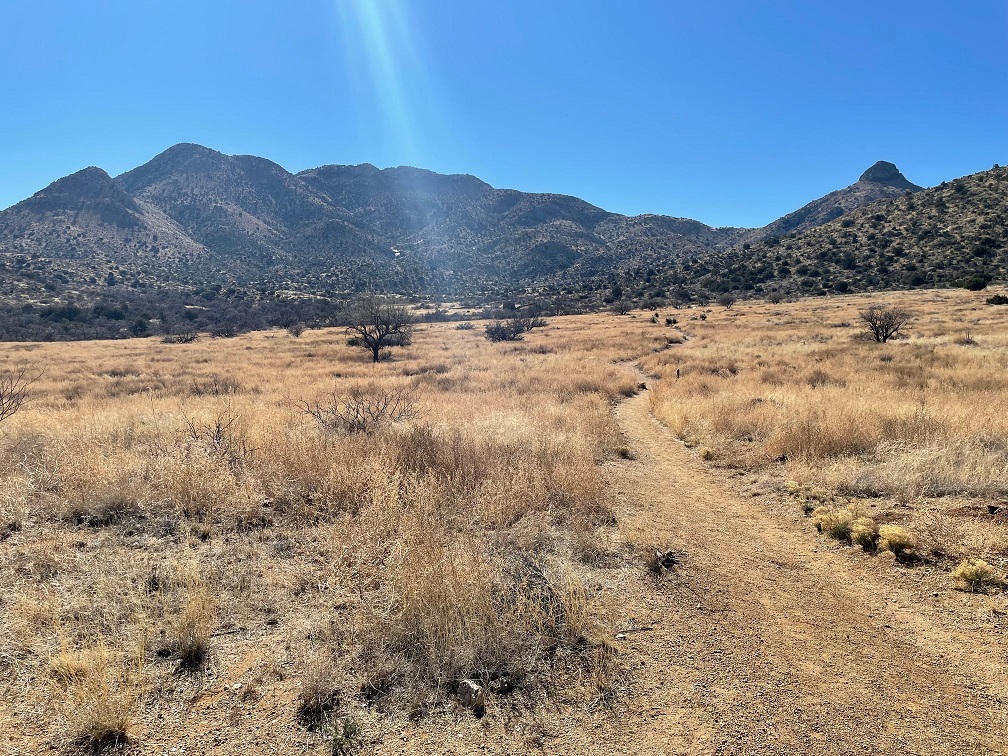
The Butterfield Overland Mail route passed through the center of the area shown in this photo (I think the trail is a modern hiking one, not a remnant of the stage trail) and passed by the stage stop. In 1857, the U.S. government awarded John Butterfield a contract to carry mail between St. Louis and San Francisco. The stage coaches took 25 days to complete the 2,500-mile route. The Chiricahuas permitted the passage of the stages for two years; in exchange for gifts, the Apaches provided firewood for the stage station. Butterfield used smaller mule-driven coaches for this mountainous stage of the route, as opposed to larger horse-driven coaches on either end of the line.
The company received $600,000 per year to carry the mail between St. Louis and San Francisco. Butterfield started with 2,000 employees, more than 250 coaches, nearly 2,000 horses and mules, and 240 stage stations along the route.
After the stage stop ruins, the next stop along the trail is the post cemetery for Fort Bowie.
The cemetery actually predates the fort, as some U.S. Army soldiers were buried here in 1862. In addition to soldiers, the cemetery held the remains of the soldiers’ families, civilians, emigrants, mail carriers, and three Apache children, one of whom was Geronimo’s two-year-old son. About a half-year after the closure of Fort Bowie, most of the remains were reinterred at the San Francisco National Cemetery. However, the graves of 23 civilians are still here.
The next significant stop on the trail to the visitor center is the ruins of the Chiricahua Apache Indian Agency.
Cochise died of natural causes in 1874 on the Chiricahua Reservation. Before his death he’d befriended a U.S. Indian agent named Thomas Jeffords, who governed almost a thousand Apaches from this agency from 1875-1876. The U.S. government removed Jeffords from this agency in June 1876 and relocated 325 Apaches north to the San Carlos Reservation. Many of the Chiricahua fled the reservation, however, and resumed hostilities with Anglos that would continue for another decade. The ruins of this agency were excavated in 1984. The building had three rooms, each with its own fireplace, and wood floors. National Park Service conservators have stabilized the ruins with plaster to slow their erosion; an ill-behaved dog at right provides a sense of scale.
A recreation of an Apache camp is a little ways further down the trail. The surrounding area, although rocky and mountainous, provided everything that the Chiricahua needed to make their home here: water from Apache Spring, wild game, edible plants, and materials for building shelter, weapons, and tools. The Chiricahua culture centered around the wife’s extended family; after marriage, the husband entered into the family and committed to supporting his wife’s relatives. While the men hunted and participated in raiding expeditions, the women maintained the wild food crops.
The camps consisted of small groups of several wickiups, built from a pole framework and covered with long grass and animal hides, like this one. Because of inconsistent food supplies and threats of enemy attack, the camps were not permanent and the Apaches moved often. Here we see a big baby absolutely terrified of what unimaginable horrors might wait in the dark depths of the wickiup recreation (there was nothing, as it turned out), accompanied by Nancy.We got Gunther as an eight-week-old puppy in early November 2019, just a couple of months before the pandemic started, so he grew up in the last couple of years not having a whole lot of exposure to new experiences. For instance, we were made to realize he’d never been very close to horses when we went to Tombstone a few days after this hike. Once he gets used to new things, he’s generally okay with them. He gets along great with other dogs and people (and horses, once he’s seen one). He’s a really good dog, although I think he prefers hikes that have a lot more walking and a lot fewer opportunities to learn about history than this one did.
The Battle of Apache Pass
In mid-July, 1862, a guard of about 100 California Volunteers marched through Apache Pass toward the San Simon River in order to build a supply depot in that area. When the column approached the Butterfield stage station, which had by then been abandoned, it was attacked by Cochise, his ally Mangas Coloradas, and about 150 Apache warriors. The Californians drove the Apaches into the hills shown above, only to find that the Native Americans had taken up new positions around Apache Spring. After another attack, the Californians finally reached the spring and drove the Apaches away once again. The Battle of Apache Pass, July 15-16, 1862, led to the establishment of Fort Bowie.
We were on this trail in early February and were plenty warm; I cannot imagine what it would have been like to engage in battle with Apaches in mid-July, and while trying to fight your way to water.
Apache Spring
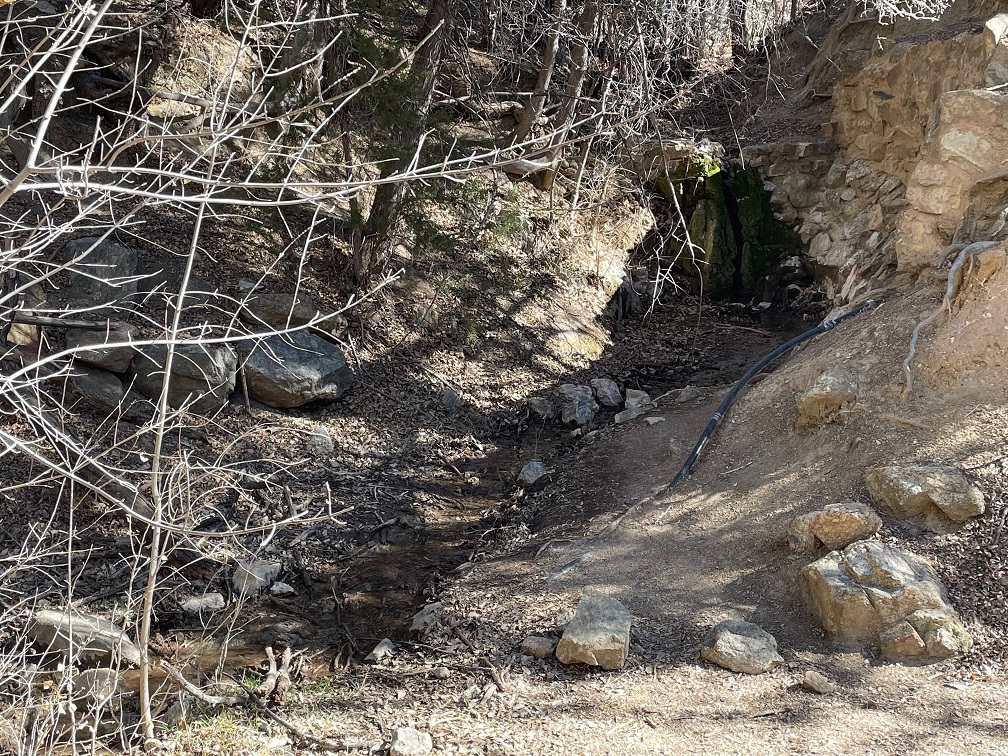
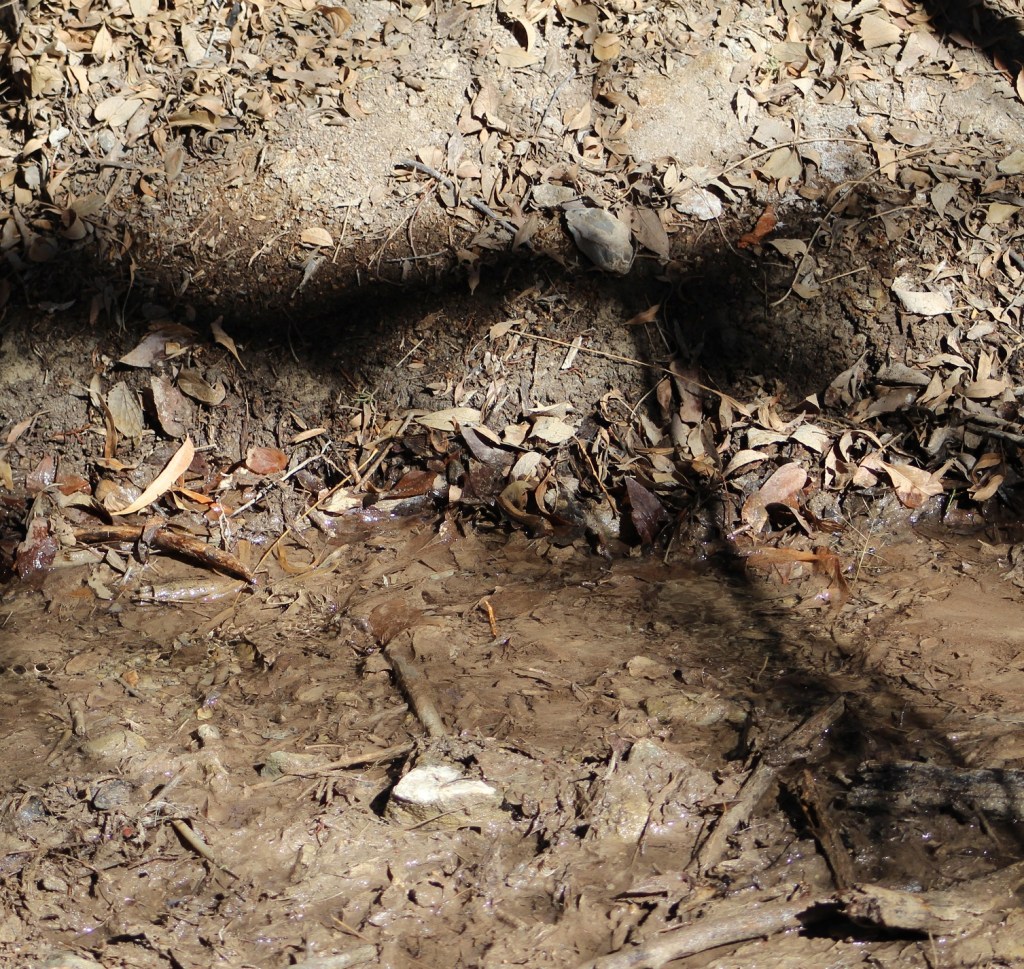
This is what all the deadly fighting over the decades at this site was about: Apache Spring, the only year-round source of water in the region. Archeologists have found pottery fragments around the spring that suggest the Mogollon Native Americans were here many years before the Apache came to this area.Apache Spring averages a flow of about 5 gallons per minute, but that can vary significantly depending on the time of year and recent precipitation amounts. It’s not a big outflow, but it’s wet and that’s all that matters. This little rivulet a few yards from the mouth of the spring is about a foot wide. Fort Bowie is a quarter-mile further down the trail.
The First Fort Bowie
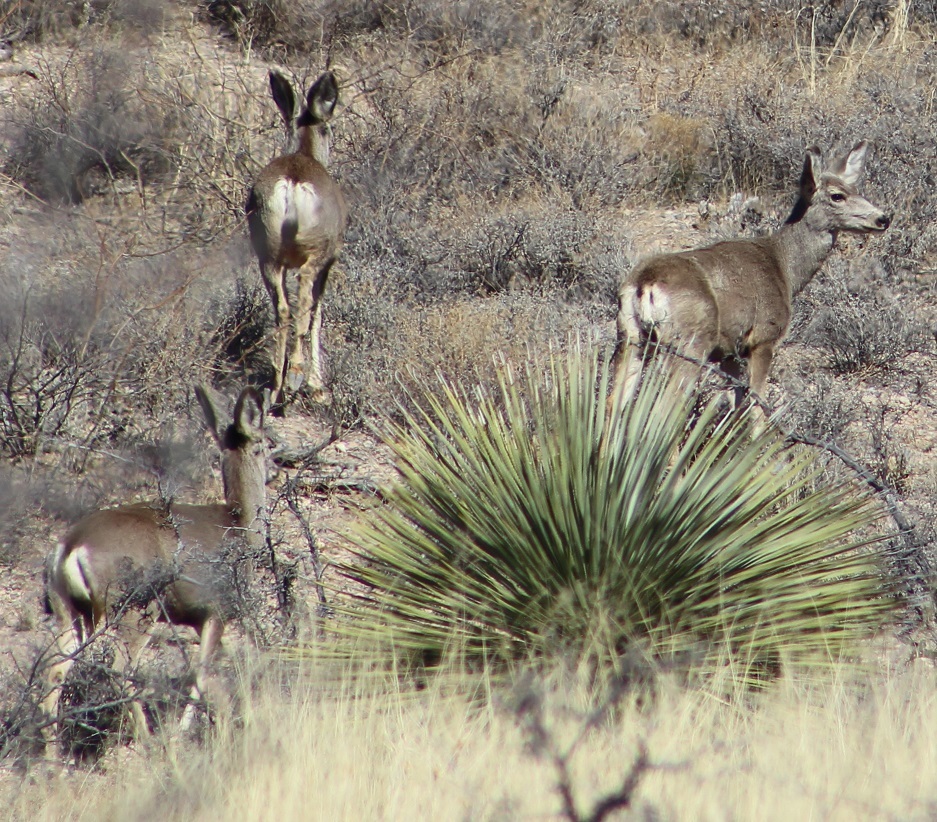
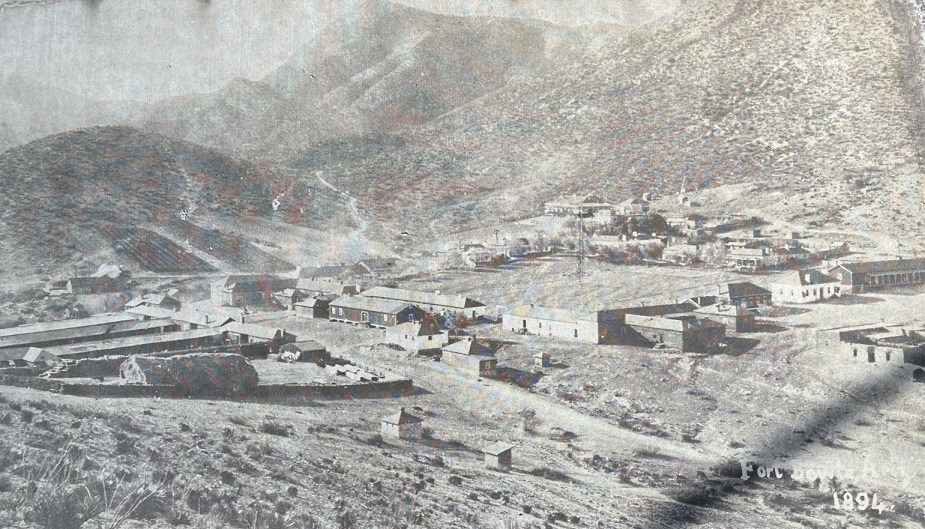
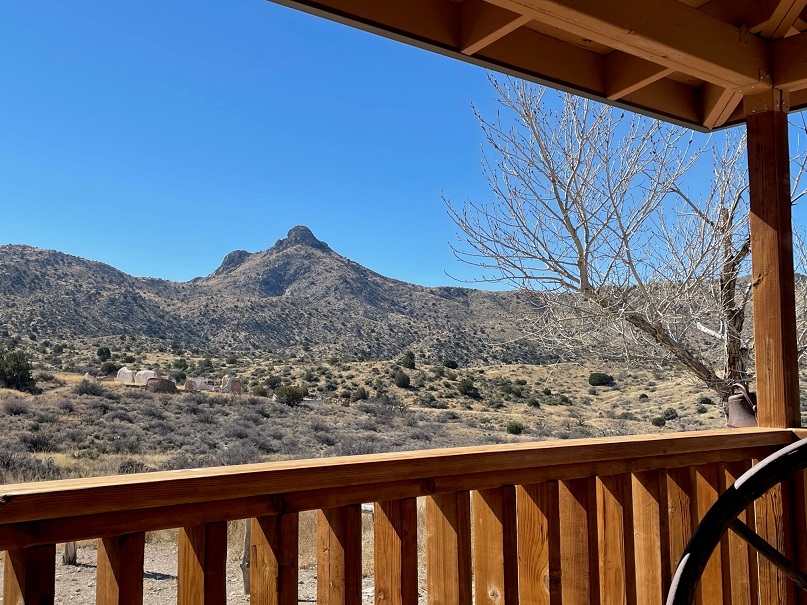
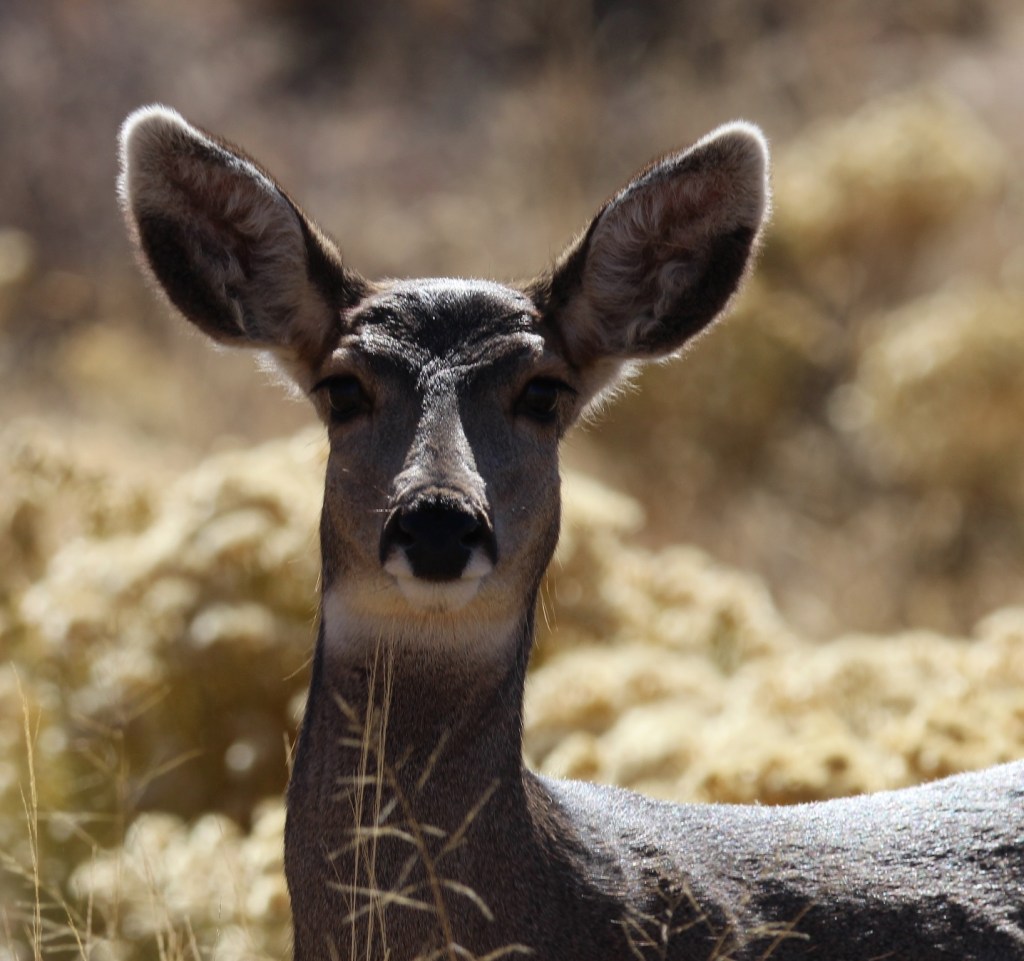
A 500-yard spur from the main hiking trail leads to these ruins of the first Fort Bowie. Construction started in July 1862 following the Battle of Apache Pass and the U.S. Army’s control of Apache Spring. A 100-man detachment of the 5th California Volunteer Infantry, under the command of Col. George Washington Bowie, completed the fort in two weeks. Incidentally, this instance of “Bowie” is pronounced “BOO-ee,” not “BOH-ee.” Also, that tree growing in the middle of the ruins is a catclaw acacia (Acacia greggii). Its Apache name is “ch’il gohigise,” which means “a bush that scratches you.” It has very sharp and claw-like thorns, but its seed pods were a significant food source for the Apache and they used the wood to make furniture and drumsticks. Bees are attracted to the catclaw’s blossoms and make a very distinctive honey.Although the Apaches didn’t control the water at Apache Spring any longer, they continued to attack travelers that weren’t being protected by the U.S. Army as they traversed Apache Pass. This first fort was only in use for six years as the California Volunteers pursued the Apaches with little success. It was apparently not an enviable duty post because of the extraordinary isolation, constant illness, poor living conditions, and consistent threat of Native American attack. I’d think, however, that the original builders would be pleased to know that the walls they constructed are still standing, in the heat of the Arizona sun, 160 years later. Regular U.S. Army soldiers relieved the volunteers in 1866 and began construction of the new Fort Bowie, 300 yards northeast of this location.This picture was taken looking to the southwest of the hill on which the first Fort Bowie was built; I’ve indicated the locations of several stops on the trail. The location of Apache Spring is not in this photo; it’s to the right of the area shown in the picture. The prominent mountain in the background is Government Peak, elevation 7,556 feet.As we approached the visitor center, we encountered a herd of 10-12 mule deer about 100 yards away. They gradually made their way up the opposite hillside, blending really effectively into the rocks and brush of the area.This is the visitor center for the Fort Bowie National Historic Site. At the end of the 1.5-mile hike, it’s an impressive structure that overlooks the site of the second Fort Bowie, and has a wonderful wraparound patio with plenty of rocking chairs and benches from which to admire the view. The building contains artifacts from the fort and other items representative of military life in the late 19th century; we didn’t spend much time in the building because due to Covid concerns NPS was understandably limiting how many people could be inside at the same time. That’s what is left of the fort’s armory on the left side of the image, well removed from the original site of the fort itself.Like the Indian agency from down the trail, there’s not much remaining of Fort Bowie. The mounds you see in the middle foreground are walls of the fort’s buildings that have been covered in plaster by NPS conservators in an attempt to preserve as much of the original construction as possible. This picture is taken from in front of the visitor center, looking to the northeast.This is a picture of a picture of Fort Bowie from January 1894, at the height of its presence at Apache Pass. For a perspective, the angular hill at the top left of the previous photo is the same one at the top center of this one. The tall building on the right side of the photo comprise the commanding officer’s quarters and in front of that structure are the officers’ quarters. The hospital is to the left and up the hillside a bit from the CO’s quarters. The low buildings at left are the corrals and stables; behind those are the ice machine and steam engine. In total, there are about 38 buildings in this photo. With the Apache Wars ending after Geronimo’s final surrender in 1886, the Army occupied Fort Bowie for eight more years. The U.S. Army abandoned Fort Bowie nine months after this original photo was taken. Area residents stripped the wood from the buildings for their own uses, and all that was left were adobe walls.Here’s a view over the ruins looking southeast from the visitor center’s railed porch, where Nancy and I sat on rocking chairs while enjoying a picnic lunch. Gunther collapsed in the shade of the porch. Some of the fort’s ruins can be seen in the mid-foreground as light tan mounds. You may have noticed the prominent rock formation in the background in previous photos; it is called Helen’s Dome, elevation 6,376 feet. The granite peak is reportedly named after the wife of an officer at Fort Bowie, and served as an important landmark for travelers approaching Apache Pass.
After the visitors center, hikers can either retrace their steps back to the trailhead’s parking lot or use an alternate route that provides a different perspective on the surrounding area. We chose the latter.
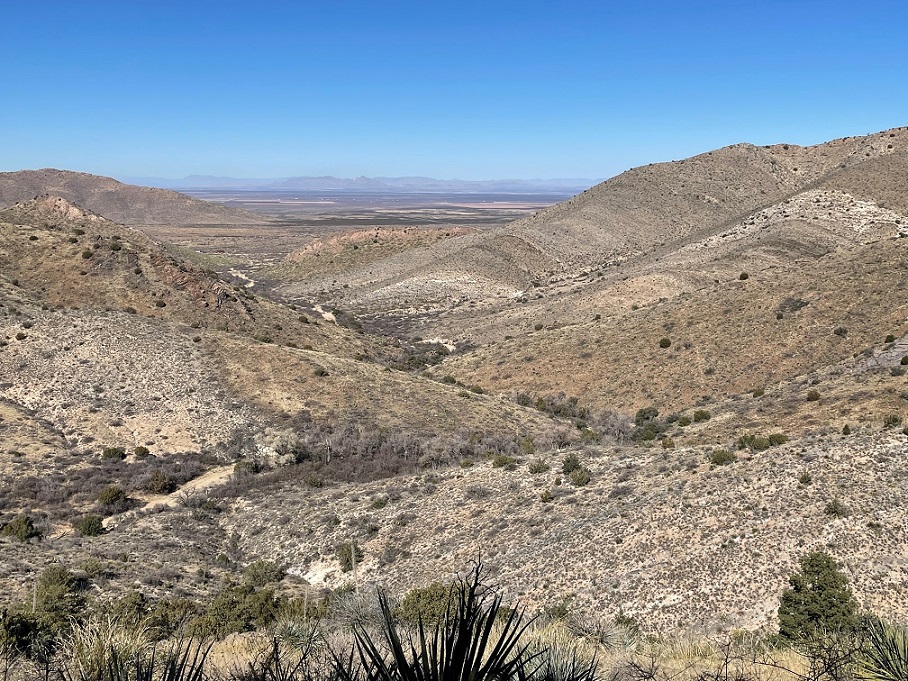
This spectacular view shows the valley of the eastern approach to Apache Pass and the Peloncillo (Spanish for “little baldy”) Range, 35 miles away on the horizon, and just beyond those mountains lies the New Mexico/Arizona border.
We also decided to drive back to The Goddard by a different route, making a loop between Willcox and Bowie on either end. It gave us a chance to see some different country, and I’m glad that we did.
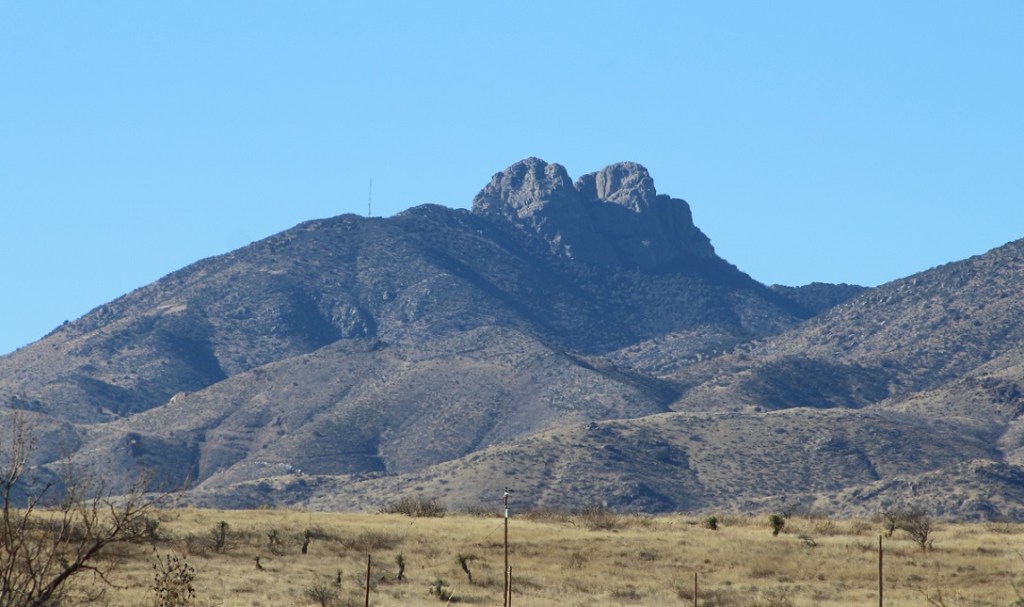
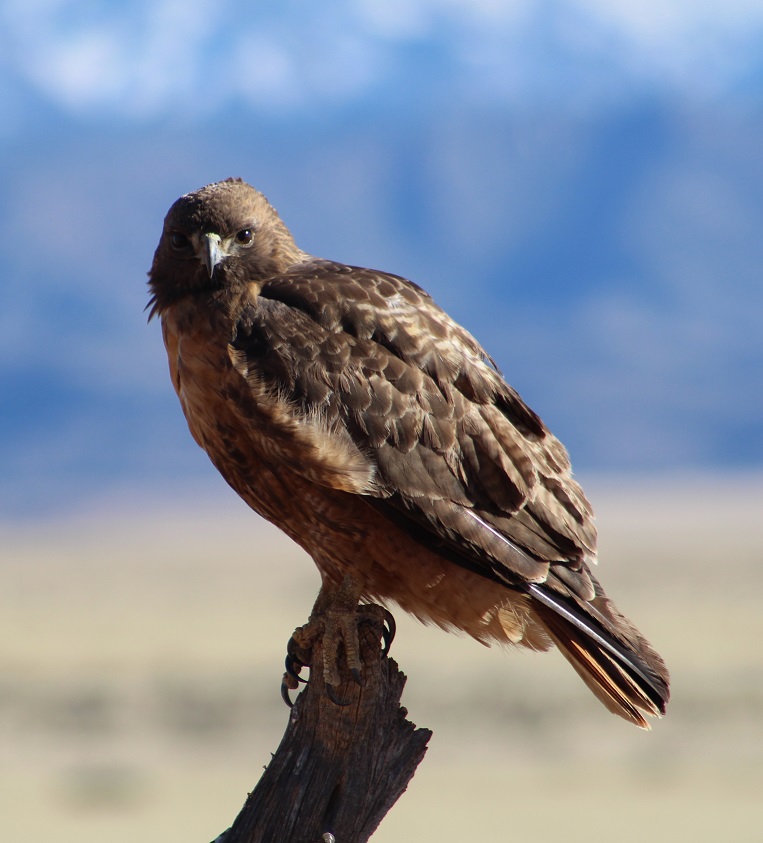
This is the rock formation that gives the Dos Cabezas (“two heads” in Spanish) Mountains their name. It doesn’t take much imagination to see faces in the rocks, especially the one on the left. This formation is about 15 miles due west of Willcox; it’s easily visible from the town (I enjoyed watching the colors of the setting sun on the formation while playing with Gunther in the campground’s dog run), but this perspective from the opposite side definitely shows you why it’s named what it is.We also passed this red-tailed hawk, perched on a roadside fencepost, on the way back to Willcox. It let me take five or six pictures before taking off. That’s snow-covered Mount Graham in the background, but from the opposite side of where we saw it while staying in Safford, Arizona.
We really enjoyed Fort Bowie National Historic Site. This was a “the journey is the destination” sort of experience — while it was interesting to see the ruins of the actual fort, the hike to those ruins, and the natural and cultural historic points we saw, was more rewarding. Hiking in the same paths that Cochise and Geronimo once walked, and learning more about the conflicts between the Chiricahua who lived here and the U.S. Army, is something that we’ll always remember.
When we traveled to Arizona from New Mexico in late January of this year, we noticed a lot of very tall and very thin pine trees growing next to buildings (as in, just inches away from them), and also grown close together as natural windbreaks or privacy fences. They are called pencil pines, and they are a cultivar of a species of cypress tree called Cupressus sempervirens.
Did you know / did you care that this cultivar was developed from trees native to the Mediterranean region of western Europe? The same conditions in Italy and Greece can be found in some parts of the American southwest, and the cultivars are very popular in Arizona’s arid and hot climate.
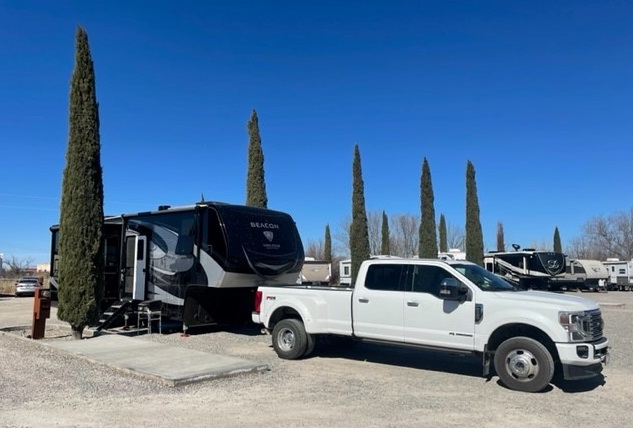
Our campground in Willcox, Arizona, had a single pencil pine planted next to each campsite.
In addition to providing protection from wind and prying eyes (when planted in close proximity), pencil pines, we were to discover, also serve as great habitat for a wide variety of songbirds. Their dense foliage and impressive height – up to 110 feet – provide plenty of safe nesting and perching spaces for our feathered friends.
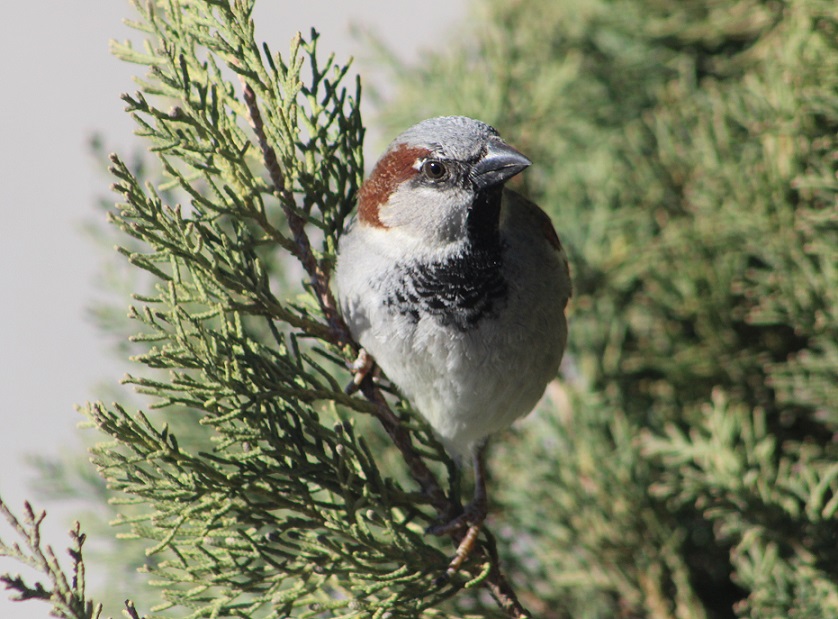
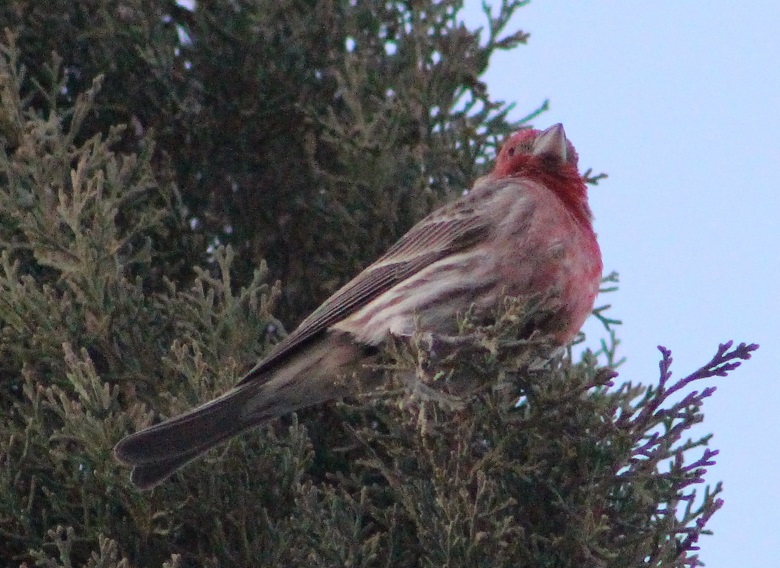
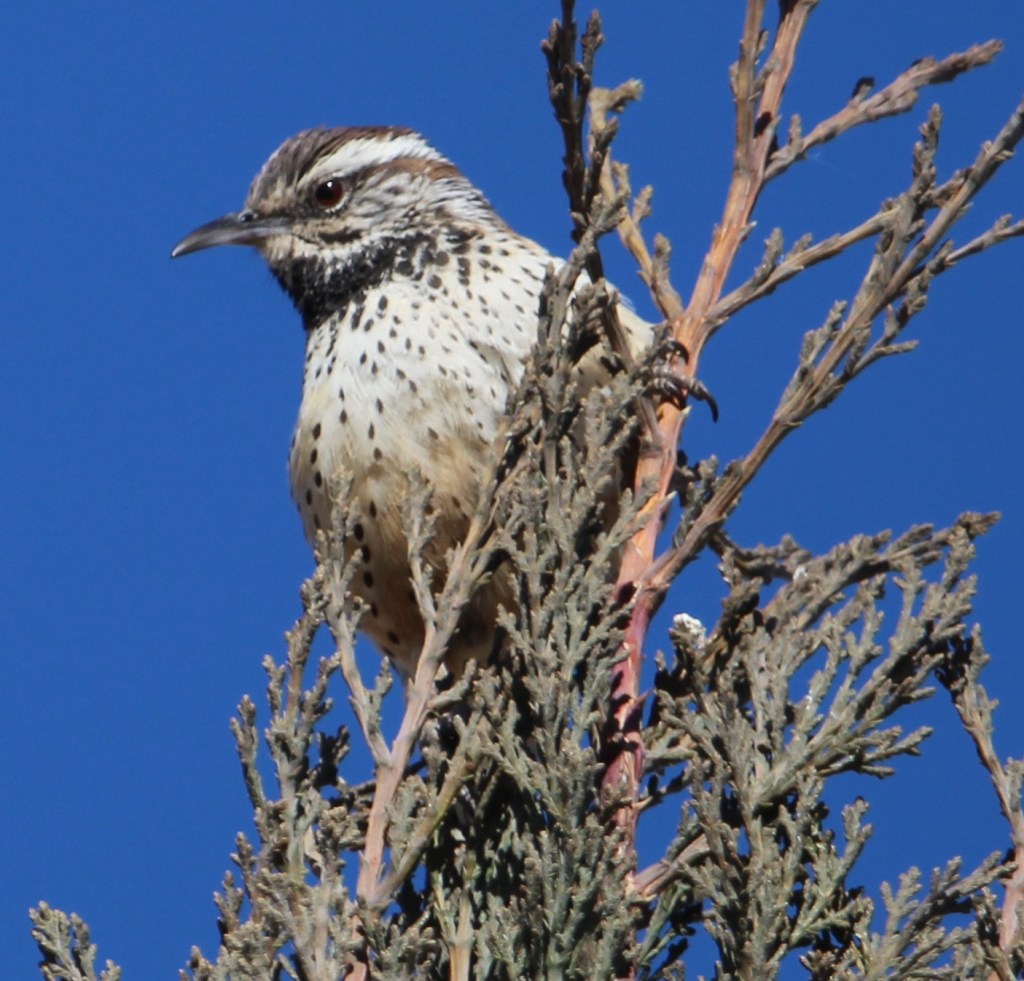
I took this photo of a house sparrow (a very common bird around the entire country) from a window inside The Goddard. It was perched in the pencil pine planted next to our front door (the one at far left in the photo of The Goddard above).Here’s another common bird, a house finch, perched in the same tree. This photo was taken in the late evening from below the bird. A bonus Did You Know / Did You Care!: house finches are native to the American southwest but some were captured in the 1940s and taken to the East Coast for breeding and to sell as house pets. That practice violated a couple of federal laws, and, in an effort to avoid prosecution, the captors released the birds to the wild. The house finches established wild populations, and now the species is found from coast to coast. The species was also taken to Hawaii in the 1870s and is now found on all of that state’s islands.Here’s a bird not found from sea to shining sea (and Hawaii): the cactus wren. This guy perched at the very top of a different campsite’s pencil pine and called out almost every morning we were in Willcox. I thought it sounded like a car with a dead battery trying to start (but in a way that’s somewhat more pleasing than what it sounds). The calls last up to four seconds and can be heard a thousand feet away.
Of course, all of this avian activity was of great interest to the feline member of The Goddard’s crew.
Here’s Rusty keeping an eye on the goings-on in the pencil pine outside the door of The Goddard.We regret not getting the optional extra-wide tread for the steps in our trailer, but we didn’t know that Rusty would be spending so many of his waking hours watching birds from the doorway.
Riparian areas, or habitat on or near flowing rivers, have historically constituted only 2 percent of the state of Arizona’s landmass. According to the Bureau of Land Management, in the last 200 years almost 95% of that meager acreage has disappeared due to human development from grazing, farming, and diversion projects
The Gila Box Riparian National Conservation Area, located between Safford and Clifton in southeast Arizona, was established in 1990 to protect 23,000 acres (about 36 square miles) of wildland river habitat and the surrounding area.
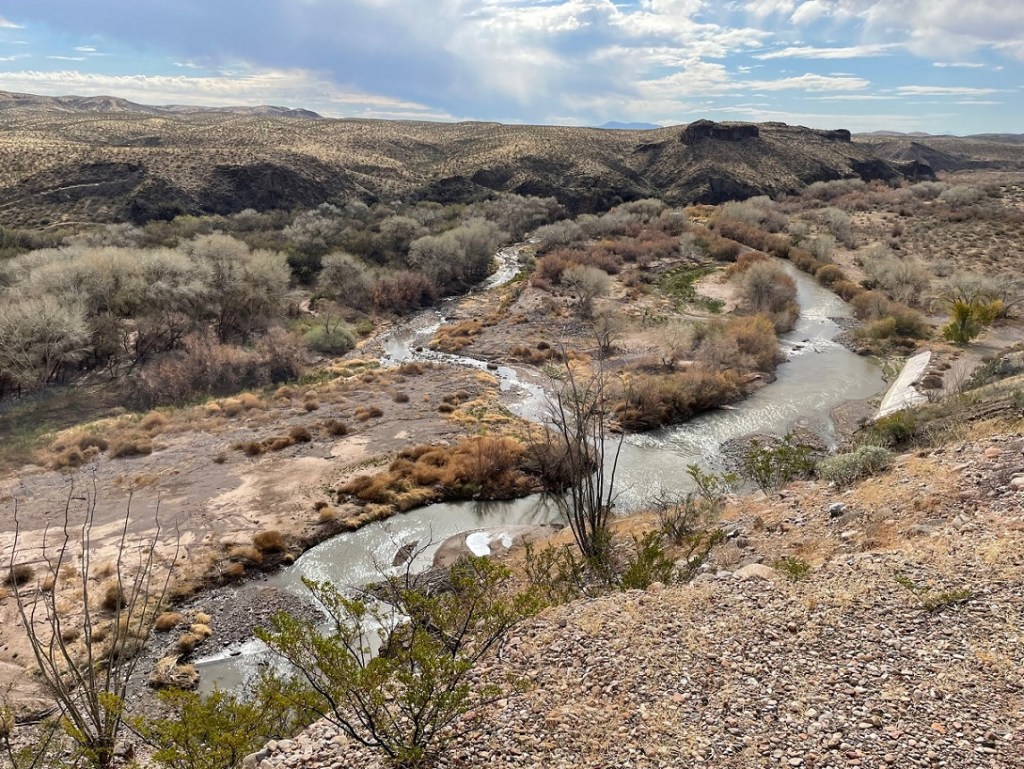
This photo is from an overlook above the Gila River as it briefly splits before rejoining downriver, looking to the southeast. The Gila Box Riparian National Conservation Area has plenty of very long vistas of natural spaces. The section of the Gila River that runs through the NCA is a very popular destination for kayakers, canoeists, and rafters during high-flow season, and there are several developed areas along the river for putting in and taking out watercraft.
The word “Gila” is found in many, many placenames and other references in New Mexico and Arizona, and it’s thought to be derived from a Spanish contraction of “Hah-quah-sa-eel,” which is a Yuma Native American word that means “running water which is salty.” The river starts near Gila Cliff Dwellings National Monument and flows almost 650 miles along an watershed of nearly 60,000 square miles in the two states before emptying into the Colorado River near Yuma, Arizona, where the Colorado forms the state’s western border with California..
The Gila Box Riparian NCA includes more than 20 miles of the Gila River as well as sections of three other waterways that flow year-round in southeast Arizona. Gila Box is one of only two riparian NCAs in the United States; the other is San Pedro Riparian NCA, located in extreme southeastern Arizona along the border with Mexico.
The waterways provide food, shelter, and water for a huge variety of wildlife, including fish, mammals, and birds as well as invertebrates.
The importance of preserving these lands can be seen in the variety of animals that call Gila Box home, including at least:
175 permanent and migratory bird species
42 mammal species, including bighorn sheep, black bear, javelina, mountain lion, and cougar
24 reptile species
17 fish species, including the endangered Gila chub and razorback sucker
and 10 amphibian species.
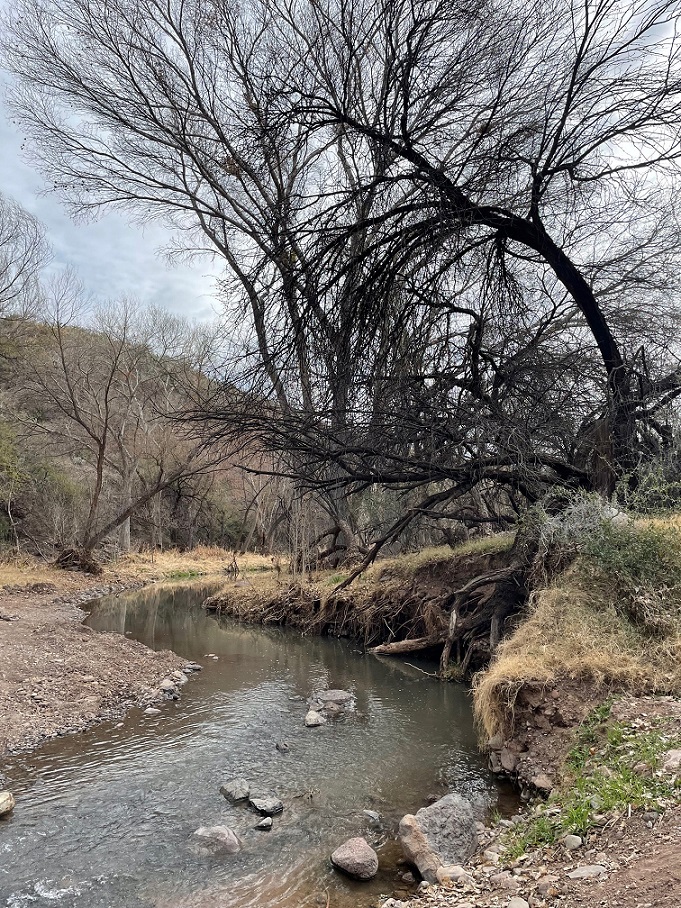
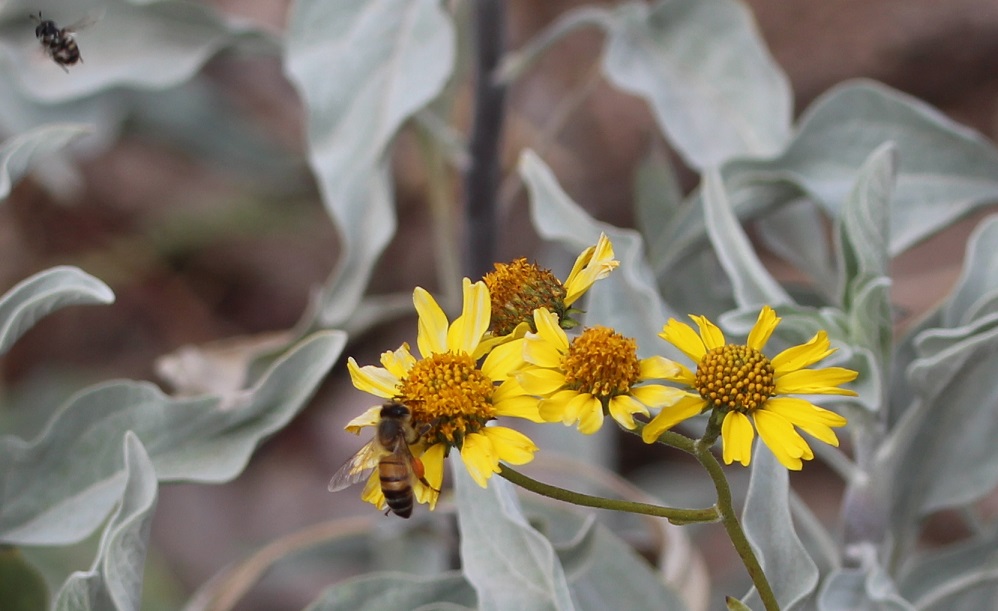
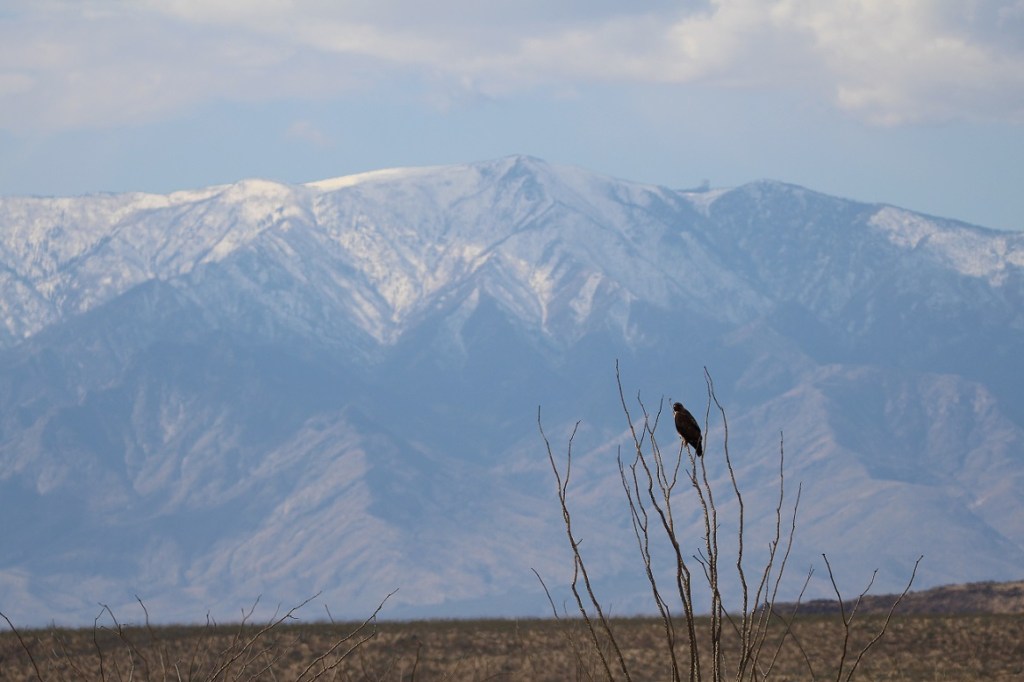
This is Bonita Creek, which flows southeast from the San Carlos Apache Reservation, now home to about 10,000 Apache, northwest of the National Conservation Area to enter the Gila River near the NCA’s western edge. This riparian environment is certainly atypical habitat for the mostly desert state of Arizona: Fremont cottonwood, Goodding’s willow, and Arizona sycamore trees are prevalent along with uncommon large bosques of mesquite, which is a very common tree/shrub in the drier areas of the desert but there grows in sparser groupings.One of these days I’ll stop being surprised at seeing blooming flowers in January, but today was not that day. This is a plant called brittlebush (Encelia farinosa), which has several interesting characteristics: it derives its name from having very fragile stems; depending on where in the stem the sap is collected the sap can be used as a glue or as a resin to hold seal pottery vessels; or the sap can be melted to use as a varnish. There were a lot of bees collecting pollen from this plant.It’s difficult to be sure, but I’m fairly certain this raptor is a redtailed hawk perched on an ocotillo. A few minutes after this photo, the bird took off and immediately rose a hundred feet in the air to soar over the desert. The mountain in the background is Mount Graham (elev. 10,724 feet), the southernmost peak in the continental United States to exceed 10,000 feet. Mount Graham dominates the landscape in southeastern Arizona: it’s visible from nearly everywhere. It and other tall mountains are referred to as “sky islands” in the American southwest because their different elevation zones support a number of varied habitats for wildlife and plants. Beyond this bird and the bees, we didn’t see much in the way of wildlife on our visit to Gila Box; we’d especially hoped to encounter Gila monsters, which we’d been advised by Arizonans were common in the NCA.Here’s another view of Mount Graham taken at a different time of day in the NCA, with part of the city of Willcox seen at its base. It’s barely visible in the previous photo with the raptor, but this image better shows a box-like structure in a mountain saddle at the right: that’s one of several telescopes maintained in the Mount Graham International Observatory (MGIO), which is operated by the University of Arizona along with other partners. The one viewable here is the Large Binocular Telescope; the other two MGIO telescopes are the Vatican Advanced Technology Telescope (the “Pope ‘Scope,” if you will, and maybe you won’t) and the Submillimeter Telescope. The clear skies due to the high elevation and sparse populations in the immediate area lend themselves to excellent telescope operations. The Large Binocular Telescope is about 30 miles from this viewpoint; it is indeed large. Regrettably, the MGIO only conducts tours from mid-April through mid-October because of road conditions so we weren’t able to check it out. We had a great view of Mount Graham from our campsite, and enjoyed seeing the changing weather conditions across the mountainside during our stay.The abundant water of the Gila Box area (by Arizona’s standards, at least) supported ranching operations, including by the Apache, beginning in the 1870s. Cattle, sheep, and goat production peaked in the 1880s and early 1890s as the Southern Pacific Railway was completed across this part of Arizona, but later droughts and land mismanagement led to a near-total collapse of the industry. Ranchers may still graze stock on the NCA, which is overseen by the Bureau of Land Management, but must restrict their herds to upland parts of the area and no grazing is permitted on public lands near the riparian areas. This structure’s roof has seen better days.From a geology point of view, there’s a lot going on in these cliffs about 100 yards away from the Gila River. Between 25 and 16 million years ago, volcanic eruptions created lava flows that resulted in layers of basaltic rock. Later eruptions formed layers of sedimentary and conglomerate rocks, all of which the Gila carved through to make a spectacular canyon over millions of years. These cliffs are probably about 100 feet high.And here is that canyon, which is the Gila Box. This is a few miles upstream from the overlook where I took the first photo of this posting. I really wish the sun had been shining on the canyon walls when we were there, but canyons and sunlight rarely have good timing together. The color of the rocks is still spectacular. Water is an amazingly destructive force, especially given enough time: this is the other side of the canyon formed by the cliffs in the previous photo, which are at least 100 yards west of this standpoint. Nancy and I were somewhat frustrated with the lack of established hiking trails in the NCA, but we did enjoy a short walk along the banks of the Gila River and experiencing this canyon wall, several hundred feet high, was especially rewarding. Gunther wasn’t able to join us next to the river; he kept getting spooked by something in the underbrush as we approached the river – it could only have been a lair of writhing, snapping Gila monsters, we believe – so we took in this sight individually while the other held the leash of our big baby.
Despite not being able to find any trails on which to stretch our legs (and it’s very possible that trails exist in parts of the NCA we didn’t see), we did enjoy the visit to Gila Box Riparian National Conservation Area. It would be really interesting to see it in spring, when the water’s really flowing. Maybe we’ll find Gila monsters somewhere else in Arizona.
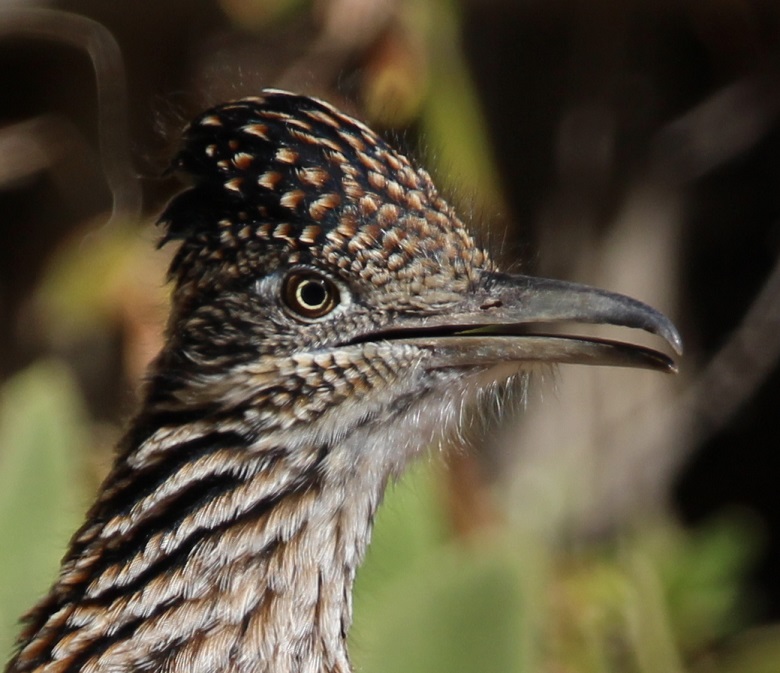
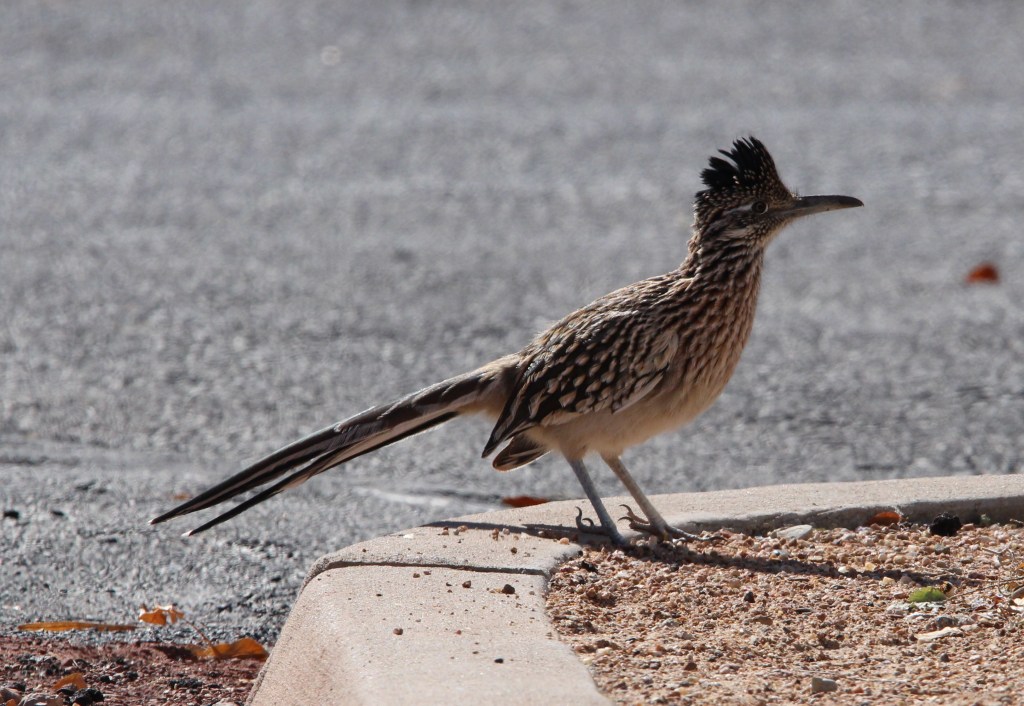
The opportunity to photograph another roadrunner presented itself while we were at the Albuquerque Botanic Garden on Sunday, Nov. 14. The garden has a display of vintage farm equipment next to its exhibit on old-timey farmsteads, and this greater roadrunner (as we now know, the state bird of New Mexico) was hanging out among the implements. He/she spent a couple of minutes in full view. I really like the coloration on that snappy head crest.
Many, many species of birds serve as powerful reminders that dinosaurs still walk among us in a way, but roadrunners must be near the top of that list.I think Rico (what could his/her name be, other than “Rico”?) was looking up at a wooden fence here, perhaps looking for grasshoppers. Although they can fly, roadrunners greatly prefer to run. And run they do, at speeds of up to 20 mph.I am greatly amused by photos of birds looking directly at the camera, and I hope that you are too. Thanks for entertaining us for a couple of minutes, Rico!
The ABQ BioPark includes the city’s Botanic Garden, Aquarium, and Zoo. The first two attractions are next to each other, just a short distance from the Old Town Plaza of Albuquerque. We visited the Botanic Garden on Nov. 14 and had a lovely time. We’ve been to a couple of other botanic gardens in the American Southwest (Tucson and Phoenix), and Albuquerque’s is definitely a jewel – even though our visit was during the offseason when there were very few flowering plants.
A number of structures, representing plants, animals, and holiday decorations, for the garden’s holiday light display were already out, although the nightly display didn’t start for another week or two. Still, it was pretty neat to see the structures close up and ready to go.
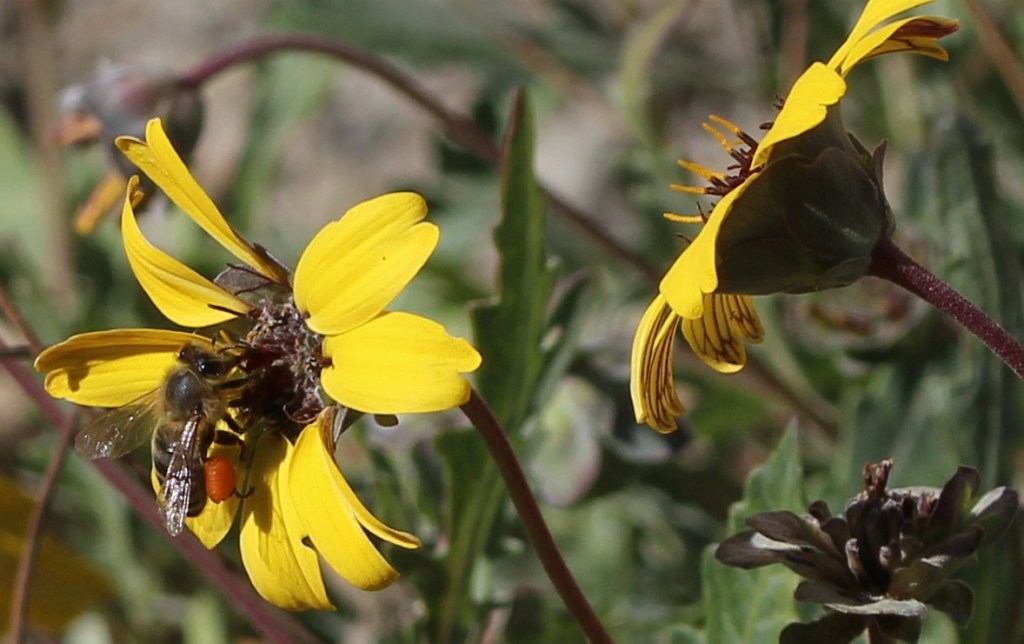
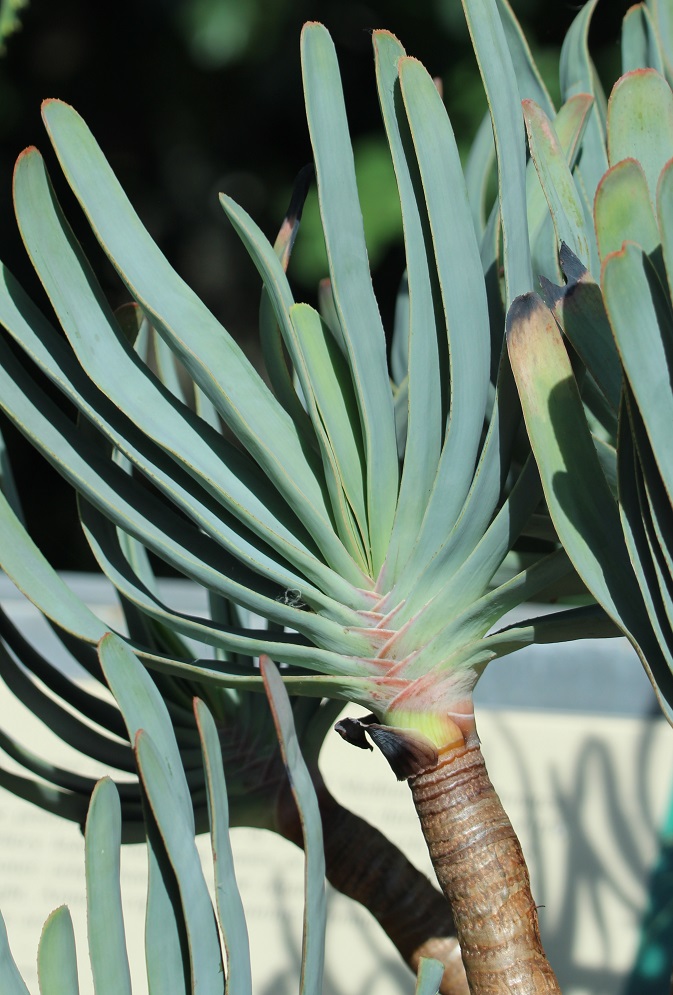
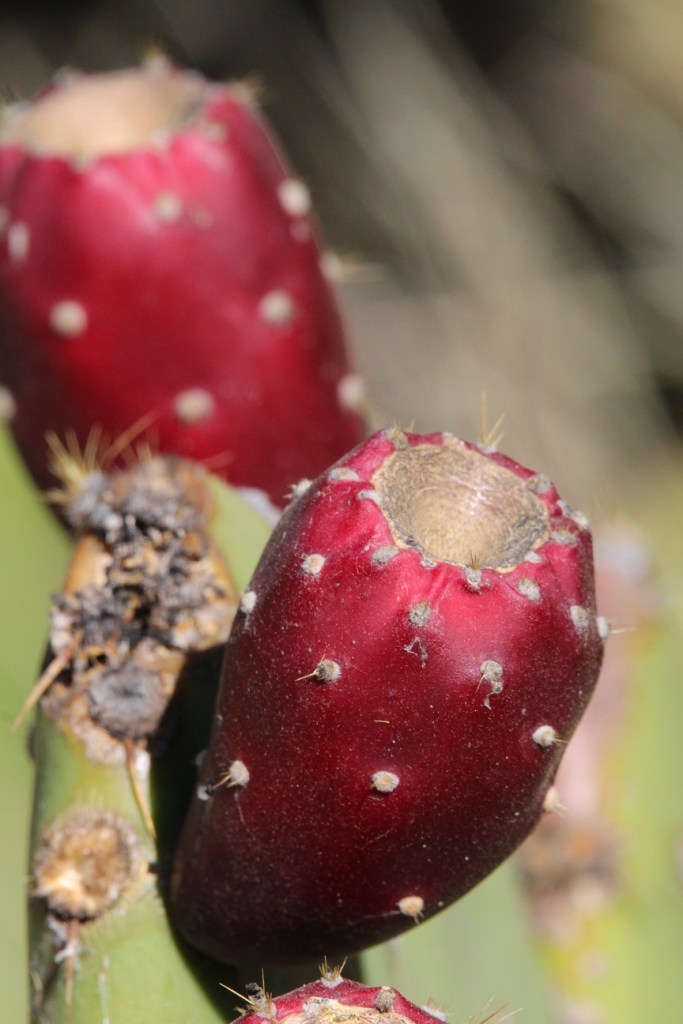
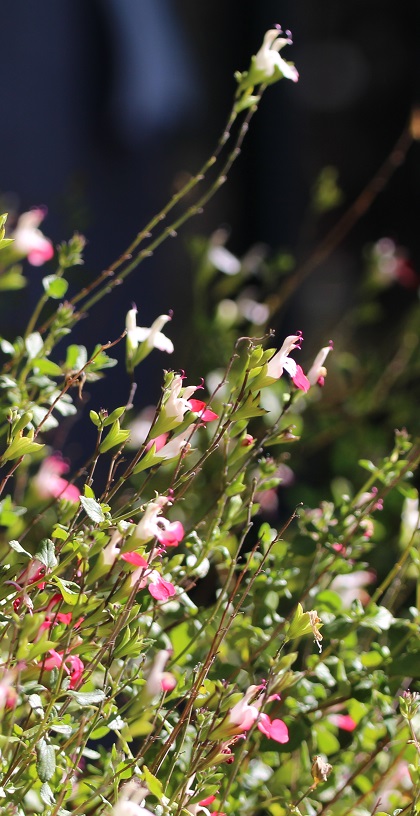
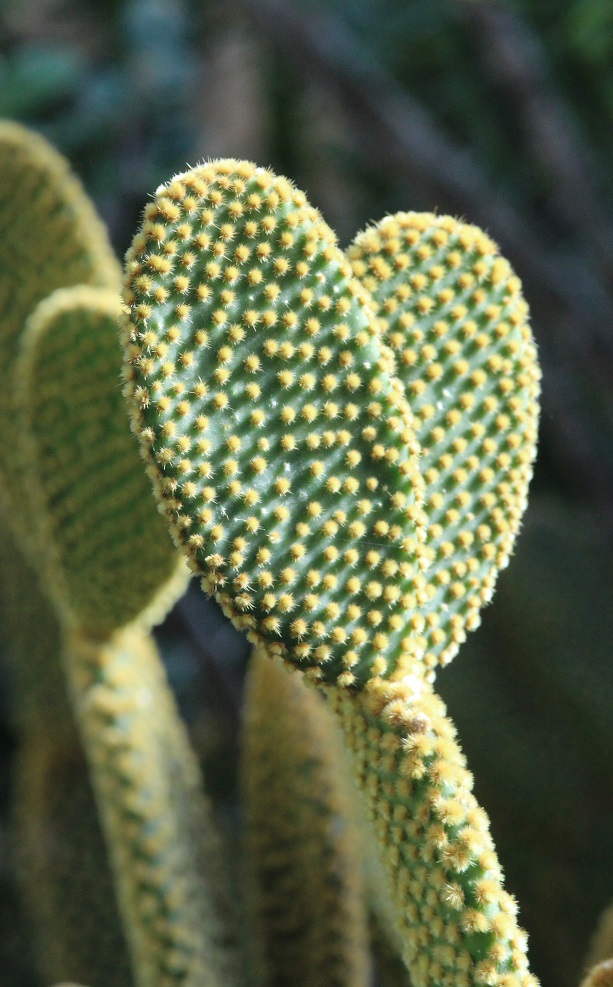
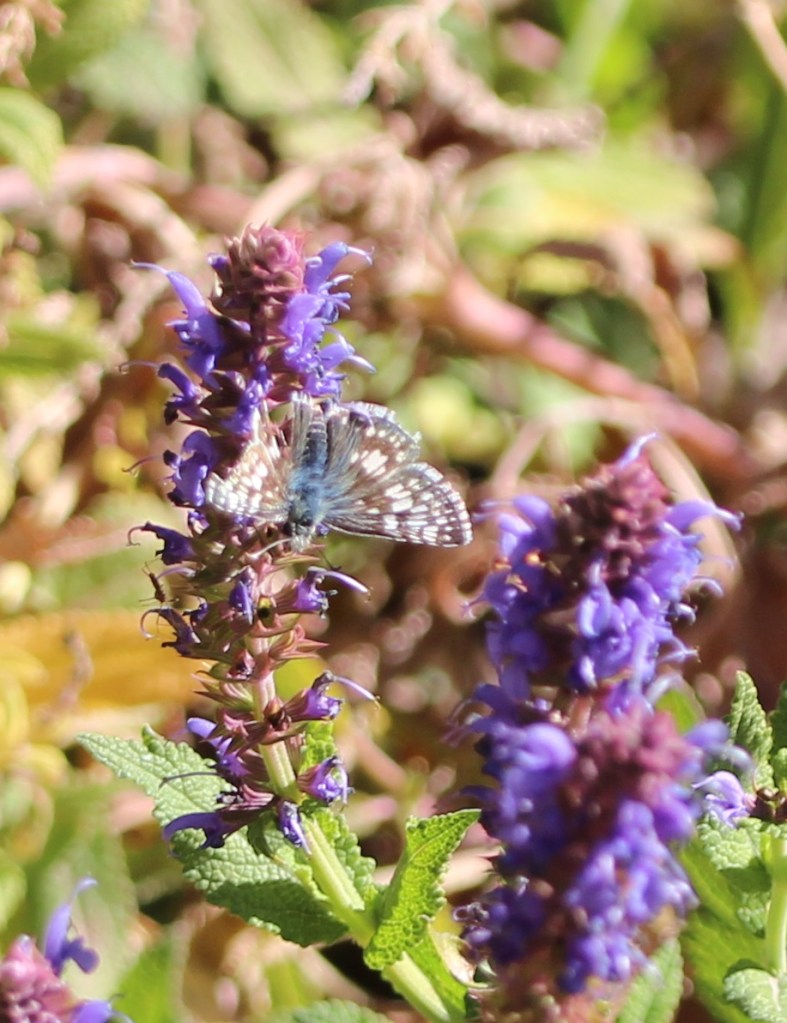
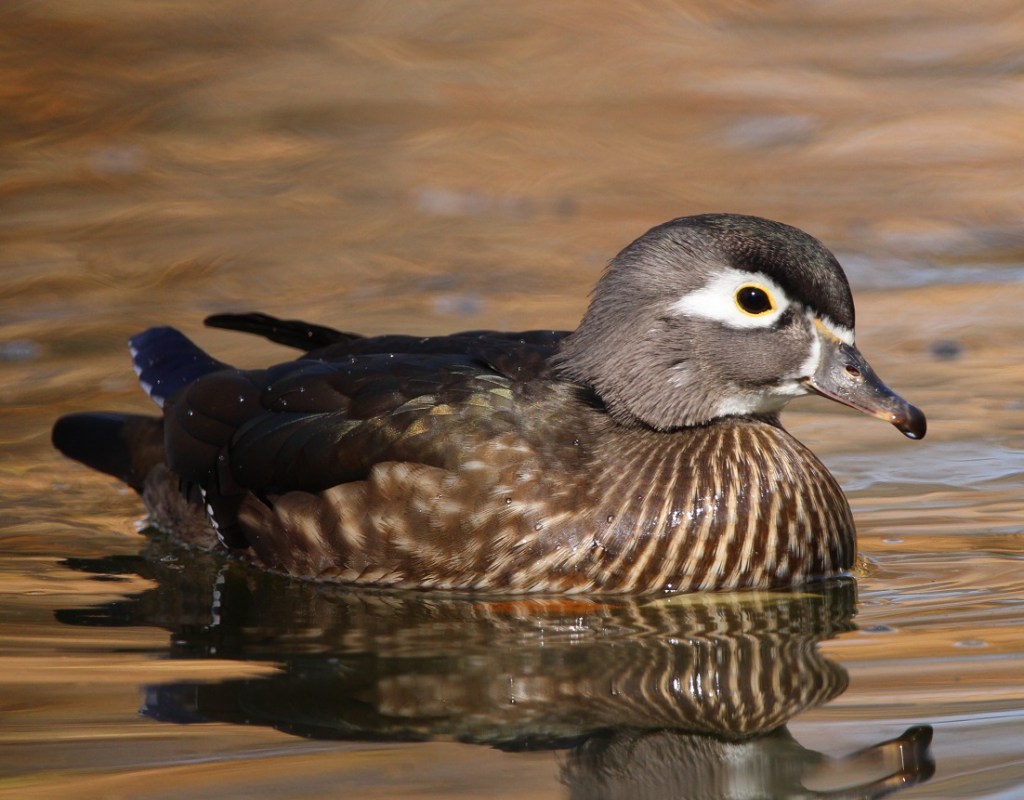
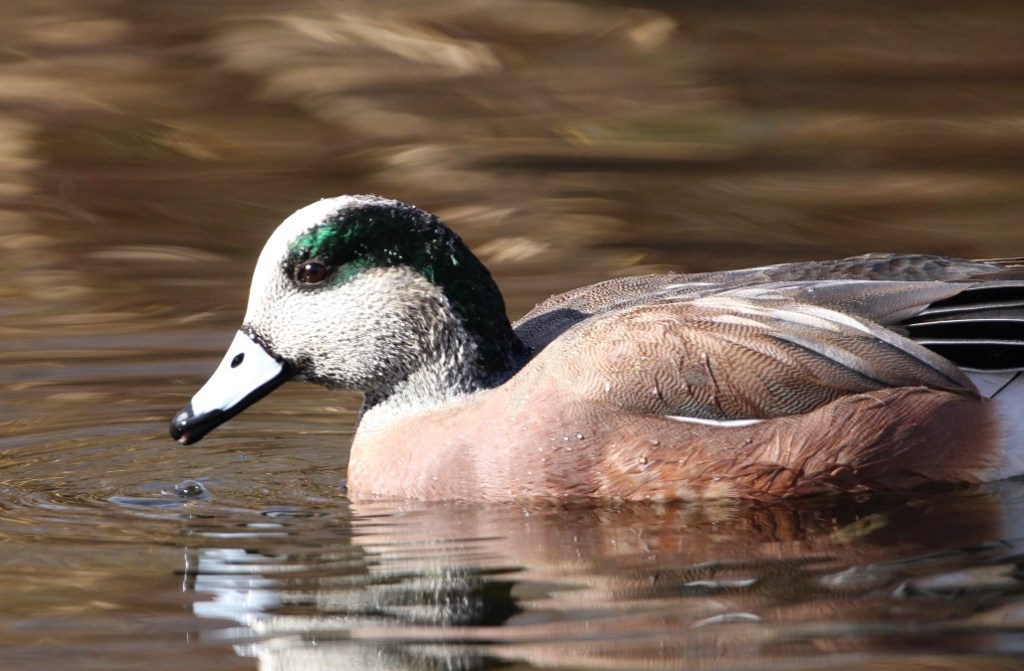
Although it was mid-November, there were still a few plants in bloom like this Chocolate Flower (Berlandiera lyrata) hosting a bee that, judging from the amount of pollen on its legs, had already been very busy that morning.This fan aloe (Kumara plicatilis) is a native of South Africa. It’s one of many eye-catching succulent plants that were on display in a couple of different buildings at the garden.The fruit of the Texas prickly pear (Opuntia engelmannii) makes for good eating by animals and humans alike. When we were on a guided tour of Old Town Albuquerque the previous weekend, one of our fellow tourists (who was apparently not from the United States) picked one of these off the host cactus with his bare hand. He regretted that decision.This was another outside plant that was in full bloom and attracting bees – it’s Autumn Sage (Salvia greggii).This distinctive cactus was potted inside a building. It’s Opuntia microdasys, or bunny ears, and it’s native to Mexico.The thing I love most about going to botanic gardens is seeing all of the different wildlife that enjoy the plants as well. This is a common checkered-skipper (Pyrgus communis) pollinating a woodland sage (Salvia nemorosa) plant. These butterflies are found from Canada all the way into Mexico. The photo’s blurry, but the butterfly wasn’t being very cooperative in holding still.In the very pretty Japanese garden area, the Nanking cherry trees (Prunus tomentosa) were full of fruit. These are enjoyed by birds and humans too; they’re more closely related to plums than to true cherries.By the time you hear the wingflaps, it’s already too late. Much as we did the day before at Rio Grande Visitor Center State Park, we heard a lot of sandhill cranes flying overhead. These were low enough to photograph.I saw my first-ever wood duck at the state park on Saturday but didn’t get a decent photo. There were plenty of wood ducks in one of the Botanic Garden’s ponds. They’re remarkably beautiful birds. This is a hen and drake pair.As incredibly gaudy as the drakes are, the wood duck hens are very attractive as well. This little lady seems to have a contented smile.Wood duck drakes are just amazingly beautiful, but they look like they were put together by several different committees of very talented artists who didn’t communicate very well in the design process.Here’s another bird that was new to me: the American wigeon. They are found throughout North America except the furthest reaches of northern Canada. This is a drake …… and here’s a hen. The very pretty light blue bill of the wigeon shows up better in this photo. She’s on the move to someplace that must be very important to be.Here’s another new-to-me bird: the black phoebe (Sayornis nigricans). They’re about six inches tall and the males and females have the same coloration. Black phoebes are found in the southwestern United States, and central New Mexico is about as far north as they go. This one was hanging out on a sculpture in the pond, keeping an eye out for flying bugs.I’ll close this posting with yet another photo of a wood duck. The lighting’s no good on it (although the mahogany color at the base of the tail is very pretty), but I really like that the duck is looking up – I don’t see ducks doing that very often. You may well wonder what this one was looking up at, so I may as well tell you: the duck was looking up at a little boy named Owen. How did we know the duck was looking up at Owen? Because Owen was standing behind a fence over the pond, tossing dried leaves to the ducks. How did we know the boy’s name was Owen? Because we heard his name being called about 300 times by his little friends. We hope that Owen and his friends slept well that night, because we know they had a very active day at the ABQ BioPark Botanic Garden.
One of the things I’ve most looked forward to doing in New Mexico, in addition to eating every kind of Mexican food there is and plenty of it, is seeing a roadrunner. I’ve gotten into birdwatching quite a lot in the last several years, and it’s exciting to see a species I haven’t seen before. It’s why I was thrilled to see the western grebe and snow goose at Lathrop State Park last month.
I think there are roadrunners in far southeastern Colorado, and we’ve been in New Mexico and Arizona plenty of times, but I’d never seen a roadrunner until earlier this week. Nancy was working at our dining table in our fifth wheel a couple of mornings ago and said, just out of the blue, “There’s a roadrunner.” There was indeed a roadrunner at an adjacent campsite. I luckily had my camera handy and stepped outside the trailer to take a few photos. They didn’t turn out great (the roadrunner didn’t have the best lighting), but I was still really happy to finally see one. Hopefully we’ll get plenty of more chances to see, and photograph, the New Mexico state bird.
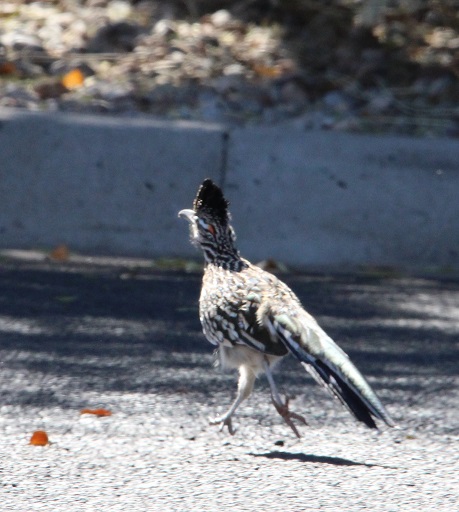
It’s a very pretty bird with great coloration. I was not expecting those savage-looking talons, but I suppose if you’re going to hunt rattlesnakes you want to come ready.A terrible photo, but I like it nonetheless because it depicts a roadrunner running on a road.
We’re starting off in Colorado’s first state park, which opened in 1962. The state now has 42 parks across Colorado, and a new one, including the area around Sweetwater Lake in Gypsum, was just announced earlier this month.
Sunset at the entrance to the park. The Sangre de Cristo mountain range is on the western horizon.
Named after Harold Lathrop, the first director of Colorado’s Division of Parks and Outdoor Recreation (now Colorado Parks & Wildlife), the park has two large (for Colorado) lakes that attract a huge variety of migratory birds throughout the year. On a walk around one of the lakes, Ken saw two birds he’d never seen before: a western grebe (which had just happened to catch an early supper) and a juvenile snow goose.
In addition to the grebe and goose, Ken saw American coots, Canada geese, seagulls, American robins, and mallard ducks all enjoying a late afternoon at the lake.
Lathrop State Park is about an hour’s drive east of Great Sand Dunes National Park. On Sunday, Oct. 24, we took Gunther on a visit to the dunes, which are the tallest in North America – some are 750 feet tall.
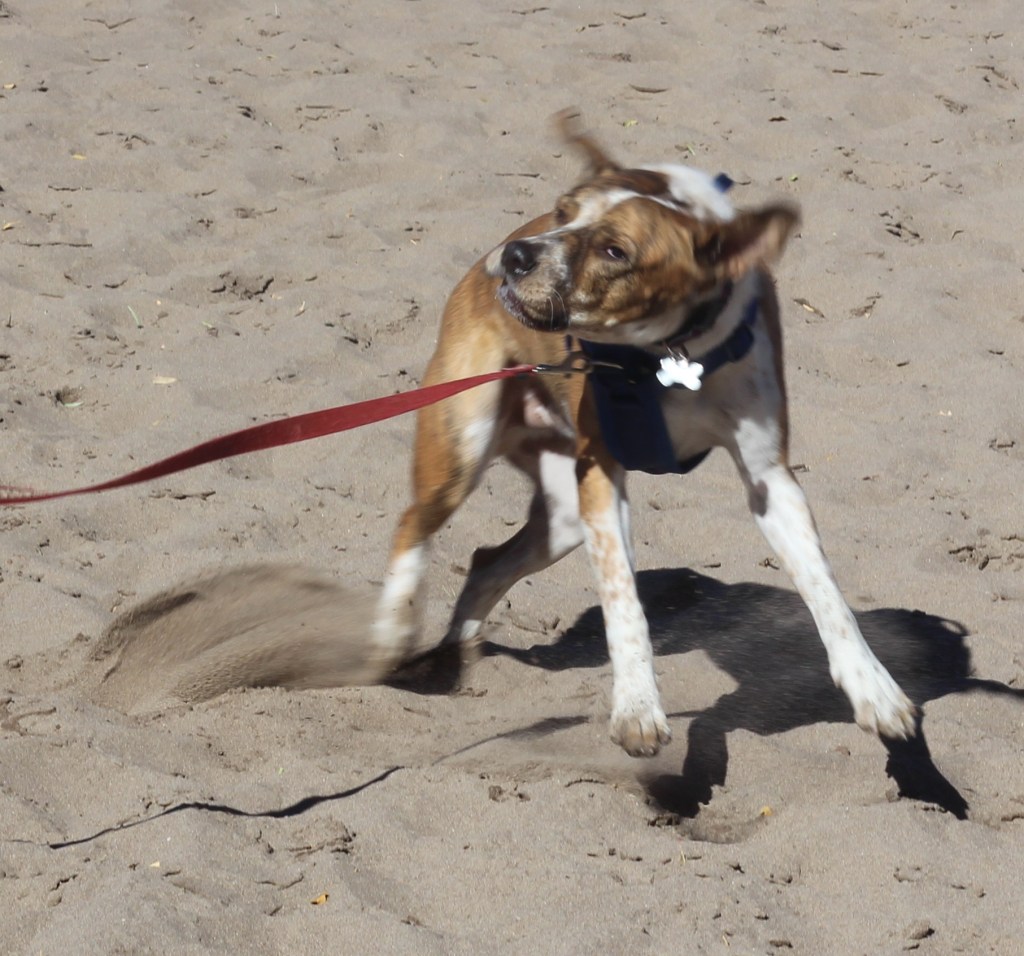
The eastern side of the Great Sand Dunes from the national park’s visitor center, about half a mile away. Mt. Herard (13,345 feet) is in the background. It’s estimated that the dunes contain 1.2 cubic miles of sand (imagine a cube with edges 1.2 miles long and then fill it with sand).We were both surprised at how many visitors the dunes received that day, given the time of year. Many were apparently from other countries, which is fairly common to experience during the off-season. The park attracts about half a million people each year.Gunther had a great time running and jumping around in the sand. We enjoyed ourselves as well, although we neither ran nor jumped.While we enjoyed a picnic lunch in the parking lot of the dunes, a small herd of mule deer paraded by. There were two bucks and probably eight or 10 does like this one.






















 Tales of The Goddard