We’ve just made our retreat from winter quarters in Las Vegas, Nevada, and now, in the first week of March 2026, find ourselves in Kingman, Arizona – just 100 miles down the road. I’ve written before about the many reasons we spend the winter months in Las Vegas, but it mostly comes down to these two:
The warmer temperatures of the Mohave Desert make the winter months both more comfortable and more practical. Cold-weather campers who stay in truck campers, travel trailers, and fifth-wheels like The Goddard know that it’s a pain – a necessary one, but still a pain – to disconnect water supplies from your RV if the temperature drops much below freezing. It’s critical to keep your water hoses, valves, and other equipment from breaking because of the frozen-water expansion. In three years totaling more than 12 months in Las Vegas, we had to disconnect from the water supply five times, and at least two of those were out of an abundance of caution.
If you run out of things to do in the literal Entertainment Capital of the World, that’s kind of on you.
There are other reasons, too, of course: frequent departures and arrivals from and to Harry Reid International Airport, through which 58.5 million people passed in 2024, allows for plenty of flights to see friends and family, there are restaurants featuring pretty much any kind of cuisine in the world, and (maybe this should be in the bullet list above) there are birding opportunities a-plenty.
Nancy and I had been to Las Vegas many times prior to selling our home in Denver and becoming full-time RVers, but our experiences in the city were pretty much limited to flying in to the airport, being transported to a hotel/casino, being entertained, and then being transported back to the airport so we could return to Denver. Having the opportunity to effectively live in Las Vegas for a quarter of the year gives us a much different perspective: people actually live, work, and raise families there – did you know that? Buying groceries, having your vehicle’s tires rotated, going to a park to escape the city noise: all of the things that people do every day in other cities are done by Las Vegans every day.
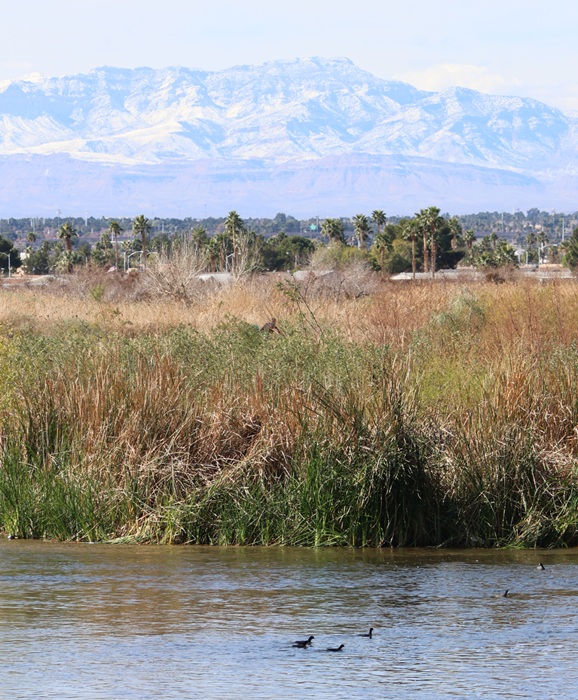
American coots swimming in the Las Vegas Wash were a familiar sight all four months we visited Clark County Wetlands Park. The city of Las Vegas (or, rather, the unincorporated towns of Paradise and Winchester; incorporated Las Vegas is itself a really small part of the metropolitan area) is on the other side of the tall grasses, and the snow-dusted mountains in the background, situated west of the metro area, show that it really was wintertime.
Maybe it’s not such a revelation to you, but, as someone who previously didn’t think about what people who actually live in Las Vegas do (you can’t make a living playing cards and going to shows, or at least not consistently), it certainly was to me.
Two of the places that we spend a lot of time while in Las Vegas are also home, or at least serve as a temporary stopover, to a number of different birds. I’ve written before about both Clark County Wetlands Park and the Springs Preserve, and they were once again sites to which we returned in the winter of 2025-2026.
I probably took about 500 pictures of birds over the winter (I’m not exaggerating), and here, in alphabetical common-name order, are 10 species that I really enjoyed watching (I enjoyed watching all of them and I didn’t get pictures of some that I really, really enjoyed watching, like an osprey hurtling into a stream in pursuit of a fish, or an American white pelican gliding over the desert).
Anna’s hummingbird
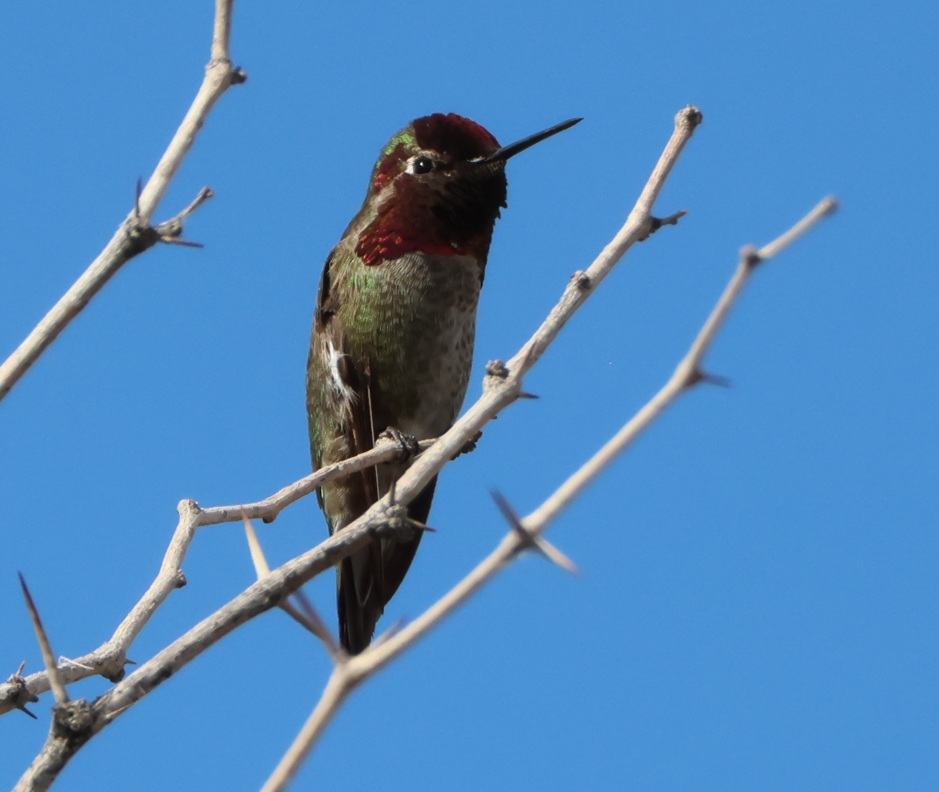
Primarily because of its warm climate, Las Vegas is a year-round home, or nearly so in some instances, to four different hummingbird species. The most common is the Anna’s hummingbird (Calypte anna). These little birds have a wingspan of 4.7 inches (12 cm) and weigh only up to 0.2 oz (5.7 g). Their bodies have the volume of a ping-pong ball and the mass of an American nickel. I took this picture at Springs Preserve on February 28 near the ciénega (Spanish for “swamp”), the manmade wetland feature that recreates the original water springs around which the original townsite of Las Vegas developed. Northern mockingbirds were by far the most common birds we saw at Springs Preserve, but we saw many Anna’s hummingbirds, as well as a couple of possible other hummingbird species, that day.
We’ve stayed at the same campground in the Las Vegas area the last three winters, and there’s a dog run there with a nearby tree that usually has an Anna’s hummingbird (not the one pictured, unless it decided to fly 11 miles to this different tree) perched at its top in the mornings. Seeing that little guy is always a great way to start the day.
Common merganser
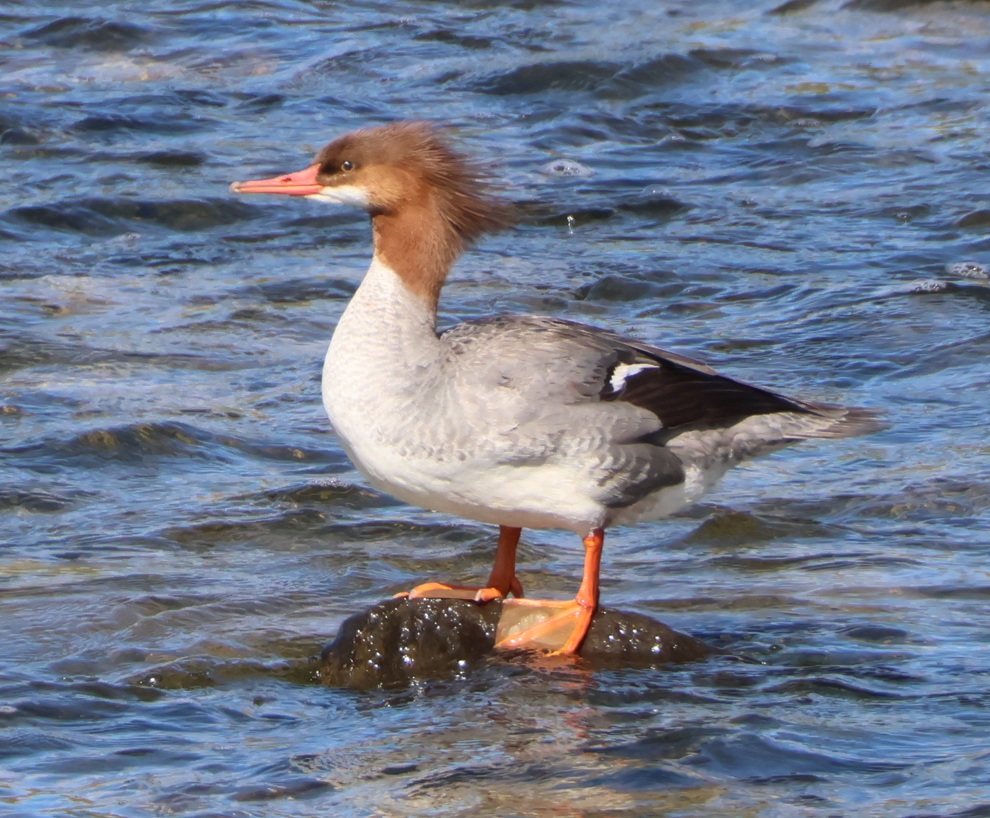
Nancy and I saw our first common merganser (Mergus merganser) two years ago in Pagosa Springs, Colorado, when one of these ladies (the drakes have dark-green head plumage) plopped down into the San Juan River flowing next to the restaurant at which we were dining al fresco. I got a really bad picture of it with my iPhone, but I could still tell that it was a common merganser (and a hen) because of the distinct reddish-brown head. We saw our second common merganser (another hen) paddling about the Yellowstone River during our first evening in Wyoming’s Yellowstone National Park last fall. This pretty lady pictured was one of five or six mergansers in the Las Vegas Wash on the morning of February 13. These birds have wingspans of 30-38 inches (78-97 cm) and weigh up to 4 pounds, 10 ounces (2.1 kg). All mergansers have serrated bills, which help them catch and hold on to fish. This species is found across the northern hemisphere at least part of the year; they are year-round residents of areas with ice-free water.
Crissal thrasher
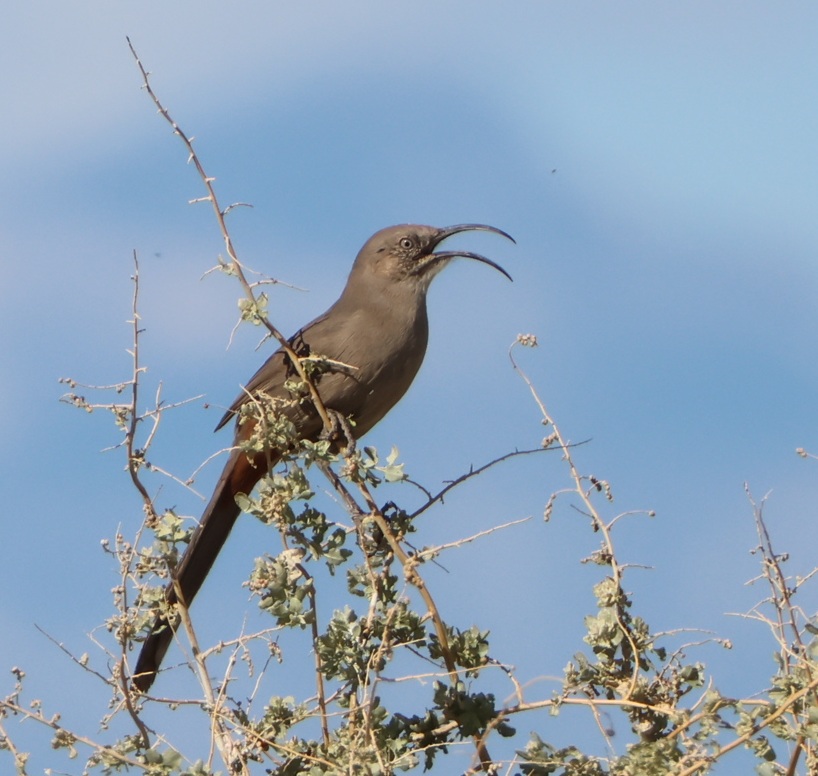
I saw my first crissal thrasher (Toxostoma crissale) last winter at Clark County Wetlands Park, and I saw a few more there this winter; I’ve only seen them there. These birds have bodies ranging from 10.5 to 12.5 inches (27-32 cm). I’ve been a somewhat serious bird enthusiast for perhaps five years, and I’m still amazed at their diversity. Crissal thrashers’ beaks evolved into this shape to allow them to capture insects in the leaf litter at the bases of trees and shrubs. Compare this thrasher’s beak and its diet with those of the merganser (which eats fish) and hummingbird (primarily flower nectar) above. A different thrasher species, Toxostoma curvirostre, has the common name of curve-billed thrasher (we’ve seen them in Arizona and New Mexico); its bill is indeed curved, but not nearly as much as that of a crissal’s. Inexplicably, my copy of the National Audubon Society’s Field Guide to Birds has a photo of the crissal thrasher facing the camera, so the effect of that wondrous bill is completely lost.
House finch
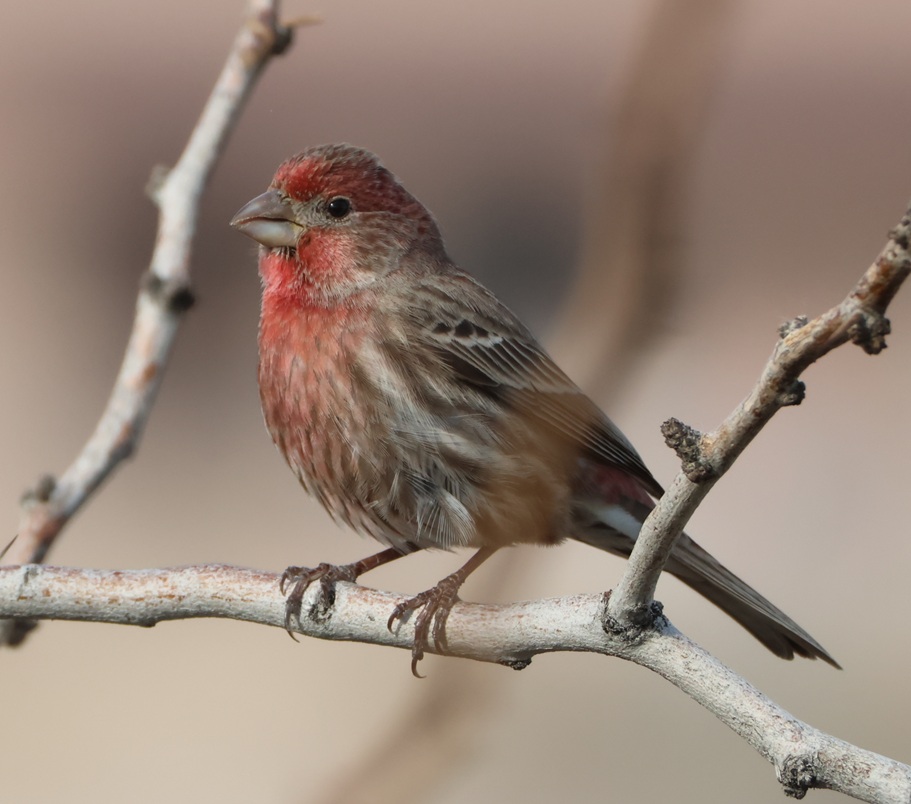
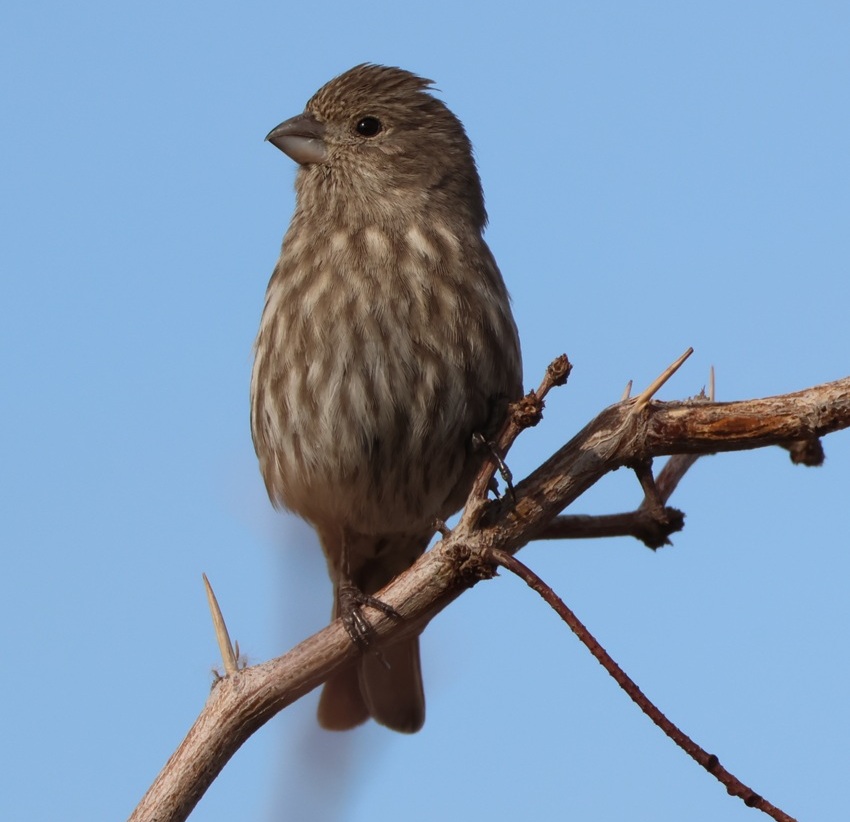
Continuing the comparisons of birds’ beaks and what they eat, have a look at these male (top) and female house finches (Haemorhous mexicanus) I photographed at Clark County Wetlands Park on January 7. For relatively small birds [5-6 inches (12.5-15 cm) in length, with an 8- to 10-inch (20-25 cm) wingspan], those are pretty stout beaks; they’ve evolved to crack open grains, nuts, and seeds with ease. Male house finches, as is the case with many (not all) birds, are more colorful than females; the red color comes from their diet. I’ve also seen orange- and yellow-colored male house finches; we saw a couple of orange ones at Springs Preserve in late February. House finches have very cherry calls and songs. As indicated by their scientific name, house finches are native to Mexico and the American Southwest. Populations were taken to the East Coast at the turn of the 20th century with the intention to be kept as house pets, but that was illegal so the owners let the birds into the wild and now the species is found over most of the United States.
Great blue heron
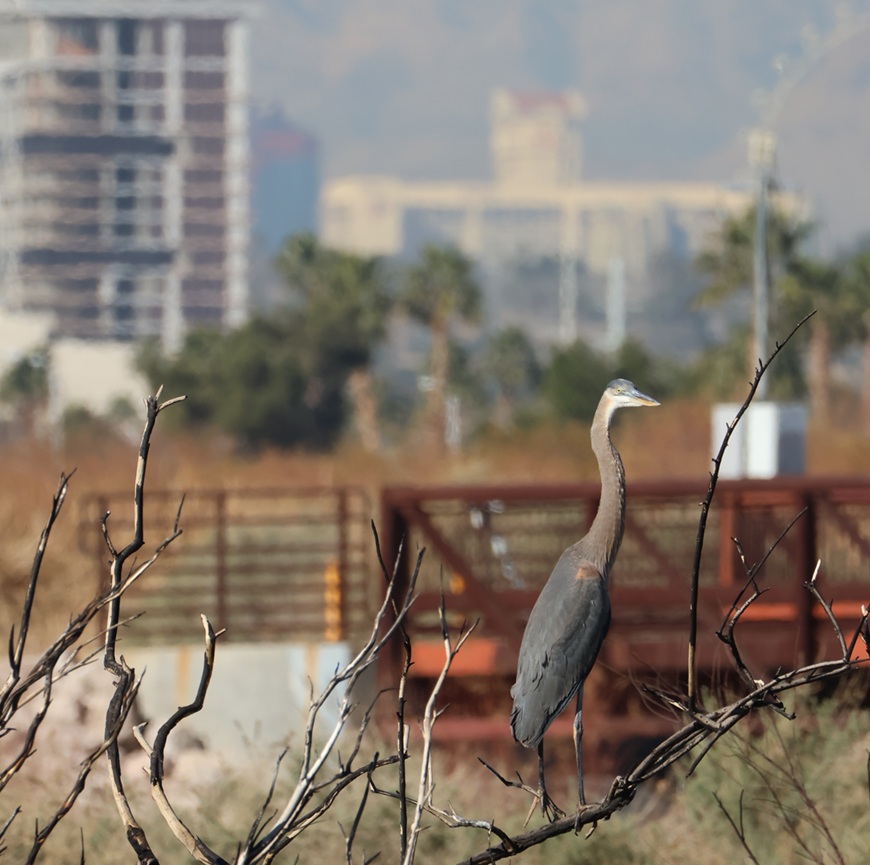
They’re usually seen standing silently on the bank of a river or lake while hunting fish, but it’s not terribly unusual to see great blue herons (Ardea herodias) find a perch (a place to rest, not a type of fish) in a tree. This particular perch was perhaps 3 feet off the ground, so I don’t think that this 45- to 54-inch-tall (115-138 cm) bird found much advantage in this position, but I’m not one to question such decisions. These are the largest herons found in North America; their wingspans measure 66-79 inches (167-201 cm). Great blue herons are found from throughout Canada down through the United States, Mexico, and South America. They are an apex predator of wetlands, where their diet includes small mammals, reptiles, and invertebrates, in addition to fish.
Some incidental notes about this photo: the brown railed structure in the background is part of the bridge that crosses the Las Vegas Wash. Most of the photos of ducks and other waterbirds in the river were taken from that bridge. The Las Vegas Wash (“wash” in the American Southwest refers to a usually intermittent riverbed) runs from the city all the way to Lake Mead about 30 miles downstream, transporting treated wastewater and runoff along the way. The water from Lake Mead finds its way back to Las Vegas via pumping stations and other infrastructure to be used again. At the top left corner is the Eastside Cannery, a 16-story hotel and casino at Boulder Highway and Nellis Boulevard, just south of the campground where we spend the winters. The 307-room property was built at a cost of $250 million and completed in 2008. The property was purchased by Boyd Gaming (owner and operator of many gaming properties around Las Vegas and the United States) in 2016. The Eastside Cannery casino and hotel closed due to COVID-19 in March 2020 and never reopened; it is set to be imploded two days from this writing (that is, on March 5, 2026).
And so it goes.
Not a bird
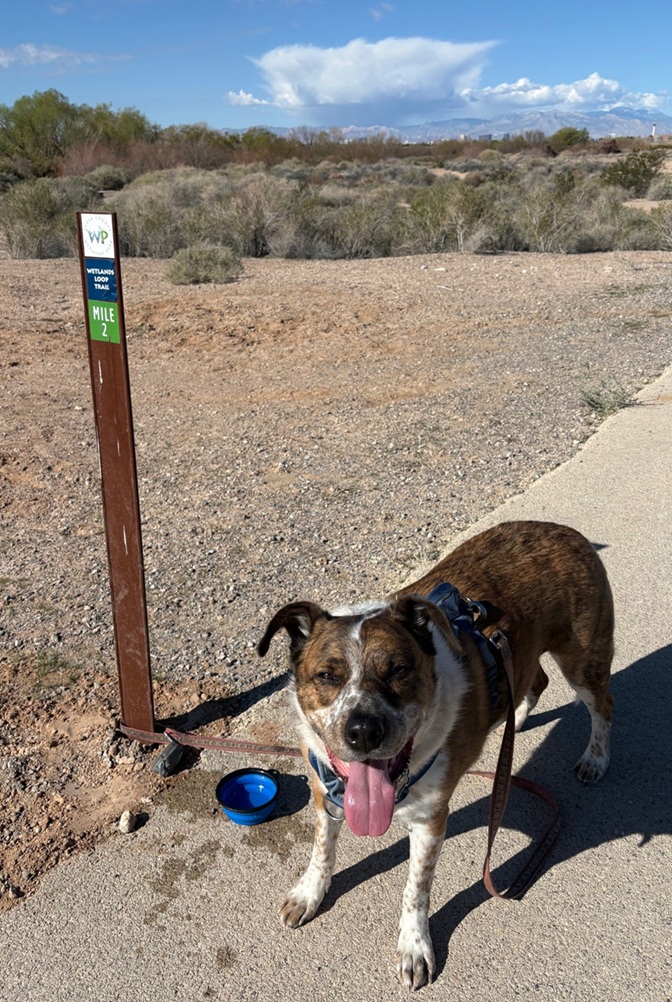
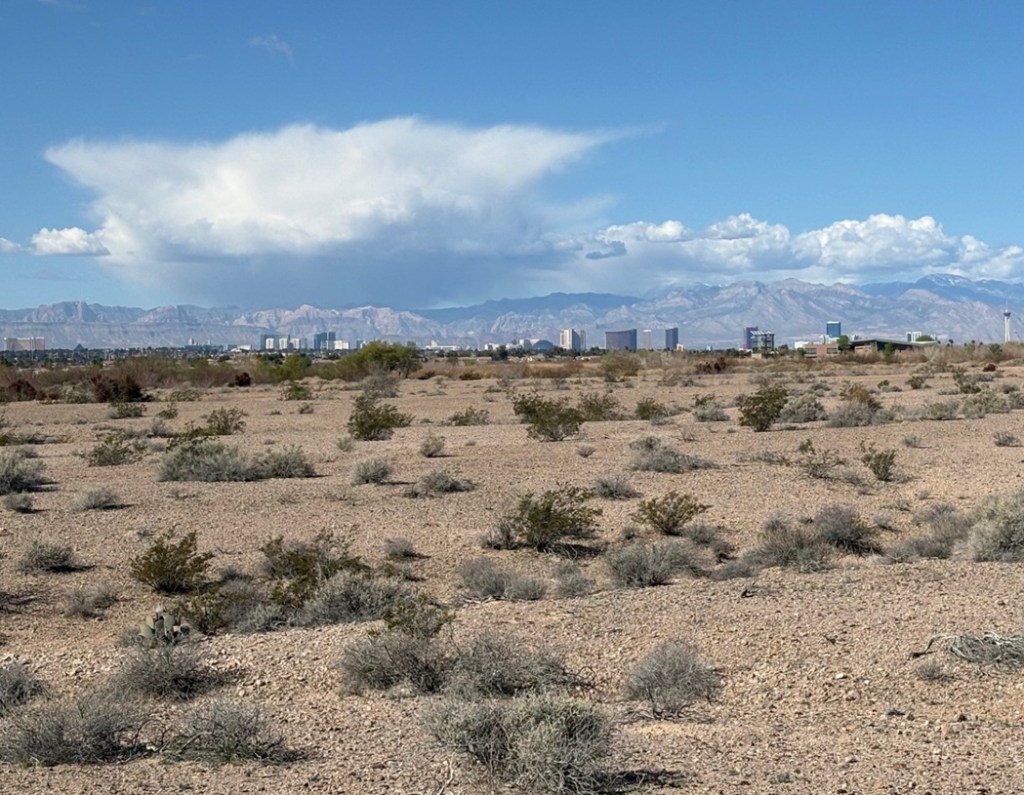
Halfway through – time for a water break! This is actually the halfway point on the Wetlands Loop Trail that Gunther and I enjoyed a couple of times this past winter. Gunther probably got at least as much water in him as he did on the sidewalk. The buildings just this side of the mountains are on Las Vegas Boulevard (“The Strip”); that’s the 1,149-foot-tall (350 m) white tower of The Strat (formerly The Stratosphere) at the right edge of the photo. It is the tallest observation tower in the United States. Readers of a certain age will remember Vegas World, a property owned by Bob Stupak that opened in 1979; some of that casino and hotel was refurbished into The Stratosphere, which opened on April 30, 1996.Here’s another photo of The Strip, taken a little later in our walk (notice the cumulonimbus cloud at left) and showing some of the Mohave Desert terrain typical of Clark County Wetlands Park when you’re not next to the water provided by the Las Vegas Wash. This viewpoint is about 10 miles east of The Strip. The white tower of The Strat is at far right; the beige Mandalay Bay is at far left (the pyramid of the Luxor Hotel & Casino is just to Mandalay Bay’s right) and about five miles south of The Strat. All of the other Strip properties, like Caesar’s Palace, Paris, The Bellagio, the MGM Grand Las Vegas, The Flamingo, The Wynn – there are 30 in all – are in between. Incidentally, the biggest hotel on the strip, the MGM Grand Las Vegas, has 4,762 rooms – more than a third of the total number of hotel rooms in all of downtown Denver. Mandalay Bay is the southernmost large hotel and casino on The Strip; The Strat, five miles north, is located within the city limits of Las Vegas and therefore, according to Clark County, not technically on The Strip.
And so it still goes.
Greater roadrunner
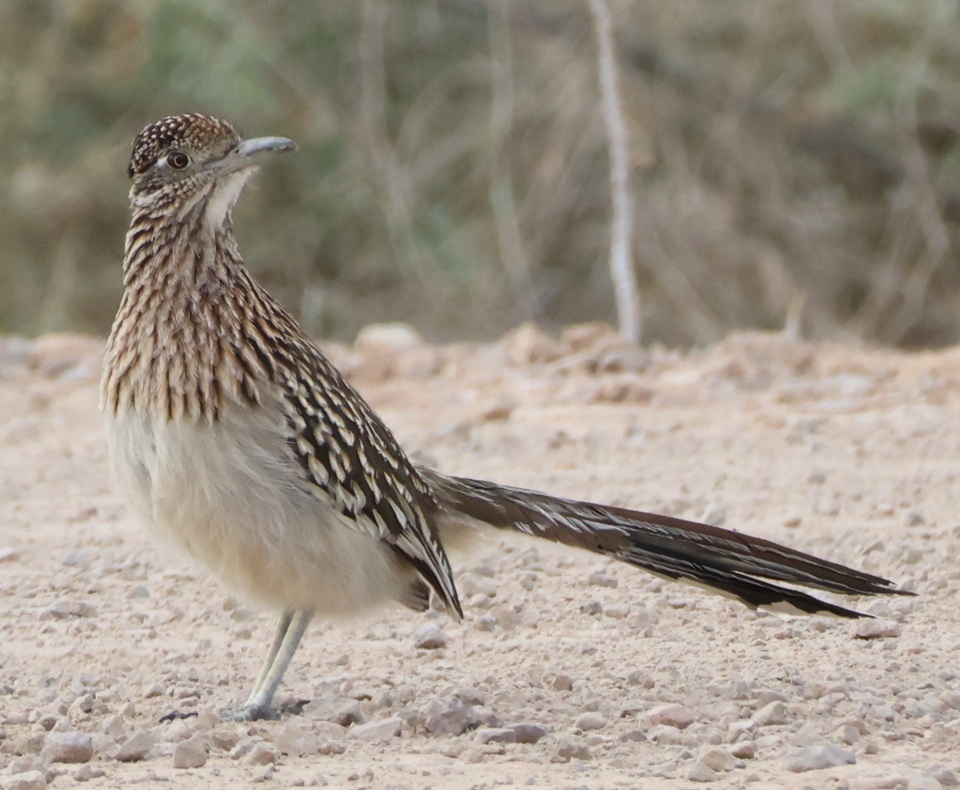
Let’s get back to birds, with this photo I took on Jan. 23, 2026. One of the reasons I include the scientific names of birds in these postings is because they’re just fun to say. This is Geococcyx californianus, the “Californian earth-cuckoo.” The only other member of the Geococcyx genus is the Geococcyx velox (that, too, is fun to say), the lesser roadrunner, which is found only in Central America. Standing 9 3/4 to 11 3/4 inches (25-30 cm) tall, the greater roadrunner is the largest cuckoo on the American continent. Roadrunners have zygodactyl feet, meaning they have two toes in the front and two toes in the back of the foot [as opposed to most birds, which have three toes in the front and one toe in the back (anisodactyl)]. Osprey, too, are zygodactyl: the configuration allows them to carry their fish prey in the air facing forward, rather than side-to-side, for better aerodynamics. I saw this greater roadrunner while it was running on a road; it was great.
Mallard
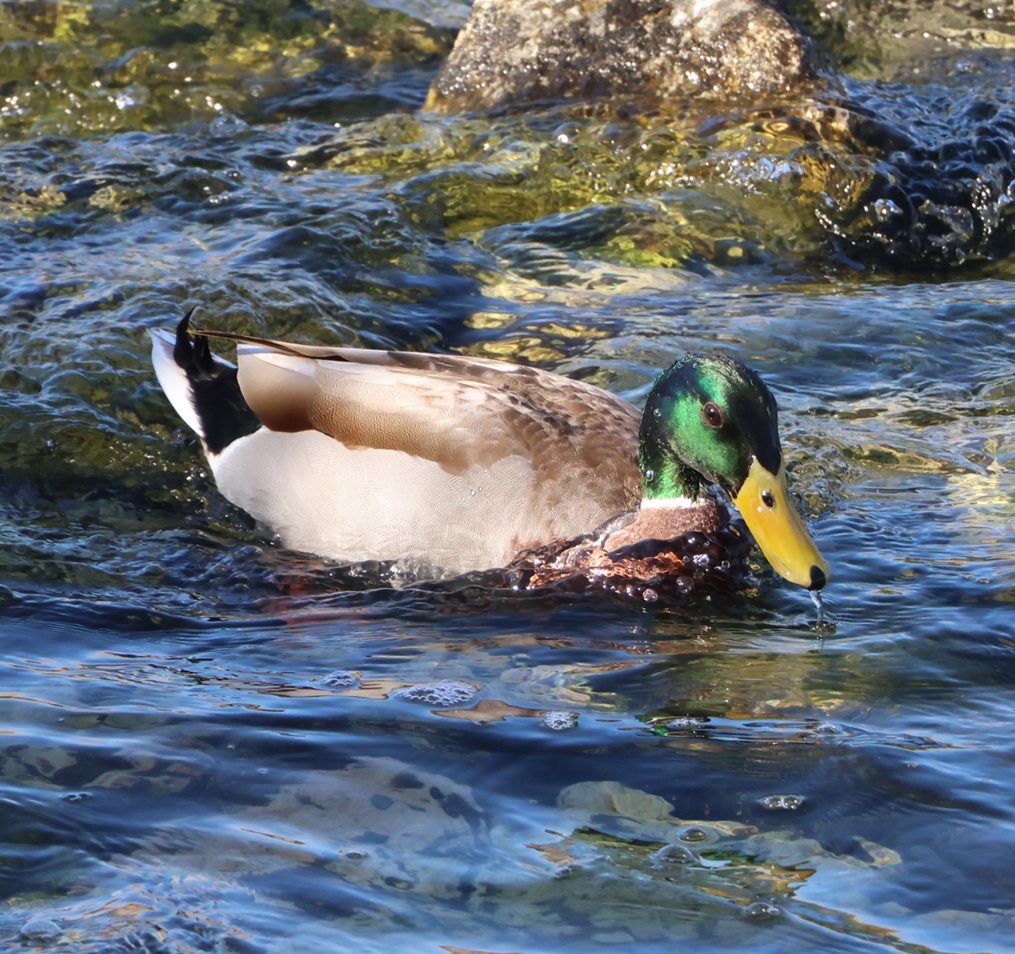
Most readers will recognize this handsome fellow as a mallard (Anas platyrhynchos) which is one of the largest species of dabbling ducks, or ducks that feed mostly on the top of the water rather than diving down for their prey (like, say, a common merganser). Mallards are 20 to 26 inches (50-65 cm) long, with wingspans measuring 32 to 39 inches (81-98 cm). The drakes have these gorgeous green heads while hens have more restrained brown overall coloration. I’ve taken lots and lots of photos of ducks in general and mallards specifically over the last four or five years. I’ve never been as close as I was to this one when I took this on Feb. 13, 2026, from the Las Vegas Wash bridge. I’m happy with how this photo turned out. Look at that duck dabble!
Ring-necked duck
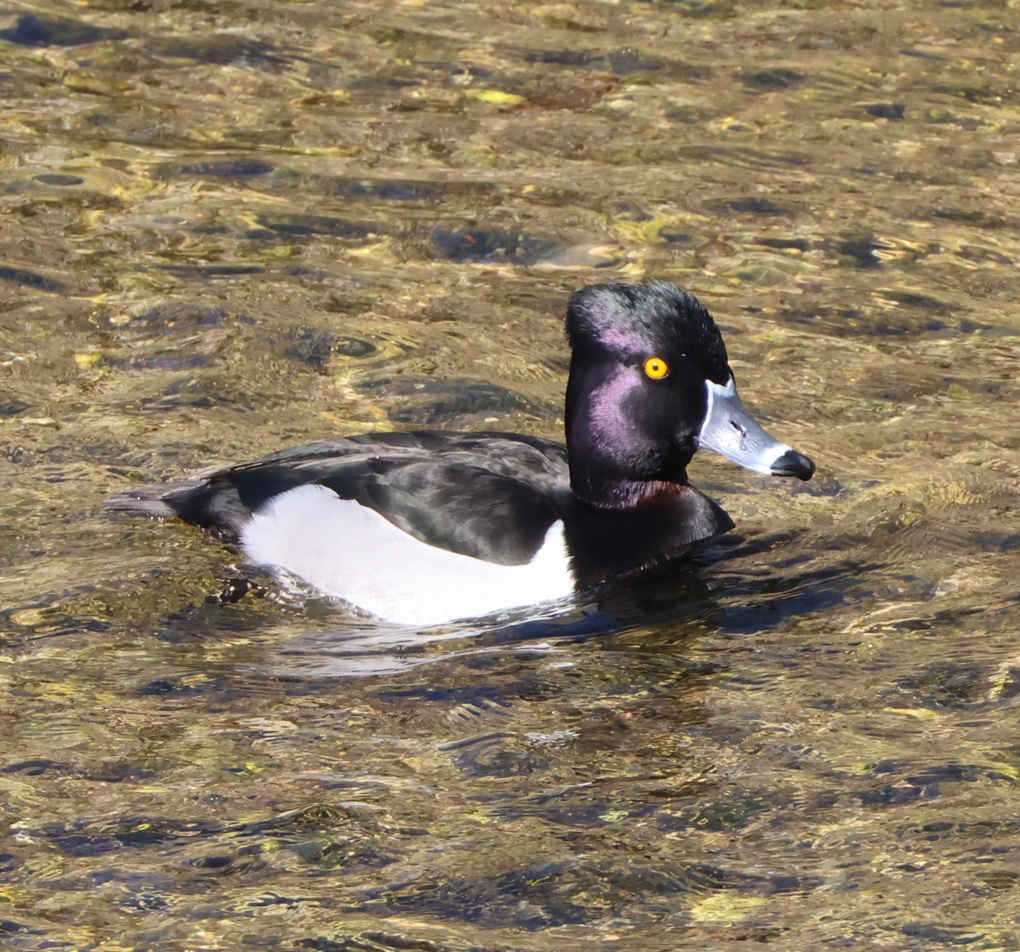
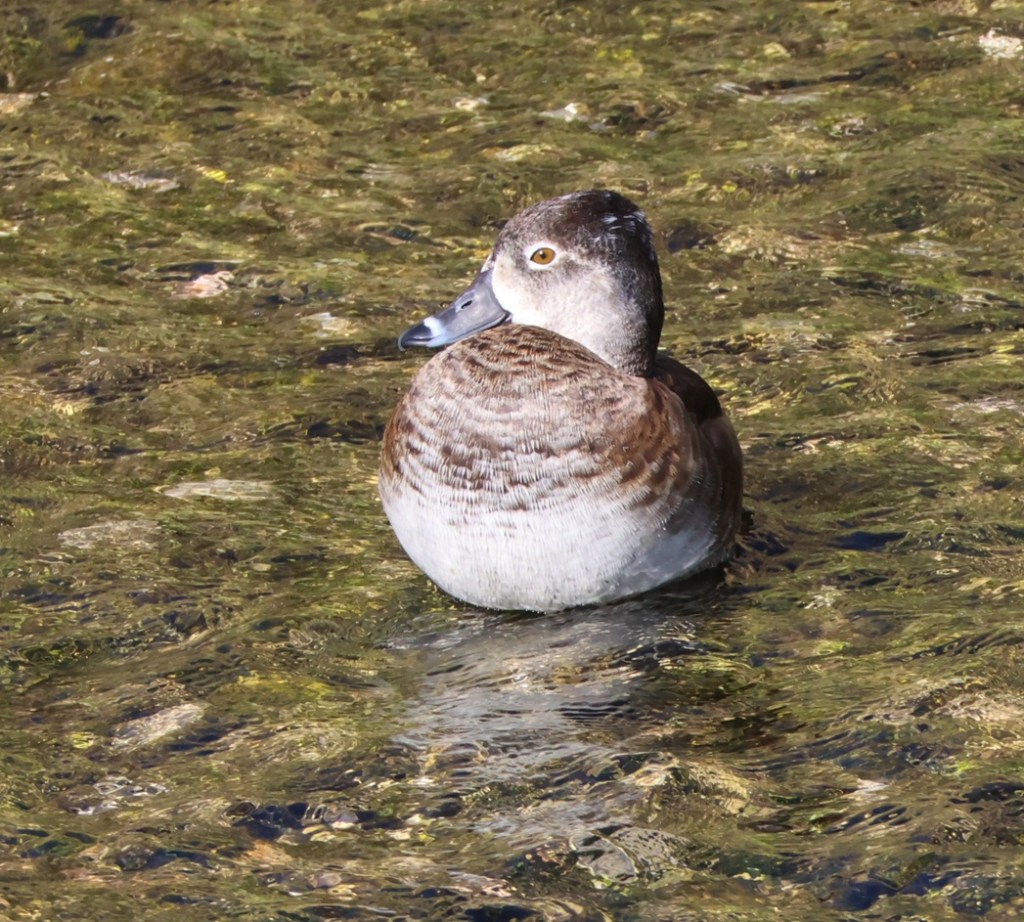
Doubling down on ducks: these are ring-necked ducks (Aythya collaris), a drake (top) and a hen. This species is a diving duck, which, appearances aside, significantly differentiates it from a dabbling duck like the mallard. Genetic research shows that, while diving ducks and dabbling ducks may look similar in body style (morphology), they are different enough that it’s likely they evolved separately. For instance, the feet on diving ducks are placed further back on their bodies than those on dabbling ducks to help propel them underwater – but for that reason, a dabbling duck is better able to walk about on land. Don’t bother looking for the rings on these ducks’ necks: they’re very difficult to discern. This species is sometimes called a ringbill because the rings on the bills are distinct. Just look at that hen. Doesn’t she have a calming presence?
Not a bird, again
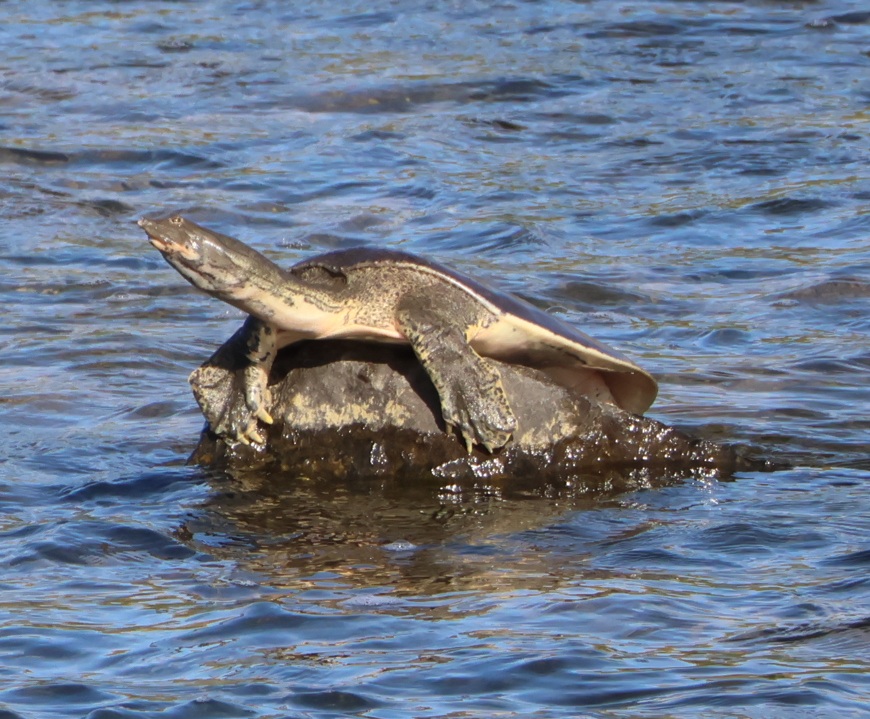
A little over a year ago, I got a new camera and lens that allow me to take photos of fairly far-away birds. With a teleconverter attached, it’s effectively around a 500mm telephoto lens. Sometimes the birds are so far away that I can’t really tell what kind of bird it is that I’m photographing. For instance, when I took the earlier photos of the crissal thrasher, I was 95% sure that it was a northern mockingbird until I got home and looked at the photos closer to full-size. Same thing happened with a loggerhead shrike this winter: I thought it, too, was a northern mockingbird until I got home. Well, this thing in the Las Vegas Wash, photographed on Feb. 13, 2026 from maybe 75 yards (68 m) away, looked to my eyes like some kind of bird so I took its picture. I was wrong. It is, as the heading indicates, not a bird. This is a Texas spiny softshell turtle (Apalone spinifera emoryi), a non-native species to the Las Vegas Wash. This is most likely a female, because a female Texas spiny softshell turtle has a carapace (something akin to a shell) measuring about two feet (61 cm) long. The species is naturally found in the Rio Grande and Pecos river drainages of Texas and New Mexico, but someone (likely) released this species into the Las Vegas Wash some time ago and now they’re pretty well established. This is yet another reason that I will never dip my toe in the Las Vegas Wash.
Verdin
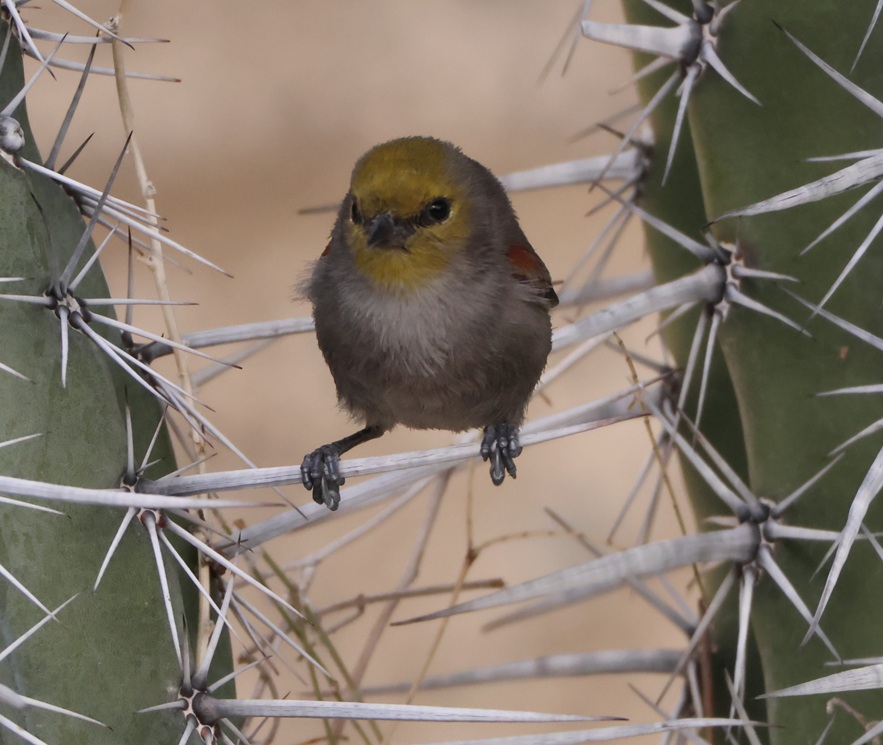
Let us turn away from turtles and return once again back to birds. This was one of the last birds I photographed in our winter in Las Vegas. It was one of four or five verdins (Auriparus flaviceps – that one’s fun to say, too) at Springs Preserve on Feb. 28, 2026, that were flitting back and forth between a tall tree and this good-sized pipe organ cactus. I was finally able to get a couple of decent photos when this one settled for a bit on a cactus thorn. That’s a good-sized thorn: a verdin is only 4 1/2 inches (11 cm) in length. I got some decent pictures of verdins over the winter at Clark County Wetlands Park, but I’m happy with this photo (and I’m also well-aware that it is 95 percent luck). We saw several of these beautiful little birds entering and exiting their nests while at Springs Preserve: it’s an exciting time of year!
White-crowned sparrow
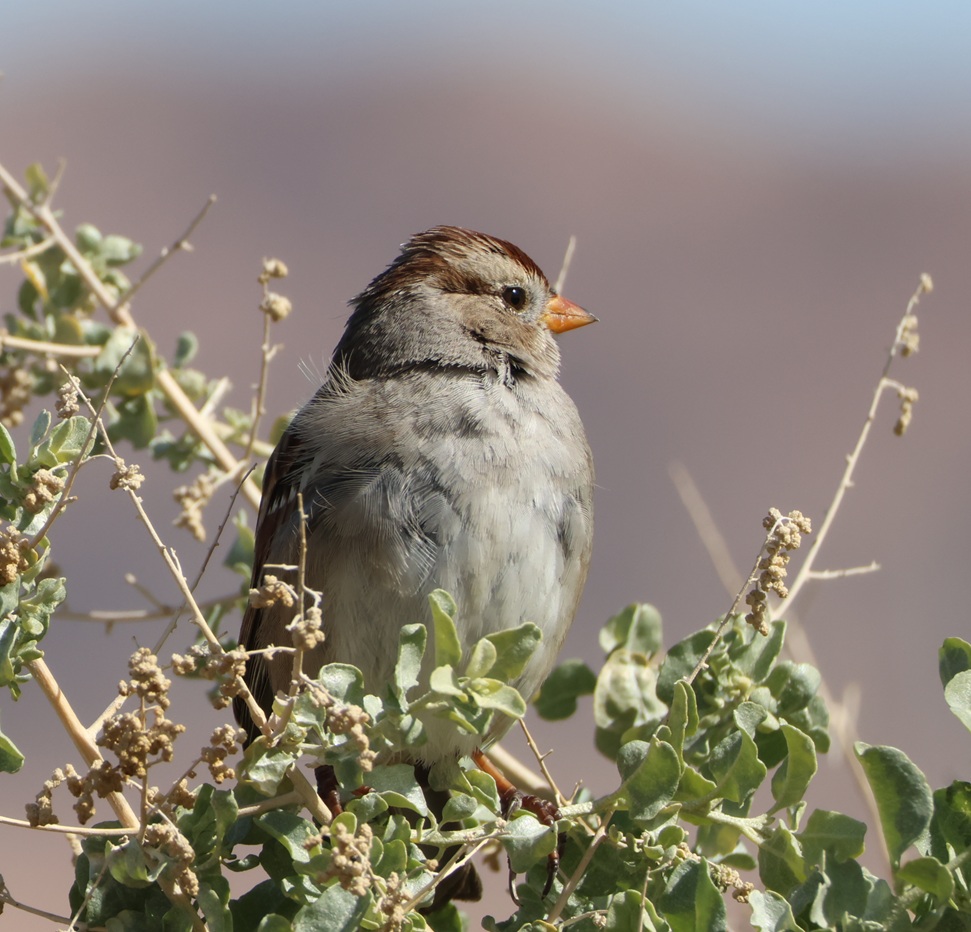
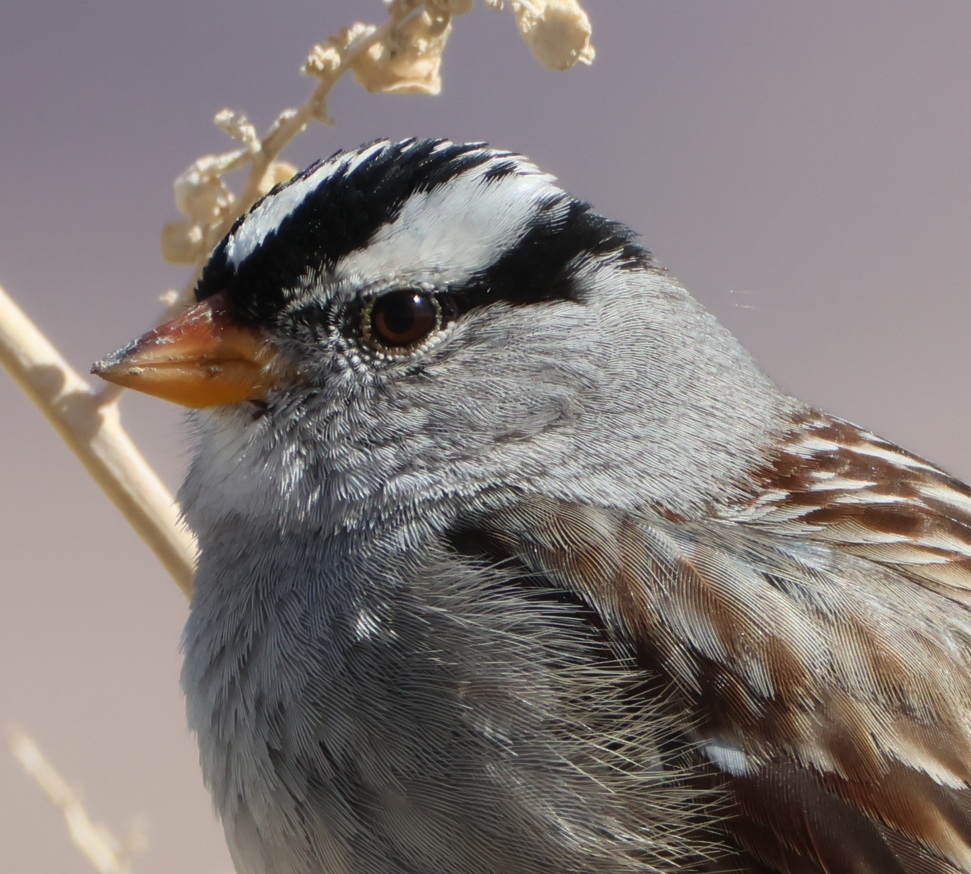
As I noted above, I have a camera that lets me get photos of far-away subjects. It also works pretty well when the birds are relatively close. At the trailhead of the Wetlands Loop Trail at Clark County Wetlands Park, the sidewalk goes by a lot of shrubs called four-wing saltbush. Those shrubs provide a favored perch for white-crowned sparrows (Zonotrichia leucophrys), who usually let Gunther and me walk on by, without taking off, when we’re on the trail. I was able to photograph a juvenile (top) and adult from a very close perspective. White-crowned sparrows are among the most gregarious wild birds I know, and the ones that hang out next to the Wetlands Loop Trailhead are perhaps the most sociable I’ve ever seen. Maybe it’s all the foot and bike traffic they see during the day, but it was great to be able to get these detailed photos for a close look at their feathers and coloration.
One of the things that really appeals to be about birdwatching is being able to see the similarities and differences between species: the coloration (some species have wildly different color patterns between males and females, for instance); the differences in size and shape of beaks/bills, wings, and tails; even noting that in some species, like ring-necked ducks, the drakes have bright yellow eyes and the hens have beautiful brown eyes. All of the birds in this posting were photographed within no more than 15 miles of each other: the riparian habitat at Clark County Wetlands Park brings a lot of birds to Las Vegas that wouldn’t normally stop there, and there’s great diversity even between the native desert birds like crissal thrashers and hummingbirds.
I keep a list, beginning on Jan. 1 of each year, to keep track of how many different bird species I see during that year. My goal is always 100 different species, and I’ve never met it (I got to 94 in 2023, 62 in 2024, and 96 in 2025). In the first two months of 2026, I’ve recorded 36 different species, all of which were observed in either Clark County Wetlands Park or the Springs Preserve in Las Vegas. With a 3,000-mile trip scheduled through the American Southwest, Midwest, and Upper Midwest, along with a 3,000-mile trip back to Las Vegas in the fall, I’m feeling pretty good about my chances of meeting my goal of 100 observed bird species this year. I hope my little Anna’s hummingbird pal is back on top of his tree next to the dog run when we return to Las Vegas in December.
Bird species observed in the Las Vegas, Nevada, area in January and February 2026
The ABQ BioPark includes the city’s Botanic Garden, Aquarium, and Zoo. The first two attractions are next to each other, just a short distance from the Old Town Plaza of Albuquerque. We visited the Botanic Garden on Nov. 14 and had a lovely time. We’ve been to a couple of other botanic gardens in the American Southwest (Tucson and Phoenix), and Albuquerque’s is definitely a jewel – even though our visit was during the offseason when there were very few flowering plants.
A number of structures, representing plants, animals, and holiday decorations, for the garden’s holiday light display were already out, although the nightly display didn’t start for another week or two. Still, it was pretty neat to see the structures close up and ready to go.
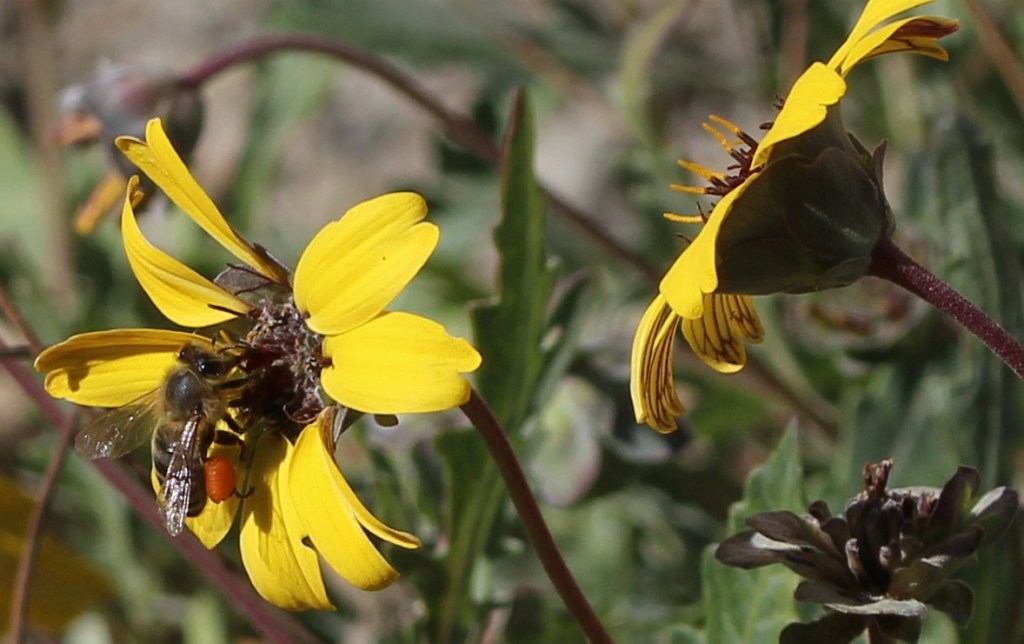
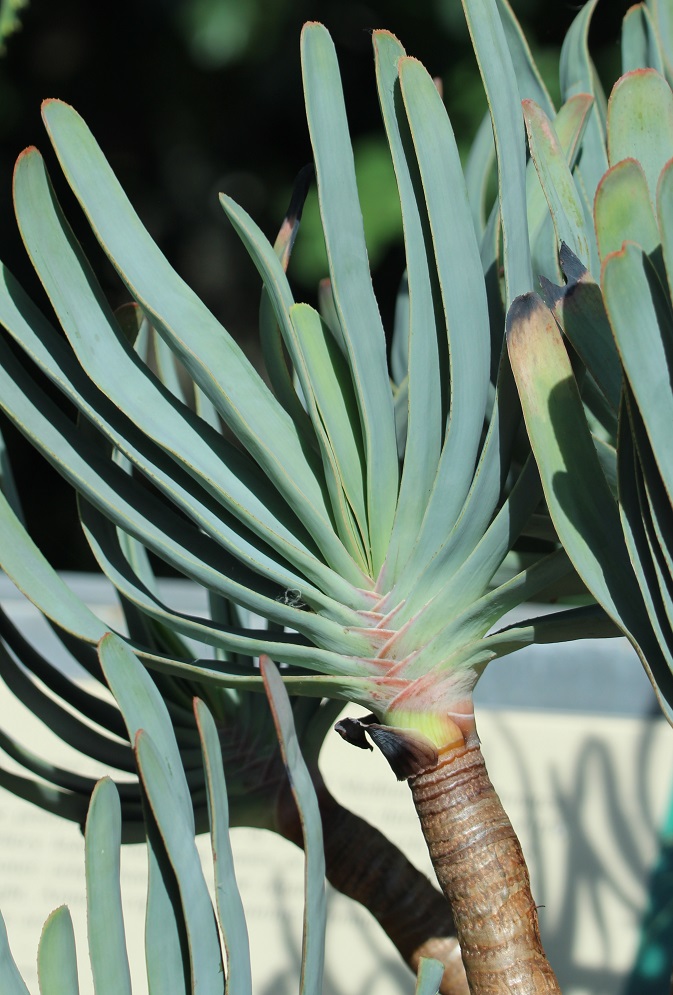
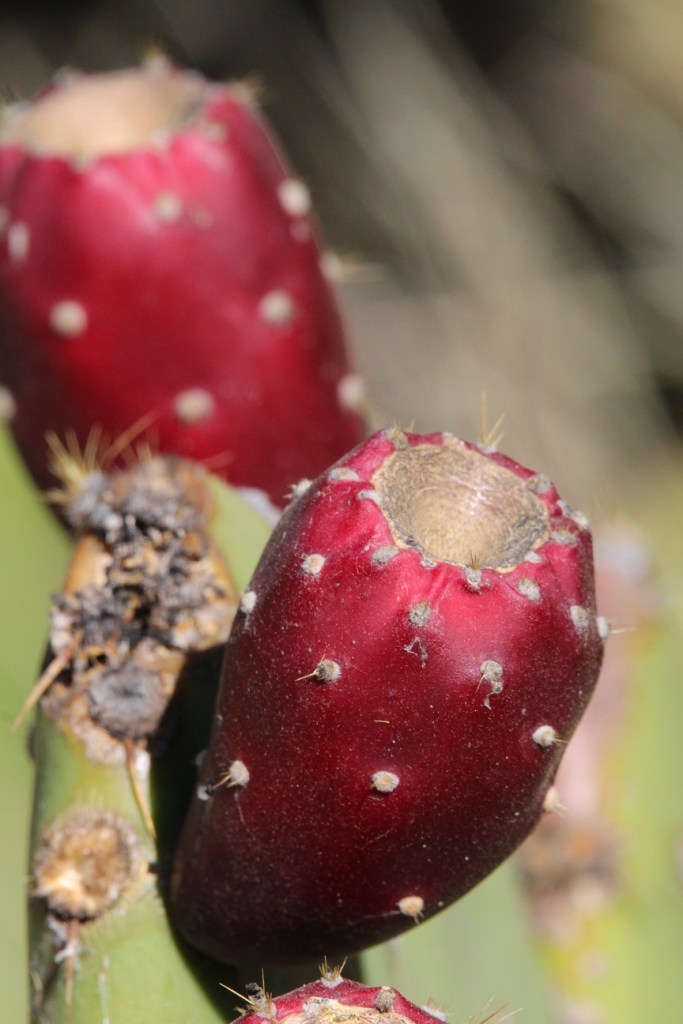
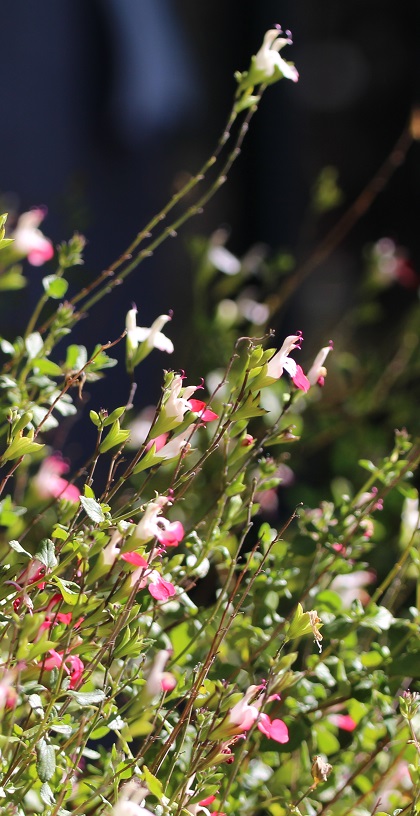
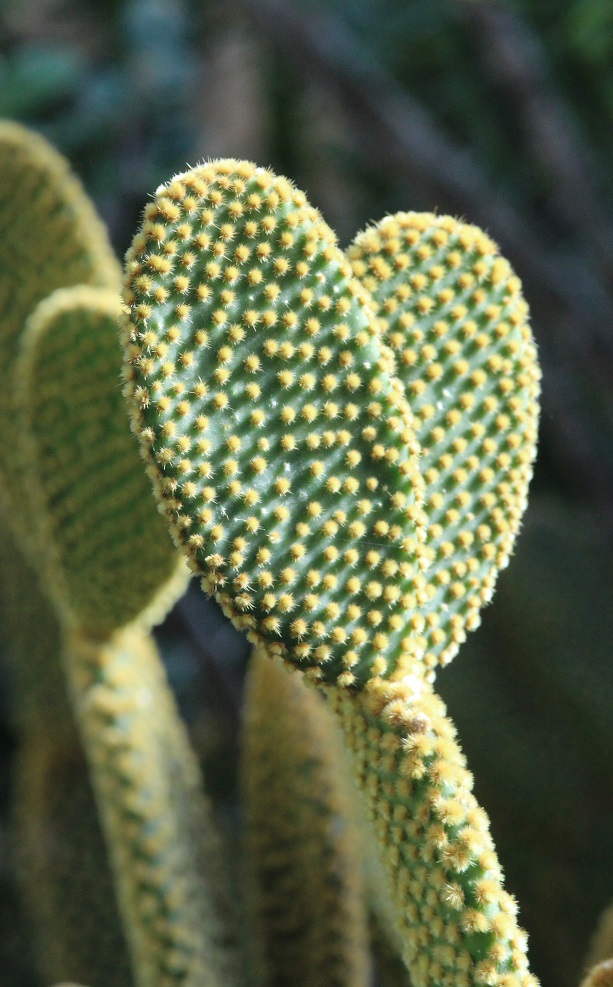
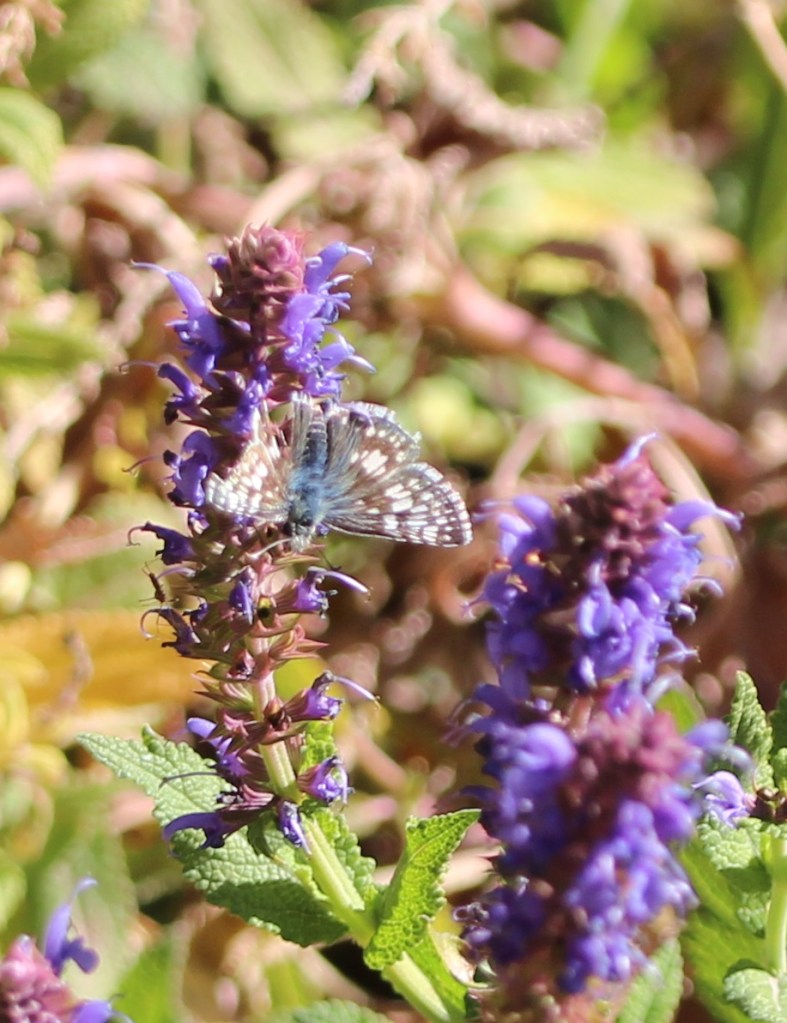
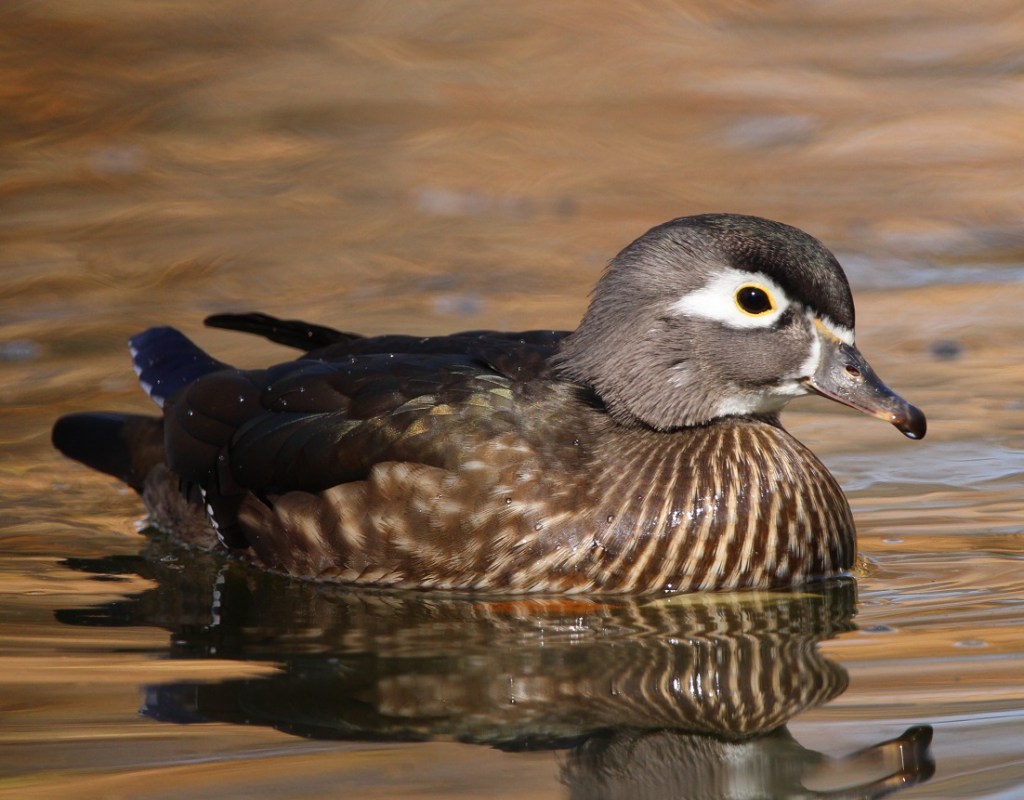
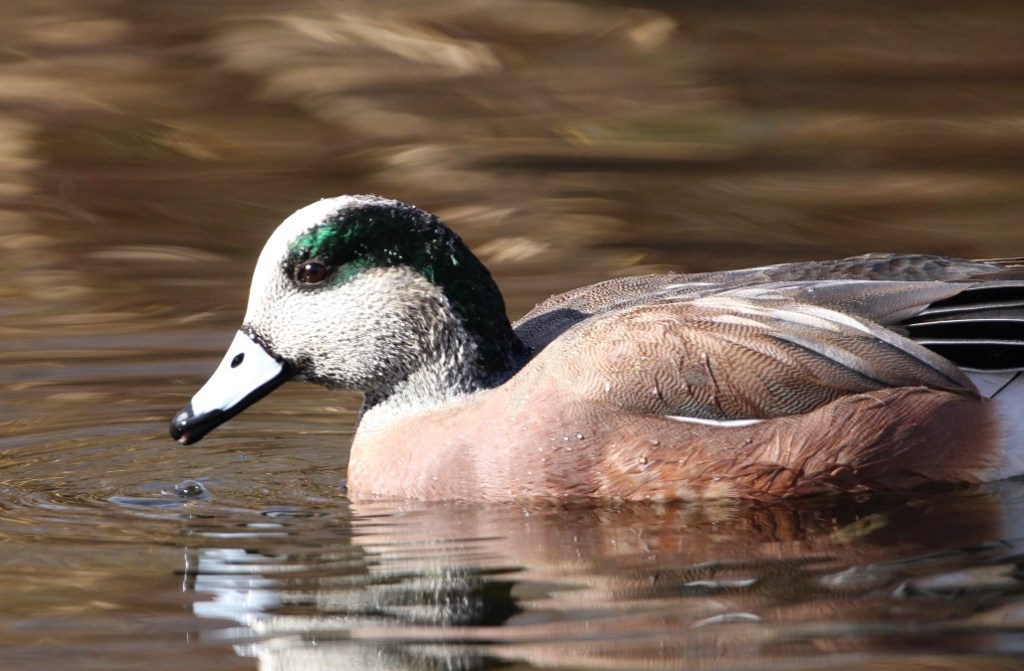
Although it was mid-November, there were still a few plants in bloom like this Chocolate Flower (Berlandiera lyrata) hosting a bee that, judging from the amount of pollen on its legs, had already been very busy that morning.This fan aloe (Kumara plicatilis) is a native of South Africa. It’s one of many eye-catching succulent plants that were on display in a couple of different buildings at the garden.The fruit of the Texas prickly pear (Opuntia engelmannii) makes for good eating by animals and humans alike. When we were on a guided tour of Old Town Albuquerque the previous weekend, one of our fellow tourists (who was apparently not from the United States) picked one of these off the host cactus with his bare hand. He regretted that decision.This was another outside plant that was in full bloom and attracting bees – it’s Autumn Sage (Salvia greggii).This distinctive cactus was potted inside a building. It’s Opuntia microdasys, or bunny ears, and it’s native to Mexico.The thing I love most about going to botanic gardens is seeing all of the different wildlife that enjoy the plants as well. This is a common checkered-skipper (Pyrgus communis) pollinating a woodland sage (Salvia nemorosa) plant. These butterflies are found from Canada all the way into Mexico. The photo’s blurry, but the butterfly wasn’t being very cooperative in holding still.In the very pretty Japanese garden area, the Nanking cherry trees (Prunus tomentosa) were full of fruit. These are enjoyed by birds and humans too; they’re more closely related to plums than to true cherries.By the time you hear the wingflaps, it’s already too late. Much as we did the day before at Rio Grande Visitor Center State Park, we heard a lot of sandhill cranes flying overhead. These were low enough to photograph.I saw my first-ever wood duck at the state park on Saturday but didn’t get a decent photo. There were plenty of wood ducks in one of the Botanic Garden’s ponds. They’re remarkably beautiful birds. This is a hen and drake pair.As incredibly gaudy as the drakes are, the wood duck hens are very attractive as well. This little lady seems to have a contented smile.Wood duck drakes are just amazingly beautiful, but they look like they were put together by several different committees of very talented artists who didn’t communicate very well in the design process.Here’s another bird that was new to me: the American wigeon. They are found throughout North America except the furthest reaches of northern Canada. This is a drake …… and here’s a hen. The very pretty light blue bill of the wigeon shows up better in this photo. She’s on the move to someplace that must be very important to be.Here’s another new-to-me bird: the black phoebe (Sayornis nigricans). They’re about six inches tall and the males and females have the same coloration. Black phoebes are found in the southwestern United States, and central New Mexico is about as far north as they go. This one was hanging out on a sculpture in the pond, keeping an eye out for flying bugs.I’ll close this posting with yet another photo of a wood duck. The lighting’s no good on it (although the mahogany color at the base of the tail is very pretty), but I really like that the duck is looking up – I don’t see ducks doing that very often. You may well wonder what this one was looking up at, so I may as well tell you: the duck was looking up at a little boy named Owen. How did we know the duck was looking up at Owen? Because Owen was standing behind a fence over the pond, tossing dried leaves to the ducks. How did we know the boy’s name was Owen? Because we heard his name being called about 300 times by his little friends. We hope that Owen and his friends slept well that night, because we know they had a very active day at the ABQ BioPark Botanic Garden.







 Tales of The Goddard