Deming Luna Mimbres Museum

December 11, 2021

Nancy and I are big into museums. We absolutely love them, and it doesn’t really make much difference what the museum’s about; we’re interested in taking a look. Well, except maybe for museums devoted to dolls. Or clowns. Or clown dolls.

There were definitely dolls on display at the Deming Luna Mimbres Museum in Deming, New Mexico, when we visited, and some of them may well have been clown dolls. We didn’t stop at the exhibit to investigate. However, there was much more of interest to take a look at in this 20,000-square-foot museum skillfully managed by the Luna County Historical Society, and there’s something for everyone there.

About the name of the museum: it’s in the city of Deming (more about that later), in Luna County (and Deming is the county seat), and the Mimbres are a branch of the Mogollon culture, Native American peoples who lived in present-day southern Arizona and New Mexico from around 200 CE to when the Spanish arrived in the 1400s and 1500s. There are many cultural references to the Mimbres in this area.

The museum is mostly contained within the walls of this 1916 brick building. It’s a former National Guard Armory. Image credit: Deming Luna Mimbres Museum, because I somehow forgot to take an exterior photo of this impressive structure.

Nancy and I agreed that, other than Harold Warp’s Pioneer Village in Minden, Nebraska, the Deming museum is one of the largest and widest-ranging local museums we’ve visited. If you’ve got an interest in Native American pottery, it’s got you covered. Want to see a lot – a lot – of geodes? You won’t be disappointed. Curious about early public schools in Deming? You’ll leave wiser for the experience. Fancy yourself a railroad aficionado? Hang on to your engineer’s cap. The museum’s website suggests arriving no later than 11 AM to ensure that visitors have plenty of time to see everything, and that’s sound advice.

Let’s start with the railroads. The city of Deming lies within the Gadsden Purchase, a nearly 30,000-square-mile area in present-day southern Arizona and southern New Mexico that was acquired from Mexico in 1854 solely so that a southern U.S. transcontinental railway could be built. The city has historical ties to four different railroads:

  • Southern Pacific Company, which began building a railroad from California to the Gulf of Mexico in the 1870s. The railroad reached Deming on Dec. 15, 1880.
  • Atchison, Topeka & Santa Fe Railroad, which wanted to expand its line from Kansas City to the Pacific Ocean. The Santa Fe reached Deming on March 8, 1881, and by an agreement with Southern Pacific, established a new transcontinental railroad with the driving of a silver stake. Despite that ceremony, competition between the two lines for trade along the route remained fierce through the 1980s.
  • Silver City, Deming & Pacific Railroad, which was incorporated in 1882 to transport copper ore from huge deposits in the hills about 50 miles north of Deming. A 48-mile narrow-gauge line between Silver City (silver was originally found in the area but that played out and was replaced by copper, which is still being very actively mined to this day) and Deming was completed on May 12, 1883. The Santa Fe bought the line in 1899.
  • El Paso & Southwestern, incorporated in 1901, started a line intended to connect Deming with Douglas, Arizona, to move copper ore from the Bisbee, Arizona, area to eastern markets. Executives with EP & SW wanted the Southern Pacific and Santa Fe lines to compete for their business at the Deming connection.

Deming is named for Mary Ann Deming Crocker, the wife of Southern Pacific executive Charles Crocker. The city was originally 10 miles east of its current location; there wasn’t sufficient water at that first location, so the townsite was moved to the west to take advantage of the Mimbres River location.

The number of railroads, in addition to being a port of entry from Mexico into the United States, gave promoters at the time the fanciful idea that Deming would grow to be a huge metropolis. It was even given the nickname of “New Chicago.” That idea did not pan out (although Deming is really a lovely city, its current population is around 14,000).

Because of Deming’s long association with railroads, the museum has an extensive exhibit devoted to railways, including uniforms of railway staff, timetables, equipment, and other memorabilia. Looks like I chose to take a somewhat disorienting picture of this Underwood typewriter, dating to the early 1900s, which was used in the Southern Pacific freight office.

Much of the popular culture around the “Old West” is centered on cattle drives and open range ranching. It’s said that two occurrences ended the open range period: horrific blizzards in the winters of 1887 and 1888, and the development of barbed wire. Although it had been initially developed a couple of decades prior, barbed wire wasn’t widely used until 1874, when Joseph Glidden, an Illinois farmer, developed a machine to make the fencing material efficiently. More than 500 U.S. patents were issued on different barbed wire patterns between 1868 and 1874. The introduction of barbed wire in the West allowed ranchers to keep their cattle in one area, but it also meant that migratory herds of buffalo weren’t able to move around. Barbed wire also, of course, had huge a impact on the Native American tribes that lived on the plains. There’s still a good deal of cattle ranching in the Deming area, at least in the areas that can be irrigated for pasture, and the museum has a nice little exhibit on barbed wire.

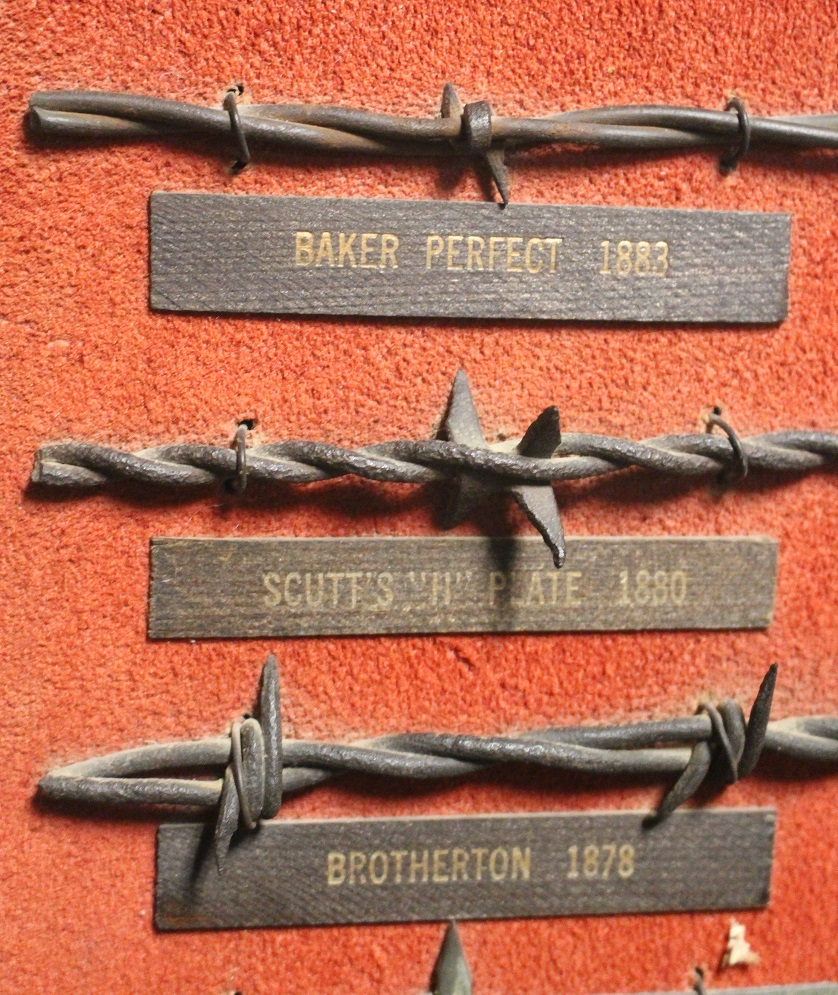
Barbed-wire buffs will recognize, from top, the following patents: Two Around Two, R.E. Sunderland (patented 1884), Crandal’s Champion (1879), D.C. Stover Clamp on Barb, and Kelly’s Diamond Point with Crimped Barb (1868).
Like many of the exhibits at the Deming museum, I suspect that this display was a gift from an area benefactor who had a strong interest in a very particular field (in this case, historic barbed wire). All of those barbs remind me of hiking on trails in New Mexico and trying to avoid cacti and other spiky hazards.

Writing of strong interests in very particular fields, the Deming museum has many display cases that contain thousands (I’m not exaggerating, and I may even be underestimating) of geodes. These rocks, which formed as bubbles in volcanic rock, contain a cavity that is filled with crystals, usually quartz. Rockhound State Park, a few miles south of Deming, is a great place to find lots of geodes. The ones that aren’t there are probably at the Deming museum.

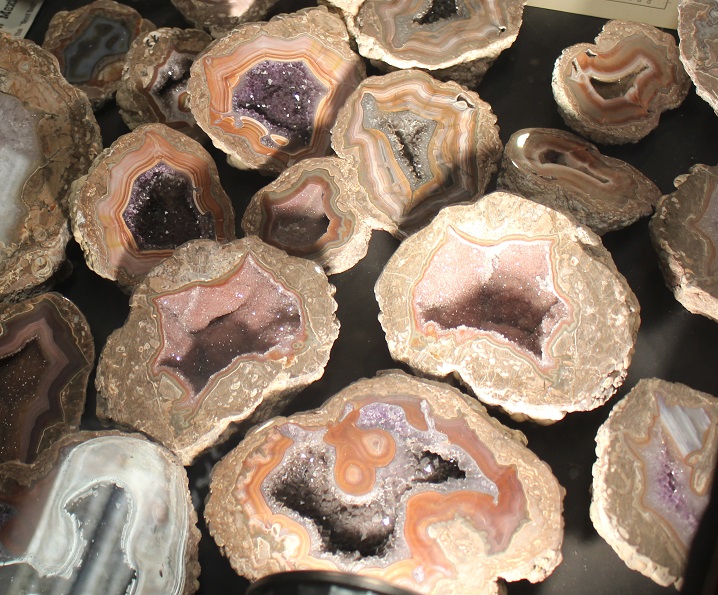
So. Many. Geodes.
Geodes are really pretty, though. But there were so many.

Writing of rocks, there were a number of other different kinds of rocks besides geodes, including dinosaur fossils, petrified wood, and samples of other minerals from all around the world.
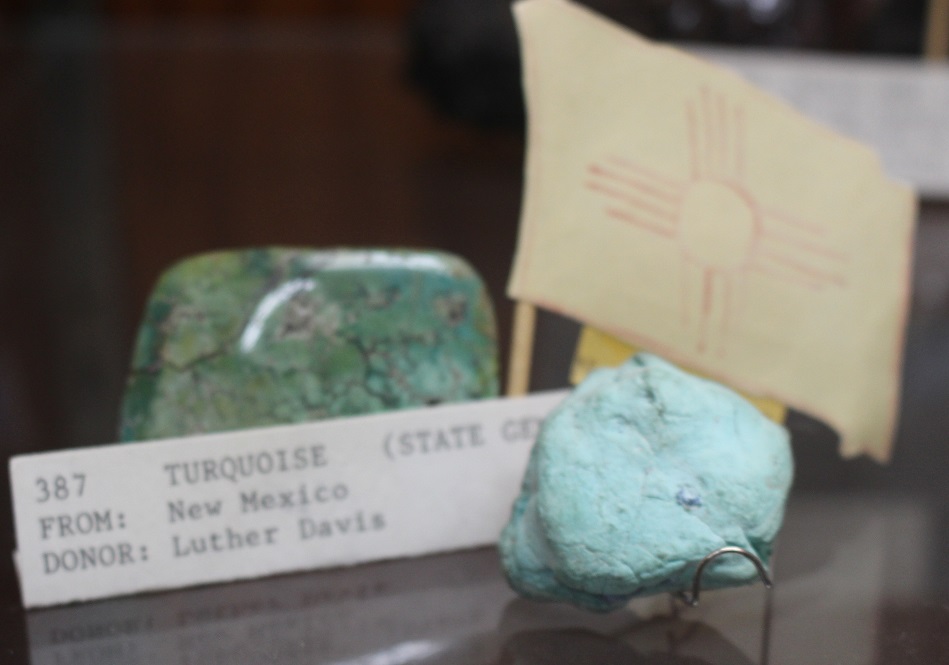
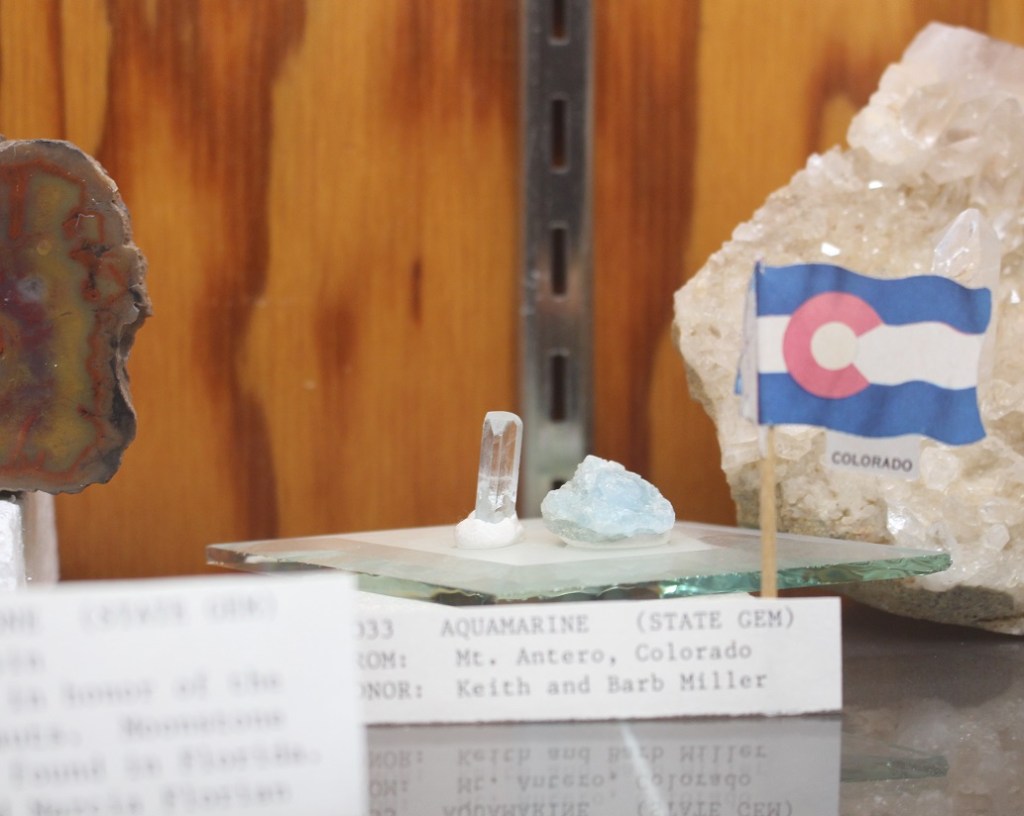
One display case had shelves of all of the states’ official gemstones and minerals. The state gemstone of New Mexico is turquoise. It’s easy to remember the name of this rock, because it’s turquoise-colored.
Nancy often reminds me that Colorado’s state gemstone is aquamarine, even when I don’t ask. It’s a lovely shade of light blue – almost, but not quite, turquoise-colored.
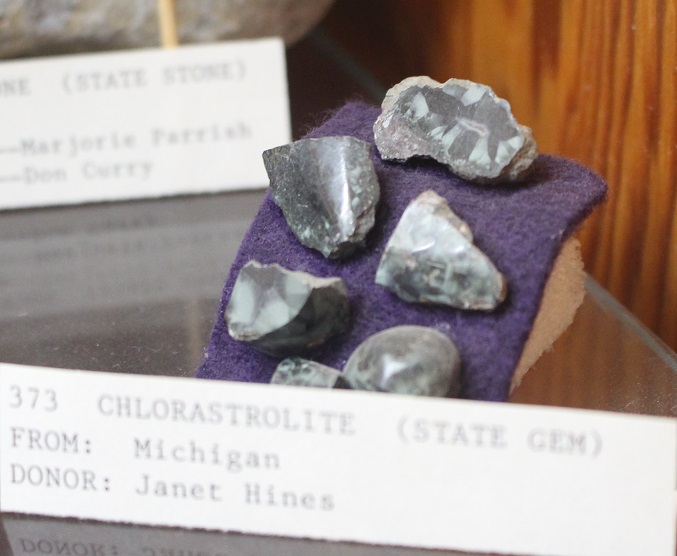
Finally here’s one for the Michiganders, who will of course recognize chlorastrolite (Ca2(Mg,Fe)Al2(SiO4)(Si2O7)•(OH)2H2O). It’s found in the Keweenaw Peninsula in the Upper Peninsula of Michigan and Lake Superior’s Isle Royale, but it’s not even close to being turquoise-colored.

Enough with the rocks. The museum has on display a couple of firetrucks from Deming’s earlier days, along with a display of other firefighting equipment.
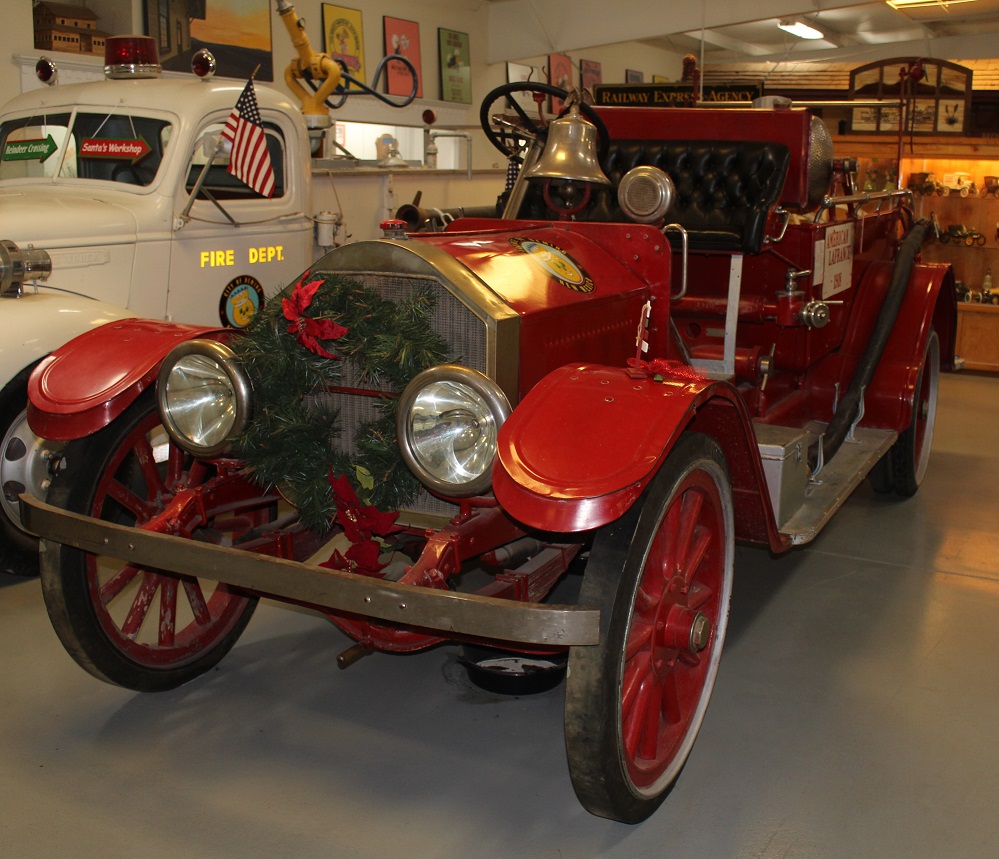
This 1918 American LaFrance fire engine was acquired by the city of Deming around 1919. It delivers 300 gallons of water per minute. LaFrance started making hand-pumped fire engines in 1832. The company was purchased by Freightliner, a Daimler-Chrysler company, in 1995. The descriptive placard on the engine asked observers to please note the hard rubber tires, and I must ask you to do the same. The Deming fire station at that time was staffed by at least one driver and four firemen at all hours. (The wreath on the grill is not standard-issue firefighting finery; the museum had a very nice holiday theme while we were there.)
I thought this map of cattle drives was really interesting. Most of us have heard of the Goodnight-Loving and Chisholm trails, but there were quite a few more that date back to Spanish and Mexican colonial times. The major trails had their heyday for about two decades after the end of the U.S. Civil War. Tens of thousands of longhorns were driven north from Texas to the railheads in Kansas, or further north and west into ranches in the surrounding territories.
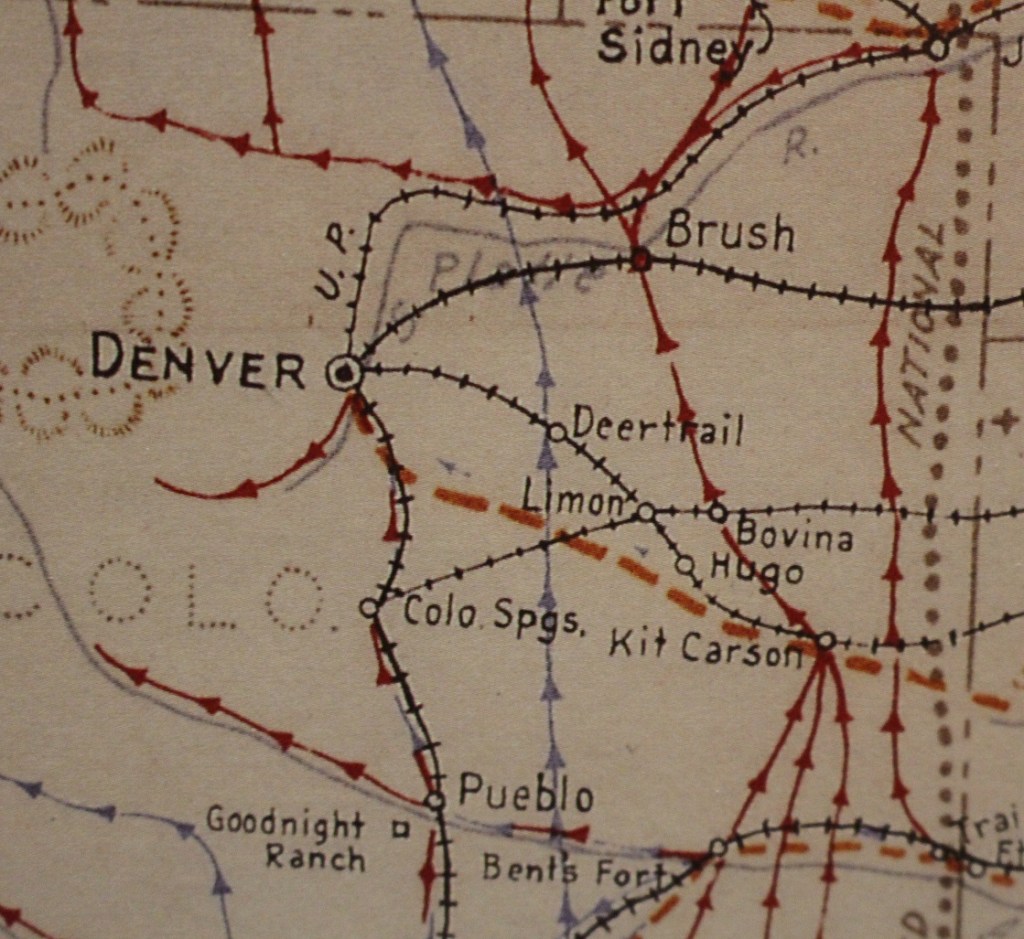
Here’s a closeup of that cattle drive map showing eastern Colorado. You’ve got the cities of Denver, Colorado Springs, and Pueblo, as well as towns around my hometown of Flagler (not indicated on map) like Hugo and Limon. It’s interesting that Bovina, which has an exit off of I-70 but otherwise doesn’t exist anymore, is shown. “Bovina” is the Spanish word for “cattle” – there used to be a number of ranches there. The map was compiled in 1992 from a variety of sources.

I didn’t take any pictures of it, but there’s a very nice display of some saddles, boots, chaps, and other equipment belonging to a locally famous rodeo cowboy from Deming who won a few bronco riding world championships in the 1950s and 1960s. He was asked in the 1980s, well after his retirement, what the difference between rodeo cowboys of the 1950s and the 1980s was and he replied, “Well, no one robs banks anymore.” I thought that was just hilarious.

The second floor of the museum, which we gradually discovered had previously been a full-size basketball court, had many more exhibits from Deming’s past, including a room devoted to some really beautiful formal Mexican clothing, an area with historic medical equipment (including an iron lung), and displays of memorabilia from Deming’s public schools through the years.

This cart was owned by Leonardo Reyes, who sold hot tamales in downtown Deming from the late 1930s to the early 1950s. The tamales were kept warm in the cart’s crock with heated bricks in the crock’s bottom. Note the hard rubber tires. I would normally have cropped out the display cases of German nutcrackers in the background, but this perspective, I think, gives one a better appreciation for the diversity and scope of the Deming museum.
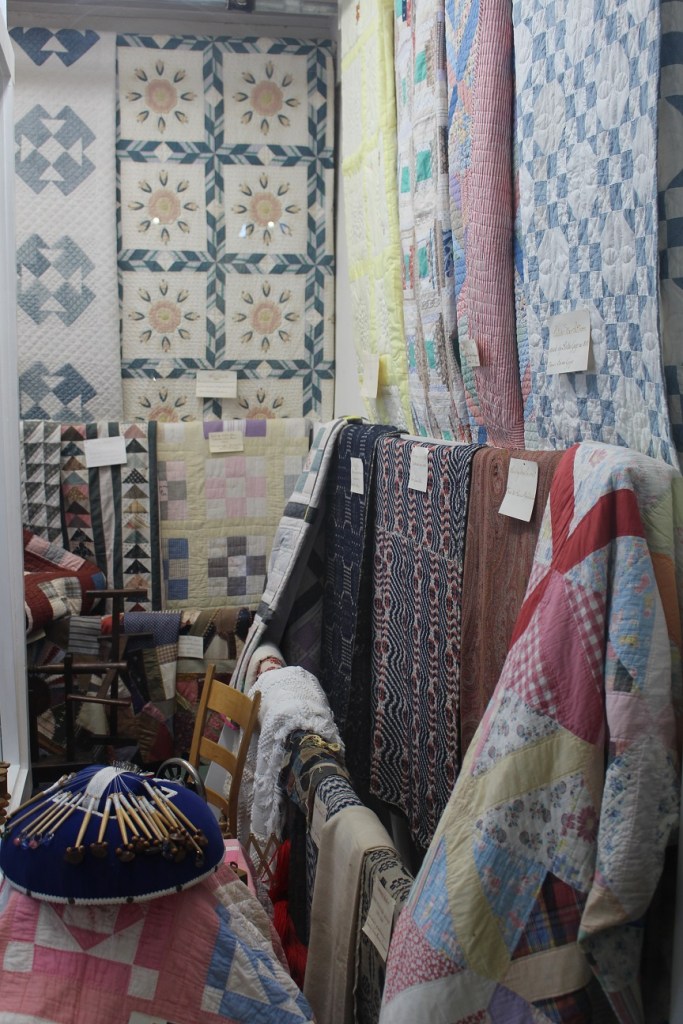
There’s a very nice display of quilts dating from the late 19th century (the blue one at upper right, for example, was made around 1885).
Here was a nasty shock for me: I used a Macintosh SE identical to this one (on the right) to write for my college’s weekly newspaper, and lay out the pages for printing, when I was a student in the late 1980s, and here’s one on display in a historical museum. I held out my hand to measure the screen; its diagonal length was almost exactly the distance between the tips of my thumb and pinky. And I used to lay out newspaper pages on it. Unbelievable. This dusty old artifact is shown next to an even older typewriter, and they are both part of an exhibit of office equipment used in Deming through the decades. [I just looked up the specifications of a Macintosh SE: the screen (monochromatic, naturally) measured 9 inches on the diagonal, it had 1 MB of RAM (expandable to 4 MB for a price well outside the budget of a collegiate newspaper), and it weighed 17 pounds. The laptop on which I’m writing has a 17-inch color display, 8 GB of RAM (8,000 times the RAM of the SE), and it cost less than what expanding an SE’s RAM to 4 MB would have been.]

The museum also has an extensive collection, both inside and outside, of military equipment dating back to before the U.S. Civil War. I’ll write about that collection in another posting.

The Deming Luna Mimbres Museum was a great visit for us, although, to be honest, it was a little overwhelming in some areas. I thought I had taken pictures of a display of dozens upon dozens of buttonhooks (again, I’m not kidding and I could definitely be undercounting), and that’s what I was going to end with, but I guess I didn’t get any photos. It’s unfortunate. While I was there, I wondered – a lot – about who would find some of these displays of any interest. But I realized that’s exactly why museums like these are so important: you’re pretty much guaranteed to find something of interest to you, and particularly you, whether that’s fire engines or commemorative Jim Beam whiskey decanters or geodes or ancient Macintosh computers or a copy of the Braille edition of Playboy magazine (again, not kidding) or German nutcrackers or horsedrawn hearses or iron lungs (the iron lung was stationary, not horsedrawn) or barbed wire (I actually do have an interest in barbed wire) or buttonhooks or Native American pottery. Everyone has their particular interest(s) that are absolutely appropriate for curating exhibits (except for dolls – there should never be dolls on display). I recently read of the existence of an International Jim Beam Bottle & Speciality Club (IJBBSC). It has more than 150 affiliated clubs and more than 5,000 members. I hope some of those IJBBSC members make it to the Deming Luna Mimbres Museum, because let me tell you: there’s an impressive collection of whiskey decanters to be enjoyed.

Meet the crew of The Goddard

Joining Nancy and I on our travels are our cat Rusty and our dog Gunther. As you can tell, they’re both full of energy!

Rusty is three years old and appreciates watching all of the people and animals (especially birds) from the ever-changing views through the windows of The Goddard.
Gunther, who is two years old, enjoys checking out the dog runs in each of the RV parks and making new dog friends. He’s working on his Frisbee catching skills, and loves playing fetch with his tennis ball. He also likes accompanying Nancy and me on our hikes.

Some folks may be wondering why we call our fifth-wheel trailer The Goddard. Robert Goddard (1882-1945) was an American scientist who developed the world’s first liquid-fueled rocket in 1926. In 1919, he published a paper that proposed using a multi-stage rocket to reach the Moon. Goddard was ridiculed by many for that notion, but mankind did walk on the Moon 50 years later and it wouldn’t have happened without Goddard’s advancements in rocket science. Nancy and I learned about Goddard on a previous trip to Roswell, New Mexico, where Goddard conducted many rocket experiments in the 1930s. The Roswell Museum and Art Center has a reconstruction of Goddard’s laboratory. It’s in recognition of Goddard, and his contributions to science to fulfill his desire for humankind to go places, that we named our new home The Goddard.

Robert Goddard, rocket scientist. (Photo courtesy U.S. Library of Congress)

New Mexico Farm & Ranch Heritage Museum

November 26, 2021

On the day after Thanksgiving, we visited the New Mexico Farm & Ranch Heritage Museum on the east side of Las Cruces. It’s an impressive museum, with a 24,000-square foot building with permanent and traveling exhibits, and almost 50 acres of outside space devoted to livestock, crop, and farm equipment exhibits. I managed to forget to bring my DSLR camera for our visit, so all of the photos were taken with the camera on my iPhone.

Nancy and I always pronounce the breed of this cow as “HAIR-uh-fehd,” because of the way Lynn Redgrave’s character, from England, pronounced “Hereford” in the TV miniseries “Centennial.” Most Herefords today are polled; the hornless strain was first developed in 1901 from cattle that naturally never developed horns.

The museum’s pens had a good variety of cattle breeds: joining the Hereford from Great Britain were a couple of Angus, and they also had a Brahman bull, Texas Longhorns, and an important breed that I’d never heard of called Corriente.
The Spanish brought the Corriente breed to North America from the Old World in the 1490s and the cattle arrived in the American Southwest in 1598. “Corriente,” which translates to “common” or “cheap,” was one of the foundation breeds for Texas Longhorns, which were brought north into the American West on the great cattle drives beginning in the 1830s. Today the breed is mostly used as rodeo stock.
This is a Corriente calf that was just a few days old when we visited. It was laying right next to its mother (not the white Corriente cow pictured above). The museum also has several horses, in addition to sheep and goats.
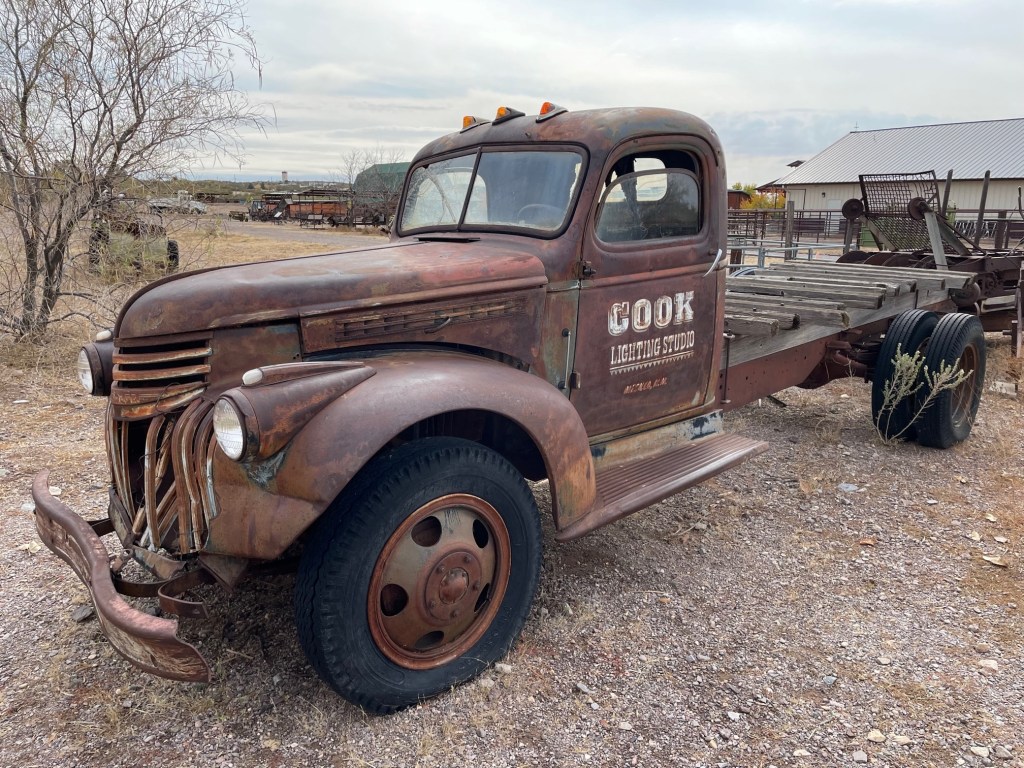
The museum has a huge collection of vehicles, including tractors and trucks, that saw work on New Mexican farms and ranches in the past decades. This is a 1946 1 1/2-ton Chevrolet pickup. It’s an example of Chevrolet’s product line from 1941-1947 that has been called “art deco” by enthusiasts because of the design of the grille and hood.
This is a small grove of pistachio trees at the museum. Pistachios are grown in New Mexico, Arizona, and California; the latter state has 99% of the production, but pistachios are very popular as a snack in New Mexico. There are now more than 25,000 farms in New Mexico, producing a value of $3.4 billion in value (30% crops, 70% livestock) each year and making agriculture the #3 industry in the state. New Mexico produced 63,000 tons of chile peppers in 2019, making it the nation’s number-one state for that invaluable resource. Guess which state ranks #5 in onion production in all the land! It’s New Mexico!
This is an agave plant, situated outside the museum’s greenhouse, with a flower stalk that I think is about 30 feet tall. Some of the stalks can grow to 40 feet. The stalks are produced at the end of the agave plant’s life; the stalk falls down and spreads its seeds to begin the cycle anew. Agave is used for food and fiber, and I am given to understand that it’s also used in the production of tequila and other mezcals.
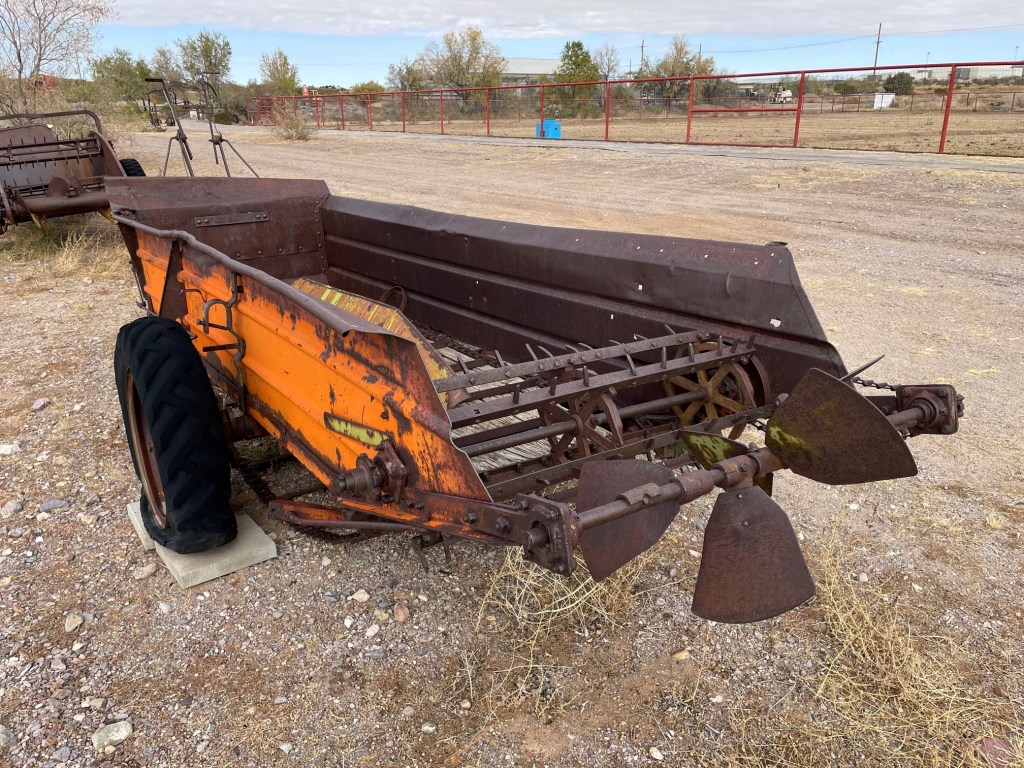
Of course, one of the highlights of a visit to any agricultural museum is checking out the collection of manure spreaders, and on this opportunity the New Mexico Farm & Ranch Heritage Museum does not disappoint. First developed in 1875, manure spreaders did the work of five people attempting to spread manure by hand. Early manure spreaders, like most implements, were originally pulled by horses until tractors became more available. This magnificent example was made by the J.I. Case company, which was founded in 1842 by Jerome Increase Case as the J.I. Case Threshing Machine Company. The museum has a really impressive collection of vintage equipment, including threshers, hay stackers and balers, harrows and plows, and much more.
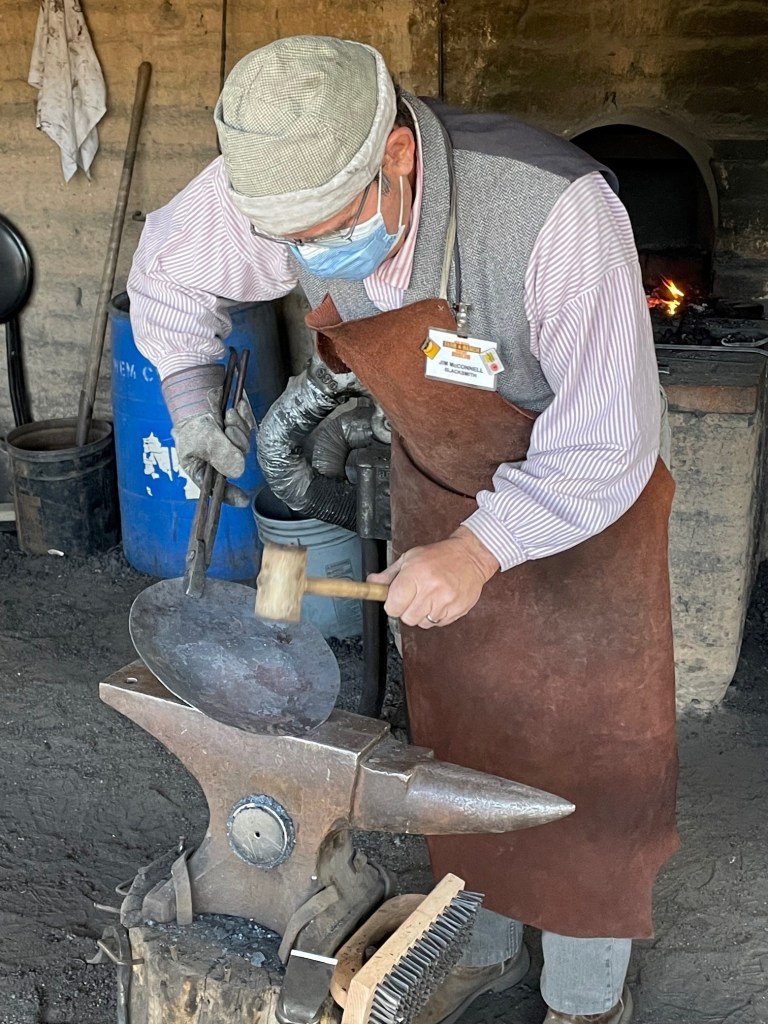
We enjoyed visiting with Jim McConnell, who was busy in the museum’s blacksmith shop. Here he’s creating the rounded side of a skillet using a rawhide mallet. The smell of the leather mallet, when it struck the red-hot metal, reminded me of being around cattle being branded – which I guess makes sense. Jim was a lot of fun to talk with. He said that blacksmiths were often the most educated people in a rural community, because they had to be knowledgeable about chemistry, physics, and all kinds of math like geometry and algebra.
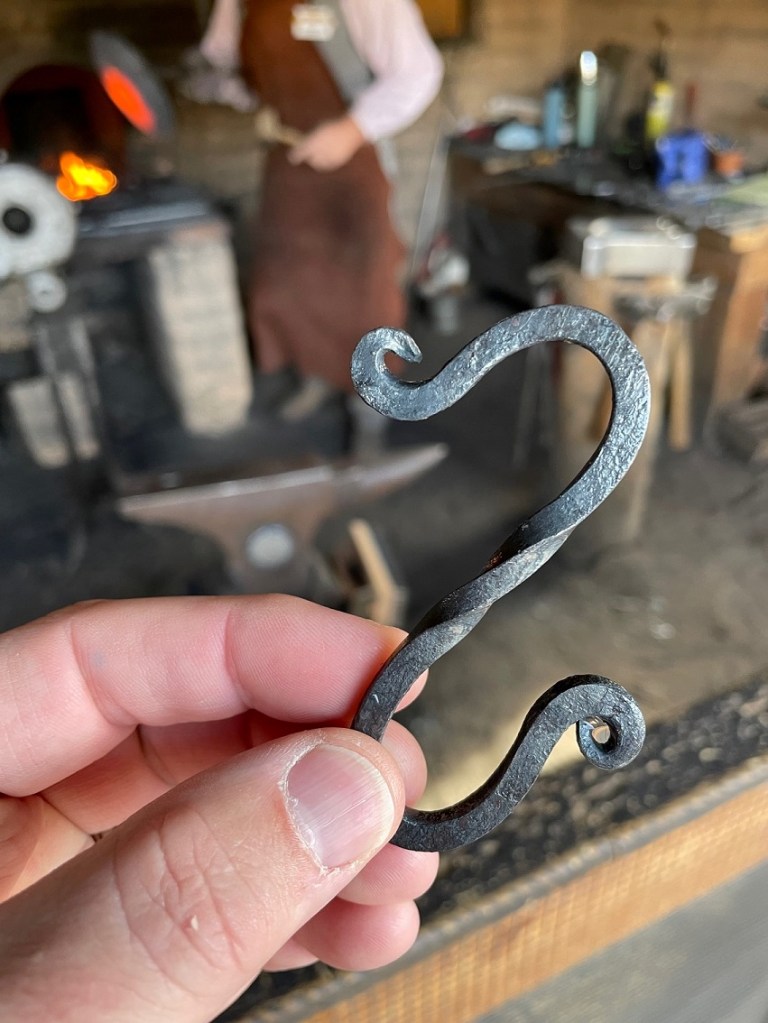
Here’s an “S” hook, used for hanging tools or kitchen pans and utensils, that Jim made that day; Jim is busy heating his skillet (note the color of the metal) for more shaping over the fire in the background. Blacksmiths usually have several projects going at the same time because of the need to wait for the metal to cool down to the correct temperature before continuing. Also note the fancy twist in this hook – great work, Jim!

The Farm & Ranch Heritage Museum is really a lot of fun: there’s plenty to see and learn without even going inside a building, and one can get really close to a wide variety of farm and ranch animals.

The National Museum of Nuclear Science & History

November 12, 2021

We visited the National Museum of Nuclear Science & History in Albuquerque. It’s a museum that had formerly been located on Kirtland Air Force Base, southeast of Albuquerque, but closed on Sept. 11, 2001, and then temporarily relocated to Old Town Albuquerque before opening in a new facility in 2009. It’s a very impressive museum, with many historical exhibits, plenty of room for traveling exhibits, and a great collection of World War II- and Cold War-era aircraft and missiles.

The museum starts with a historical survey of nuclear research, paying homage to the men and women who discovered the incredible power – for constructive as well as destructive purposes – of splitting an atom. There’s a good bit of exhibit space devoted to the United States’ development of the first atomic bomb, including artifacts from the U.S. Army facilities in Los Alamos, New Mexico, and Oak Ridge, Tennessee, where the materiel for the test and actual bombs was created. A short film describing the training of the crews of the Enola Gay and Bockscar, the B-29s that dropped the atomic bombs on Hiroshima and Nagasaki, was really interesting; it had interviews with many of the members of the Enola Gay crew (conducted some years ago) in which they said they viewed the operations as helping to bring a quicker end to hostilities in the Pacific. In the summer of 1945, everyone in the United States and the country’s allies wanted the war to end.

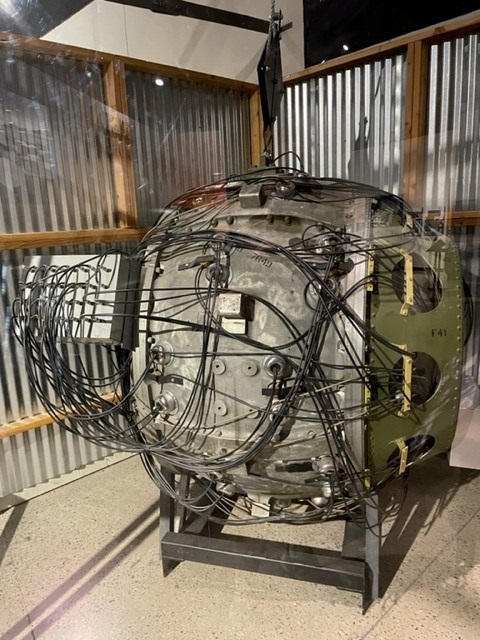
A replica of “The Gadget,” the test atomic weapon that was detonated at the Trinity site in New Mexico (now part of the White Sands Missile Range between Alamogordo and Las Cruces). It was dropped from a 100-foot tower during the operation. The test detonation, and the remarkable destruction that it caused, prompted Robert Oppenheimer, director of the Las Alamos Labratory, to reflect on the phrase “Now I am become Death, Destroyer of Worlds,” which is taken from Hindu scripture.
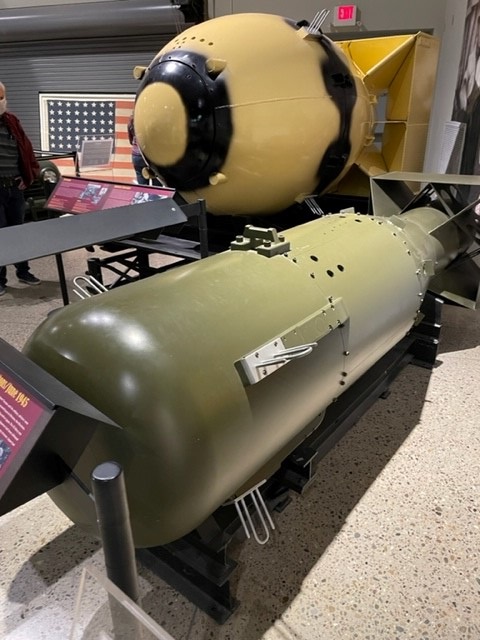
A replica of Little Boy, in front, which was the first atomic weapon deployed in warfare, and Fat Man. Little Boy was dropped on Hiroshima on August 6, 1945, from the B-29 Superfortress Enola Gay, killing about 70,000 people (30% of Hiroshima’s population) and destroying about 75% of the city’s buildings and roads. The B-29 Bockscar deployed Fat Man over Nagasaki on August 9, 1945, killing about 35,000 people. Japan, facing an imminent invasion of the Japanese archipelago, the possibility of additional atomic bombings, and a Soviet intention to begin hostilities, announced its intention to surrender on August 15, and signed the official documents on September 2, 1945, bringing an end to World War II.

It’s not easy, but I think it’s necessary, to learn about all of the destruction caused by these atomic weapons. I was moved to see the atomic bomb replicas, realizing that the actual weapons killed many tens of thousands of civilians but also ended a war that Japan was willing to continue with perhaps many more casualties than even Little Boy and Fat Man caused. The idea of an Allied invasion of Japan’s islands, similar to the D-Day invasion of Europe, had, frankly, never even occurred to me – I had never thought about the fact that there had been plans to invade Japan that were developed because of the necessity to keep the Manhattan Project under wraps even to the majority of the U.S. military. Because Japan was running low on military resources, it’s easy to surmise that the planned invasion would have gone the way of the Allies, just as it’s easy to see the victory would have come at a horrific human cost as well.

This is one of the reasons we enjoy going to museums, I think: the information they display fill in a lot of gaps in knowledge that I didn’t even know we had.

The museum had many Cold War-era artifacts inside its building, including disarmed nuclear missiles (some large, some small) that were placed in readiness in Europe in the years following World War II.

“Writing a Wrong”

There was also a traveling exhibit from the Smithsonian Institution that examined the history of the incarceration of Japanese Americans following the bombing of Pearl Harbor, Hawaii, in December 1945. “Righting a Wrong: Japanese Americans and World War II” displayed many artifacts from some of the 10 incarceration camps and many more smaller facilities in which 75,000 Japanese Americans were detained from March 1942 to March 1946. The families had to sell nearly everything they owned in their households and businesses, and carried only what they could take with them to the camps. Some decades later, the U.S. Congress recognized that the civil rights of these people had been violated and President Ronald Reagan signed the Civil Liberties Act of 1988, which formally apologized, and made restitution, to those who had been incarcerated. Some of the camps, which were all west of the Mississippi River, have been developed into U.S. national historic sites, and I believe an effort is underway to get Camp Amache, which was located in far southeastern Colorado near the Kansas border, national historic site status as well. I don’t remember when I first learned about the incarceration camps, but I do know it was well after I’d graduated from high school. It’s a dark period in American history, to me, and I think it needs all of the light that can possibly be shone on it.

World War II and Cold War Aircraft

The exterior grounds of the Nuclear Museum feature seven aircraft developed to deliver nuclear devices (or protect those that did), the sail from the nuclear submarine James K. Polk, and a large variety of disarmed nuclear missiles and rockets. I thought it was interesting that many of these photos have contrails in their backgrounds from aircraft originating from Kirtland Air Force Base.

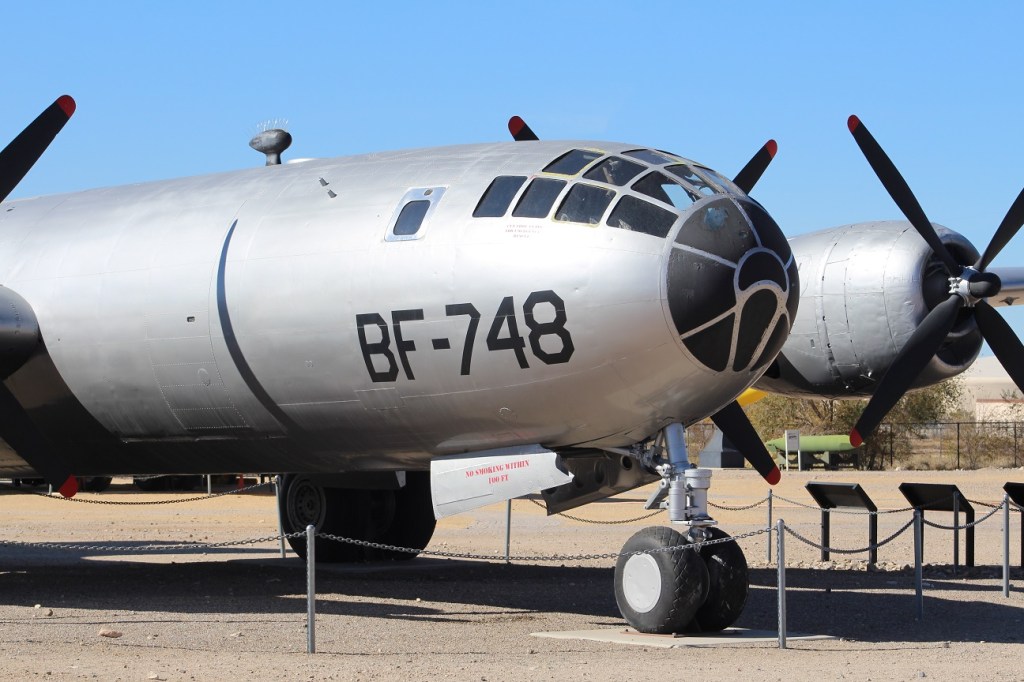
A B-29 Superfortress, which was the model of bomber used to drop nuclear weapons on the Japanese cities of Hiroshima and Nagasaki in August 1945. A replica of the 100-foot tower used to test “The Gadget” at the Trinity test site in New Mexico (see above) is at left.

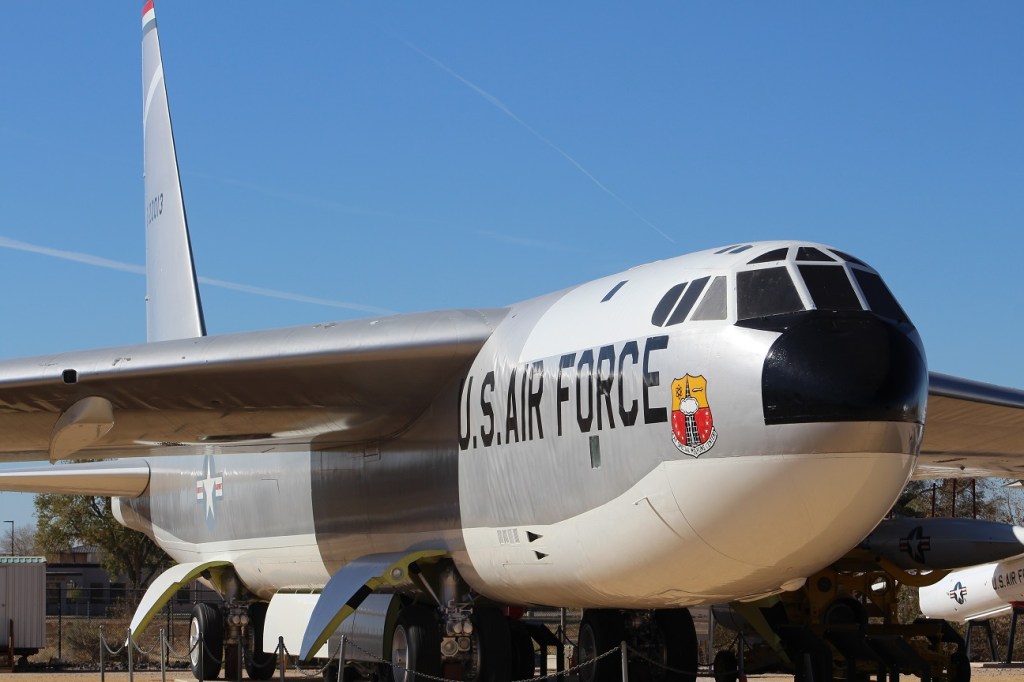
A B-52 Stratofortress on display. This particular bomber was shielded as protection from possible radioactive activity because of its proximity to nuclear weapons. First flying in 1952, a total of 744 B-52s were produced by Boeing until 1962. About 50 are still in service.
I was unfamiliar with this bomber. It’s a B-47 Stratojet, and it was developed to deliver nuclear weapons over the Soviet Union. They had a wingspan of 116 feet and had a top speed of 607 mph (for comparison, a B-29, powered by propellers rather than a jet, had a wingspan of 141 feet and had a top speed of 357 mph). More than 2,000 were produced beginning in 1947, and they were retired by 1977.

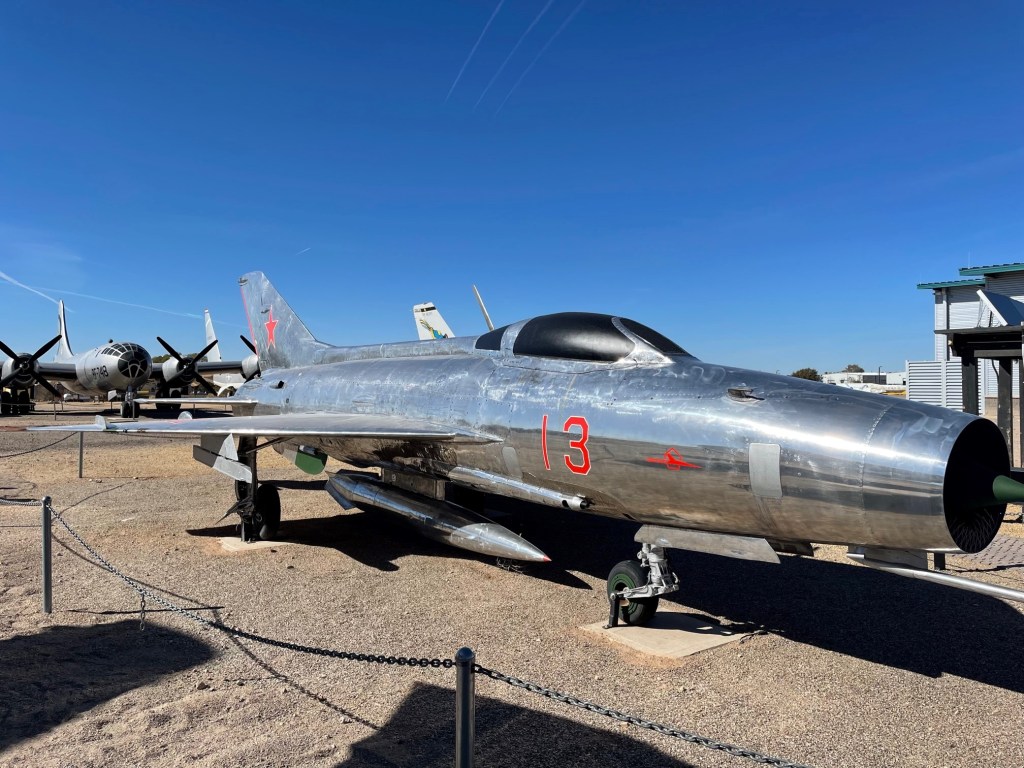
I was very happy to see examples of two of my favorite Cold War-era aircraft: the F-105 Thunderchief and the Soviet MiG-21 (they’re my favorites for no better reason than I just think they look awfully darned cool).

I managed to cut off the inlet cone on the front of this MiG-21 when taking the photo on my iPhone, which is unfortunate. The MiG-21 was developed by the Soviet Union’s Mikoyan-Gurevich Design Bureau in 1955 and is the most-produced supersonic jet in military history; almost 11,500 were built between 1959 and 1985 for more than 60 countries on four continents. This particular one has a B-29 on its six but it’s probably okay because the MiG is capable of a top speed of 1,300 mph.
A total of 833 F-105s were produced by Republic Aircraft from 1955-1964, and the last one flew in 1984. It was the primary bombing aircraft of the early years of the Vietnam War. This particular aircraft originated service at Spangdahlem Air Base in West Germany in 1962. That’s the sail of the U.S.S. James K. Polk submarine, launched as a ballistic missile submarine in May 1965 and decommissioned in July 1999, stealthily emerging from the sands of the New Mexico desert to the left of the F-105, an A-7 Corsair II in the immediate background, and the building for the National Museum of Nuclear Science and History is behind the Corsair.

Much of the museum is devoted to the social impacts of living in a world protected and powered, and threatened by, nuclear power: bomb shelters, advances in nuclear medicine, and nuclear power as a source of sustainable energy.

We spent about four hours at the museum, and they were well spent. I learned much more about subjects and events that I was at least aware of, and I learned plenty more about events I knew nothing about. We talked a lot about the enormous amount of money spent on all of these weapons, and of the lives lost in combat as well as in maintaining them, but we recognize and appreciate that they were built to ensure that Little Boy and Fat Man have been the only nuclear weapons used in war.

A Hike on the Hogback Trail

October 28, 2021

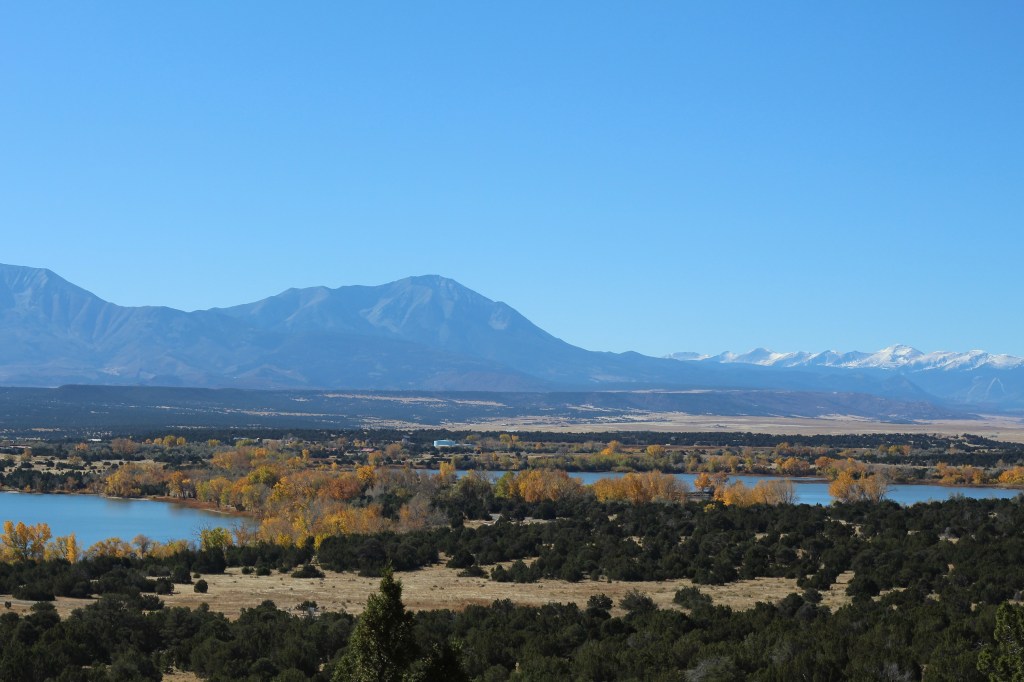
Nancy and I took a long lunch break to enjoy a hike above the Lathrop State Park campground. The Hogback Trail is a loop providing incredible views of the Spanish Peaks, the Sangre de Cristo mountain range, and the area to the north of the park including Pikes Peak (14,115 feet).

East Spanish Peak (on the left, 12,683 feet) and West Spanish Peak (13,326 feet) are a pair of mountains formed by igneous intrusions (lava flow) that overlook the two lakes of Lathrop State Park. West Spanish Peak is the easternmost mountain in the United States with an elevation greater than 13,000 feet. They were prominent landmarks on the Santa Fe Trail in the early 19th century. The Sangre de Cristo mountain range, topped with an early snowfall, is on the right.
The same igneous intrusion process that formed the Spanish Peaks also formed a number of volcanic dikes in the area, including the hogback on which we were hiking.

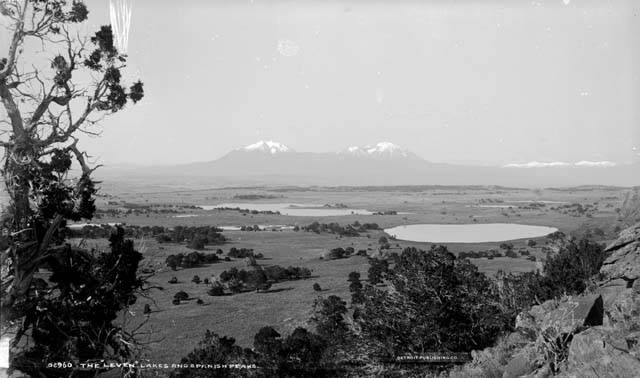
The famed photographer William Henry Jackson (1843-1942), whose images chronicled the American Civil War as well as the growth of the American West (his famous photograph of Colorado’s Mount of the Holy Cross, along with other images of the areas around present-day Yellowstone and Grand Teton national parks, convinced many people in the east that they needed to travel west), visited the area that is now Lathrop State Park in the 1880s. A short spur hike from the Hogback Trail takes one to the spot where Jackson took the photograph below; I took the one below that one about 120 years later (with the only lens and camera that I had on the hike, so it’s not a great match). Still, a pretty neat experience from a historical perspective.

Image courtesy History Colorado.

Website Built with WordPress.com.

Up ↑