Craters of the Moon National Monument, located midway between Twin Falls and Idaho Falls in the south-central part of Idaho, is one of those National Park Service sites that you kind of have to want to get to. The monument and its associated preserve receive only about 220,000 visitors each year; for comparison’s sake, Rocky Mountain National Park northwest of Denver receives more than 4 million visitors annually. Craters of the Moon is not on any Interstate highways, and it’s about 90 miles from Twin Falls and more than a two-hour drive from Idaho Falls. I imagine many of its visitors are on their way to or from Yellowstone National Park, which gets about 3.3 million visitors each year.
Thousands of years ago, these rocks were part of a slow-moving river of magma. Craters of the Moon National Monument doesn’t have especially tall volcanoes – it has about 20 cinder cones that top out at about 700 feet in height – but it does have immense flows of basalt resulting from lava that escaped through fissures in the earth. As they cooled, the magma flows hardened into these beautiful rock structures.
Still, it’s a unique and beautiful place that clearly shows that the area was the site of tremendous volcanic activity in the planet’s relatively recent past. We parked the Goddard in Arco, Idaho, about an hour’s drive northeast of Craters of the Moon and visited the monument not once but twice in a week. Why? Lava! And cave-like geologic structures!
The year 2024 marks the hundredth year since the establishment of the monument. The monument and preserve protects 753,000 acres (about 1,200 square miles) of south-central Idaho for visitors to experience what it could be like to walk on another world. The scientists have dated some of the lava flows and have determined that the area experienced an extended period of geologic activity – and one that was quite recent, geologically speaking. The oldest lava flows yet recorded are from eruptions 15,000 years ago, and the most recent flows occurred just 2,100 years ago.
Our first impression of the national monument: everything is black, due to the miles and miles of basalt that’s all around. It’s really difficult for plant life to establish itself in relatively new basaltic soil; total vegetation coverage on the entire monument is less than 15 percent, and on cinder cones like this it’s only 5 percent. Here we see an intrepid hiker (it’s Nancy) making her way up the slope of Inferno Cone, a tall cinder cone in the monument. Cinder cones are the most common type of volcanic structure on Earth. The lava emissions at what is now Craters of the Moon were less explosive than many other eruptions around the world, so the slopes of the cinder cones are gentler. It’s a little less than a half-mile to the top of the cone, from which one can see 360 degrees all around Idaho (and on especially clear days even the peaks of the Teton Range, 100 miles away in western Wyoming, can be spotted). The sun, pictured in the upper right of this image, is no joke: its rays can heat the black basalt to temperatures of 150 degrees. Winters can be harsh as well, with plenty of snow and frigid temperatures.
Craters of the Moon contains the largest lava field in what is known as the Great Rift, a 53-mile-long fissure in Idaho running from the southeast to the northwest. The relatively quiet (as quiet as a volcanic eruption can be, anyway) release of gas and magma created these lava flows over a period of many thousands of years. This part of Idaho has several other such lava fields and the soil that has resulted from those older flows results in regions famed for growing fine potatoes. (There were a couple of grocery stores in Idaho in which the smallest baking potatoes weighed a pound.)
In time, the soil in the national monument may break down enough (through the work of erosional forces like wind, water, and plant growth) to allow more plants to survive. Until then, it’s pretty desolate but in a beautiful way, and any potato harvests in this particular part of Idaho will be many years in the future. Incidentally, it’s believed that the caldera underneath Yellowstone National Park, which is responsible for the geysers, paint pots, and other hydrothermal features there (and possibly a mass extinction event if it erupts while humankind is still around), is connected to the hotspot that created Idaho’s lava fields. Over millions of years, the North American Plate has been moving slowly while the hotspot heats up the landform currently over it: 10 or 11 million years ago, that hotspot was underneath what is now Craters of the Moon National Monument.
In order to survive, plants and animals have to be extraordinarily adapted to make it in both extreme heat and cold. This is dwarf buckwheat (Eriogonum ovalifolium), a plant only four inches tall that can boast a root system up to three feet in diameter. That root system works to get as much moisture to the rest of the plant as it can, and this plant is so efficient at doing so that plants can’t survive within about three feet of each other – they wind up being so evenly spaced that they appear to have been hand-planted. Additionally, the plants light-colored leaves reflect, rather than absorb, the sun’s rays. Note the texture of the black basaltic soil.
Craters of the Moon was established and named as a national monument almost 50 years before NASA put astronauts on Earth’s actual moon, so it wasn’t until the very late 1960s and early 1970s that it was discovered that the moon’s surface isn’t anything like southern Idaho. The moon has been shaped by impacts of meteorites rather than volcanic eruptions. But the national monument did serve as an ideal training ground for astronauts so they could practice selecting rock samples in an unfamiliar environment.
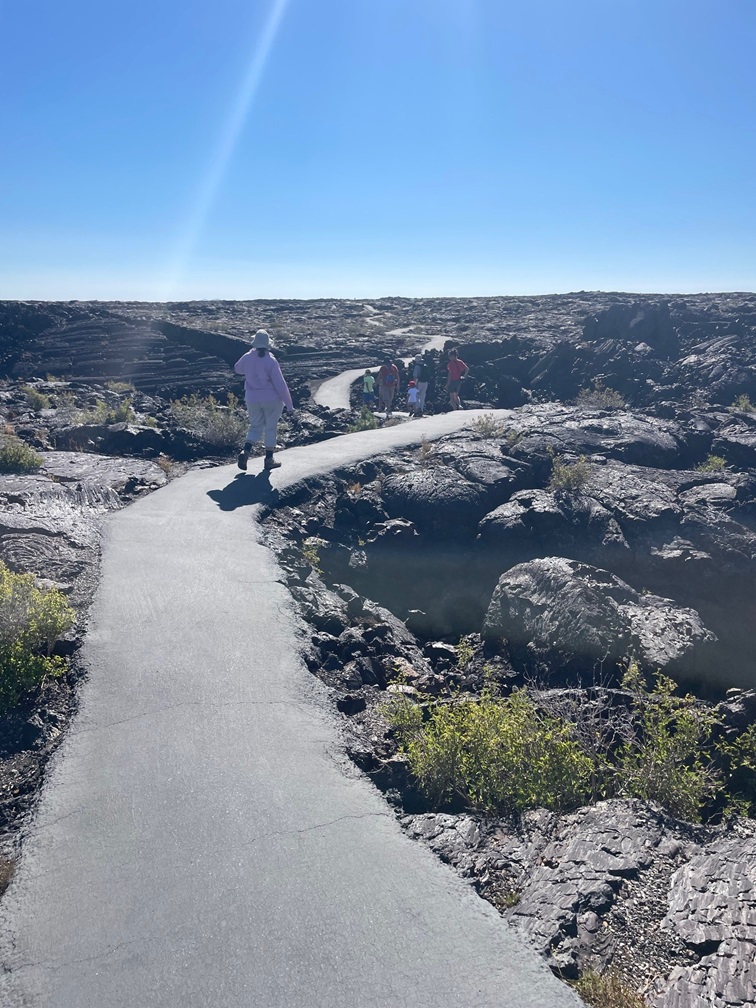
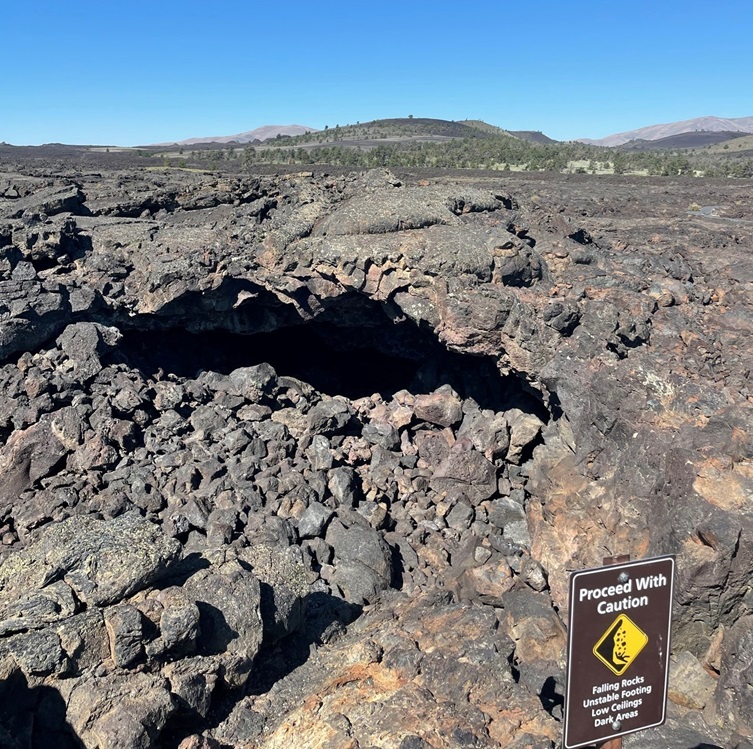
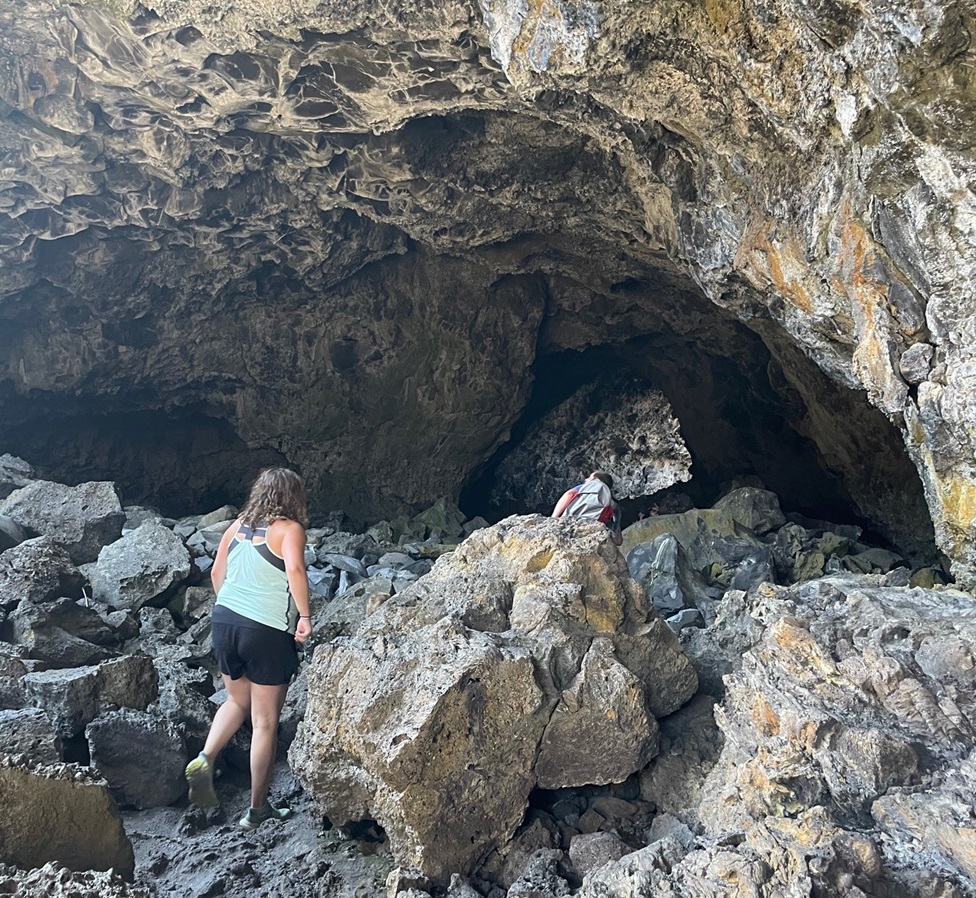
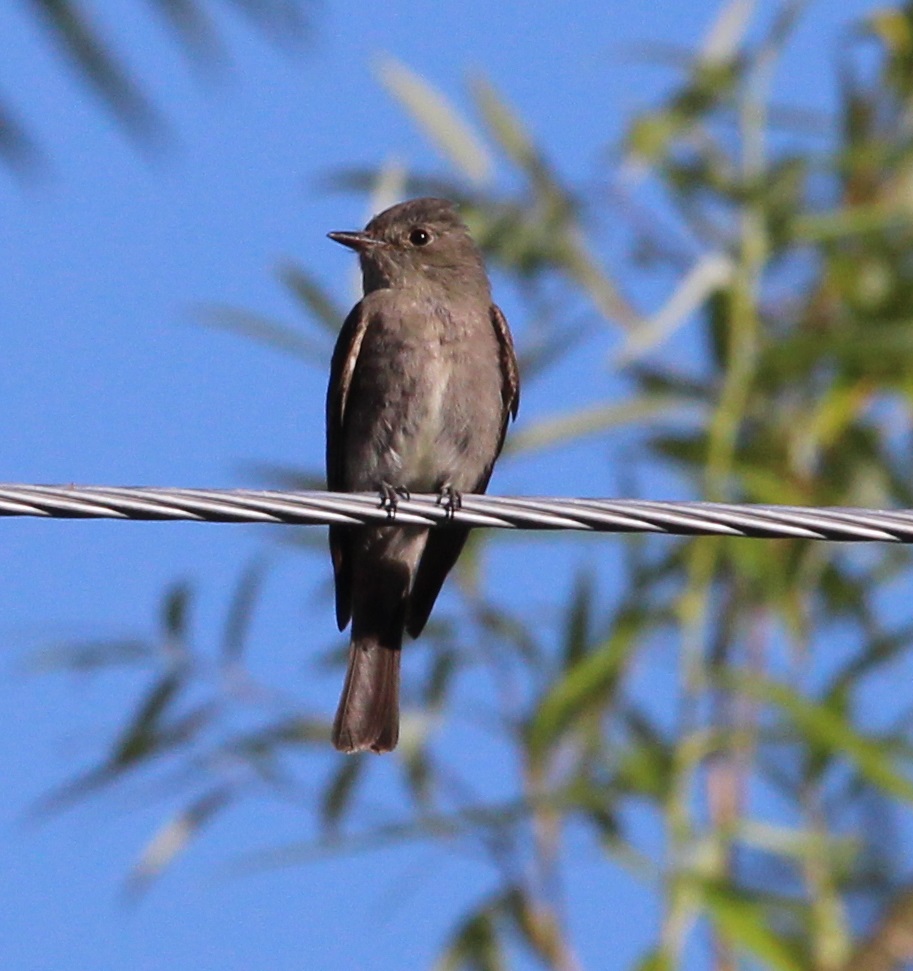
While we hiked up Inferno Cone, we saw a few turkey vultures (Cathartes aura) circling in the beautiful blue sky and perching in this dead limber pine tree. I took several pictures of this bunch, but they apparently had more important things to look at than me and they never turned around. These birds can have wingspans of up to six feet in length. Turkey vultures aren’t the most attractive representatives of the avian world, but their diet of nearly exclusively carrion is essential to preserving the natural order of things.This is known as a spatter cone, formed when jets of lava spout vertically from the earth – for scale, that’s a person on the trail in the shadow of the cone. The monument and preserve contains about 25 cones of the spatter and cinder (such as Inferno Cinder) varieties.We happily joined a ranger-led hike to some lava tubes. We’d seen lava tubes in Hawaii many years ago, and were more than a little surprised to see them again in Idaho. This was a pretty nifty asphalt trail that wound through the basalt formations and led to the tube structures.Here is the opening to a lava tube that we didn’t enter, and you can probably see why we didn’t. The jumble of large rocks near the opening are the result of the overlying rock atop the tube collapsing into the void and down to the ground. This lava traveled 18 miles from its source, the spatter cones pictured above.Here’s the lava tube that we did enter. It was a really impressive cave-like structure, formed when a river of lava continues to flow underneath a layer of magma that has already hardened on top of it. When the supply of lava is cut off, the opening through which the lava flowed remains to form these interesting structures. The empty spaces are home to bats, just like a cave. We didn’t see any bats, but I did capture a photo of a rock pigeon in the lava tube. You know what a rock pigeon looks like, so I won’t post it. It was kind of neat to see a species of bird that’s common on big-city streets in a lava tube in very rural Idaho, though.While the first day we visited the national monument was clear with blue skies, the second day was mostly overcast and chilly. On a short hike around the lava flows, we saw several of these birds performing some impressive aerobatic maneuvers, presumably catching insects in flight. We couldn’t tell what kind of birds they were until this one landed in a tree. It’s a nighthawk, of which there are several species in North America. I don’t know which particular one this is (I’m guessing it’s a common nighthawk), but we were pretty excited to see it – we’d never seen a nighthawk before. They’re a mostly nocturnal species, so maybe the cloud cover was enough to make them active during the day.One of the hiking trails we enjoyed led to this impression of trees that were growing thousands of years ago and then were downed in the flowing magma, leaving behind these distinct patterns of bark growth in the basalt.I didn’t take this photo at the national monument, but rather at the campground in Arco where the Goddard was parked. I’m including it because it was another new-to-us bird, a plain-looking little fellow with the splendid name of western wood-pewee (Contopus sordidulus). They are about six inches long, weigh just a half-ounce, and have a wingspan of about 10 inches. Like other birds in the flycatcher family, this species is particularly skilled at snagging insects in flight.
Craters of the Moon National Monument has a lot going for it, and we were fortunate to be able to include it in our summer 2023 itinerary. We saw plenty of other places with lava flows both (relatively) new and old in Idaho – we spent more than two months in the southern and southeastern part of the state – but it was fun to be able to walk across the basalt and wonder what the environment must have looked like when the lava was flowing. Interestingly, the volcanic features at Craters of the Moon are believed to be only dormant – not extinct – and geologists expect the region to become active once again within the next thousand years, and some believe it could be within the coming century.
The Goddard spent a few weeks in far eastern Idaho – about 30 miles from the Wyoming border – during the waning days of summer 2023. Ririe Reservoir, built in 1970 by the U.S. Army’s Corps of Engineers (CoE), impounds Willow Creek as it flows toward its entry into the Snake River near Idaho Falls. The reservoir has a surface area of 6.1 square kilometers (1,500 acres), about the size of Colorado’s Chatfield Reservoir at normal pool.
We camped at Ririe Reservoir long enough to see some of the cottonwood leaves change to their autumnal colors. This pavement is what I came to call “Raptor Road” because of the frequent sightings of hawks and falcons atop the utility poles (there were, unfortunately, no raptors atop the poles when I took this photo on the morning of September 8). That’s a potato field on the horizon.
Juniper Campground serves the reservoir, and, as is usually the case with CoE-built facilities, it’s outstanding. We spent most of our time at the reservoir camped in a site that had a great view of the reservoir through the Goddard’s back and side windows. We were there for Labor Day weekend and, although the Saturday and Sunday of the weekend proved to be pretty chilly and wet, we think the families who filled up the campground still had a great time.
The campground’s stands of native juniper trees, along with planted aspen, cottonwood, and chokecherries, support an outstanding wildlife habitat. The shrubs and trees provide food and shelter for birds, squirrels, and rabbits. I managed to take a few (hundred) photos of birds in the weeks that we were at Ririe Reservoir, and a lot of the pictures featured birds of prey perched atop utility poles (thus the title of this posting).
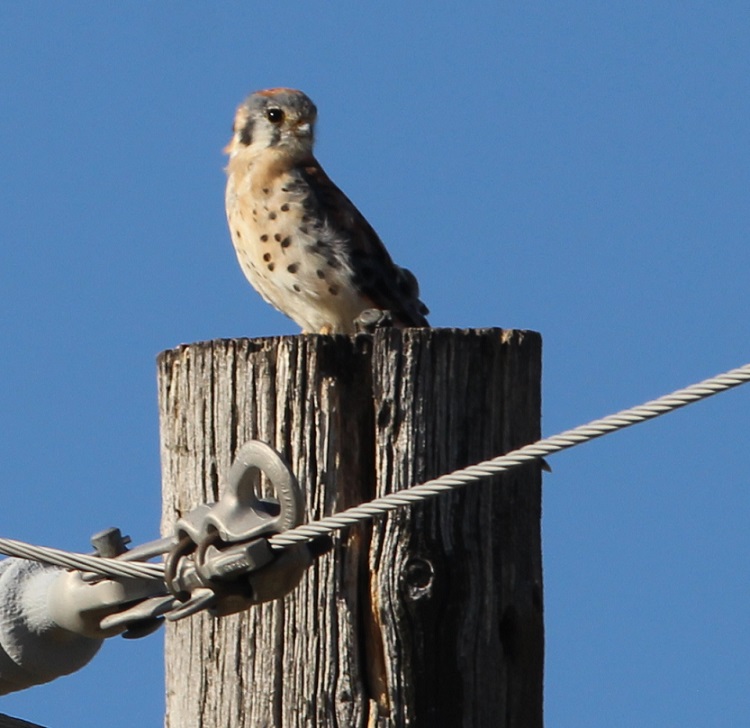
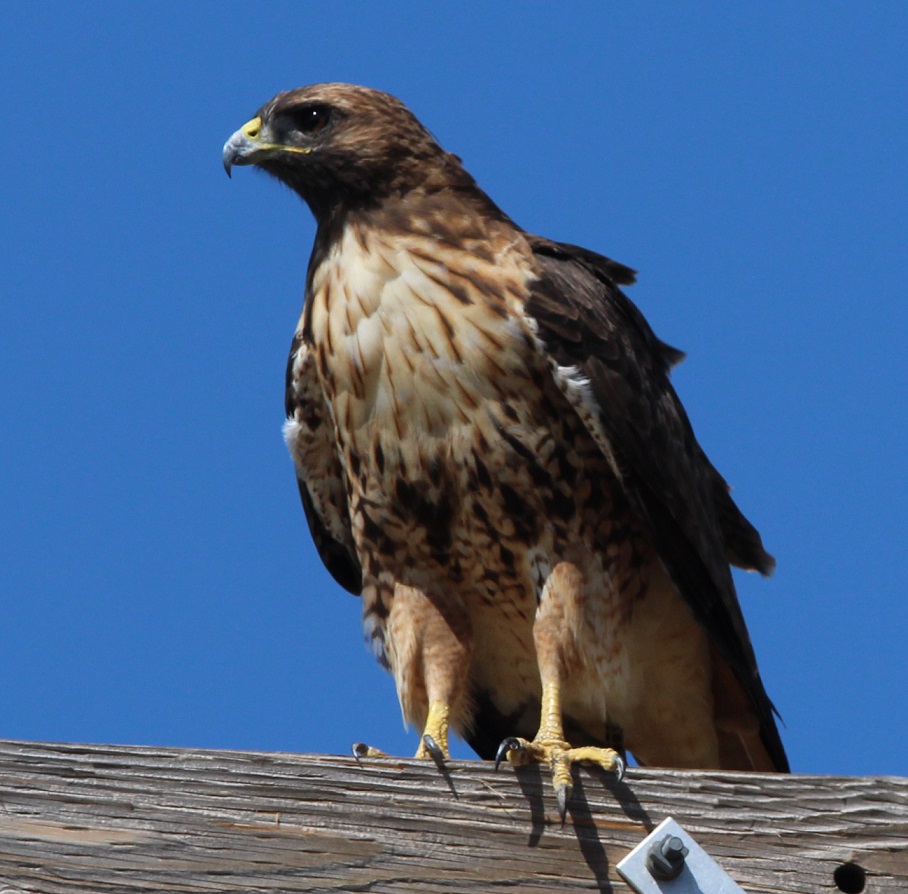
I was really happy to get some photos of this American kestrel (Falco sparverius) – it’s a species I’ve been wanting to photograph for many years. Their plumage, especially on their heads, is just so pretty. Kestrels are the smallest raptor in North America, weighing only about 5.5 ounces and measuring up to a foot in length, with a two-foot wingspan. Size- and weight-wise, they’re roughly the size of an American robin although their wingspan is much longer. They are found all over the United States, Canada, and Mexico, as well as much of South America. Like other raptors, they can see in ultraviolet light – which allows them to see a urine trail from a rodent. Kestrels also eat a lot of airborne insects, and will commonly patrol a well-lit football or baseball field in search of bugs attracted by the lights. They are fierce little birds, to be sure, but because of their size they’re also prey for other, larger raptors. We saw plenty of these magnificent red-tailed hawks (Buteo jamaicensis), both on power line poles and in the air, which makes a lot of sense because they are the most common hawk in North America. They’re found all over the United States and most of Canada. Red-tailed hawks grow to a length of 22 inches, with a weight of about 3 pounds and a wingspan measuring more than 4 feet. They have a very distinctive call, so commanding that Hollywood productions use the call whenever any bird of prey, whether it’s a bald eagle or an actual red-tailed hawk, is shown on screen (soundfile below). Red-tailed hawks are remarkably long-lived: one banded individual lived for at least 30 years in the wild.
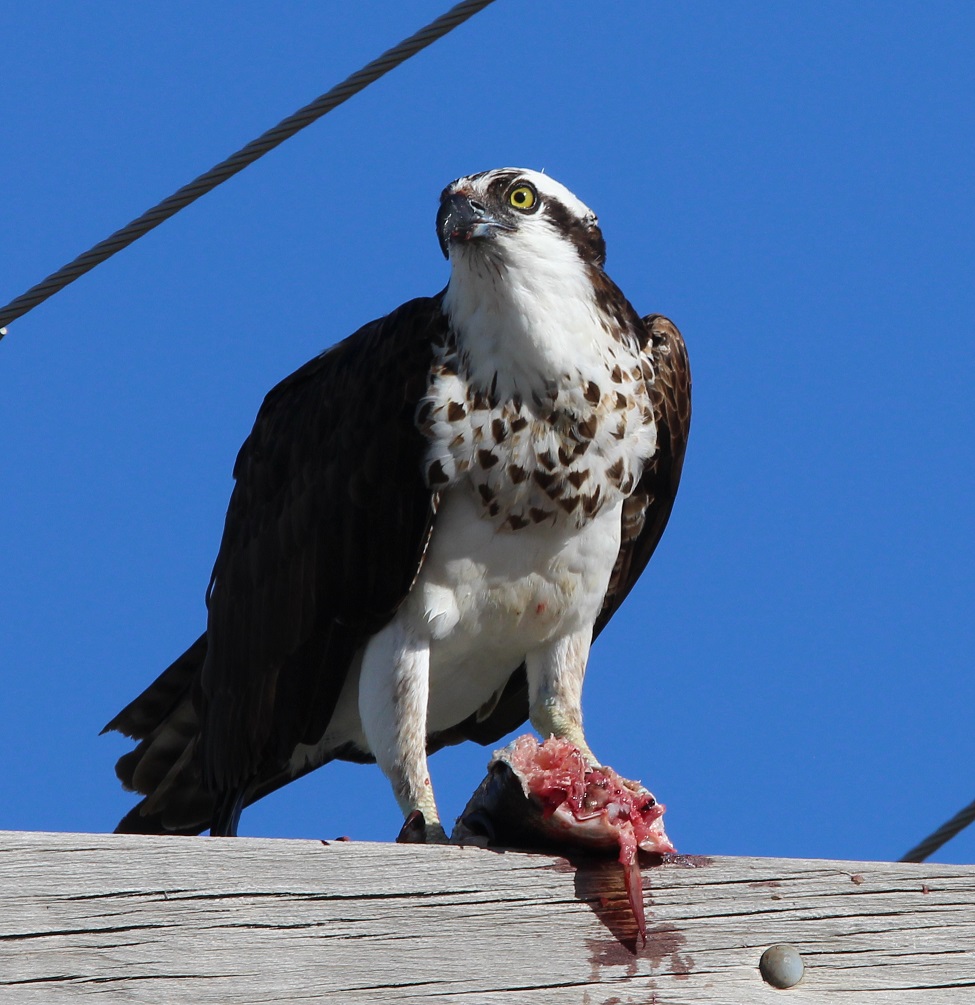
WARNING! The next photo shows a bird eating a fish; if you get squicked out by the sight of mildly bloody things, you may want to consider scrolling past the picture with some haste.
I saw this osprey (Pandion haliaetus) atop a power pole with its sushi breakfast mid-morning while I was driving to the town of Ririe on some errand that I’m sure was important. I was happy I’d thought to bring along my digital camera, because although we’d seen plenty of these birds during our stay I hadn’t gotten a picture. Ospreys weight about three pounds, with an impressive wingspan of 5 1/2 feet. Ririe Reservoir contains rainbow and cutthroat trout, kokanee salmon, smallmouth bass, and yellow perch. It’s difficult to tell what this unfortunate fellow was.
Ospreys are supremely adapted to support their diet of 99% fish (I don’t know what the 1% is; maybe like all of us, they break down about once a year and get a Big Mac): uniquely among raptors, two of their rear toes are reversible to allow them to carry fish with two toes in front and two toes in back. Their feet also have barbed lobes to aid in the grasping of fish, and they fly with their catch facing head-on to decrease wind resistance. Over the course of several studies, researchers found that ospreys are successful in catching a fish about 25% of the time. They are found all over the world, with the exception of Antarctica. Osprey were seriously endangered until DDT was banned, and their numbers have since strongly rebounded. These birds typically have a lifespan of about 20 years.
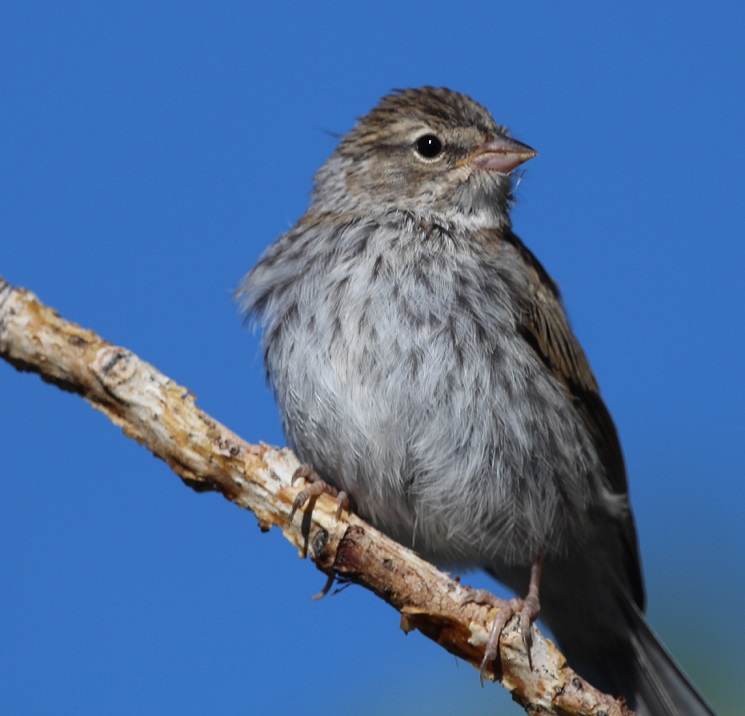
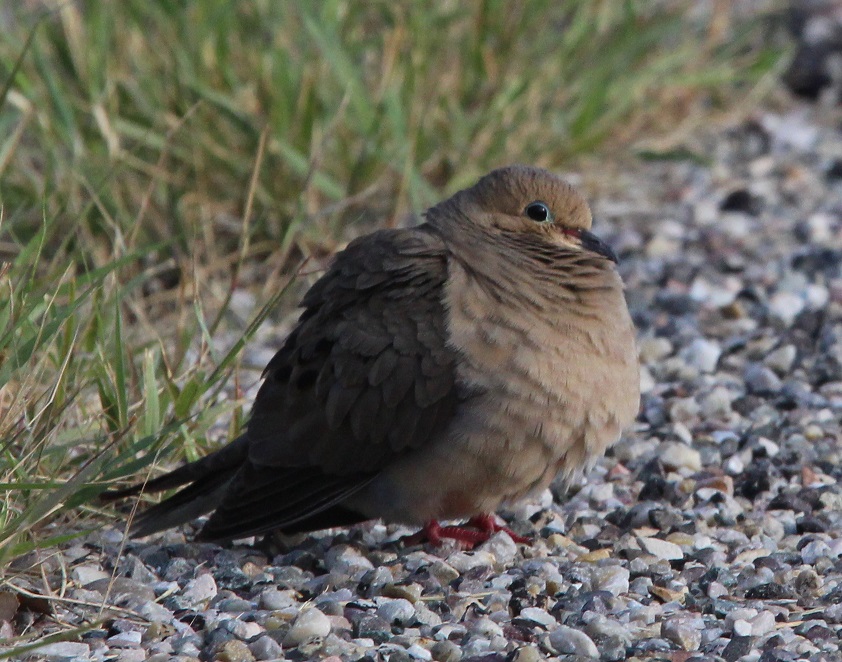
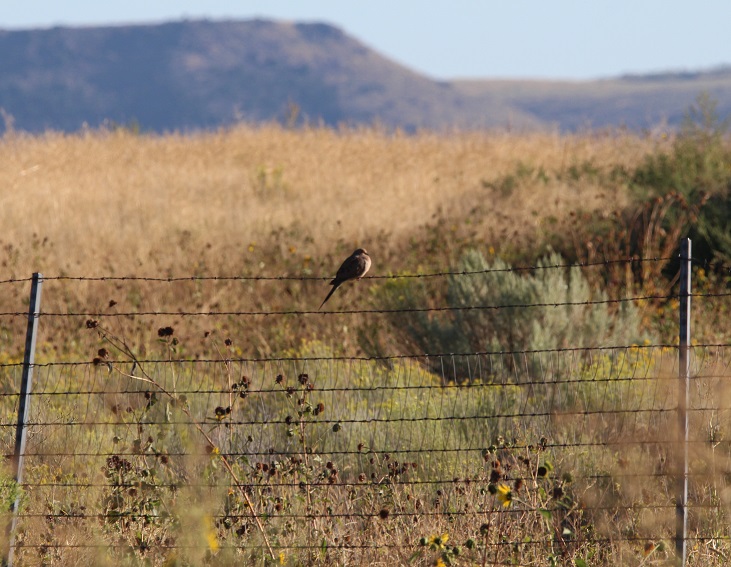
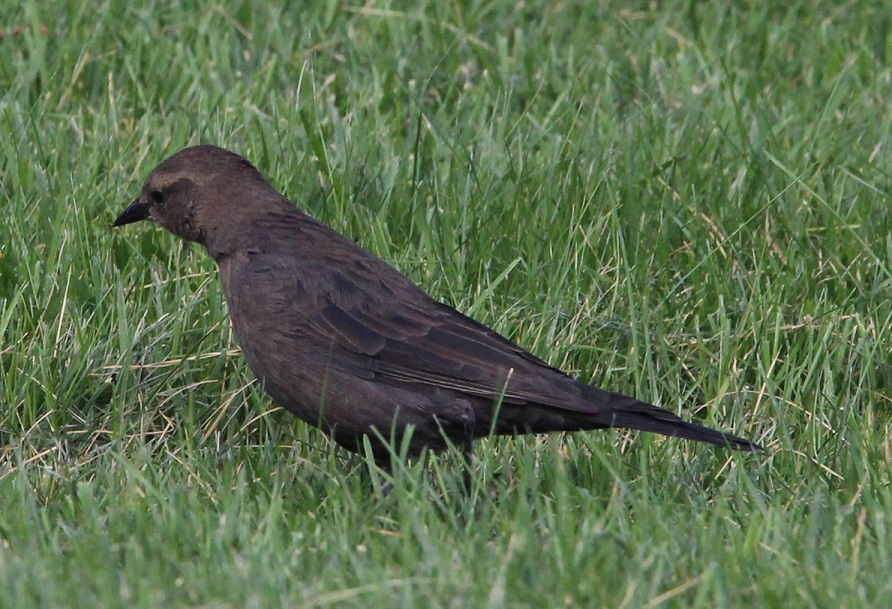
Of course, there were birds perched on things other than power poles at Ririe Reservoir (and apologies for anyone expecting more utility pole content; the title of this posting is probably misleading). Here’s a chipping sparrow (Spizella passerina) enjoying a quiet morning while perched on a cottonwood limb. The easiest way to tell a chipping sparrow apart from the other several billion brown-and-white sparrow species is the presence of a dark horizontal line through their eye. Male chipping sparrows have a handsome ruddy-brown cap atop their heads. This species is found throughout the United States, although they’re found in the center of the country only during their migration.This pretty bird sitting atop a juniper tree is a female American goldfinch (Spinus tristis). In the waning days of summer, the plumage of these birds is starting to molt into its winter colors. Goldfinches are unusual among most birds in that they molt twice each year: once in late winter and again in late summer.When birdwatching, I usually have my eyes trained at the tops of trees. Nancy spotted these male American goldfinches from a window in the Goddard, and I stuck my camera out the front door and snapped a couple of photos. We’d just had a brief rainshower in the campground, and these guys were looking for seeds on the ground. Goldfinches are purely vegetarian birds; they eat predominantly grass and flower seeds, and insects only inadvertently. There’s a species of bird called the brown-headed cowbird that lays its eggs in other species’ nests and lets the new parents raise their young (and the cowbird hatchings often crowd or starve out the real hatchlings because cowbirds are much bigger). In the case of goldfinches, cowbird hatchlings usually die a few days after hatching because they can’t survive on the all-seed diet that the goldfinch parents bring to the nest. Note that, like the female goldfinch above, these two fellows also appear to be in the process of molting for the winter.More birds on the ground: while on a morning walk with Gunther down Raptor Road, I saw this mourning dove (Zenaida macroura) on the roadside and bundled up against the chill of the early day. I feared it was sick or injured, but it flew off shortly after I took this picture. You may have heard a whistling sound when a dove flies off; that’s not coming from their beak, but from the beating of their wings. Doves spend a lot of time on the ground gathering seeds, and can eat 20 percent of the body weight (the birds can weigh up to 6 ounces) in seeds every day. This is the most frequently hunted gamebird in North America, but the current population is estimated to number 3.5 million birds (more than one mourning dove for every person in the country). I really like the pale blue ring around mourning doves’ eyes.Mourning dove, elevated (and a shout-out to all the barbed-wire aficionados).Lots o’ ladies in this particular blog posting. This is a female Brewer’s blackbird (Euphagus cyanocephalus) hunting for breakfast in the grass near a campsite. These birds (the males are definitely black, with a startlingly bright yellow eye) are fairly sociable and help reduce insect populations near human habitations. Blackbirds also eat a lot of seeds. They can gather in flocks numbering up to 100; we didn’t see any gatherings that big, but we did see lots of these birds.
We also saw black-billed magpies and an eastern kingbird during our time at Ririe Reservoir. The new species that we saw at the reservoir brought our total species count for the year, through early September, to 87 – the number with which we ended the calendar year 2022. We also saw a lot of utility poles, but I haven’t been keeping track of those. Will we reach 100 species of birds seen in 2023, with more than 3 months left to go? No one can say. However, we’ll be spending quite a few weeks in parts of the country in which we haven’t yet stayed, so it’s very possible.
I should probably include a picture of Ririe Reservoir in this posting, so here’s one with a friendly dog (it’s Gunther, on one of his security patrols around Juniper Campground; everything checked out on this walk). We’ve stayed at more than 60 public and private campgrounds in the nearly two years since we began full-time RVing, and Ririe Reservoir’s Juniper Campground is definitely in our top 5 favorites. Between the opportunities for wildlife watching, enjoying the quiet environment (the dark skies at night allowed for some incredible stargazing), and easy access to a number of attractions in the area, this campground really impressed us.Alright, one more utility pole photo, at sunset, with a center-pivot irrigation system on a potato field, some beautiful Idaho mountains, and an osprey.










 Tales of The Goddard