While traveling around the country, Nancy and I try to visit botanic gardens whenever possible. In addition to the great opportunity to see all kinds of different plants, botanic gardens’ trees and flowering plants also attract a great variety of birds, butterflies, and other wildlife that we enjoy seeing and photographing.
Until October 2021 when we sold our Denver home and became full-time RVers, we made regular visits to Denver Botanic Gardens’ two sites. We’d most often go to the gardens in central Denver, but we also went to the gardens near Chatfield Reservoir in the southwestern metro area.
I was very fortunate to make a return visit to Denver Botanic Gardens’ central Denver site in early August, bringing along a camera and lens that I didn’t have five years earlier. I was planning to get a lot of photos of birds, but instead found a lot of other wildlife to enjoy.
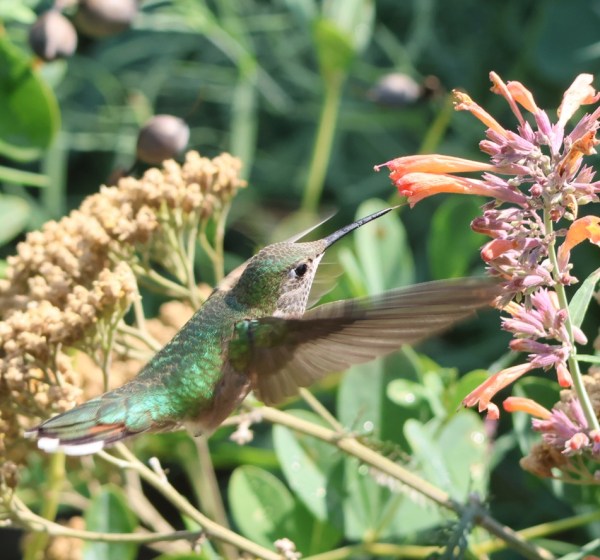
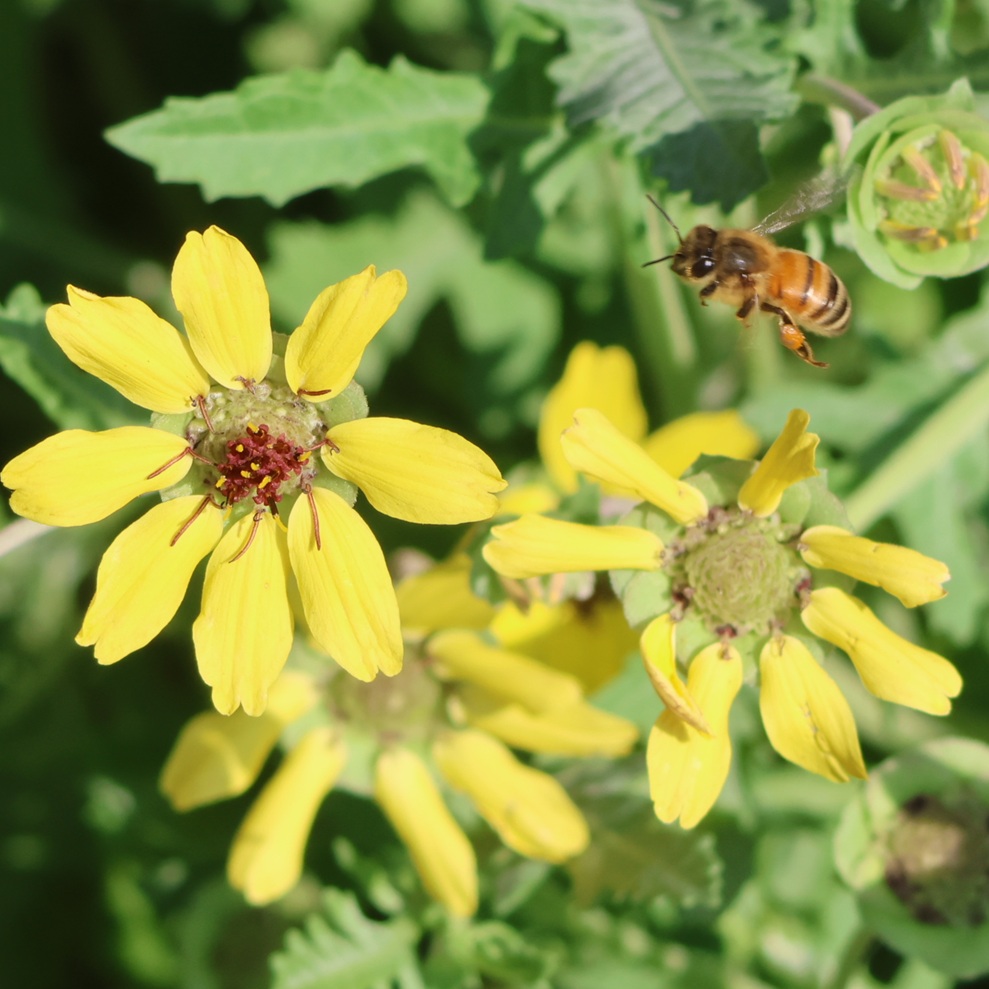
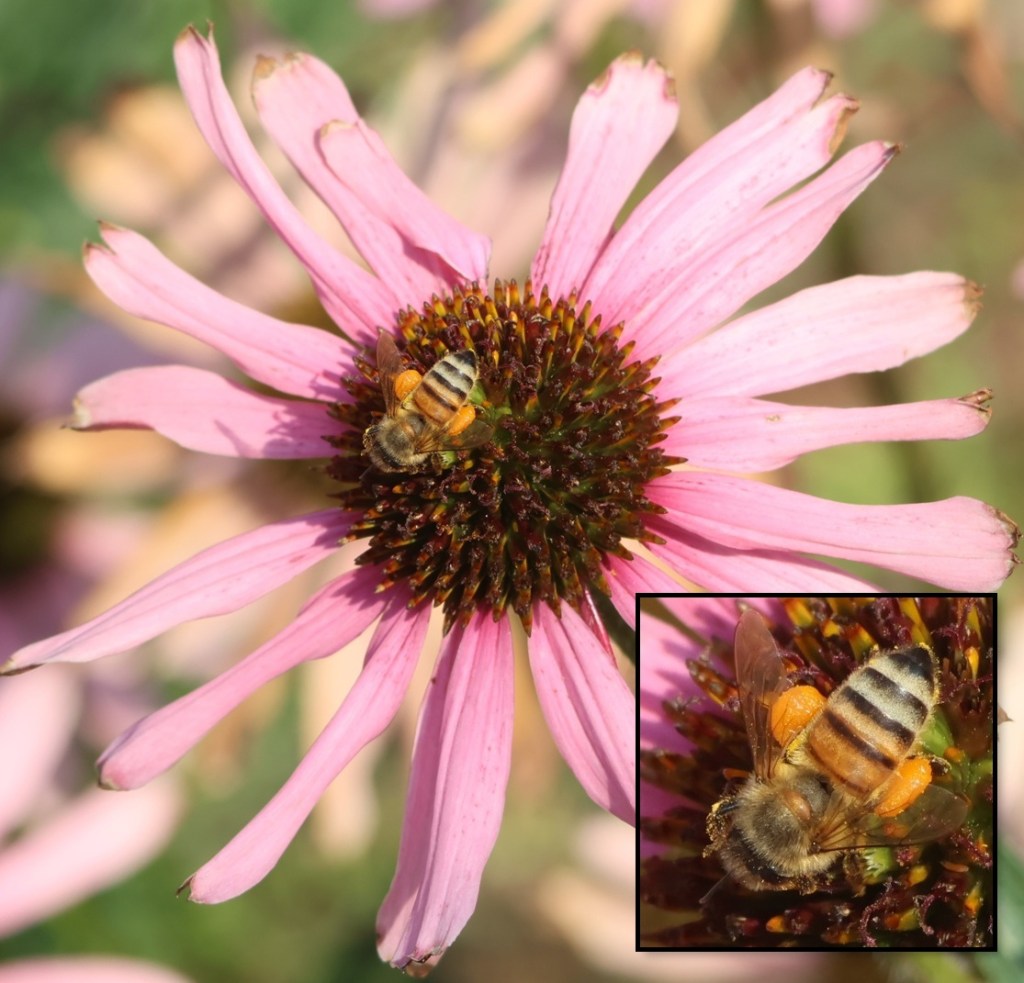
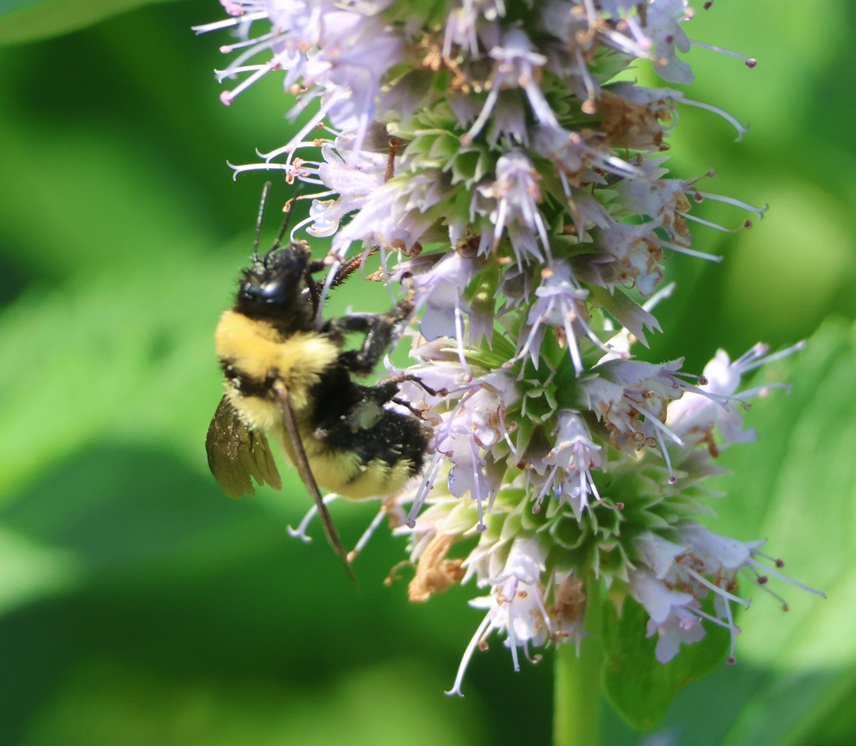
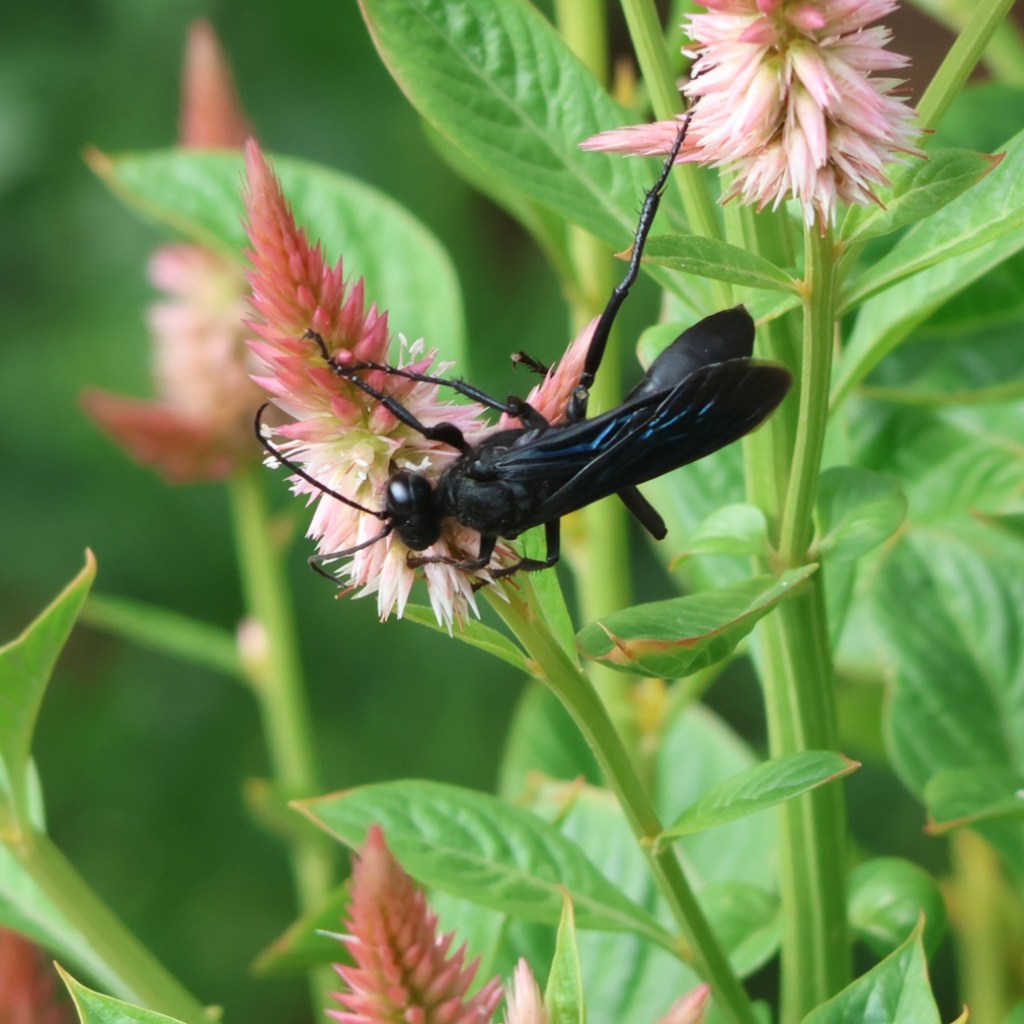
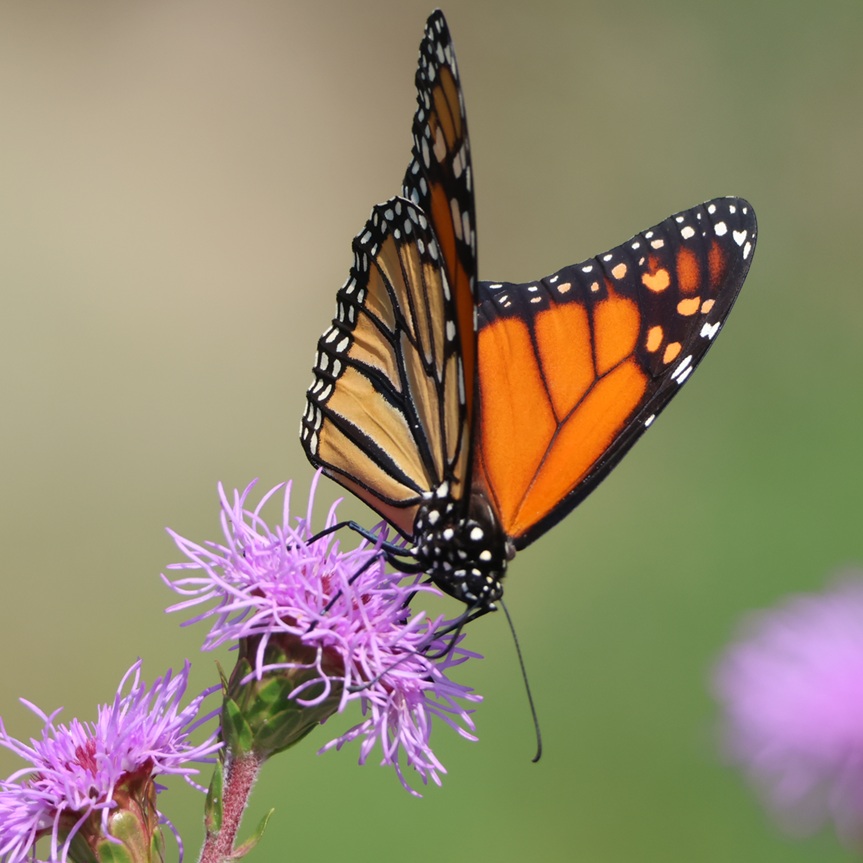
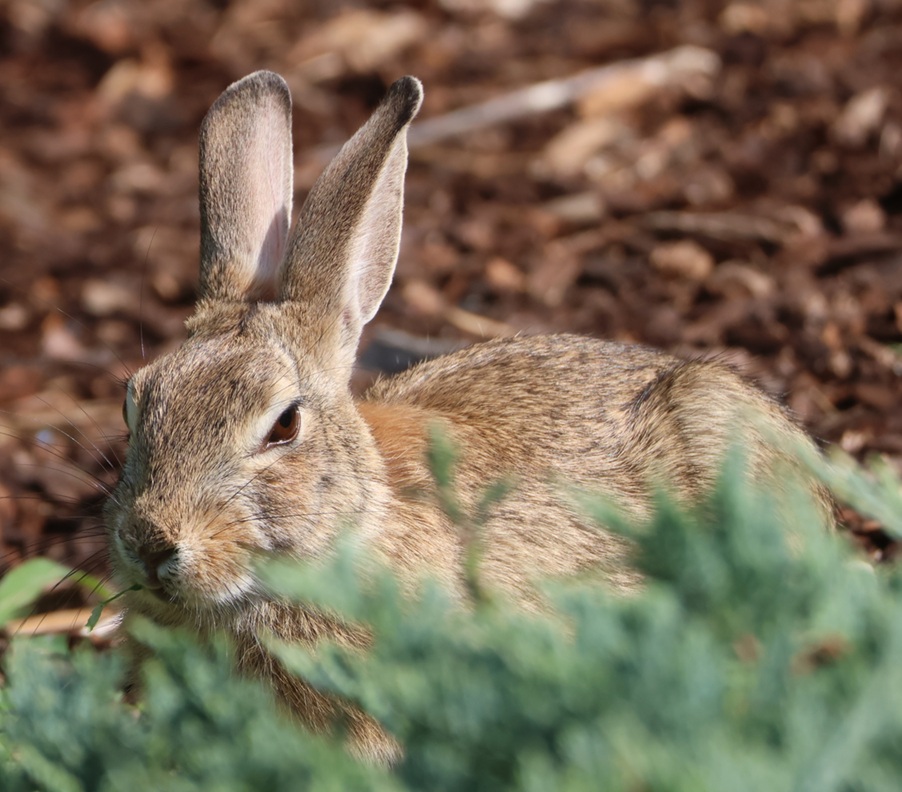
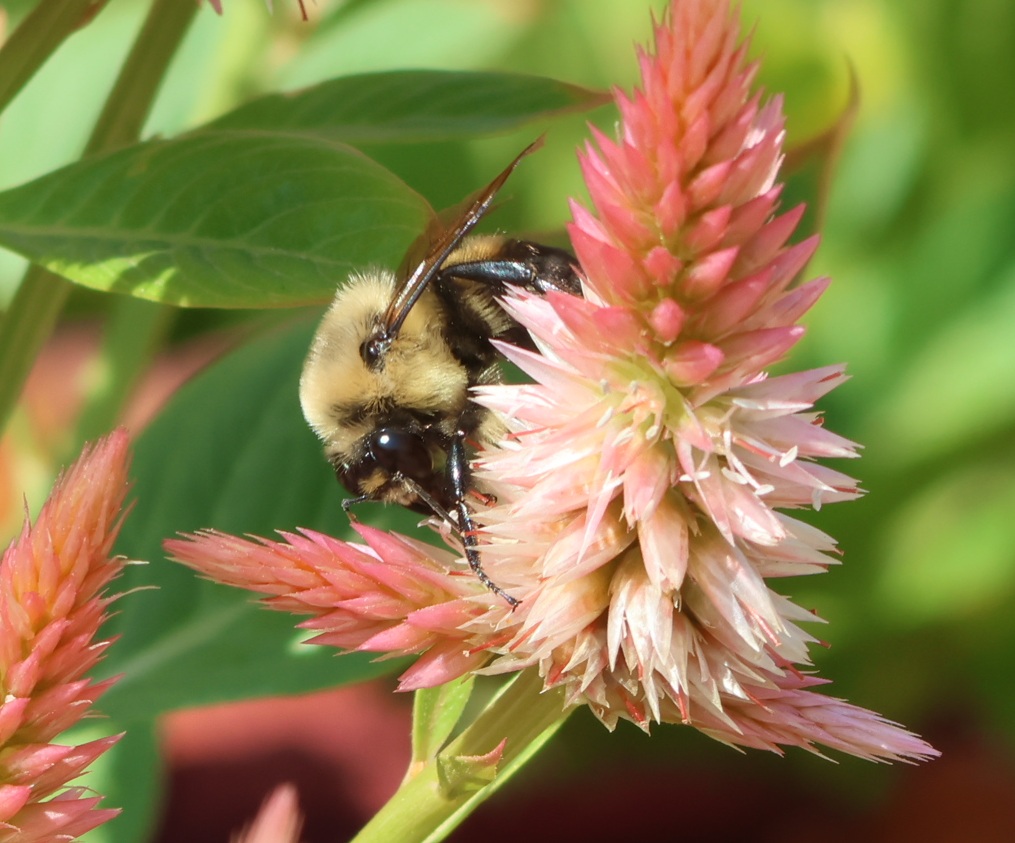
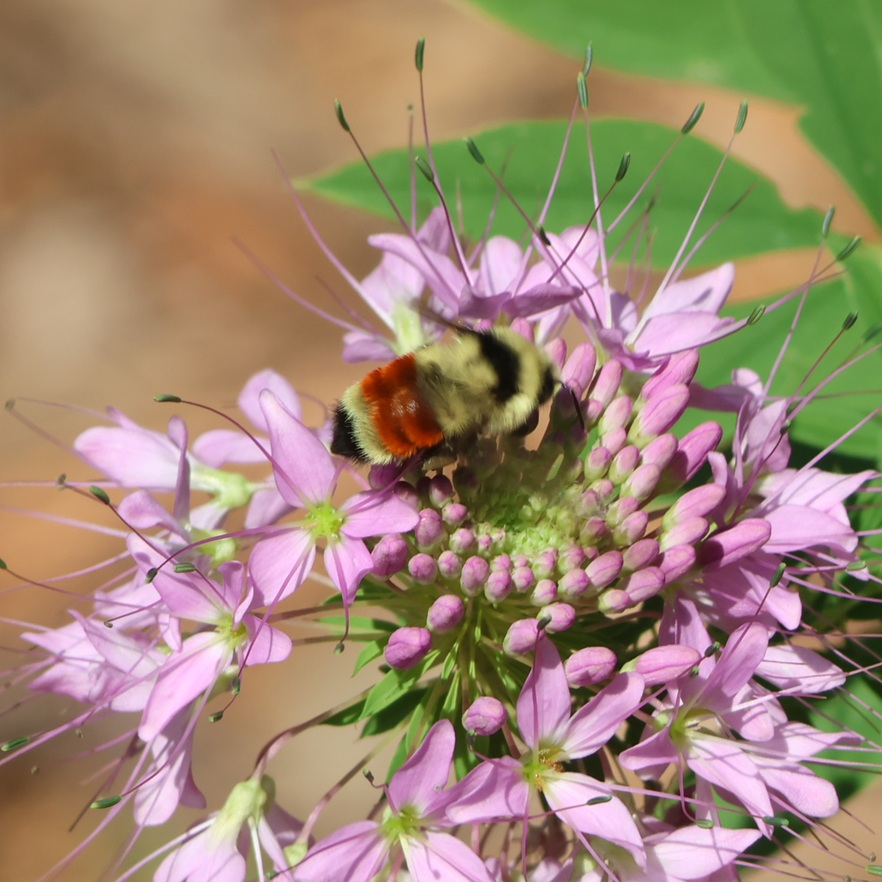
This is one of the first of about 150 photos I took during my 2 1/2-hour visit to the Gardens. It’s a western honey bee (Apis mellifera) on final approach to a bloom on a chocolate flower (Berlandiera lyrata). While researching this posting, I learned something pretty basic: the western honey bee, the most common of the honey bee species worldwide and found on every continent except Antarctica, is not native to the United States, or even the Americas. Colonists introduced honey bees to this country in the 17th century for the production of honey, which the bees make by collecting and processing flower nectar. Worker bees like the one pictured collect flower nectar and pollen (seen as the small orange clump on this bee’s left back leg) to bring back to their hive. The pollen and nectar both serve as food sources for the bees, and the nectar is also refined into honey. Rock art found in France and Spain indicates that humans have been collecting honey from bees since around 7,000 BCE. Pollination, the transfer of pollen from one plant to another either as bees and other animals visit different flowers or by the wind, allows the fertilization of plants. Whether it’s performed by animals or the wind, pollination is absolutely critical for plant reproduction: without pollinators, especially bees, we’d quickly run out of plants used for food and clothing. Chocolate flower, so named because of the fragrance it emits, is native to the southwestern United States and northern Mexico.Here’s another western honey bee, this one on a cultivated Tennessee purple coneflower (Echinacea tennesseensis). I inset a closeup of the bee in the lower right corner to highlight the amount of pollen it’s collected. Comprising mostly simple sugars like fructose and glucose, as well as proteins, vitamins and minerals, and fatty acids, pollen is the main food source for the bees back at their hive. Honey is made by refining floral nectar, also collected by worker bees such as this one. Queen honey bees produce eggs for a colony numbering between 60,000 and 80,000 worker bees, all of which collect floral material for honey production; the workers also maintain the hive.I was surprised to learn that 46 species of bumble bees have been identified in the United States. This is a Sonoran bumble bee (Bombus pensylvanicussonorus), one of the 24 bumble bee species observed in Colorado. The scientists are still deciding whether the Sonoran bumble bee is a distinct species or a subspecies of the American bumble bee (Bombus pensylvanicus). This one was collecting material from a giant hyssop, a genus of agastache that includes more than 20 species and is very popular among pollinators.Bees and butterflies are the most prolific pollinators in the animal kingdom, but other insects like moths, wasps, flies, ants, and other six-legged creatures are important as well. This unimaginatively-but-accurately-named great black wasp (Sphex pensylvanicus) was easy to spot on the Gardens’ plumed cockscomb (Celosia argentea) blossoms. This wasp, the wings of which display a beautiful blue iridescence in the right light, grows to a length of 0.8-1.4 inches (20-35 mm); the top edge of your cell phone measures about 3 inches, so these are indeed big bugs . In addition to plumed cockscomb, which originated in tropical Africa, great black wasps are important pollinators of milkweed plants.A group of three people was standing on the walk in front of me, and one of them was using their phone to film something. I started to pass the group, and then noticed that they were observing this American goldfinch (Spinus tristis). These beautiful birds are widespread throughout the United States (they’re the state bird of New Jersey, Iowa, and Washington), and can be seen seasonally in southern Canada and the eastern coast of Mexico. In one respect, American goldfinches are rare in the bird world: they’re strictly vegetarians, and eat insects only incidentally. This goldfinch was sampling seeds from a cutleaf coneflower (Rudbeckia laciniata), which grows to a height of 6 1/2 feet (2m). Many birds rely on coneflower seeds as a major source of food in the late summer and fall.Beyond bees, butterflies are probably the next-most-familiar pollinating insects and this is perhaps the most famous butterfly of all: the monarch (Danaus plexippus). It is pollinating a bloom of a Rocky Mountain blazing star (Liatris ligulistylis), a plant native to the Central Plains of the United States and Canada that grows to a height of 39 inches (100 cm). This guy is one of the reasons I took 150 photographs at the Gardens; this is the best (and it’s not great) of about a dozen that I took of it – the bug just wouldn’t stay still.Among non-insect pollinators, hummingbirds might be the most familiar to us but bats, monkeys, lizards, and a few other vertebrate animals do their part to spread pollen around. I first saw this broad-tailed hummingbird (Selasphorus platycercus) hovering in the shade but it quickly moved into the sun so I could get a better picture as it collected nectar from an orange hummingbird mint (Agastache aurantiaca) – you can even make out its super-slender tongue. I heard a lot more hummingbirds than I saw and certainly photographed at the Gardens; male broad-tailed hummingbirds make a trilling sound with their wings as they fly. Broad-tailed hummingbirds are only in the United States from late May through early August; this guy was probably on his way back to Mexico shortly after I took this photo. Hummingbirds, especially Anna’s hummingbirds, are very common in Las Vegas, Nevada, when we winter there, and it was great to be around them again.This is not a bee, nor a butterfly, nor a bird, but rather a bunny that I photographed munching on some salad alongside one of the Gardens’ trails. This is most likely a mountain cottontail rabbit (Sylvilagus nuttallii), but another thing I learned while writing this blog posting is that Colorado is home to three (desert and eastern being the others) of the 13 species of cottontails – I previously thought there was just one species.Great black wasps weren’t the only insects enjoying plumed cockscomb at the Gardens – here’s a brown-belted bumble bee (Bombus griseocollis) collecting floral material. These bumble bees live in a remarkably wide variety of habitats and thrive in urban environments – they’ve even been observed at the top of the Empire State Building, 1,250 feet (380 m) above the streets of New York City.I was taking pictures of house finches (Haemorhous mexicanus) at our front-yard birdfeeders for a couple of years before we became full-time RVers; I’ve since taken several hundred more pictures of them around the country, but this is one of my favorites. She is perched at the top of some species of arborvitae. As the species name suggests, house finches are natives of Mexico and the southwestern United States, but populations were (illegally) taken to the eastern United States in the 1940s and now they’re found in southern Canada, all of the contiguous United States and most of the islands of Hawaii, and most of Mexico. The songs of these pretty little birds are always pleasant to listen to.Hunt’s bumble bees (Bombus huntii) are commonly found in the western United States and as far east as Minnesota, as well as regions of Canada and Mexico. Easily identified by the red-orange band on its abdomen, this one is collecting material from a spider flower (Cleome houtteana), which is native to countries in South America. The genus name of bumble bees, Bombus, is Latin for “buzzing” or “booming.”Apologies if this image destroyed your retinas, but here’s one more western honey bee; it’s on a sneezeweed (Helenium autumnale) blossom. These plants are often used to restore pollinator habitats, encouraging the growth of bee and butterfly populations. The plants are pollinated only by insects, not by the wind, so despite their name they don’t actually contribute to seasonal allergies.
While I departed Denver Botanic Gardens with fewer photographs of birds than I’d planned (I also tried to take pictures of many of the barn swallows swooping above the Gardens’ water features while collecting flying insects, but was thwarted by the swallows’ aeronautics), I came away with a greater appreciation of the diversity of wildlife supported by the Gardens’ native and cultivated plants. I had no idea that honey bees are not native to this country, for example, or how many bumble bee species there were, or that there’s a wasp measuring nearly 1 1/2 inches in length that lives among us. It was a beautiful morning for looking at beautiful plants and wildlife.
Works Consulted
Interpretive signage at the Denver Botanic Gardens
National Audubon Society Field Guide to North American WIldflowers, Western Region, seventeenth printing
National Audubon Society Field Guide to Insects & Spiders, thirty-second printing
Wikipedia, accessed August 2026. If you use Wikipedia, please support it
This is the third winter we are spending in Las Vegas, Nevada. The benefits of spending the winter in the Mojave Desert are many: the temperatures remain fairly warm compared to the rest of the United States (important for even the best-insulated recreational vehicles out there); the campground at which we stay has a number of amenities that we appreciate; and the Entertainment Capital of the World has a lot to offer, extending far beyond casinos, theatrical entertainment, and concerts.
One of those attractions we’ve really enjoyed visiting is the Springs Preserve, a beautiful 180-acre piece of land just west of downtown Las Vegas owned and operated by the Las Vegas Valley Water District. True to its name, the Springs Preserve is the original site of the city’s water source – it has since dried up, for the most part, but the property continues to offer a number of different attractions: botanic gardens, several museums (including the Nevada State Museum), a recreated “boomtown” that shows what early Las Vegas was like, hiking trails through the desert, and much more.
We’d been to the Springs Preserve many times in the previous two years, but never to its Butterfly Habitat because it closes for the season, due to cold weather (cold for the Mojave Desert, anyway) in late November. Nancy and I made visiting the Butterfly Habitat a priority for the early part of our 2025-2026 winter in Las Vegas, and we’re glad we did.
You’re familiar with the lifecycle of a butterfly, which includes four distinct metamorphic stages: adults (the ones that fly around) lay eggs on the underside of plant leaves or along stems; the larval stage hatches from those eggs as a caterpillar; the larvae encase themselves in a cocoon or chrysalis; and the adult emerges after a few days or weeks to fly around and the females lay eggs once again.
Butterflies have four wings: two forewings and two hindwings. Some butterflies live only for a few days as adults, and others, like monarchs, can live up to a year. The average lifespan of an adult butterfly is a mere two weeks, which makes seeing them extra-special.
Incidentally, Clark County in southern Nevada is home to Las Vegas and about 135 species of butterflies. They visit the Las Vegas area year-round, heading up to the higher elevations of the nearby mountains to wait out the sweltering summers and some species find warmer microclimates in the winter months. The butterflies at habitats like that at the Spring Preserve, none of which are native to Las Vegas and few of which are even found naturally in this country, come from several suppliers in the United States as eggs or caterpillars.
Here’s a look at the twelve (12!) different species of order Lepidoptera we encountered at the Springs Preserve Butterfly Habitat.
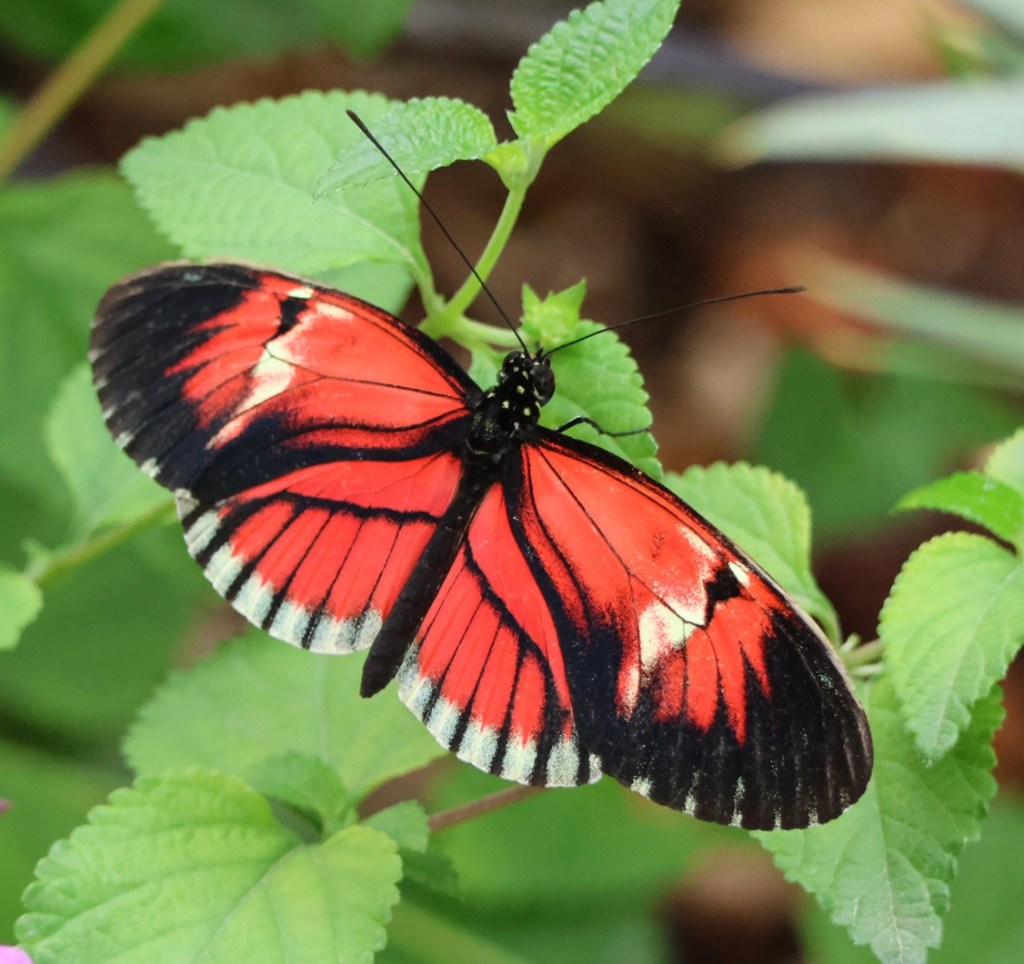
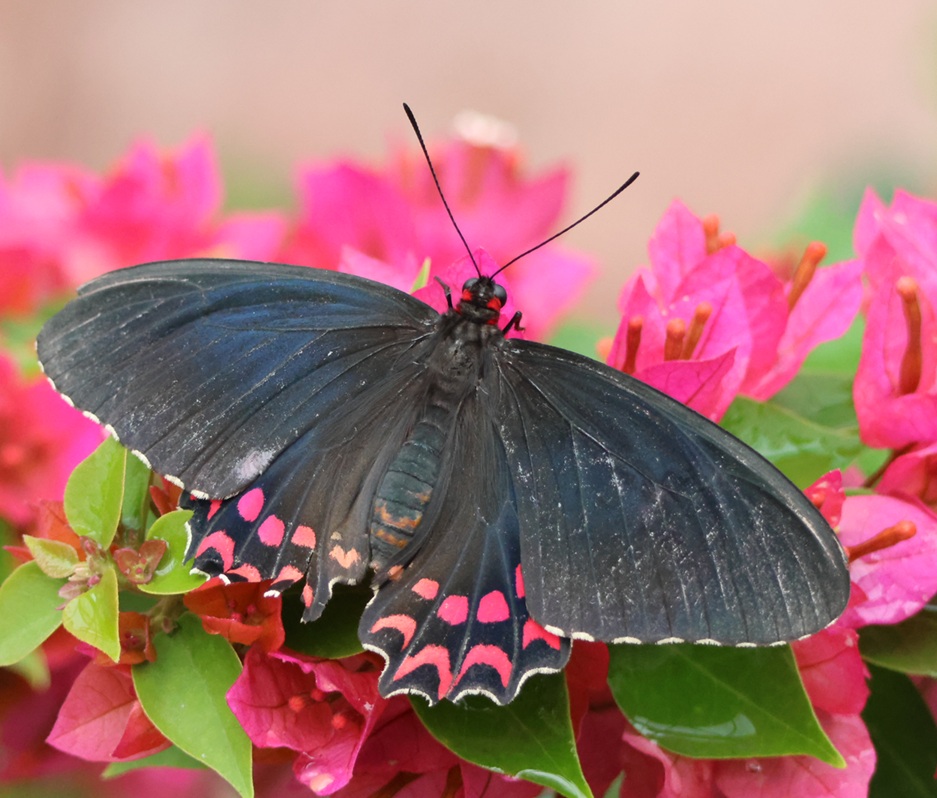
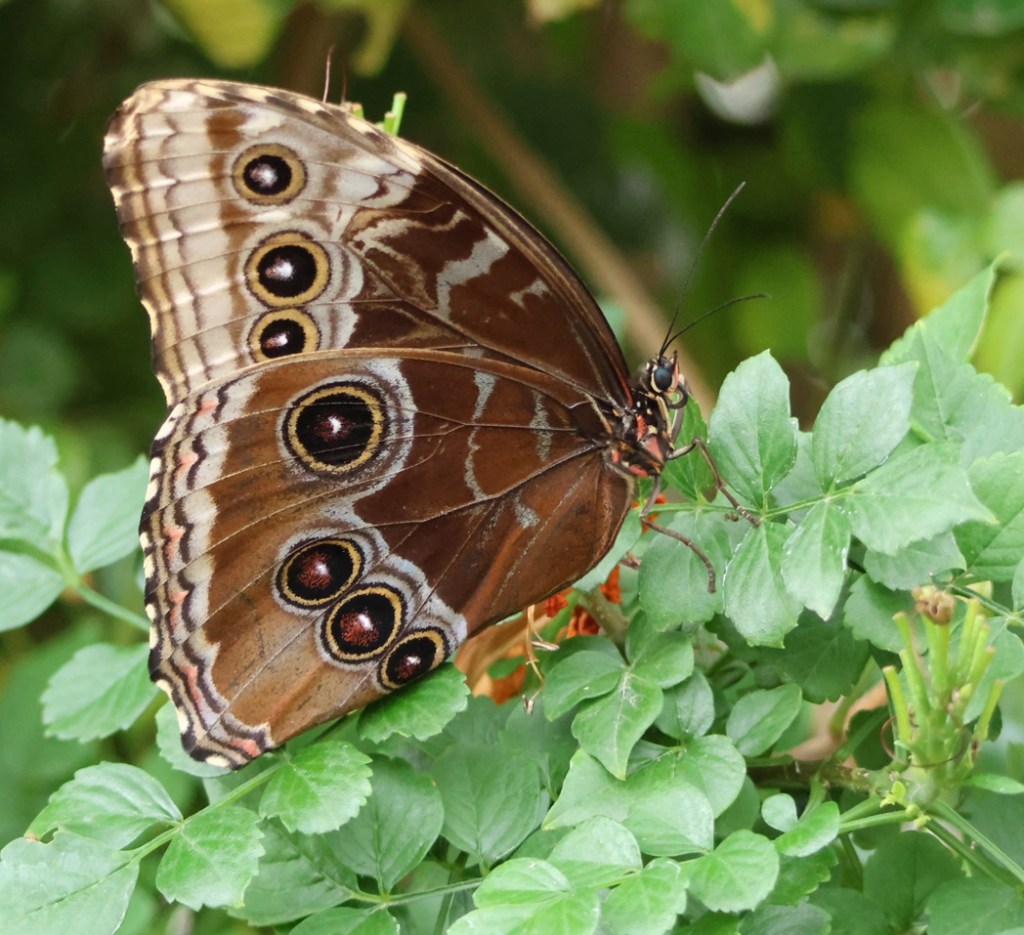
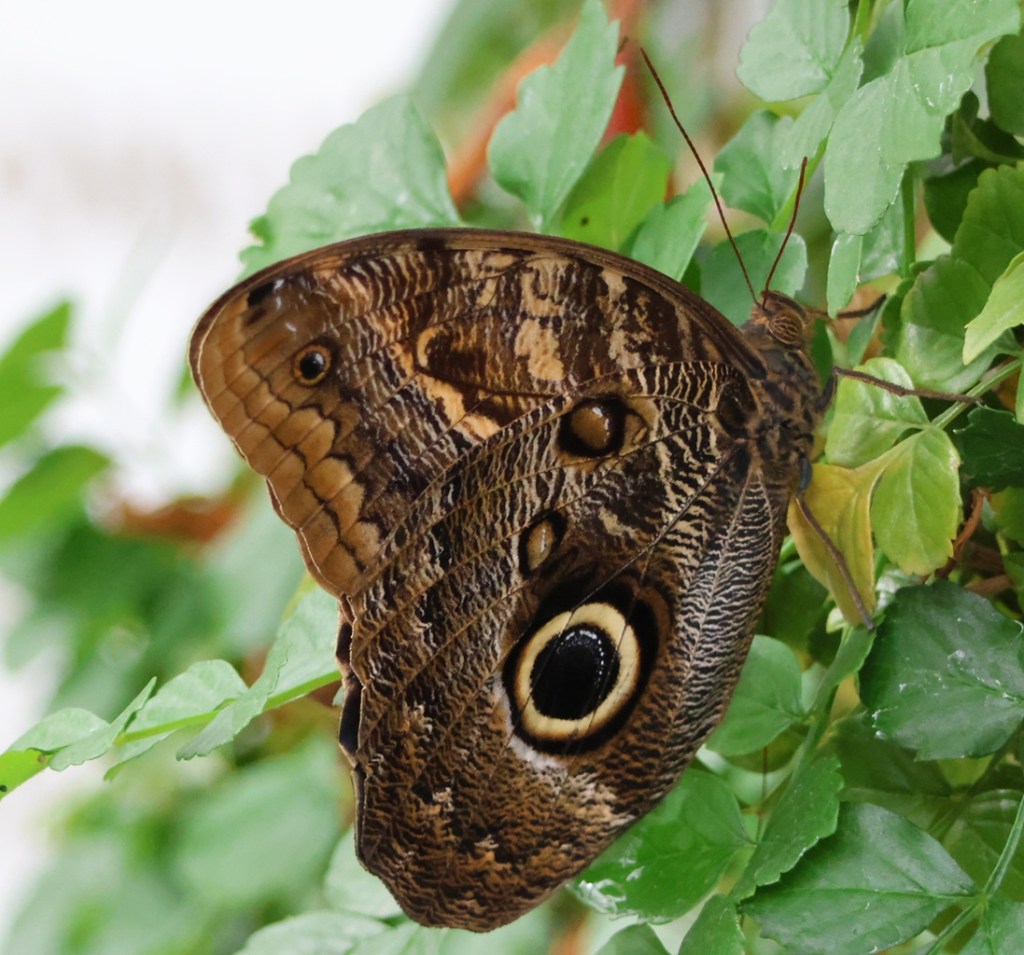
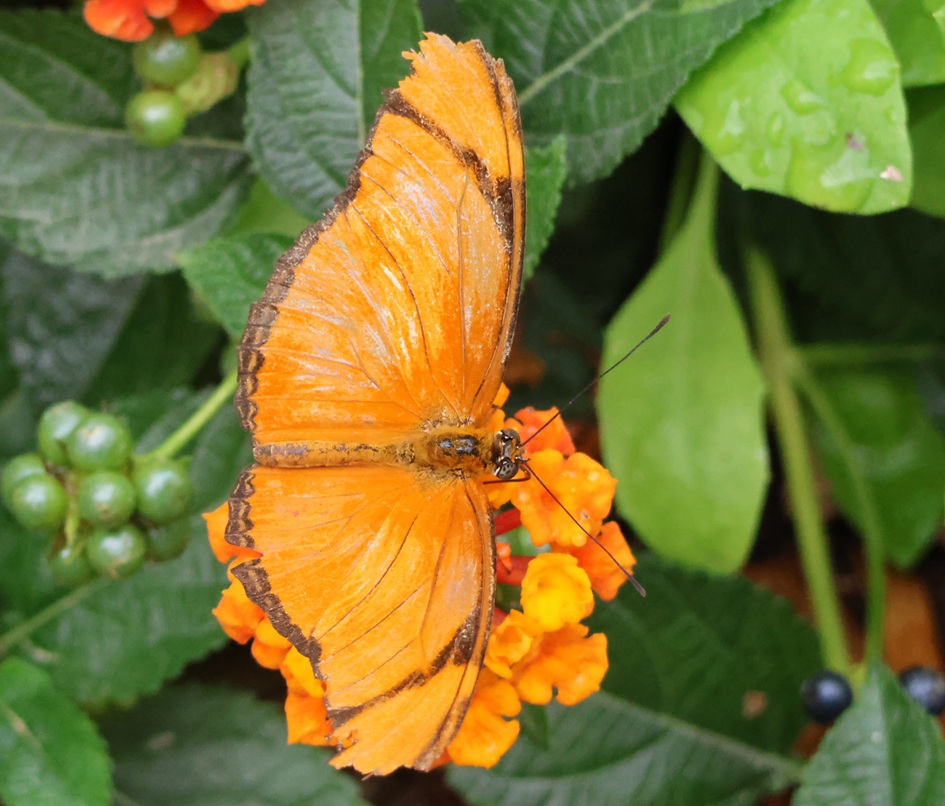
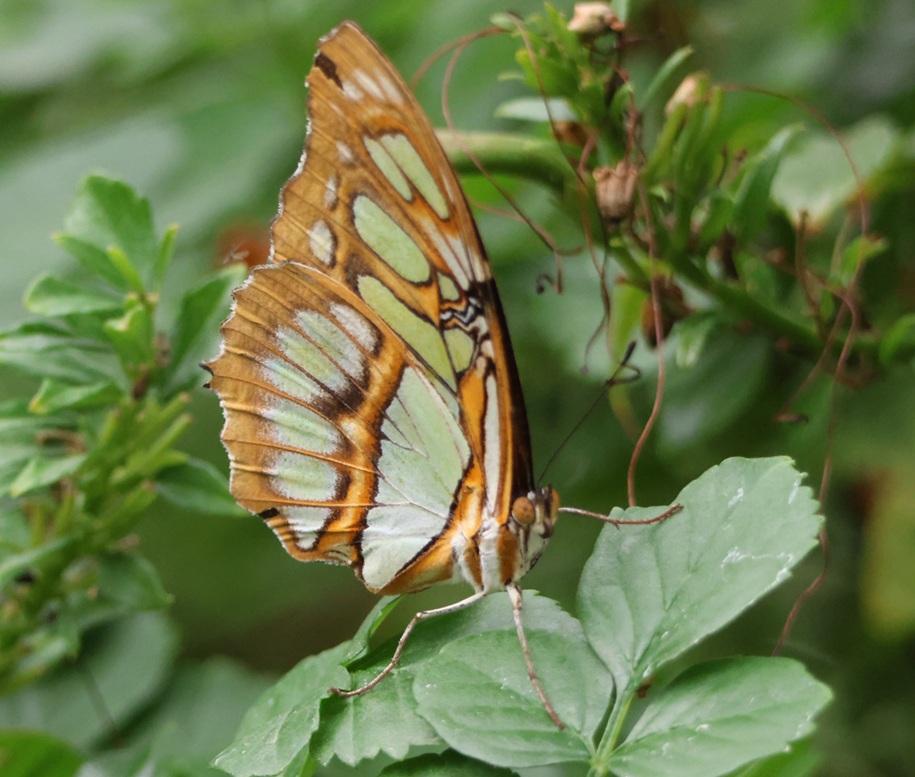
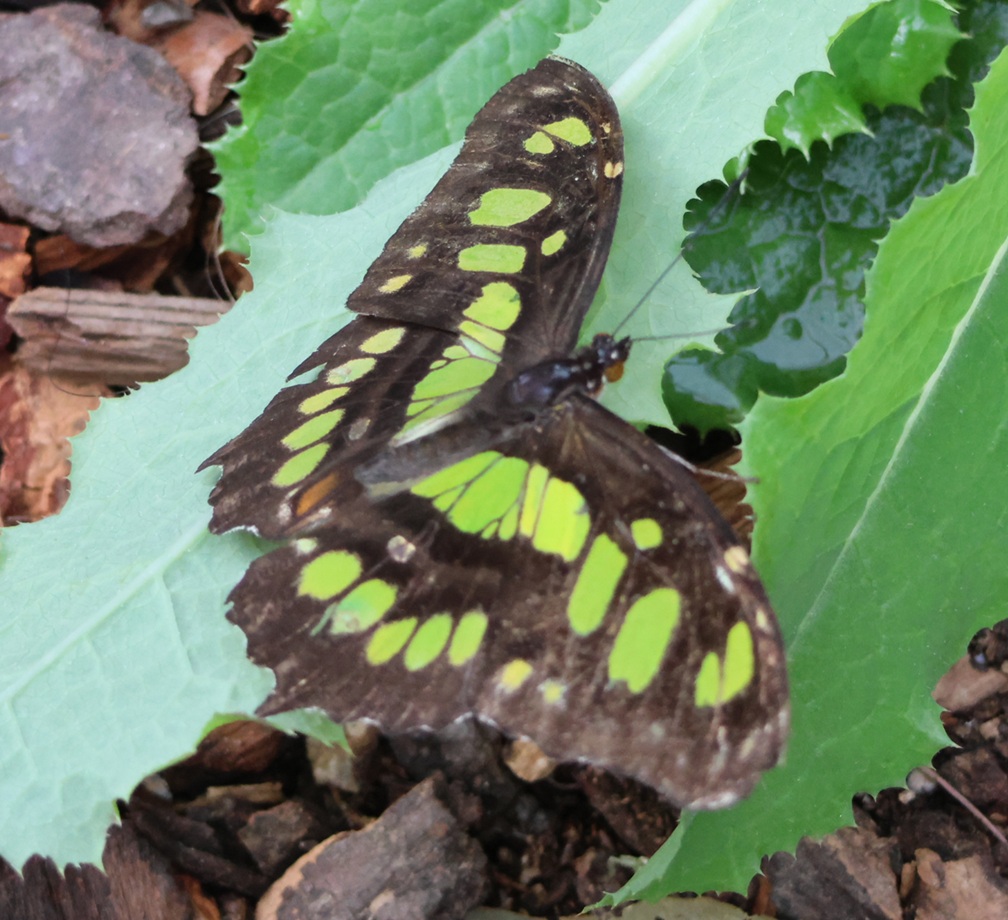
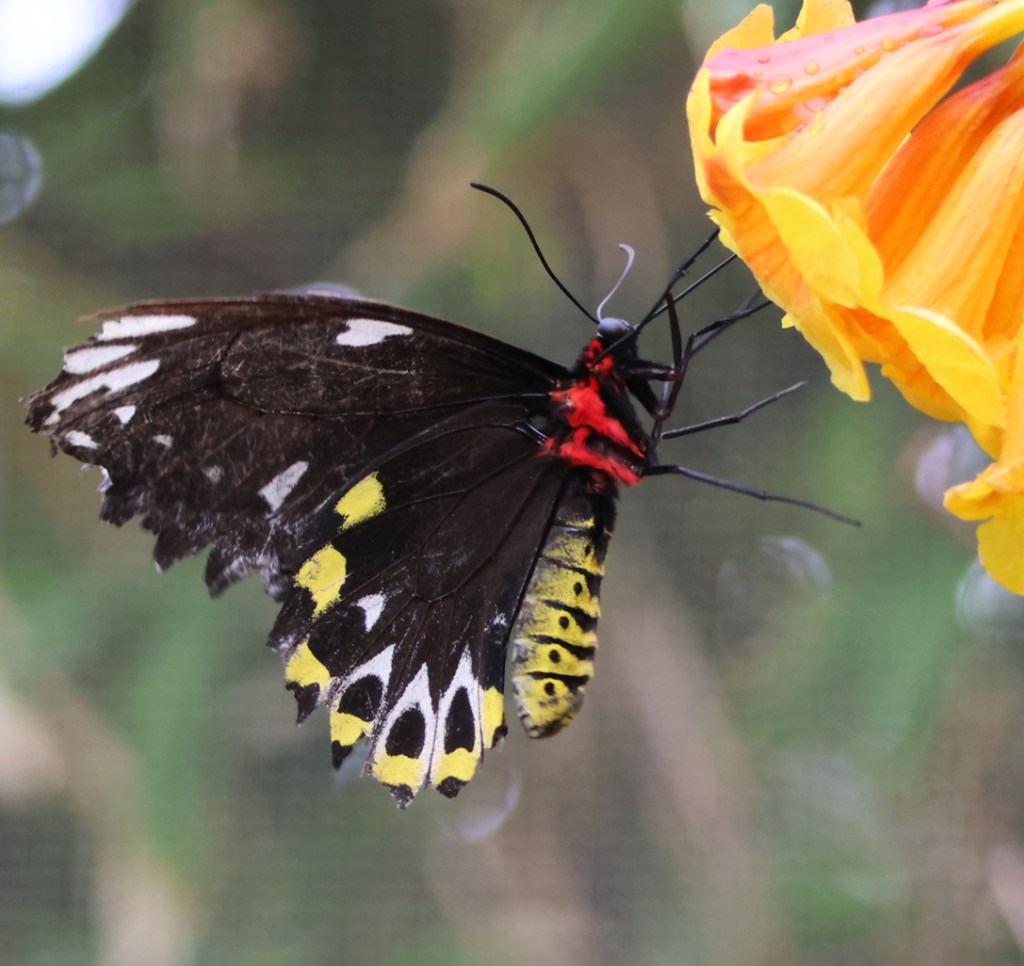
Before entering the habitat, which is fully enclosed to keep the butterflies and their food sources warm, staff and volunteers speak about the rules. If you’ve been to a butterfly habitat before, you’re familiar: don’t touch the butterflies (the scales on their wings are incredibly fragile), don’t step on the butterflies (they sometimes land on the sidewalks of the habitat), and make sure no butterflies leave the habitat on your clothing or body as hangers-on (no one wants to see non-native butterflies loose over the streets of Las Vegas). Although the habitat is a fairly good-sized structure, once we were inside the building Nancy and I probably didn’t move more than 10 feet from the entrance for a good 10 minutes. There was just too much to see! One of the first butterfly species we saw was the zebra longwing (Heliconius charitonius), also known as the yellow-barred heliconian. There were many of these black-and-yellow butterflies flitting about the entire habitat. The species has a wingspan of between 3 and 3 3/8 inches (75-85 mm). The color pattern is aposematic: the stripes warn predators to stay away from it. Zebra longwings are native to the gulf states, but sometimes can be found as far west as Kansas and as far north as South Carolina.Here is another species we saw frequently in the habitat: the postman butterfly (Heliconius melpomene). Like the previous species, the postman’s bright colors warn predators to look elsewhere for a meal. In the wild, they are found throughout Central and South America – particularly on the slopes of the Andes Mountains. This species has a wingspan of 1.375 to 1.5 inches (35-39 mm).This is an image of another postman, showing the underwings as it perches on this plant stem. Postman butterflies can see in the ultraviolet spectrum, which allows them to distinguish between different species of butterflies. The postman butterfly has been on the planet for a little over 2 million years (not this particular one; the species as a whole – after emerging from its cocoon, a postman butterfly lives for about six months in the wild).Cattleheart (Parides iphidamas) butterflies in the wild get their nutrients from a plant called pipevine. The adult butterflies ingest a toxin from pipevine, which keeps predators from eating them as well as the caterpillars. This species, too, is found in Central and South America. Nancy and I both appreciated the dark coloration, coupled with the bright magenta spots on the hindwing, of this species.Here is a butterfly probably familiar to all, the monarch (Danaus plexippus). Monarchs are one of the great migratory species of the animal kingdom. While many butterfly species make their way across relatively short distances to warmer climes as the seasons change, monarchs fly thousands of multi-generational miles each year. Their wings, spanning 3 1/2 to 4 inches (8.9-10.2 cm), carry them from southern Canada, throughout the western, central and eastern United States, and finally into Mexico, and then back again in the spring. (Unlike some other migratory animals, like birds, the trip takes roughly four generations each season – but it’s still an admirable feat.) By the by, this is a male monarch – you can tell because of the little black dots on the black stripes on the hindwings near the end of the thorax.Here’s one of the larger butterflies we saw in the habitat, the common blue morpho (Morpho helenor peleides). The wingspan of a common blue morpho is an uncommon 3.0 to 7.9 inches (7.5-20 cm). Those of you fortunate enough to be viewing this blog on color screens will notice there’s not much blue on this bug. Here’s the deal on blue morphos, which are from Central and South America: they don’t much care for cold temperatures. Daytime highs in Las Vegas had plummeted into the mid-60s during our mid-November visit, and it had briefly rained the night before. All butterflies are cold-blooded and rely on their environments to regulate their body temperature. In order to conserve heat, this blue morpho kept its wings closed the entire time we were in the habitat. If it had been a little warmer, we probably would have seen the brilliant blue of the tops of its wings – judging from the pictures I’ve seen online (I have a color monitor), they’re just gorgeous. The underside of the wings are pretty attractive too, of course. Some of the butterflies we saw, like this paper kite (Idea leuconoe), appeared to be yearning to be outside the habitat. However, it was much warmer, and the butterflies had much easier access to food sources, inside the building. Paper kites are natives of southeast Asia but can also be found in northern Australia and southern Taiwan. They have wingspans of 4 3/4 to 5 1/2 inches (12-14 cm). I really liked the subtle yellow-to-white coloration on this butterfly; while it doesn’t necessarily scream “DON”T EAT ME! SERIOUSLY!” like patterns we’d seen on other species, I’d probably refrain from doing so anyway.Speaking of escaping the bonds of the butterfly habitat, one of the volunteers there said that they really have to keep on eye on this species, the great southern white (Ascia monuste), to make sure it doesn’t follow visitors out the door.This picture happens to show the butterfly’s proboscis, which uncurls so that the butterfly can ingest nectar and other nutrients. In visiting a number of different flowering plants, many butterflies are important pollinators. Great southern whites are found on the Atlantic and Gulf coasts of the United States and on south to Argentina, with individuals occasionally straying to Kansas and Colorado. Great southern whites have wingspans of 2 1/2 to 3 1/2 inches (63-86 mm), a little bigger than half the size of the previously pictured paper kite.Hey, who let this giant owl into the forested butterfly habitat? I’m just kidding with you right now. This species is, in fact, a forest giant owl (Caligo eurilochus), another huge butterfly that has absolutely gorgeous multicolored top wings but this cranky guy never opened his wings during our visit. When they do open, the wingspan of a forest giant owl measures up to 6 3/4 inches (17 cm). In the wild, this species is found in Mexico, Centrai America, and down to the Amazon River basin. There are about 20 species within the owl butterfly genus, which gets its name from the eyespots on its underwing. The scientists are still undecided about the purpose of the eyespot; it might be an adaptation to mimic a large bird’s face, or it might serve as a target so that predators attack the wing rather than the body of the butterfly.This pretty species, Julia butterfly (Dryas iulia), is native to Brazil and up to Texas and Florida, and can sometimes be found as far north as Nebraska. Their wingspans measure 3 1/4 to 3 1/2 inches (82-92 mm). I liked how the color of its wings matched that of the blossoms of this lantana plant. There are 14 recognized subspecies of Julia.This is a terribly out-of-focus photo, but it’s the only one I have of this species. Its wings are not green, but rather display the color of the leaves on which it’s perched. The butterfly’s wings are transparent, giving it the name glasswing (Greta morgane oto). It is found in Central America and northern parts of South America, with occasional forays up into southern Texas and down to northern Chile. Its wingspan measures 1 to 1 1/4 inches (2.8-3 cm). This little butterfly looks pretty delicate, but it can carry up to 40 times its own weight – it, too, is a noted migrator. Malachite is a mineral that is bright-green in color, and it gives its name to this species of butterfly. The malachite (Siproeta stelenes) butterfly is fairly large, with a wingspan measuring between 3 1/4 and 4 inches (8.5-10 cm). It is found throughout Central and South America, and occasionally makes its way into Cuba as well as the southern parts of Texas and Florida. If you’re still reading this with a color screen, you’ll notice that the green on the wings isn’t particularly bright, so why is this butterfly called a malachite?This is why. Remarkably, this is the same butterfly species, malachite, as the one pictured above (although not the same butterfly; this one has a black body). It illustrates the huge difference between coloration patterns on the top and bottom of the wings of some butterflies.I’ll close with a couple of photos of another butterfly that illustrates the sharp difference between coloration of the top and bottom of its wings. We saw a lot of these butterflies, the common green birdwing (Ornithoptera priamus); in the wild they’re found in the western Pacific islands and northeast Australia.Again, this is the same species, common green birdwing, as in the preceding photo. Those are some bright colors, and even the bug’s thorax and abdomen are getting fancy. There are more than 20 subspecies of green birdwings.
Nancy and I spend a lot of time observing wildlife, mostly birds. It’s a relaxing pastime for us, and it’s a great way to get out to appreciate nature. The visit to the Springs Preserve Butterfly Habitat was incredibly rewarding, and I noticed, among the vibrant colors and the wide variety of sizes and body shapes, a big difference compared to other wildlife encounters. There were no birds chirping or calling to another, there were no hooves or paws passing through the grass, there were no sounds of grass being pulled from the ground or leaves being stripped from trees as food. Butterflies are totally silent, and they’re absolutely beautiful.
As I noted, the Springs Preserve Butterfly Habitat closes near the end of November and then closes for the winter months. If you find yourself in the Entertainment Capital of the World and want to do something pretty quiet, the habitat is a great way to get away from the noise and bright lights of Las Vegas. Check the habitat’s website (www.springspreserve.org/explore/butterfly-habitat.html) for current operating hours.
Works Consulted
Interpretive signage at the Springs Preserve Butterfly Habitat
“Field Guide to Insects & Spiders,” National Audubon Society, Borzoi Books, 2006
Wikipedia articles on various butterfly species; if you use Wikipedia, please consider supporting it financially