Birds of Las Vegas: Winter 2026

Las Vegas, Nevada – January & February 2026

We’ve just made our retreat from winter quarters in Las Vegas, Nevada, and now, in the first week of March 2026, find ourselves in Kingman, Arizona – just 100 miles down the road. I’ve written before about the many reasons we spend the winter months in Las Vegas, but it mostly comes down to these two:

  • The warmer temperatures of the Mohave Desert make the winter months both more comfortable and more practical. Cold-weather campers who stay in truck campers, travel trailers, and fifth-wheels like The Goddard know that it’s a pain – a necessary one, but still a pain – to disconnect water supplies from your RV if the temperature drops much below freezing. It’s critical to keep your water hoses, valves, and other equipment from breaking because of the frozen-water expansion. In three years totaling more than 12 months in Las Vegas, we had to disconnect from the water supply five times, and at least two of those were out of an abundance of caution.
  • If you run out of things to do in the literal Entertainment Capital of the World, that’s kind of on you.

There are other reasons, too, of course: frequent departures and arrivals from and to Harry Reid International Airport, through which 58.5 million people passed in 2024, allows for plenty of flights to see friends and family, there are restaurants featuring pretty much any kind of cuisine in the world, and (maybe this should be in the bullet list above) there are birding opportunities a-plenty.

Nancy and I had been to Las Vegas many times prior to selling our home in Denver and becoming full-time RVers, but our experiences in the city were pretty much limited to flying in to the airport, being transported to a hotel/casino, being entertained, and then being transported back to the airport so we could return to Denver. Having the opportunity to effectively live in Las Vegas for a quarter of the year gives us a much different perspective: people actually live, work, and raise families there – did you know that? Buying groceries, having your vehicle’s tires rotated, going to a park to escape the city noise: all of the things that people do every day in other cities are done by Las Vegans every day.
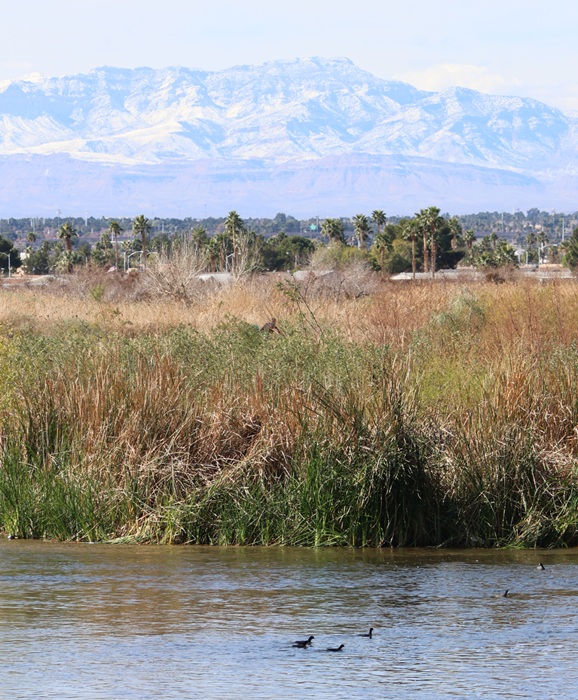
American coots swimming in the Las Vegas Wash were a familiar sight all four months we visited Clark County Wetlands Park. The city of Las Vegas (or, rather, the unincorporated towns of Paradise and Winchester; incorporated Las Vegas is itself a really small part of the metropolitan area) is on the other side of the tall grasses, and the snow-dusted mountains in the background, situated west of the metro area, show that it really was wintertime.

Maybe it’s not such a revelation to you, but, as someone who previously didn’t think about what people who actually live in Las Vegas do (you can’t make a living playing cards and going to shows, or at least not consistently), it certainly was to me.

Two of the places that we spend a lot of time while in Las Vegas are also home, or at least serve as a temporary stopover, to a number of different birds. I’ve written before about both Clark County Wetlands Park and the Springs Preserve, and they were once again sites to which we returned in the winter of 2025-2026.

I probably took about 500 pictures of birds over the winter (I’m not exaggerating), and here, in alphabetical common-name order, are 10 species that I really enjoyed watching (I enjoyed watching all of them and I didn’t get pictures of some that I really, really enjoyed watching, like an osprey hurtling into a stream in pursuit of a fish, or an American white pelican gliding over the desert).

Anna’s hummingbird
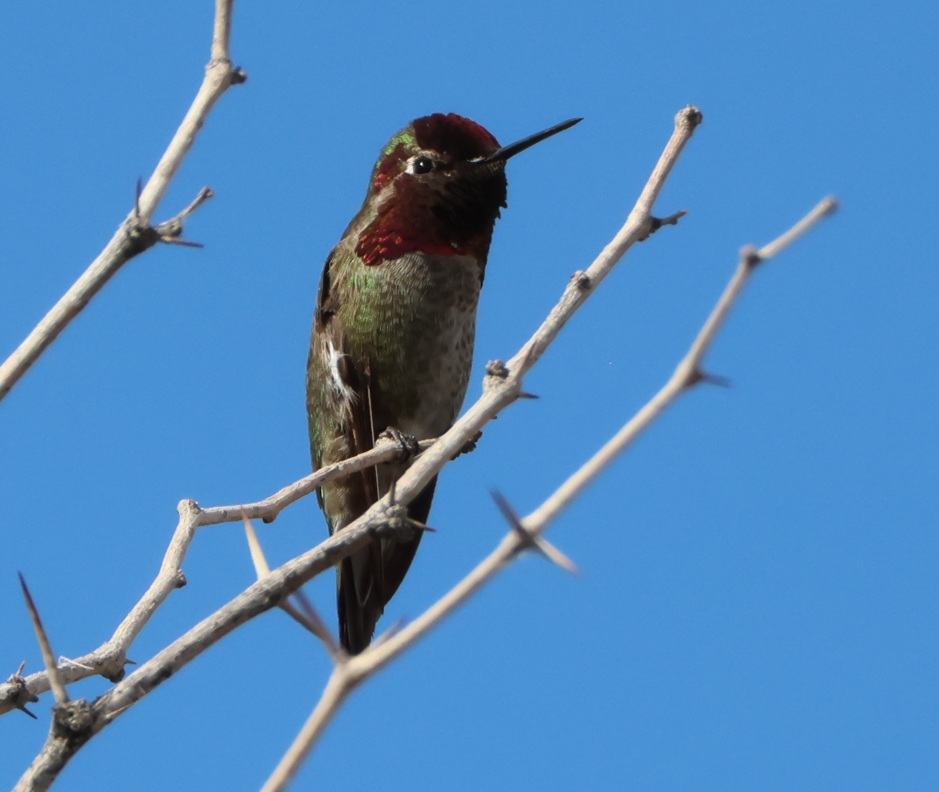
Primarily because of its warm climate, Las Vegas is a year-round home, or nearly so in some instances, to four different hummingbird species. The most common is the Anna’s hummingbird (Calypte anna). These little birds have a wingspan of 4.7 inches (12 cm) and weigh only up to 0.2 oz (5.7 g). Their bodies have the volume of a ping-pong ball and the mass of an American nickel. I took this picture at Springs Preserve on February 28 near the ciénega (Spanish for “swamp”), the manmade wetland feature that recreates the original water springs around which the original townsite of Las Vegas developed. Northern mockingbirds were by far the most common birds we saw at Springs Preserve, but we saw many Anna’s hummingbirds, as well as a couple of possible other hummingbird species, that day.

We’ve stayed at the same campground in the Las Vegas area the last three winters, and there’s a dog run there with a nearby tree that usually has an Anna’s hummingbird (not the one pictured, unless it decided to fly 11 miles to this different tree) perched at its top in the mornings. Seeing that little guy is always a great way to start the day.

Common merganser
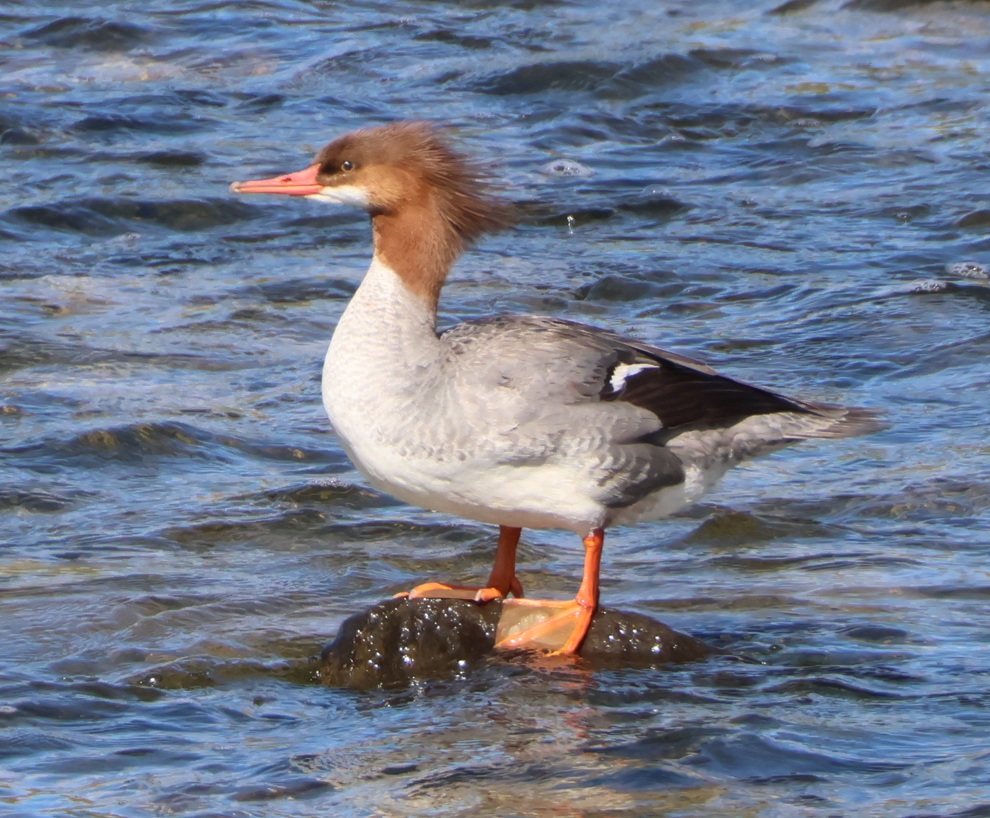
Nancy and I saw our first common merganser (Mergus merganser) two years ago in Pagosa Springs, Colorado, when one of these ladies (the drakes have dark-green head plumage) plopped down into the San Juan River flowing next to the restaurant at which we were dining al fresco. I got a really bad picture of it with my iPhone, but I could still tell that it was a common merganser (and a hen) because of the distinct reddish-brown head. We saw our second common merganser (another hen) paddling about the Yellowstone River during our first evening in Wyoming’s Yellowstone National Park last fall. This pretty lady pictured was one of five or six mergansers in the Las Vegas Wash on the morning of February 13. These birds have wingspans of 30-38 inches (78-97 cm) and weigh up to 4 pounds, 10 ounces (2.1 kg). All mergansers have serrated bills, which help them catch and hold on to fish. This species is found across the northern hemisphere at least part of the year; they are year-round residents of areas with ice-free water.

Crissal thrasher

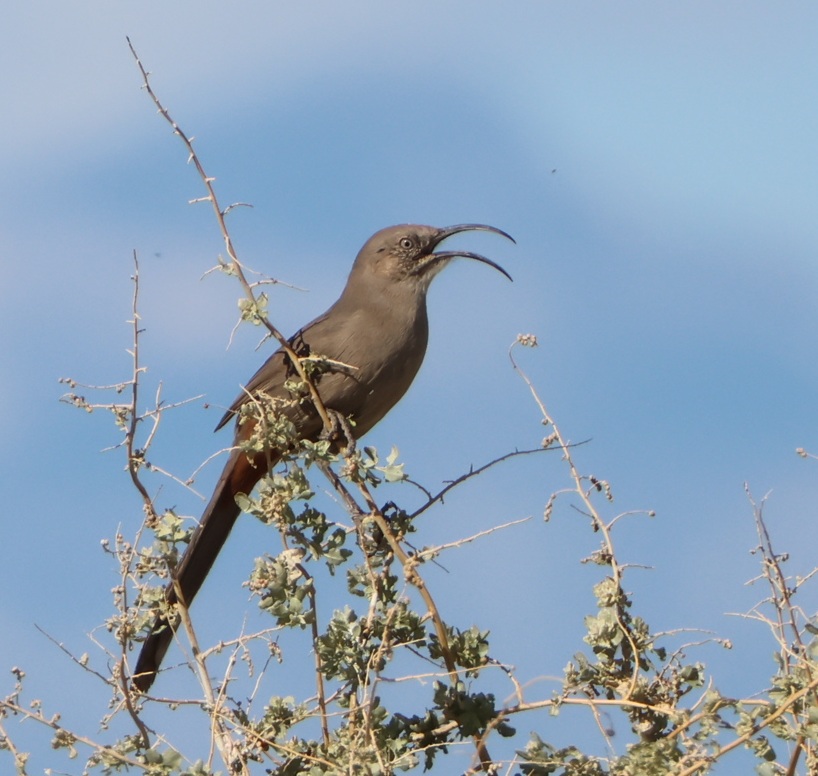
I saw my first crissal thrasher (Toxostoma crissale) last winter at Clark County Wetlands Park, and I saw a few more there this winter; I’ve only seen them there. These birds have bodies ranging from 10.5 to 12.5 inches (27-32 cm). I’ve been a somewhat serious bird enthusiast for perhaps five years, and I’m still amazed at their diversity. Crissal thrashers’ beaks evolved into this shape to allow them to capture insects in the leaf litter at the bases of trees and shrubs. Compare this thrasher’s beak and its diet with those of the merganser (which eats fish) and hummingbird (primarily flower nectar) above. A different thrasher species, Toxostoma curvirostre, has the common name of curve-billed thrasher (we’ve seen them in Arizona and New Mexico); its bill is indeed curved, but not nearly as much as that of a crissal’s. Inexplicably, my copy of the National Audubon Society’s Field Guide to Birds has a photo of the crissal thrasher facing the camera, so the effect of that wondrous bill is completely lost.

House finch

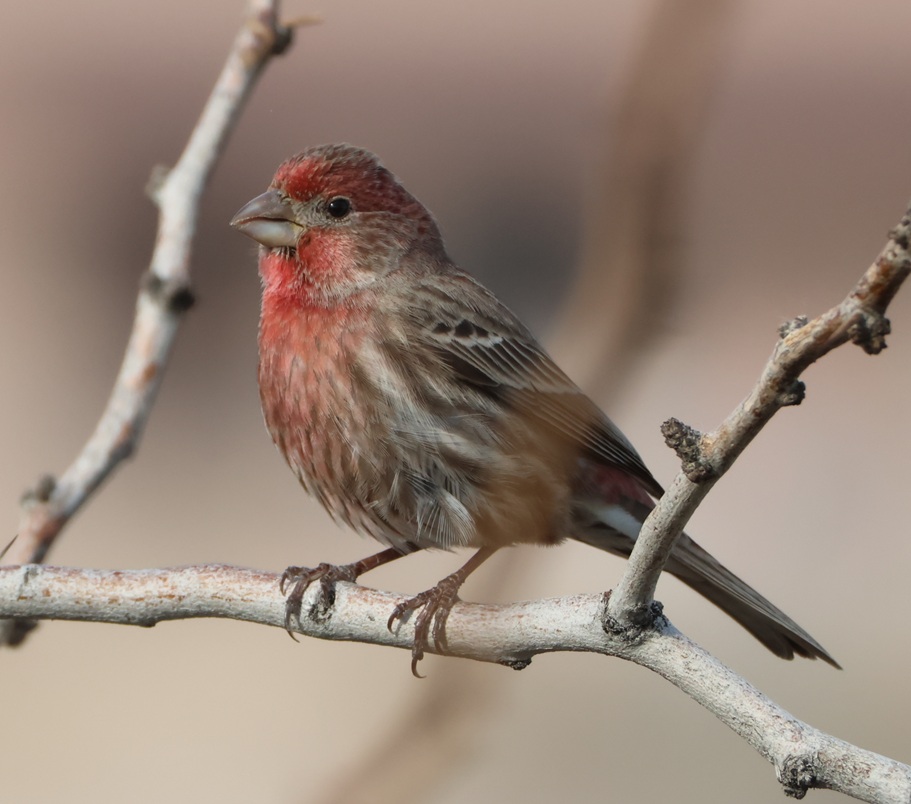
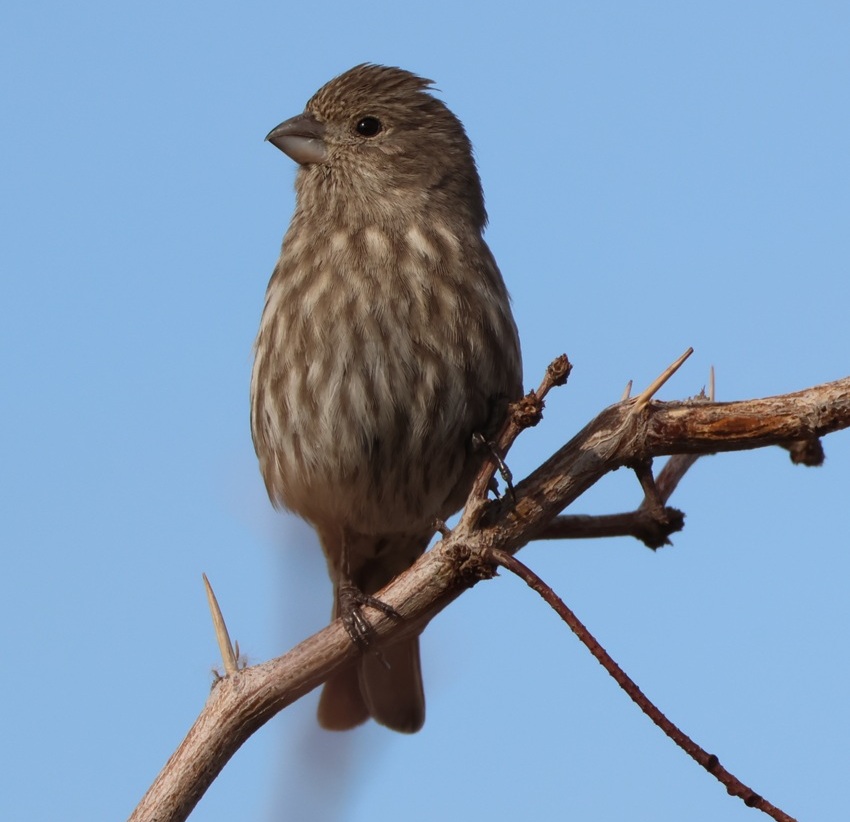
Continuing the comparisons of birds’ beaks and what they eat, have a look at these male (top) and female house finches (Haemorhous mexicanus) I photographed at Clark County Wetlands Park on January 7. For relatively small birds [5-6 inches (12.5-15 cm) in length, with an 8- to 10-inch (20-25 cm) wingspan], those are pretty stout beaks; they’ve evolved to crack open grains, nuts, and seeds with ease. Male house finches, as is the case with many (not all) birds, are more colorful than females; the red color comes from their diet. I’ve also seen orange- and yellow-colored male house finches; we saw a couple of orange ones at Springs Preserve in late February. House finches have very cherry calls and songs. As indicated by their scientific name, house finches are native to Mexico and the American Southwest. Populations were taken to the East Coast at the turn of the 20th century with the intention to be kept as house pets, but that was illegal so the owners let the birds into the wild and now the species is found over most of the United States.

Great blue heron

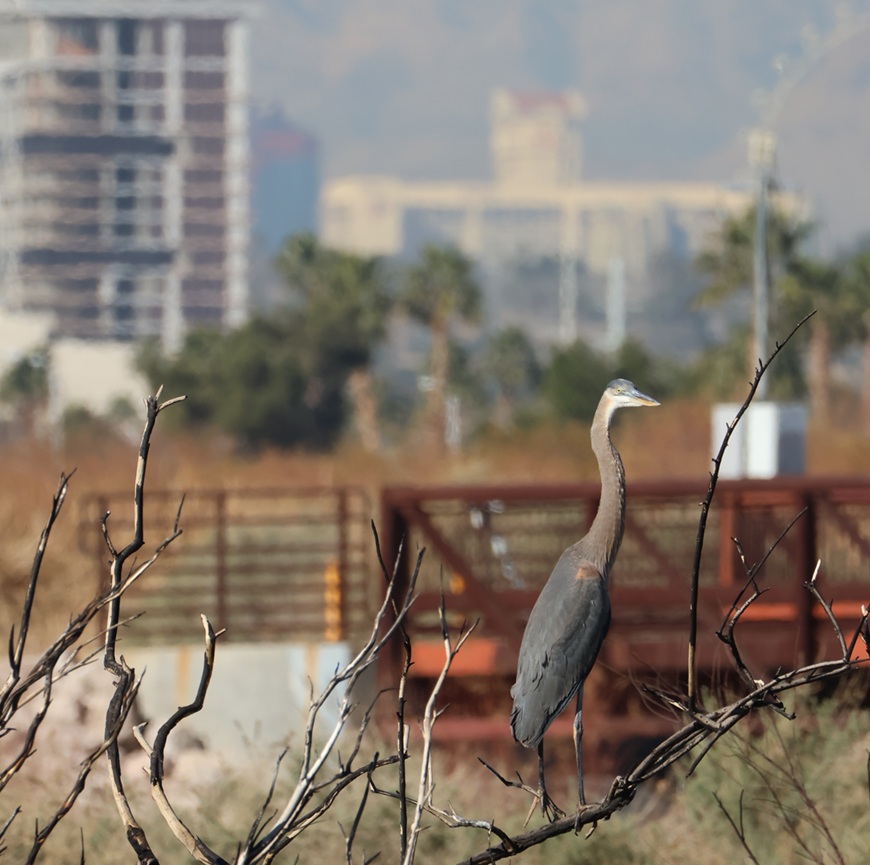
They’re usually seen standing silently on the bank of a river or lake while hunting fish, but it’s not terribly unusual to see great blue herons (Ardea herodias) find a perch (a place to rest, not a type of fish) in a tree. This particular perch was perhaps 3 feet off the ground, so I don’t think that this 45- to 54-inch-tall (115-138 cm) bird found much advantage in this position, but I’m not one to question such decisions. These are the largest herons found in North America; their wingspans measure 66-79 inches (167-201 cm). Great blue herons are found from throughout Canada down through the United States, Mexico, and South America. They are an apex predator of wetlands, where their diet includes small mammals, reptiles, and invertebrates, in addition to fish.

Some incidental notes about this photo: the brown railed structure in the background is part of the bridge that crosses the Las Vegas Wash. Most of the photos of ducks and other waterbirds in the river were taken from that bridge. The Las Vegas Wash (“wash” in the American Southwest refers to a usually intermittent riverbed) runs from the city all the way to Lake Mead about 30 miles downstream, transporting treated wastewater and runoff along the way. The water from Lake Mead finds its way back to Las Vegas via pumping stations and other infrastructure to be used again. At the top left corner is the Eastside Cannery, a 16-story hotel and casino at Boulder Highway and Nellis Boulevard, just south of the campground where we spend the winters. The 307-room property was built at a cost of $250 million and completed in 2008. The property was purchased by Boyd Gaming (owner and operator of many gaming properties around Las Vegas and the United States) in 2016. The Eastside Cannery casino and hotel closed due to COVID-19 in March 2020 and never reopened; it is set to be imploded two days from this writing (that is, on March 5, 2026).

And so it goes.

Not a bird
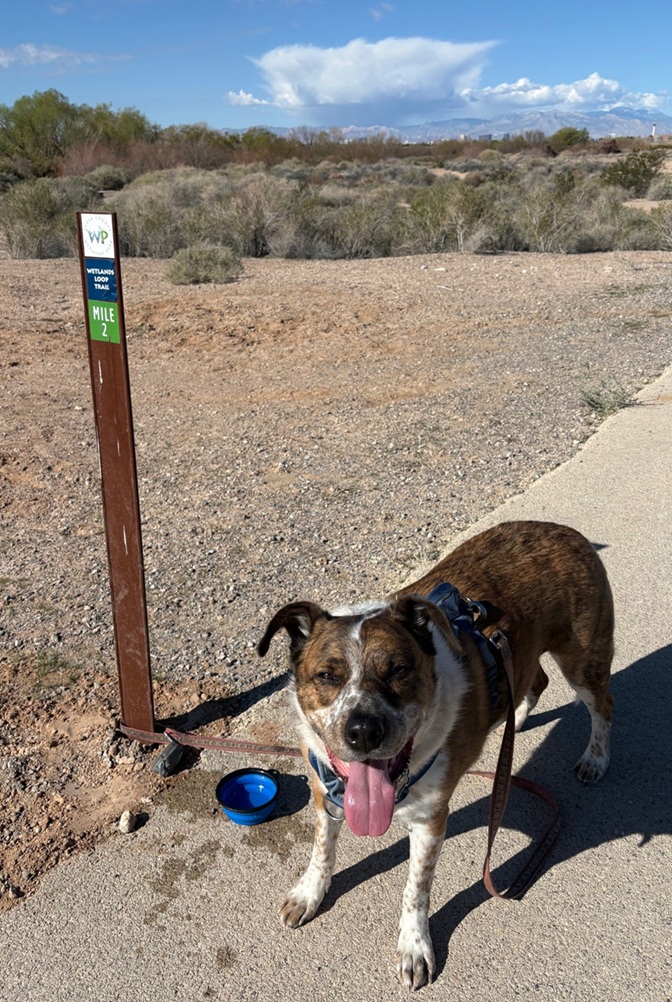
Halfway through – time for a water break! This is actually the halfway point on the Wetlands Loop Trail that Gunther and I enjoyed a couple of times this past winter. Gunther probably got at least as much water in him as he did on the sidewalk. The buildings just this side of the mountains are on Las Vegas Boulevard (“The Strip”); that’s the 1,149-foot-tall (350 m) white tower of The Strat (formerly The Stratosphere) at the right edge of the photo. It is the tallest observation tower in the United States. Readers of a certain age will remember Vegas World, a property owned by Bob Stupak that opened in 1979; some of that casino and hotel was refurbished into The Stratosphere, which opened on April 30, 1996.

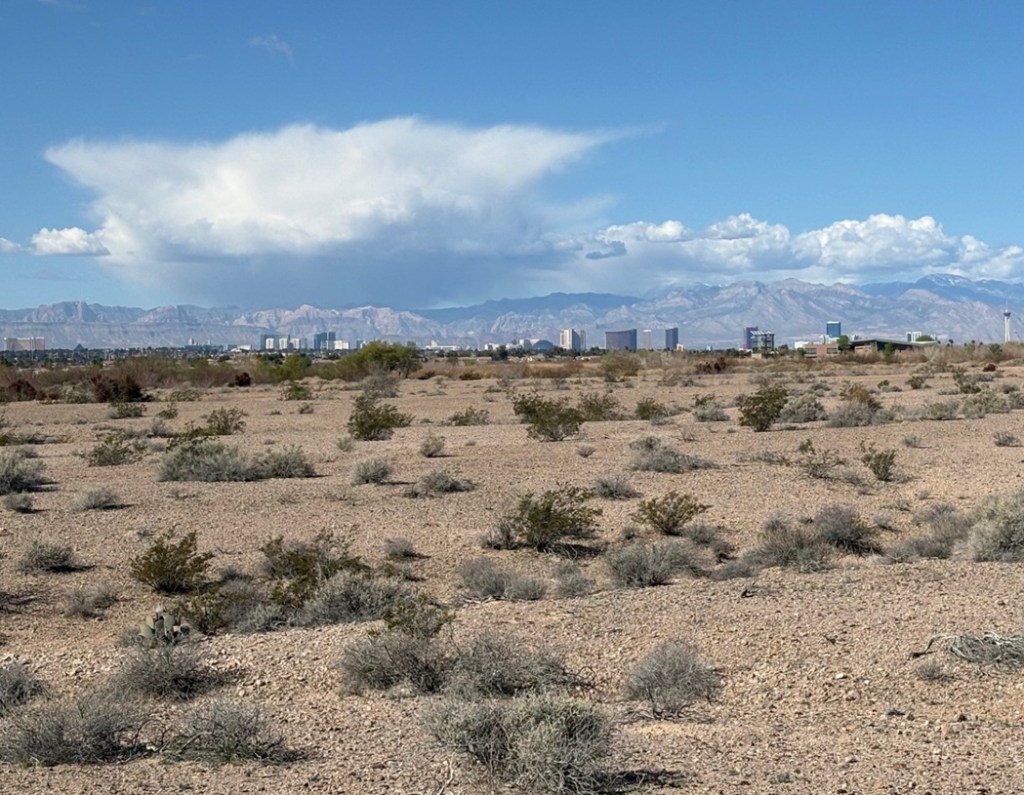
Here’s another photo of The Strip, taken a little later in our walk (notice the cumulonimbus cloud at left) and showing some of the Mohave Desert terrain typical of Clark County Wetlands Park when you’re not next to the water provided by the Las Vegas Wash. This viewpoint is about 10 miles east of The Strip. The white tower of The Strat is at far right; the beige Mandalay Bay is at far left (the pyramid of the Luxor Hotel & Casino is just to Mandalay Bay’s right) and about five miles south of The Strat. All of the other Strip properties, like Caesar’s Palace, Paris, The Bellagio, the MGM Grand Las Vegas, The Flamingo, The Wynn – there are 30 in all – are in between. Incidentally, the biggest hotel on the strip, the MGM Grand Las Vegas, has 4,762 rooms – more than a third of the total number of hotel rooms in all of downtown Denver. Mandalay Bay is the southernmost large hotel and casino on The Strip; The Strat, five miles north, is located within the city limits of Las Vegas and therefore, according to Clark County, not technically on The Strip.

And so it still goes.

Greater roadrunner
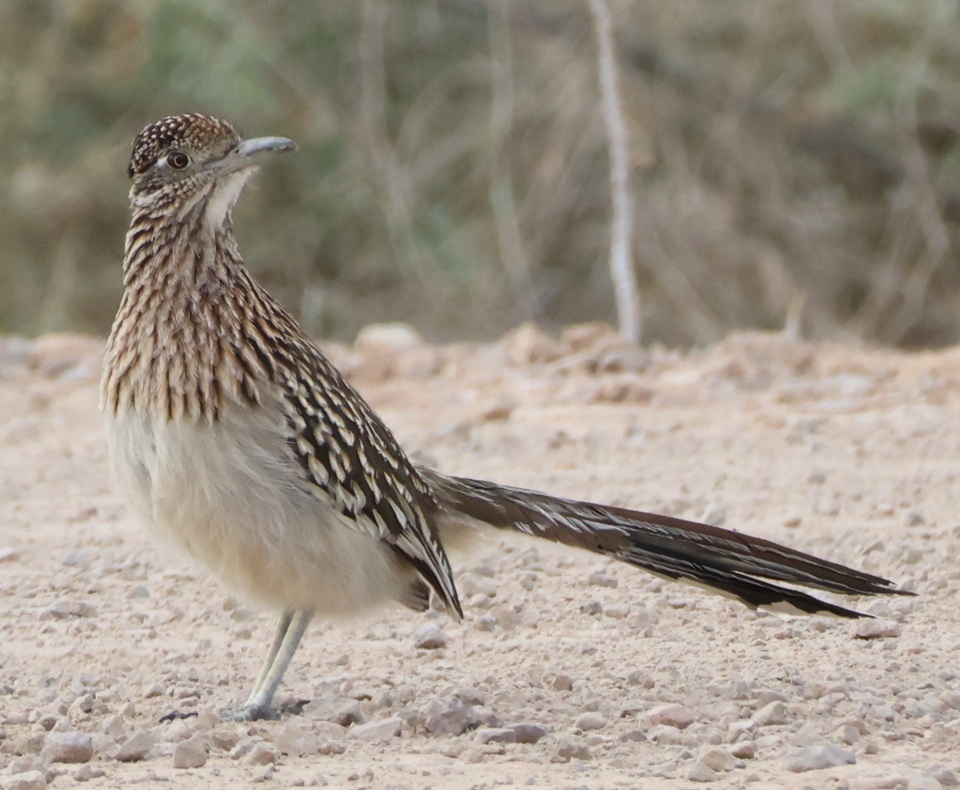
Let’s get back to birds, with this photo I took on Jan. 23, 2026. One of the reasons I include the scientific names of birds in these postings is because they’re just fun to say. This is Geococcyx californianus, the “Californian earth-cuckoo.” The only other member of the Geococcyx genus is the Geococcyx velox (that, too, is fun to say), the lesser roadrunner, which is found only in Central America. Standing 9 3/4 to 11 3/4 inches (25-30 cm) tall, the greater roadrunner is the largest cuckoo on the American continent. Roadrunners have zygodactyl feet, meaning they have two toes in the front and two toes in the back of the foot [as opposed to most birds, which have three toes in the front and one toe in the back (anisodactyl)]. Osprey, too, are zygodactyl: the configuration allows them to carry their fish prey in the air facing forward, rather than side-to-side, for better aerodynamics. I saw this greater roadrunner while it was running on a road; it was great.

Mallard

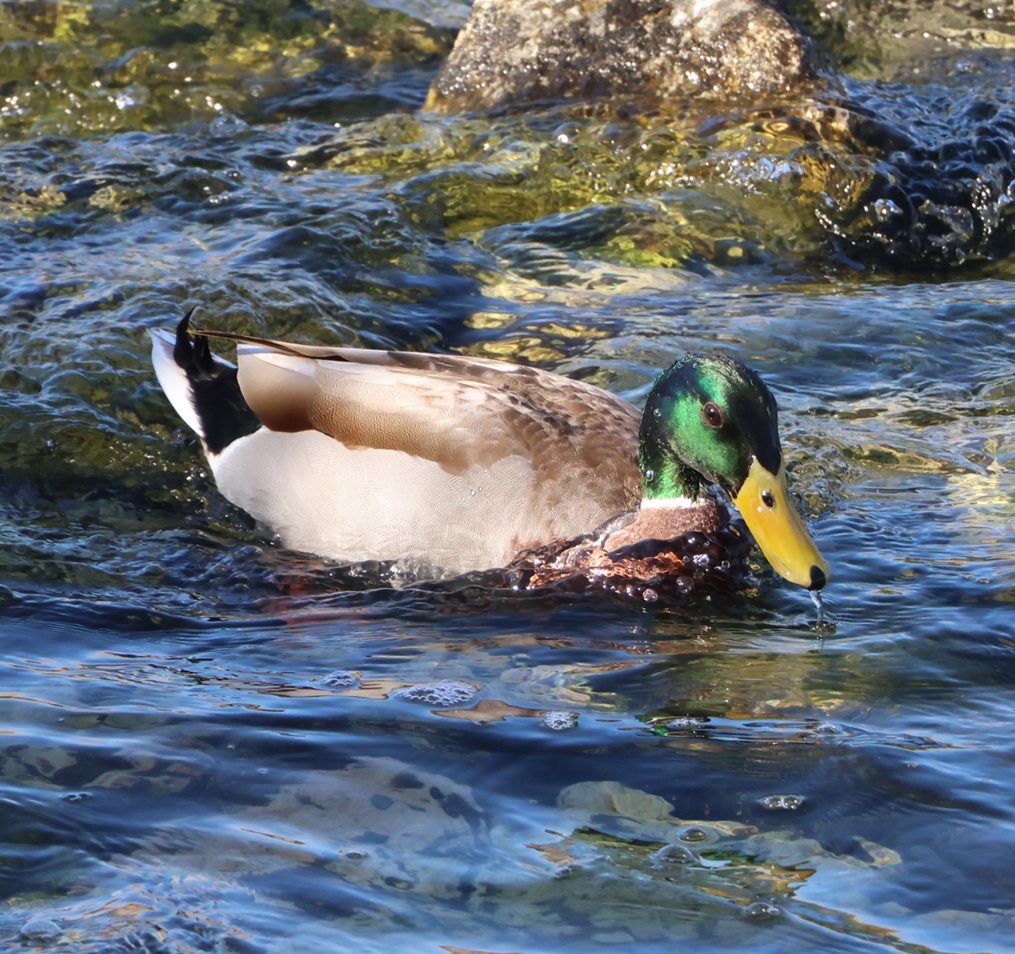
Most readers will recognize this handsome fellow as a mallard (Anas platyrhynchos) which is one of the largest species of dabbling ducks, or ducks that feed mostly on the top of the water rather than diving down for their prey (like, say, a common merganser). Mallards are 20 to 26 inches (50-65 cm) long, with wingspans measuring 32 to 39 inches (81-98 cm). The drakes have these gorgeous green heads while hens have more restrained brown overall coloration. I’ve taken lots and lots of photos of ducks in general and mallards specifically over the last four or five years. I’ve never been as close as I was to this one when I took this on Feb. 13, 2026, from the Las Vegas Wash bridge. I’m happy with how this photo turned out. Look at that duck dabble!

Ring-necked duck

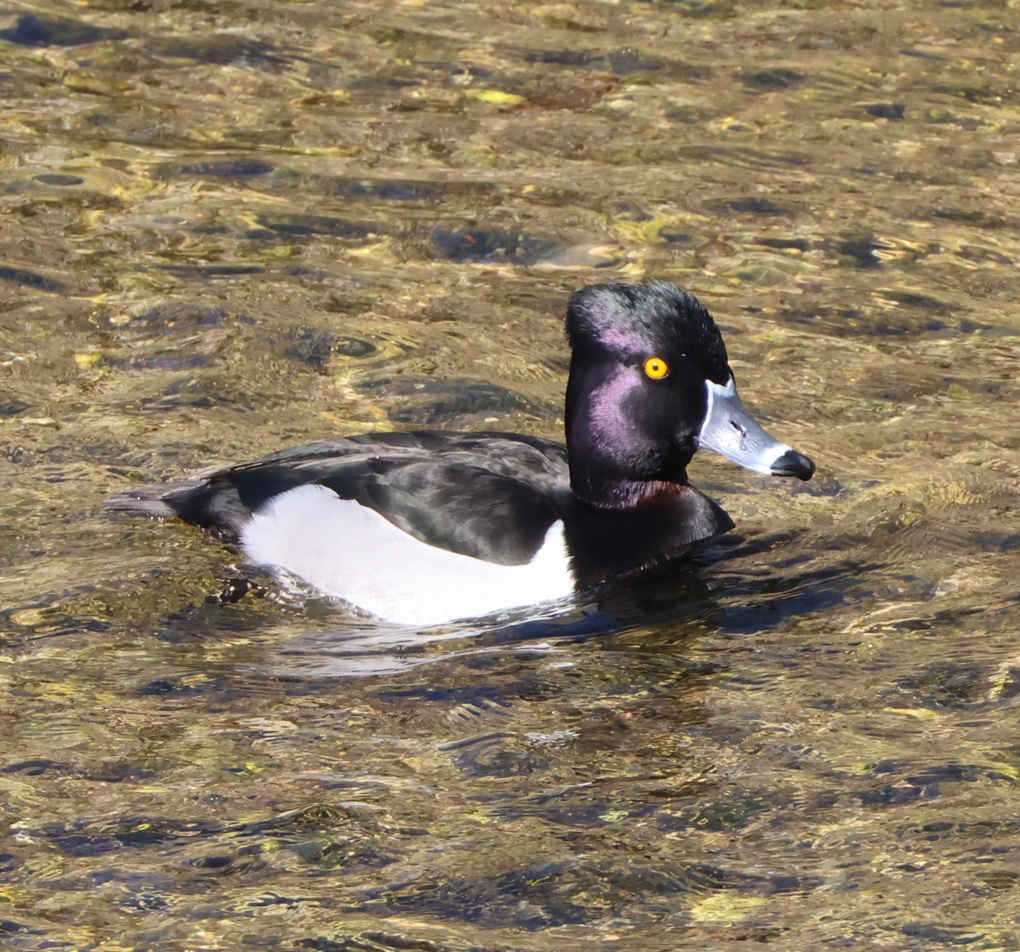
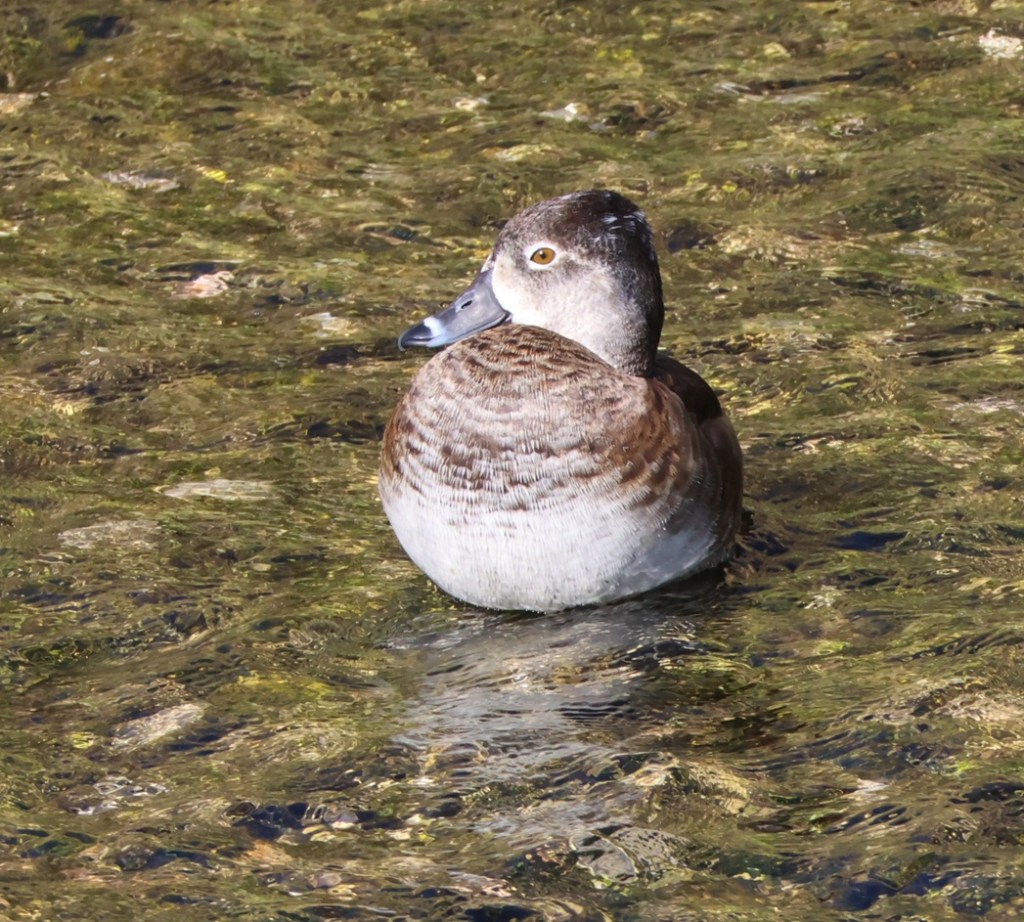
Doubling down on ducks: these are ring-necked ducks (Aythya collaris), a drake (top) and a hen. This species is a diving duck, which, appearances aside, significantly differentiates it from a dabbling duck like the mallard. Genetic research shows that, while diving ducks and dabbling ducks may look similar in body style (morphology), they are different enough that it’s likely they evolved separately. For instance, the feet on diving ducks are placed further back on their bodies than those on dabbling ducks to help propel them underwater – but for that reason, a dabbling duck is better able to walk about on land. Don’t bother looking for the rings on these ducks’ necks: they’re very difficult to discern. This species is sometimes called a ringbill because the rings on the bills are distinct. Just look at that hen. Doesn’t she have a calming presence?

Not a bird, again

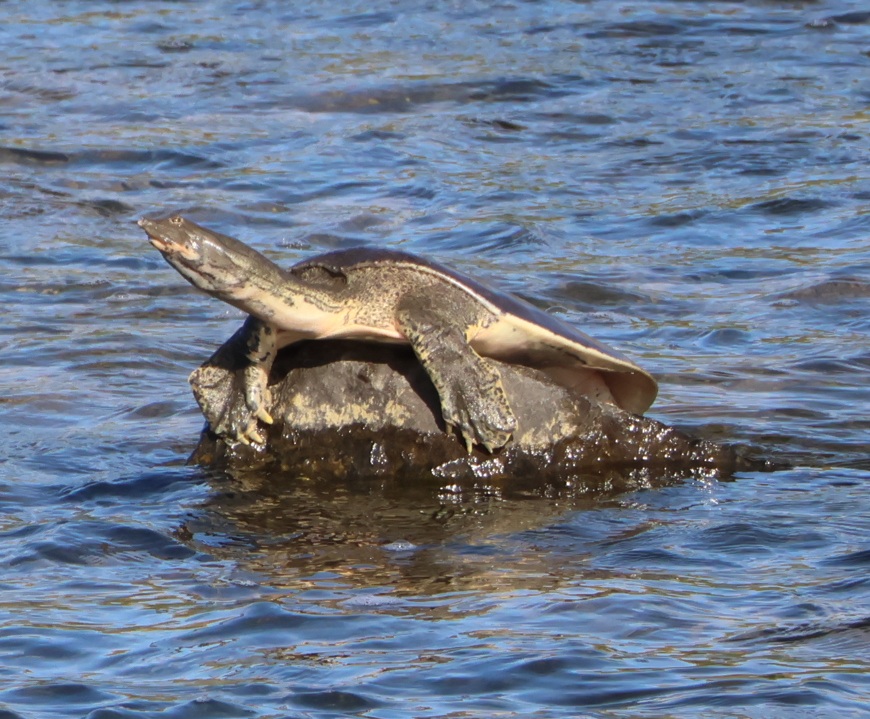
A little over a year ago, I got a new camera and lens that allow me to take photos of fairly far-away birds. With a teleconverter attached, it’s effectively around a 500mm telephoto lens. Sometimes the birds are so far away that I can’t really tell what kind of bird it is that I’m photographing. For instance, when I took the earlier photos of the crissal thrasher, I was 95% sure that it was a northern mockingbird until I got home and looked at the photos closer to full-size. Same thing happened with a loggerhead shrike this winter: I thought it, too, was a northern mockingbird until I got home. Well, this thing in the Las Vegas Wash, photographed on Feb. 13, 2026 from maybe 75 yards (68 m) away, looked to my eyes like some kind of bird so I took its picture. I was wrong. It is, as the heading indicates, not a bird. This is a Texas spiny softshell turtle (Apalone spinifera emoryi), a non-native species to the Las Vegas Wash. This is most likely a female, because a female Texas spiny softshell turtle has a carapace (something akin to a shell) measuring about two feet (61 cm) long. The species is naturally found in the Rio Grande and Pecos river drainages of Texas and New Mexico, but someone (likely) released this species into the Las Vegas Wash some time ago and now they’re pretty well established. This is yet another reason that I will never dip my toe in the Las Vegas Wash.

Verdin

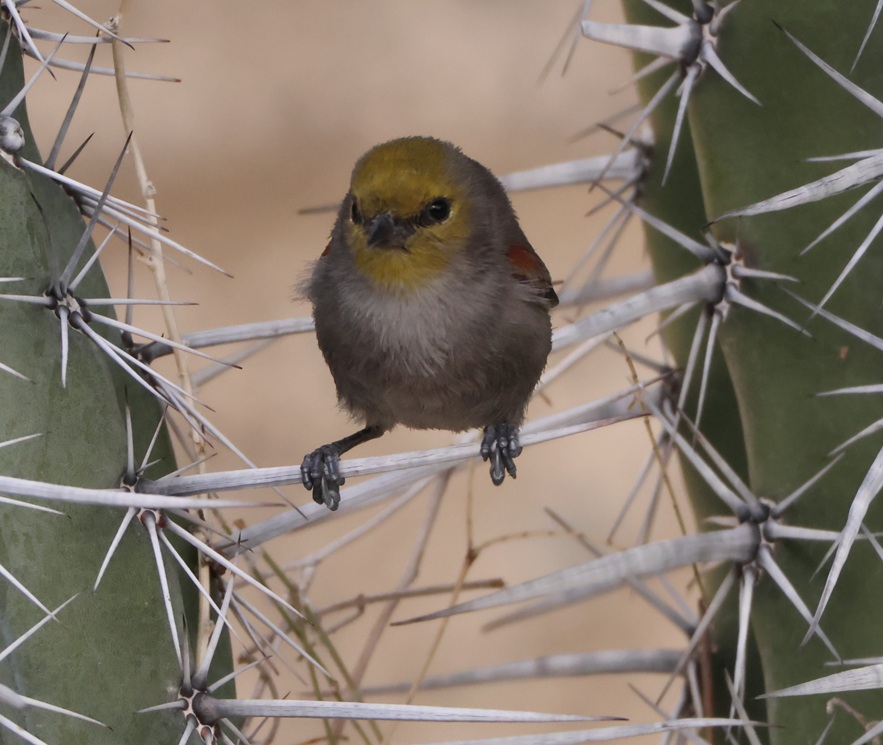
Let us turn away from turtles and return once again back to birds. This was one of the last birds I photographed in our winter in Las Vegas. It was one of four or five verdins (Auriparus flaviceps – that one’s fun to say, too) at Springs Preserve on Feb. 28, 2026, that were flitting back and forth between a tall tree and this good-sized pipe organ cactus. I was finally able to get a couple of decent photos when this one settled for a bit on a cactus thorn. That’s a good-sized thorn: a verdin is only 4 1/2 inches (11 cm) in length. I got some decent pictures of verdins over the winter at Clark County Wetlands Park, but I’m happy with this photo (and I’m also well-aware that it is 95 percent luck). We saw several of these beautiful little birds entering and exiting their nests while at Springs Preserve: it’s an exciting time of year!

White-crowned sparrow

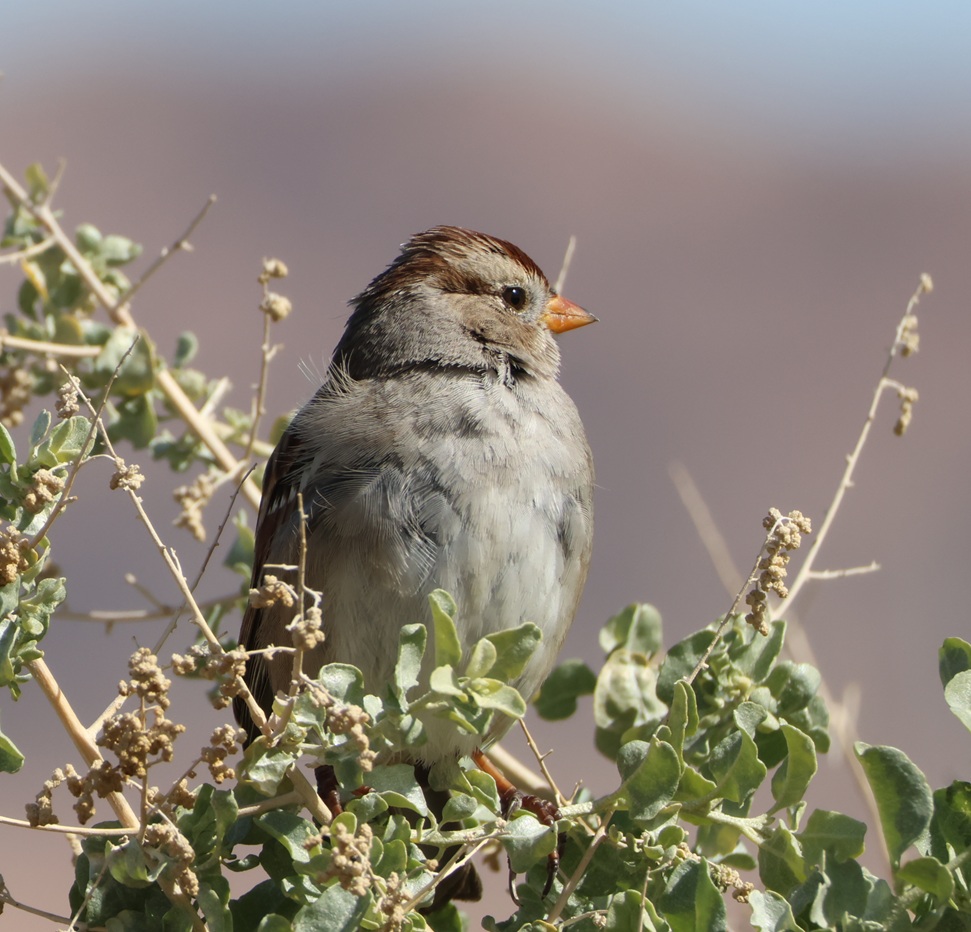
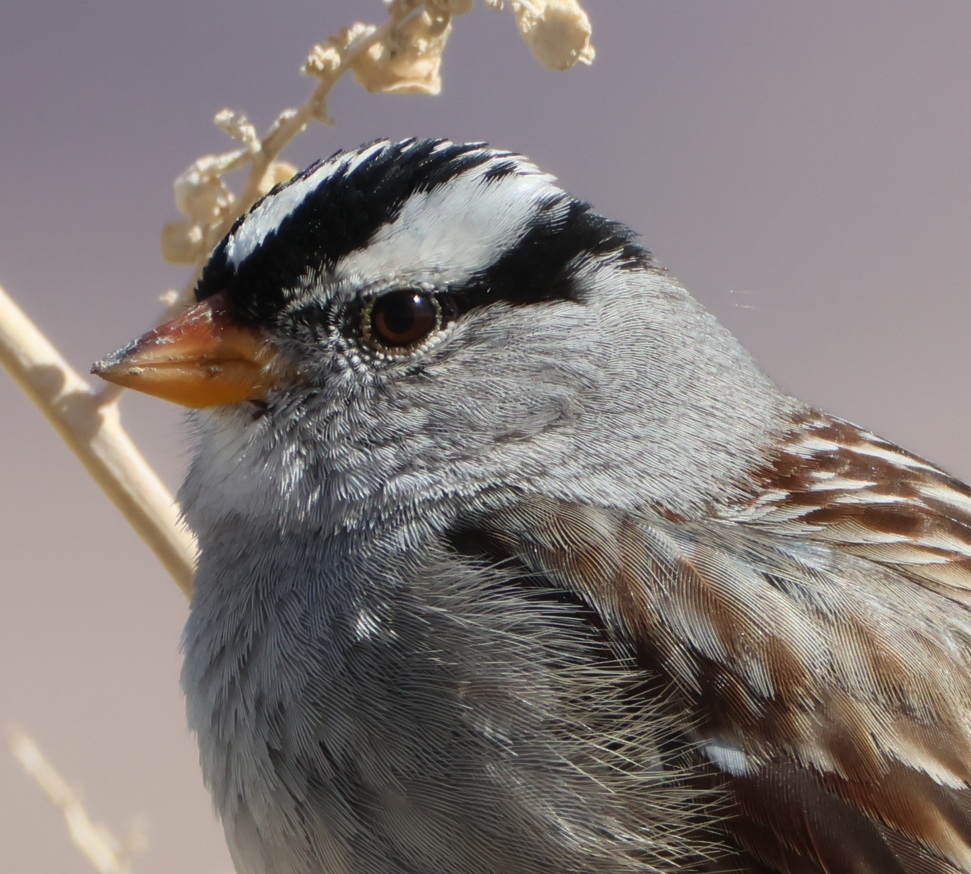
As I noted above, I have a camera that lets me get photos of far-away subjects. It also works pretty well when the birds are relatively close. At the trailhead of the Wetlands Loop Trail at Clark County Wetlands Park, the sidewalk goes by a lot of shrubs called four-wing saltbush. Those shrubs provide a favored perch for white-crowned sparrows (Zonotrichia leucophrys), who usually let Gunther and me walk on by, without taking off, when we’re on the trail. I was able to photograph a juvenile (top) and adult from a very close perspective. White-crowned sparrows are among the most gregarious wild birds I know, and the ones that hang out next to the Wetlands Loop Trailhead are perhaps the most sociable I’ve ever seen. Maybe it’s all the foot and bike traffic they see during the day, but it was great to be able to get these detailed photos for a close look at their feathers and coloration.

One of the things that really appeals to be about birdwatching is being able to see the similarities and differences between species: the coloration (some species have wildly different color patterns between males and females, for instance); the differences in size and shape of beaks/bills, wings, and tails; even noting that in some species, like ring-necked ducks, the drakes have bright yellow eyes and the hens have beautiful brown eyes. All of the birds in this posting were photographed within no more than 15 miles of each other: the riparian habitat at Clark County Wetlands Park brings a lot of birds to Las Vegas that wouldn’t normally stop there, and there’s great diversity even between the native desert birds like crissal thrashers and hummingbirds.

I keep a list, beginning on Jan. 1 of each year, to keep track of how many different bird species I see during that year. My goal is always 100 different species, and I’ve never met it (I got to 94 in 2023, 62 in 2024, and 96 in 2025). In the first two months of 2026, I’ve recorded 36 different species, all of which were observed in either Clark County Wetlands Park or the Springs Preserve in Las Vegas. With a 3,000-mile trip scheduled through the American Southwest, Midwest, and Upper Midwest, along with a 3,000-mile trip back to Las Vegas in the fall, I’m feeling pretty good about my chances of meeting my goal of 100 observed bird species this year. I hope my little Anna’s hummingbird pal is back on top of his tree next to the dog run when we return to Las Vegas in December.

Bird species observed in the Las Vegas, Nevada, area in January and February 2026

Anna’s hummingbirdCommon merganserSay’s phoebe
Rock doveRing-necked duckPhainopepla
Northern flickerMourning doveCommon goldeneye
Great-tailed grackleGreat blue heronRed-shouldered hawk
Black phoebeBlack-crowned night heronRed-winged blackbird
Northern mockingbirdBuffleheadCrissal thrasher
House finchPied-billed grebeLoggerhead shrike
American cootYellow-rumped warblerOsprey
Double-crested cormorantSpotted sandpiperMallard
White-crowned sparrowRufous hummingbirdAmerican wigeon
VerdinGreater roadrunnerSagebrush sparrow
American white pelicanBlack-tailed gnatcatcherRuby-crowned kinglet

Montezuma Castle National Monument

March 14 & 15, 2022 – Near Camp Verde, Arizona

Having nothing at all to do with Montezuma, the early 16th-century emperor of the Aztecs (known now as Moctezuma II), nor a castle in any sense of the word, Montezuma Castle National Monument is still a very rewarding site to visit.

It was very convenient to visit Montezuma Castle in the late afternoons after the workday ended, but the shadows weren’t conducive to good photos. However, we really appreciated our two visits to the monument.

Because access to enter the actual structures is limited to those who really need to go in them, the park also focuses a lot on native species of flora found in the region and provides a lot of interpretive signage next to examples of plants to explain how the plants were used by the occupants of the dwellings. As an (extremely) amateur botanist, this was fine by me.

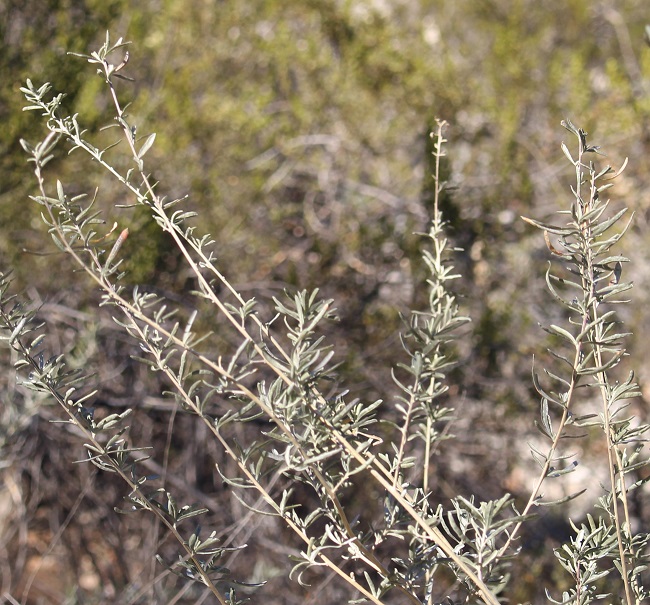
This pretty shrub is four-wing saltbush (Atriplex canescens), named for the four-winged bracts on its berries. Everything on the plant – the leaves, fruits, seeds, and young shoots – is edible. The ashes from burned saltbush leaves make a type of baking soda which fortifies baked goods; the leaves can also be used to relieve pain from insect stings.

We were able to make a couple of late weekday visits to fully explore this monument, which is located just a few miles north of our campground in Camp Verde, Arizona. It was also the first opportunity for Gunther to earn a B.A.R.K. Ranger certification (more on that later).

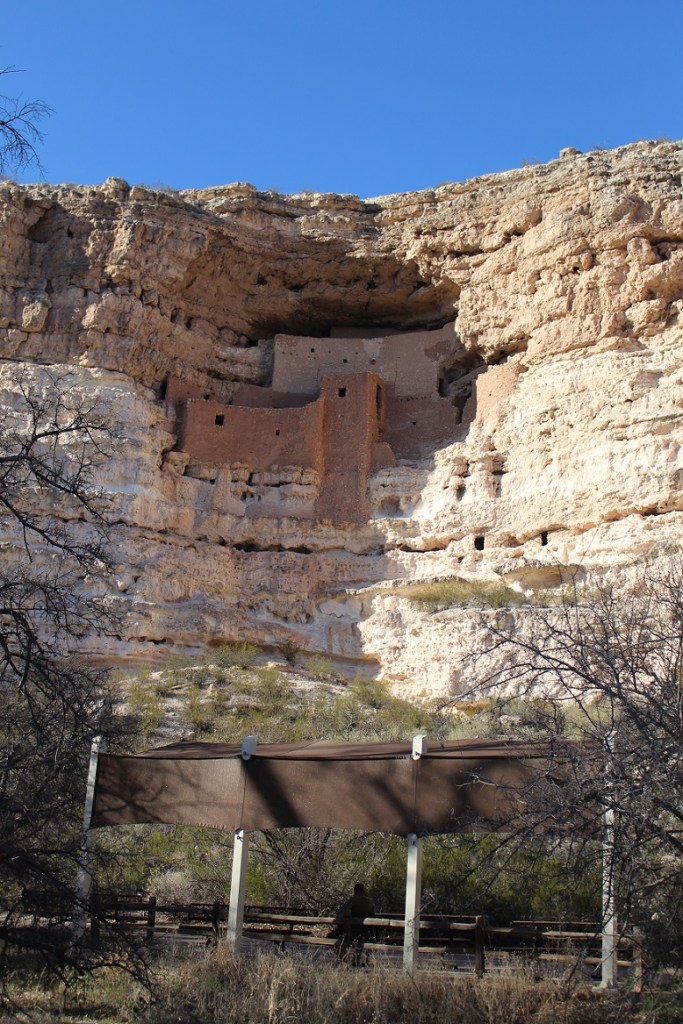
Montezuma Castle includes a 20-room structure, as well as several smaller dwellings on the same cliff face. The area was established as a national monument on Dec. 8, 1906.

The structures in the monument were built by the Sinagua, Native Americans who migrated to this area about 1,400 years ago and began building the cliff dwellings about a thousand years ago – hundreds of years before Moctezuma II was born. The current name of the monument, Montezuma Castle, comes from European Americans who in the mid-1800s were extremely interested in the Aztec, Mayan, and Incan cultures of present-day Central America and wanted to bestow exotic names on nearly everything they found.

Creosote bush (Larrea tridendata) is one of the oldest species of plants on the planet. Some stands of the bush grow in the same location for thousands of years. Its leaves definitely have an earthy smell like you’d experience after a rainshower. Native Americans used parts of the plant to treat a variety of ailments ranging from infections and toothaches to nausea and sprains.

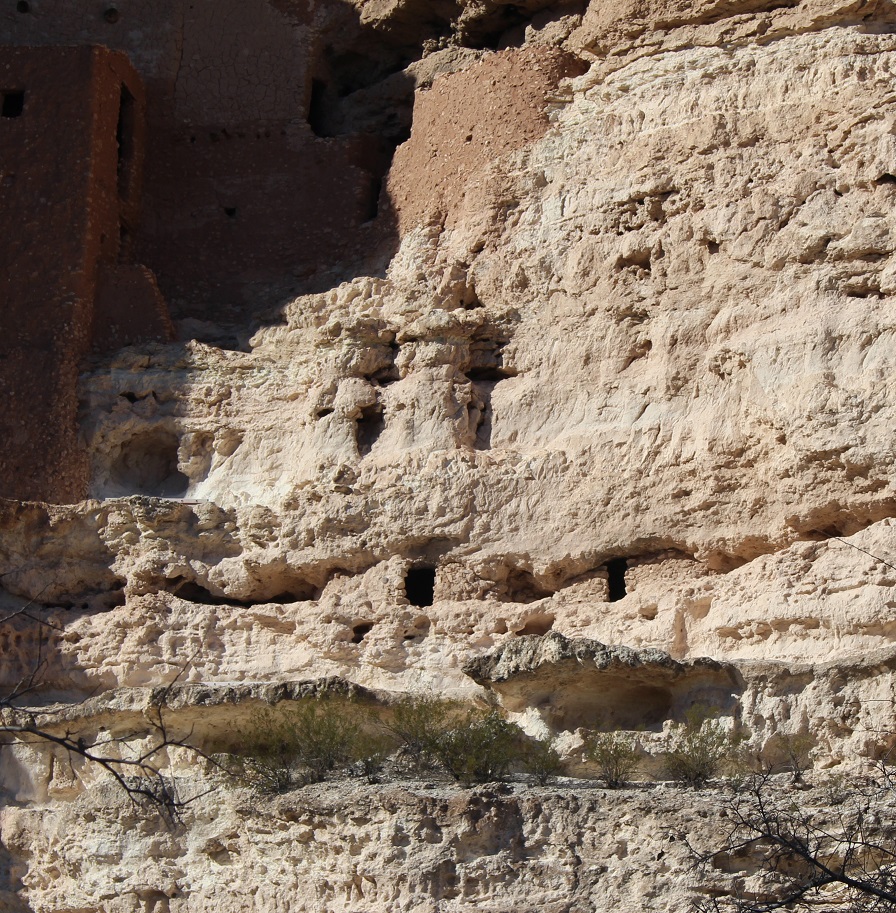
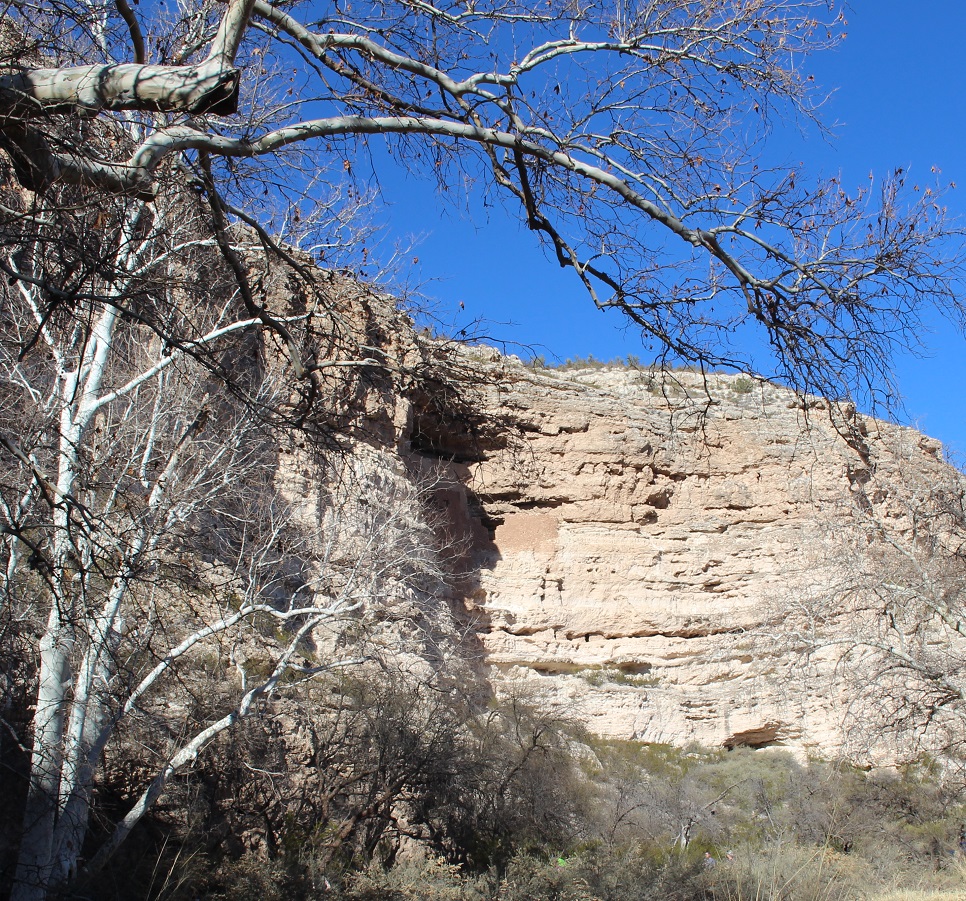
The cliff dwellings are built in Verde Formation limestone, a relatively soft sedimentary rock. Over millions of years, the erosional forces of water and wind have had their way with the limestone to carve many holes into the rock. The erosional holes that are enlarged by humans into structures are called cavates by archeologists. At Montezuma Castle, most cavates extend about 10 feet into the cliff. By closing up naturally open spaces, and building exterior and interior walls with masonry, the Sinagua were able to construct secure housing for their culture.

This collection of 20 rooms belonged to multiple Sinagua families, very similar to today’s apartment buildings.

The Sinagua built and occupied the dwellings between the years 1100 and 1425, leaving the residences about 70 years before Columbus set sail. Montezuma Castle was at the crossroads of a Native American trading network that stretched from the coast of present-day California to eastern New Mexico, and from Utah into Mexico. That central location provided the Sinagua with many resources that weren’t available in the Verde Valley:

  • Obsidian, used for projectile points, came from the San Francisco Mountains north of the castle
  • Wild game and plants were taken from the Mogollon Rim, located east of the structure
  • Strong trading relationships with the Hohokam culture, in present-day southern Arizona, provided much more than was available in the Verde Valley

Contrary, perhaps, to popular opinion, because of that trading network the Sinagua had an awareness of their world that stretched for thousands of square miles.

Where the Sinagua went, and why, after about the year 1425 is still up for debate, but most researchers believe the exodus was due to at least one of three factors: drought, depletion of food resources, and threats from newly arrived cultures.

The Hopi culture, which may be descended partially from the Sinagua, believe this structure wasn’t meant to be the final home of their ancestors. When a culture stays too long in one place, the Hopi believe, environmental disasters and societal collapses remind them of their migratory nature – and they move on. The Zuni and other Puebloan groups are also said to be descended from the Sinagua.

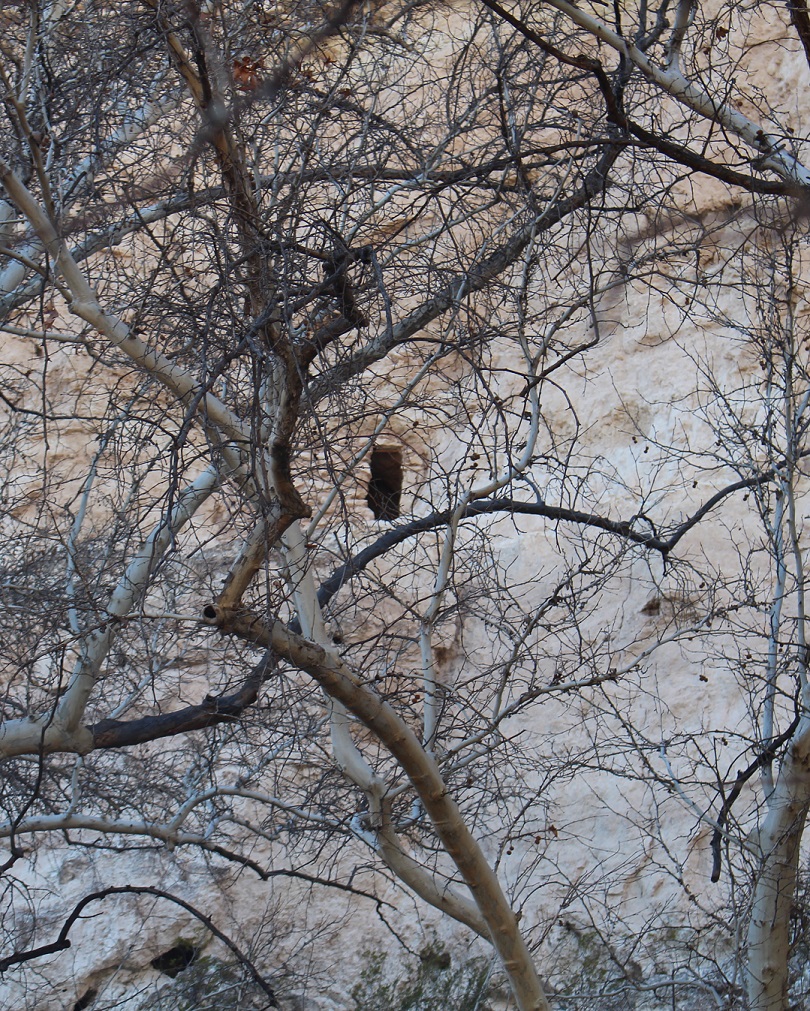
The Apache name for catclaw acacia, ch’ill gohigise, means “a bush that scratches you.” The long and sharp thorns of catclaw acacia (Acacia greggii) are best avoided, but ancient peoples relies on many different parts of the bush for food and the branches are used to make furniture and drumsticks. The honey made from this tree’s blossoms is especially prized for its delicate nature. This specimen is growing directly in front of the dwellings; there’s an doorway visible behind the bush (and accessible only by ladder). We first saw catclaw acacia in late February 2022, when we visited Fort Bowie National Historic Site in southeast Arizona.

Between 1991 and 1994, an inventory of the plants and animals at this national monument was taken by a team of researchers from Northern Arizona University and the United States Geological Survey. That research resulted in the cataloging of 784 species of plants and animals in this 859-acre (less than 1.5 square miles) site; only 11 percent were non-native species.

A level and paved trail passes in front of the five-story castle, allowing visitors to see different perspectives especially as the sunlight changed. The Sinagua made improvements and additions to the castle over a 300-year period beginning around the year 1130.
In the American Southwest, plants with protective thorns – well beyond species of cacti – are very, very common. The catclaw mimosa (Mimosa aculeaticarpa) has the nickname “wait-a-minute bush” because it catches unwary hikers’ clothing. Catclaw mimosa is a genetic cousin of the catclaw acacia, and honeybees also seek out this acacia’s blossoms for their nectar.

Looters of the 19th century took many of the contents of the structures, and today the ruins are open only to scientists for research, inspection, and maintenance. This is in contrast to Gila Cliff Dwellings National Monument in southwestern New Mexico, in which visitors are allowed to enter the structures. Part of that policy us is perhaps due to proximity. Gila Cliff Dwellings National Monument is one of those places you have to want to get to, since it’s nearly a two-hour drive from the closest large city; Montezuma Castle is just a couple of miles off Interstate 17 in central Arizona. About 350,000 people visit Montezuma Castle each year; Gila Cliff Dwellings gets about 42,000 visitors annually.

The modern structure at the bottom of the photograph is a kind of amphitheater in which U.S. national park rangers provide talks about the history and culture of Montezuma Castle. I wish we could have seen the castle with better lighting; as always, I blame the sun.
In autumn, the netleaf hackberry (Celtis laevigata) produces berries with high levels of calcium. The leaves are used to treat digestive disorders, and the bark of the tree can be woven into sandals.

Montezuma Castle National Monument was established by the administration of U.S. President Theodore Roosevelt. During his administration (1901-1909), five national parks, 18 national monuments, 150 national forests, and 51 bird sanctuaries. In all, Roosevelt authorized a total of 230 million acres (almost 360,000 square miles) for the enjoyment of future generations like ours.

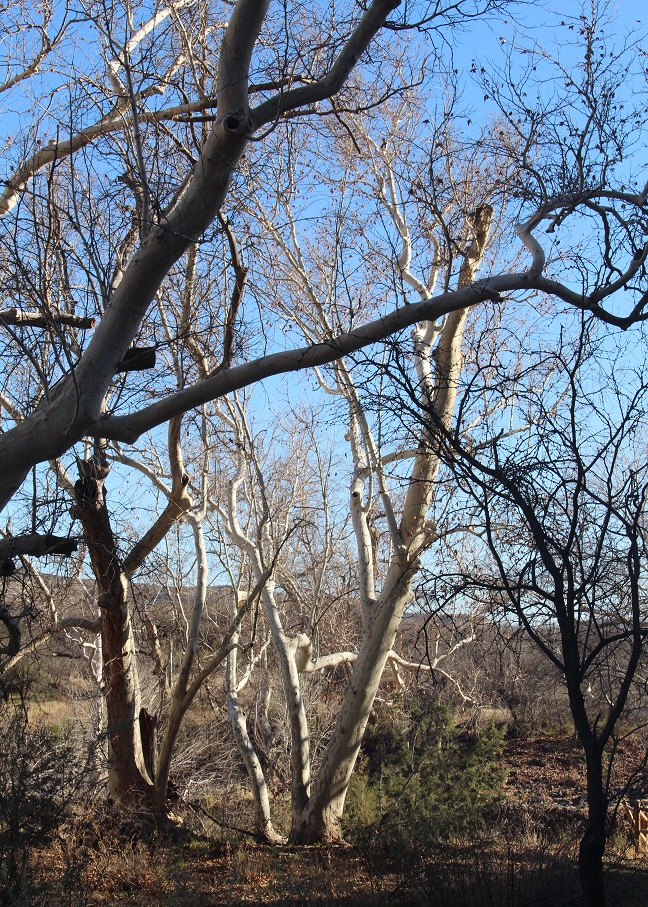
Reaching up to 120 feet high, Arizona sycamores (Platanus wrightii) are some of the state’s largest trees. When seasoned properly, the logs stay structurally sound for hundreds of years: there are Arizona sycamore beams inside Montezuma Castle still supporting roofs, 700 years after they were first placed.

We didn’t see much in the way of wildlife while at the monument (Nancy and I were both surprised at the number of late-day visitors each day, but that was probably due to the monument’s easy access from the Interstate); however the habitat’s diversity (holes in cliffs to dry meadows to riparian areas) supports all kinds of bats, foxes, mice, owls, songbirds, snakes, lizards, and turtles.

These partially reconstructed ruins are just a few steps down the trail from the vantage point underneath the castle. Smaller cliff dwelling structures were located above these rooms.

Being open only to researchers is also due to the fact that ladders must be used to access the cliffside ruins: the buildings were definitely at least partially planned with defense in mind. Additionally most of the cliff faces south, which allows the dwellings to be warm in the winters and cool in the summers. The elevated location also protects the dwellings from occasional flooding of Beaver Creek, which flows beneath the cliffs.

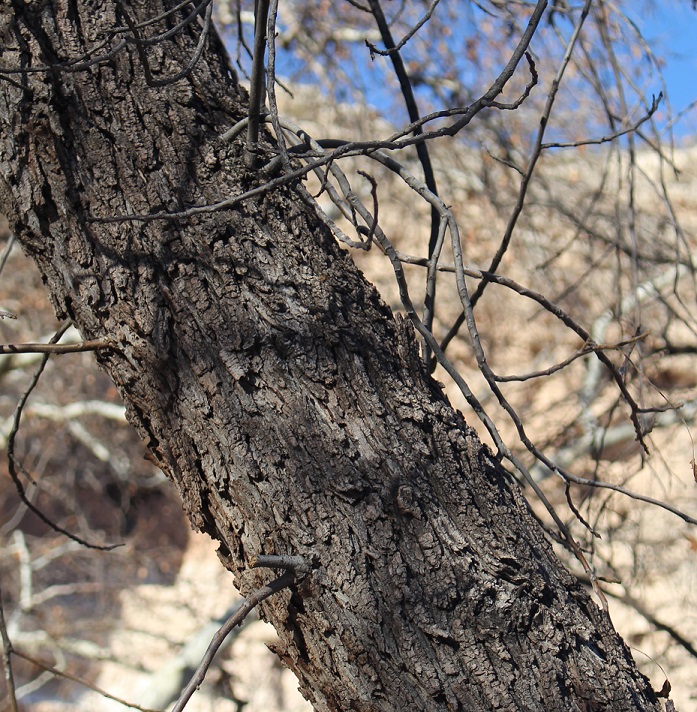
Oneseed juniper (Juniperus monosperma — hey: I can figure out that Latin!) provided the Sinagua with wood for cooking, heat, and light, as well as shelter. The branches are also boiled for treating stomach disorders. When we’re hiking, Nancy and I really enjoy finding juniper berries — they smell really, really good. I love the character of this juniper’s trunk.
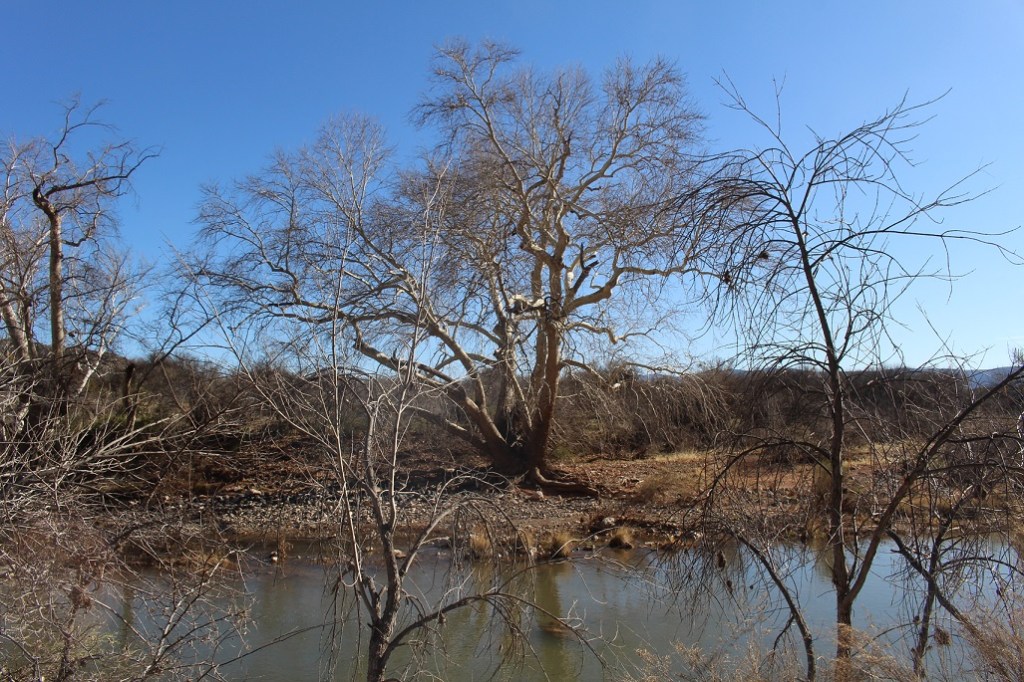
This is Beaver Creek, which flows a few hundred feet south of the main cliff dwellings at Montezuma Castle. Residents of the cliff dwellings dug ditches to transport water for irrigating corn, beans, squash, and cotton crops that were planted on land by the creek. The large tree on the far bank of Beaver Creek is an Arizona sycamore.
Providing food and shade, the Arizona walnut tree (Juglans major) was named ch’il nehe (“nuts you pound”) by the Apache. The thick husks of the walnuts were also ground to produce cloth, hair dye, and paint.
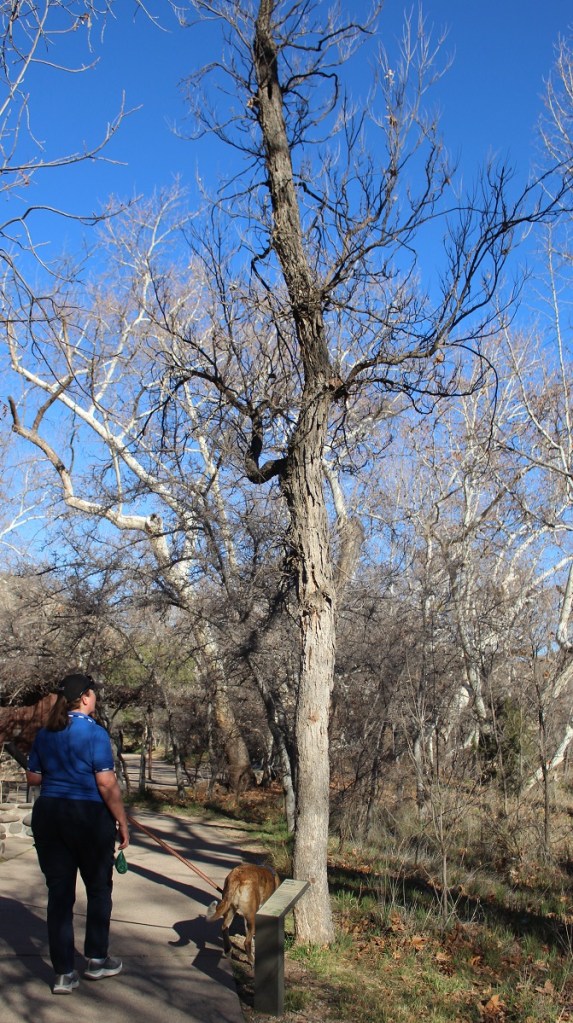
Here we see a monument visitor and her dog (it is Nancy with Gunther) passing underneath the branches of a western soapberry (Sapindus saponaria) tree. The tree produces small yellow berries, but the fruit is harmful when eaten. Despite their toxicity (and true to the tree’s name), the berries are used to make soap for laundry, shampoo, and general bathing. You can also see an interpretive sign next to the tree; that signage adjacent to the plants and trees is where I got most of the background information for this posting.
This is a view of Beaver Creek looking to the southwest. A few dwellings, much smaller than the main one we first encountered, were built in the cliffs on the right side of the photo. The creek was prone to flooding in spring, which was one reason the dwellings were built high on the cliffs.
Here’s a plant that should be familiar to many: the prickly pear cactus, in particular the Engelmann’s variety (Opuntia phaeacantha). This most common of Arizona’s prickly pears is still widely eaten throughout the southwest (after removing the spines). The pads, called nopalitos in Spanish, can be steamed, fried, pickled, or roasted. The fruits after flowering, too, are edible and are used to make jelly as well as to create red dye. This specimen was just outside the visitor center at Montezuma Castle National Monument.
Un cactus más para ti: the desert Christmas cactus (Cylindropuntia leptocaulis). In December of each year, this cactus produces a bright-red fruit which is crushed and made into jam. We saw some of these plants at Saguaro National Park near Tucson and would see additional specimens of desert Christmas cactus in a few days, at Tuzigoot National Monument.

The National Park Service has a pretty nifty program in which dogs can earn their B.A.R.K. Ranger certification in certain parks and monuments. Gunther knows, and you should too, that B.A.R.K. Rangers:

  • Bag your poop. Always have your humans bag and dispose of your waste properly.
  • Always wear a leash. When in the park, always wear a leash (6 feet or less) and don’t let your humans leave you unattended.
  • Respect wildlife. Don’t harass or harm wildlife by making noise or chasing them.
  • Know where you can go. B.A.R.K. rangers are permitted in parking lots, campgrounds, picnic areas, roads, and designated trails.
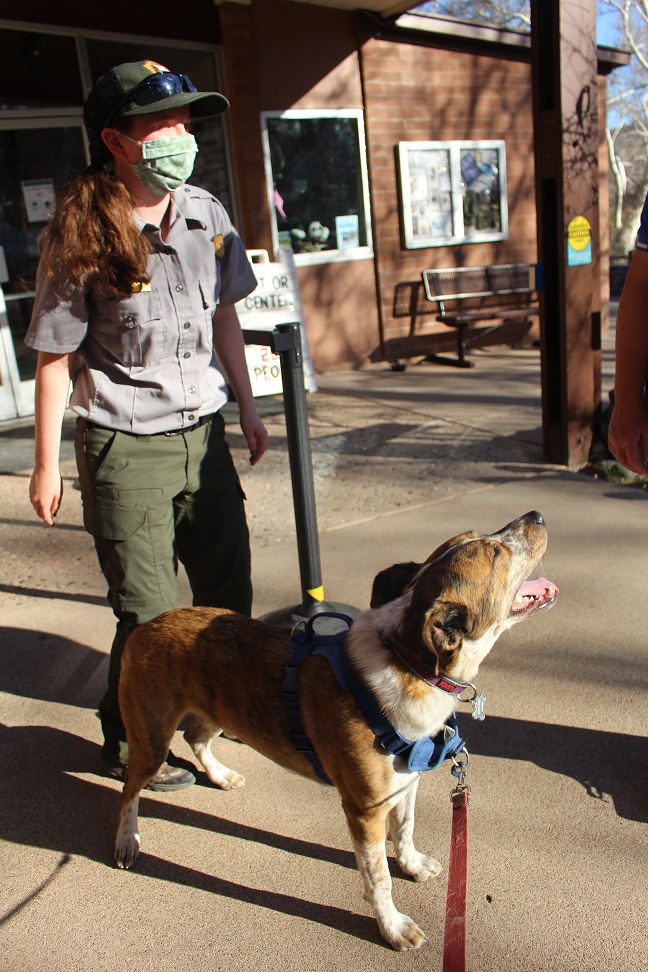
Park Ranger Stephanie greets the newest B.A.R.K. Ranger, Gunther, at the Montezuma Castle National Monument Visitor Center and congratulates him on his many achievements.
Here’s Gunther relaxing in the Goddard with his certification (the inside is signed by Ranger Stephanie). Good job, Gunther!

The B.A.R.K. Ranger program is really clever: it keeps dogs out of hot vehicles while their owners visit national parks and monuments, while encouraging those owners to be responsible for their pet. Since that great day at Montezuma Castle, Gunther has also earned B.A.R.K. Ranger certification at Petrified Forest National Park, also in Arizona, and Pecos National Historical Park in New Mexico. Look for future blog postings about those visits and more, and look for Gunther on the trails!

Saguaro National Park

March 12, 2022 – Tucson, Arizona

Nancy and I visited Tucson in 2010 in part to see the Colorado Rockies baseball club play a spring training game. It was their last spring in Tucson, as they moved their training operations to Phoenix the next year. We got a rental car at the airport, and driving away from the airport and into Tucson proper, we saw a saguaro (pr.: sah-WAH-row) cactus growing by the side of the road. We were so excited that we almost stopped and took a picture of it.

We needn’t have. We saw a lot more saguaros on that trip. They’re fairly common in the Tucson area, but not as common as they used to be because of land development and agricultural practices. Protecting a forest of saguaro cactus was the impetus behind the establishment of Saguaro National Monument in 1933, and the area was elevated to a national park in 1994.

The national park is divided into two districts, Rincon Mountain on the east and Tucson Mountain on the west, with the city of Tucson in the middle. We visited the Rincon Mountain District in mid-March, and enjoyed a five-mile loop hike (with only 185 feet gain in altitude) on the Loma Verde Trail.

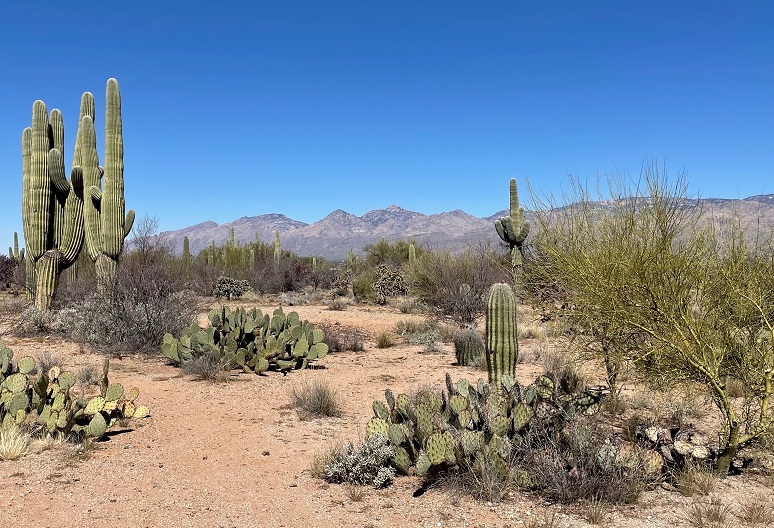
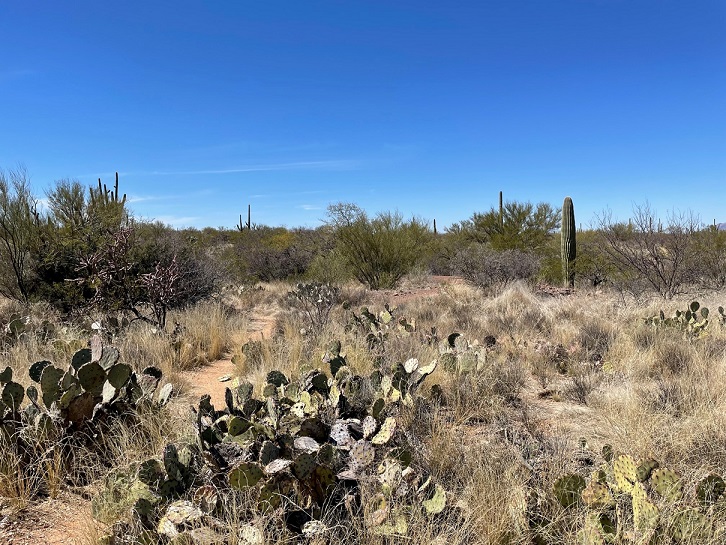
I think this is a fairly typical image that most people see in their minds when they think of Arizona: flat, hot, and not a lot of plants, with some mountains in the background. But there’s a lot of diversity in this photo: several different species of cacti, some grasses, and a palo verde tree on the right side. There are a lot of palo verde (Spanish for “green stick”) trees in and around Tucson. They are the state tree of Arizona, and easily live for 100 years and in some cases 400 years.

During the hike, Nancy and I saw a lot of different kinds of cacti and succulents, some nifty birds, and a group of three German tourists with whom I briefly practiced mein Deutsch. (Me: “Woher kommen sie?” They: “Deutschland.” Me: “Willkommen!” And then we went our separate ways.)

The Loma Verde (“green hill”) Trail allows hikers to walk next to the impressively tall saguaros. The cacti usually grow up to 40 feet in height, and many have eight or more arms branching from their trunks. They are found only in the Sonoran Desert of southwestern Arizona, southeastern California, and northern Mexico.
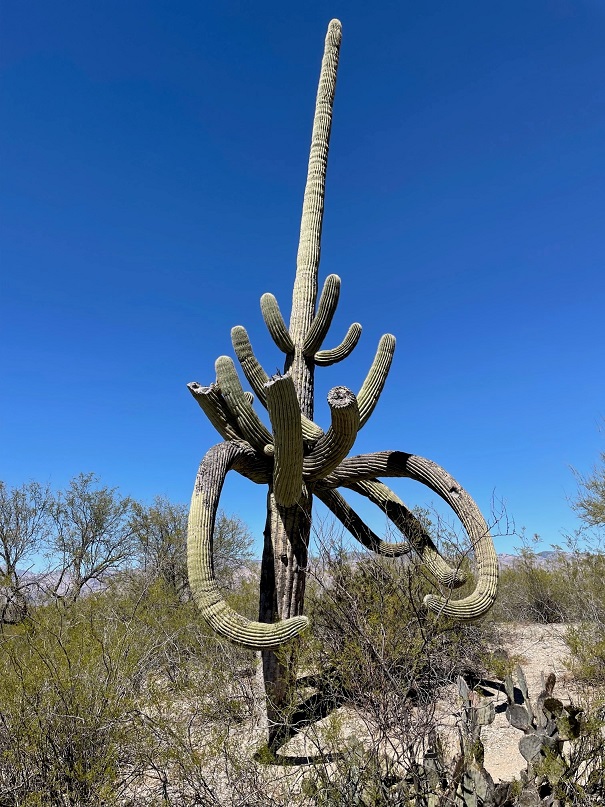
Saguaros grow very slowly: just about an inch to one-and-a-half inches in the first eight years of their lives. At 70 years of age, a saguaro will be about 6 feet tall and can start producing flowers. A 15-foot-tall saguaro is probably 95 to 100 years old, and will only start producing its first arm at that age. The spiral-looking cactus on the right was germinated around 1950 or so, and the ones on the left and center were most likely germinated in the mid- to late 19th century. The tallest saguaro on record, one growing near Cave Creek, Arizona, reached 78 feet into the sky. It was felled by a windstorm in 1986; because the plants’ root systems reach only a few inches into the soil, their great weight makes them susceptible to toppling.
The pleated structure of a saguaro allows it to expand during periods of heavy rainfall. Its roots may extend only three or four inches underground, but they draw in a lot of moisture: a 40-foot saguaro that’s full of rainwater can weigh 2,000 pounds, and taller and wider cacti can weigh seven tons.
Among the 25 species of cactus in the national park, including saguaro, are seven species of cholla. This specimen of staghorn cholla, spanning about five feet wide, was one of the largest we saw.
This is a very common type of cactus in the southwest United States: it’s a fishhook barrel cactus, named so because of its formidable curving thorns.
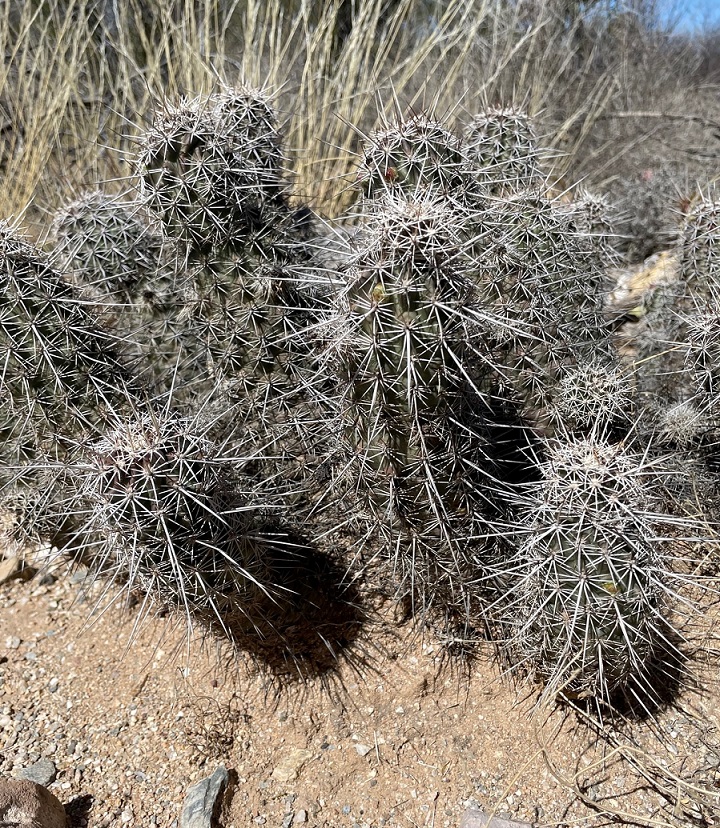
Some cacti say “Stay away,” and others scream it loudly. This strawberry hedgehog cactus is one of the latter.
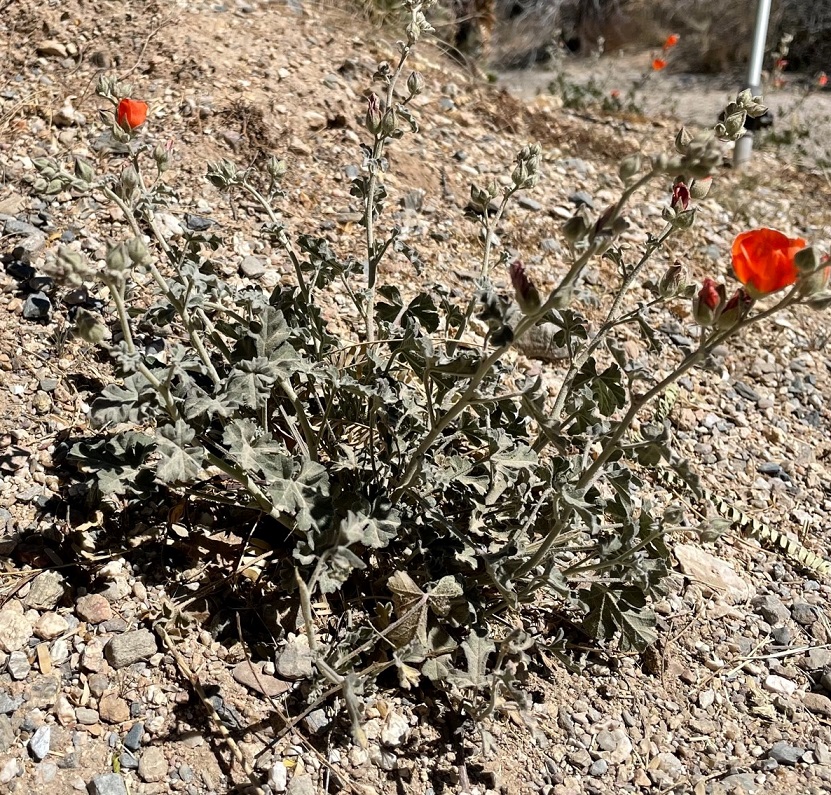
This is desert globe mallow. While they can grow up to 3 feet tall, this particular one was only about 12 inches high.
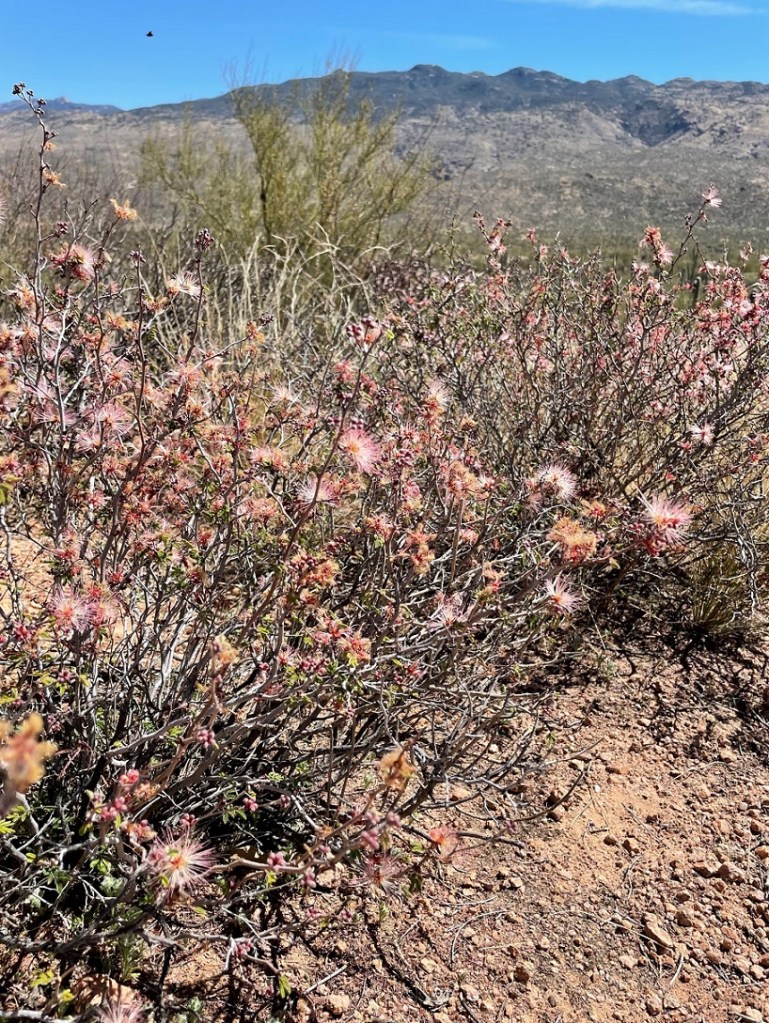
This flowering shrub is called fairy duster. Its blossoms are an important source of nectar for hummingbirds and butterflies.
One of the features of the Loma Verde Trail is a very short spur that leads to the top of Pink Hill (where we gained most of that 185 feet in altitude). This is looking west from the top of the hill toward the Tucson Mountains, and you can see part of Tucson at the foot of the mountain range. The Tucson Mountain District of Saguaro National Park is to the right of the mountains.
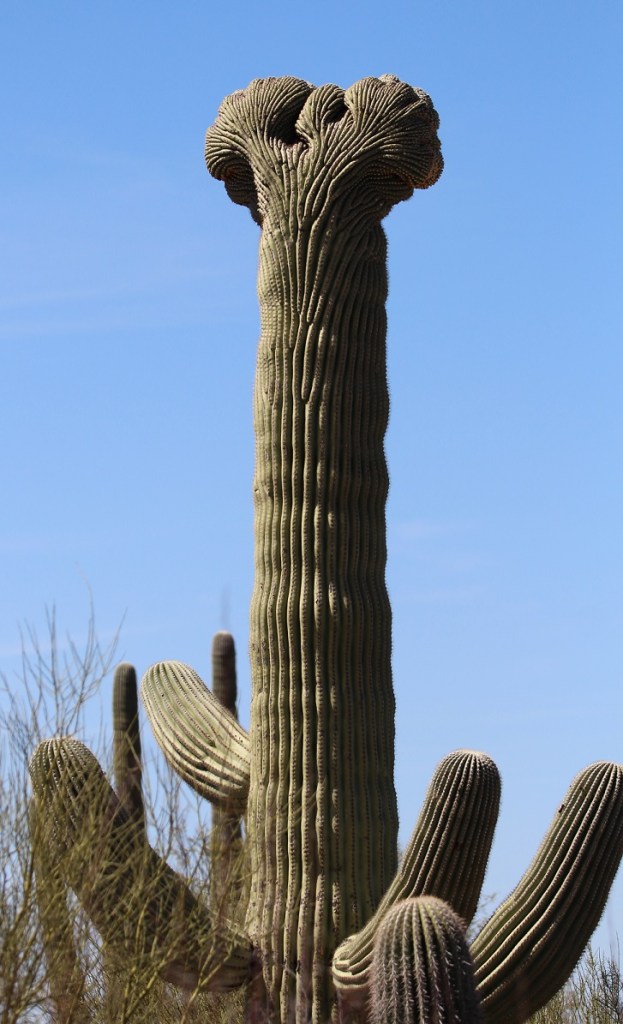
This is a cristate, or crested, saguaro. The scientists aren’t entirely sure what causes the growth pattern at the top, whether it’s a genetic mutation or damage caused by lightning strikes or freezing, but it’s pretty rare: only about 25 saguaros in the park, which has thousands upon thousands of them, have this fan-shaped feature.

Damage from freezing temperatures is a real threat to saguaros. A record cold snap in Tucson in 1937 caused many of the huge cacti to die a few years later. In the 1960s researchers discovered that exposure to 20 straight hours of sub-freezing temperatures can kill a saguaro. As recently as 1980 there were predictions of saguaros being extinct by the 1990s. The cacti have recovered, however: there are now plenty of healthy saguaros in the park.

Many birds make their nests in the protective height of saguaros. The holes are originally made by Gila woodpeckers or gilded flickers, and then when they leave the cavities are occupied by a number of different other birds including owls, finches, and sparrows.
Hikes with unexpected surprises are always fun. This is the site of the Loma Verde Mine, a copper and gold venture in the 1880s. It had a 350-feet-deep shaft. Although the copper ore was fairly high-grade, the mine soon closed and the shaft was filled by Civilian Conservation Corps (CCC) crews in the 1930s.

I couldn’t find online why the Loma Verde Mine closed, but I do know that it’s remarkably hot in Tucson. It was in the low 80s in mid-March when we visited the national park. I’m writing this post on April 27, and Tucson recorded its first 100-degree day of 2022 yesterday.

I learned a valuable bird photography lesson while taking this photo. From an eighth-mile away, the object on the right top of this saguaro appeared to look through my telephoto lens to be another bud of cactus growth. However, I took a picture anyway in case it was a bird of some kind. The picture didn’t turn out very well because it was from 700 feet away. From about 150 yards, it still appeared to be a cactus bud, but I took another photo anyway (this one) so that I’d have a better picture of a possible bird. From about 50 yards, it was clear without looking through my telephoto lens that it was only a cactus growth so I didn’t take any more pictures of it (I already had plenty of pictures of cactus from 150 feet away). Then, at about 40 yards, the cactus growth lifted its wings and flew off to the west. It was, in fact, an American kestrel, North America’s smallest raptor and a bird that I have really, really wanted to get a good picture of for several years. This terrible photo will have to do for now.
Here we see an intrepid hiker making her way past some saguaros on the Loma Verde Trail. Who knows what she’ll see around the bend of the trail? (It’ll be more saguaros.) Note the large number of bird-nest cavities in the cactus nearest the trail – it’s like a condominium building.
This cactus is at least 50 feet tall and looks like it has some stories to tell. Maybe while giving you a big hug …
… but you probably wouldn’t want it to. This is a closeup of the top of a three-foot-tall saguaro growing next to the trail. It’s definitely a cactus.
This photo gives an idea of the number of saguaros in the park – they’re in good shape for now, but it’s only because of the establishment of the national park that we get to see them in this quantity.

As is the case with all of the national parks and monuments we’ve visited, our experience at Saguaro National Park was fantastic. We’ll likely go to Tucson again in the coming years, and we’ll definitely travel to the other district of the park where we’ll hopefully see … more saguaros!

Website Built with WordPress.com.

Up ↑