We took the Goddard on an east-southeast course in the early summer of 2022 in order to get to our destination of Tishomingo, Mississippi, by late June for some warranty repair work on our home. Our travels took us through the states of Oklahoma and Arkansas, in which neither of us had previously spent much time .
In addition to seeing some new sites of interest, like the Philbrook Museum of Art in Tulsa, we also saw wildlife that was new to us since we were in an unfamiliar part of the country. Depending on where you live, these might be common in your area, but here’s a recap of the birds, new to us, we saw in Oklahoma and Arkansas while on our way to Tishomingo.
Northern mockingbird
We’ve seen many of these birds in the last 12 months, including in the western United States, but the first place we saw a northern mockingbird was about 20 miles west of Tulsa, Oklahoma. This one’s perched on a piece of playground equipment in the campground at which we were staying. Northern mockingbirds, as their Latin name Mimus polyglottos implies, are masters of mimicking the calls of other birds and even other animals and machinery. When we were camped in northern Tennessee later in the summer, a particular mockingbird perched in the campground went through a routine of perhaps 20 different calls every morning. Northern mockingbirds are noted for their intelligence, and are known to be able to recognize different humans. These are the state birds of five states: Arkansas, Florida, Mississippi, Tennessee, and Texas.
I recently finished reading Harper Lee’s novel “To Kill a Mockingbird,” in which a character notes that it’s wrong to kill these birds because “…. they don’t do one thing for us but make music for us to enjoy. They don’t eat up people’s gardens, don’t nest in corncribs, they don’t do one thing but sing their hearts out for us.” They’ve become one of my favorite birds to see and listen to, but they’re (understandably) difficult to identify by their calls alone.
In this same campground, which featured a very nice walking trail along the Arkansas River, we saw two kinds of gulls, great egrets, great blue herons, Baltimore orioles, a northern cardinal, and an indigo bunting. Water makes a big difference when it comes to attracting wildlife.
Northern cardinal
This is not the best photo of this bright species that I’ve taken, but I’m including it because it was the first northern cardinal (Cardinalis cardinalis) I photographed (we’d seen another at the same Tulsa-area campground as above, but I didn’t get a photo). This guy (unlike northern mockingbirds, in which both genders look alike, there’s a clear difference in cardinals) was hanging out in the gardens at the Philbrook Museum of Art in Tulsa. Like the mockingbird, we’ve since seen this species in other places around the country, including in Grand Rapids, Michigan, and (improbably, I thought at the time) atop a saguaro cactus outside of Flagstaff, Arizona. Northern cardinals are very common in the eastern United States as well as a large swath of Texas and parts of Arizona. They do tend to stick out, even in heavy foliage, and they’re always a pleasure to see.
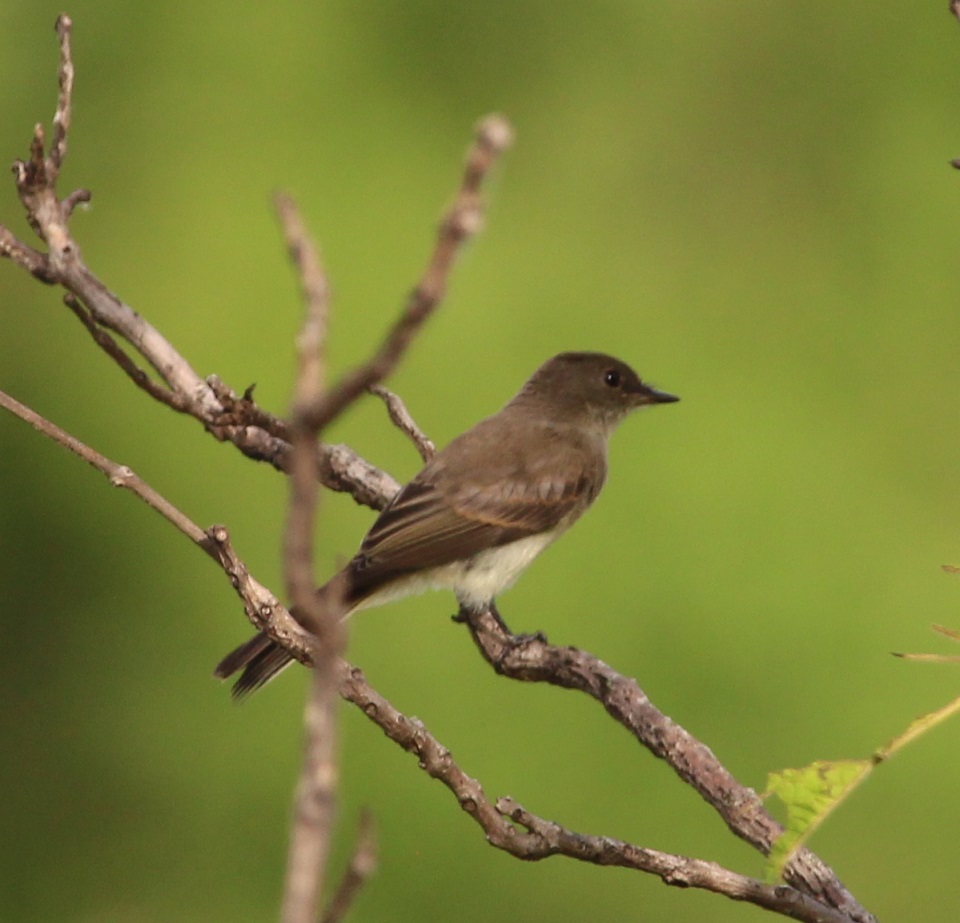
Eastern phoebe
Because we both grew up in Colorado and lived there most of our lives, anytime we see a bird with “eastern” in its name it’s likely new to us. Such is the case with this eastern phoebe (Sayornis phoebe), which is commonly found in the eastern part of the country and especially the south. This little bird, too, was perched on a tree at the Philbrook Museum of Art the evening we were there – it has a bright, very pleasant chirp of a call.
This is one of about 400 species in a group of birds called tyrant flycatchers, the largest group of birds in the world. They’re known for being rather plain-colored like this eastern phoebe [with some notable exceptions, like the scissor-tailed flycatcher (see below) and the vermillion flycatcher, which we saw in early 2023 in Tucson, Arizona]. Flycatchers subsist largely on airborne insects, like their name implies.
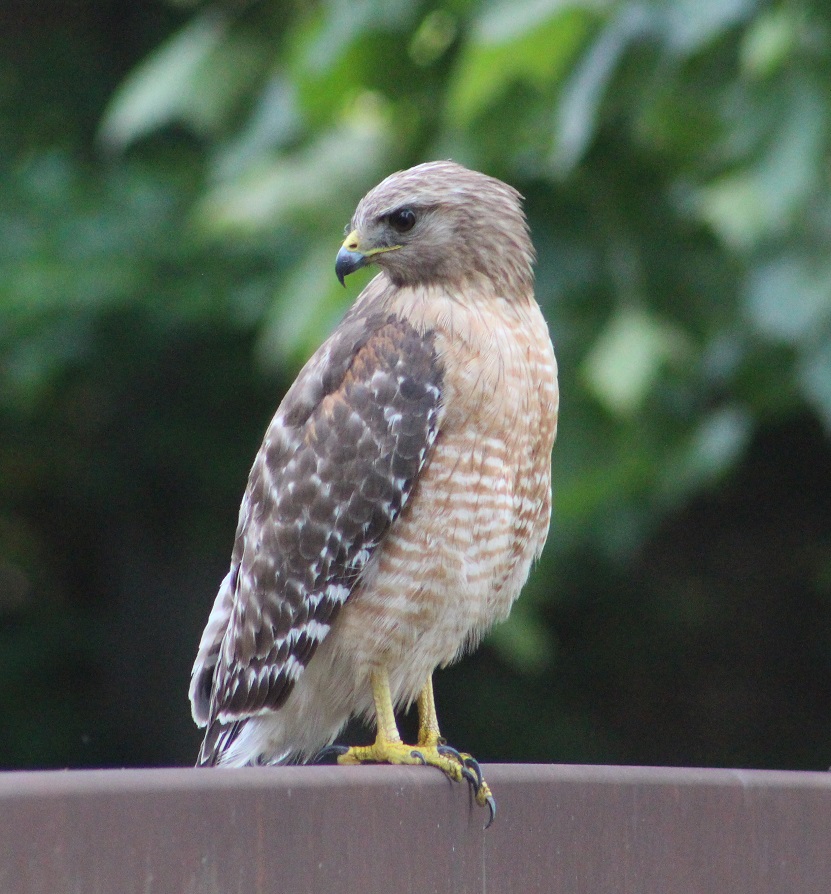
Red-shouldered hawk
This is the same bird that I wrote about in the blog posting about our visit to the gardens at the Philbrook Museum of Art, but I wanted to post this alternate photo because this red-shouldered hawk (Buteo lineatus) gave us plenty of opportunity to admire it while it perched on a bridge railing (until some ne’er-do-well kids came tramping along and scared it off, but whatever). Although there’s a small population in coastal California, this is an eastern United States raptor; Tulsa, in eastern Oklahoma, is on the very western edge of their habitat. They’re a little smaller than the red-tailed hawks that are common in the western United States. This species prefers the cover of heavily treed areas (which describes the gardens at Philbrook Museum of Art quite well). Up until around 1900, these birds were among the most numerous raptors in the United States, but deforestation and, until it was banned, DDT contributed to a marked decline in their population.
These last three birds, all seen in the same 25-acre space, give you an idea of the variety of species that can be enjoyed at botanic gardens – they’re great places to visit if you’re into birds.
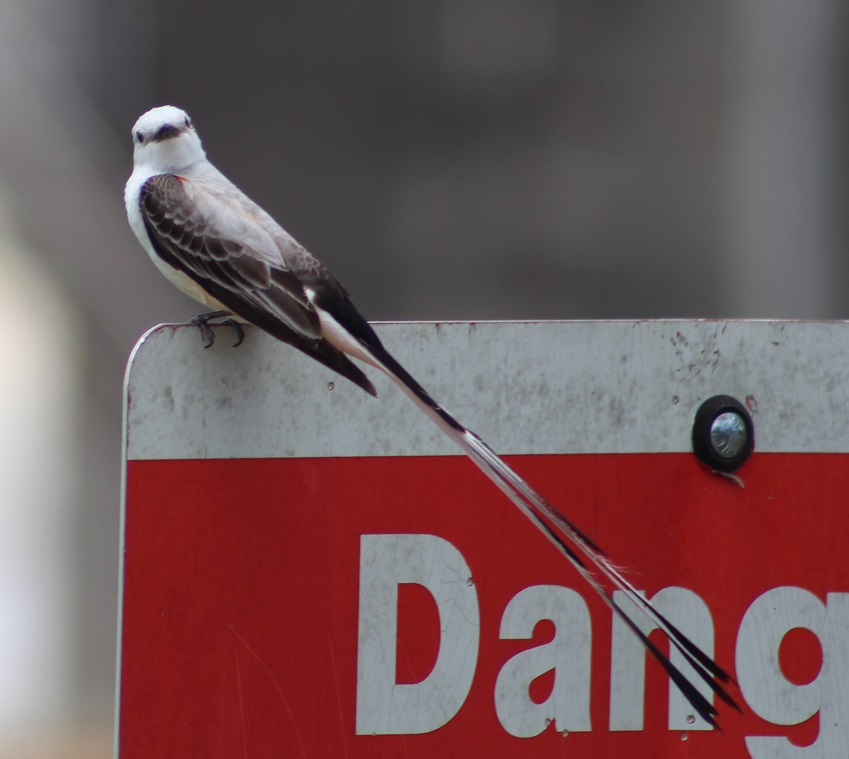
Scissor-tailed flycatcher
From the Tulsa area we proceeded to western Arkansas, where we camped outside Russellville. There’s a fantastic municipal park on the Arkansas River near Russellville, where we saw several specimens of the spectacular scissor-tailed flycatcher to which I alluded earlier. This is the state bird of Oklahoma, but I guess they’re allowed to be in Arkansas as well (their habitat is the central-southern United States, including all of Kansas, Oklahoma, and Texas).
Want to know why they’re called scissor-tailed flycatchers? Scroll on!That’s why.
(The sign didn’t say “Dang,” by the way – I cropped out the “er.”)
((The “Danger” sign didn’t refer to the scissor-tailed flycatcher, by the way – it had something to do with boating on the river.))
Prairie lizard
TALES OF THE GODDARD LIZARD ALERT: Sharp-eyed readers will have already noticed that this is not a photo of a bird. This is most likely a prairie lizard, or Sceloporus consobrinus. Note, however, that I know next to nothing about lizards, so I could definitely be wrong. Whatever species it is, there were dozens of them at the park crawling around the cement steps leading down to the Arkansas River, which obviously delighted Nancy to no end as we climbed back up. Also, we’ve seen a lot more different lizards in the last year, so prepare yourself for lots of TALES OF THE GODDARD LIZARD ALERTS.
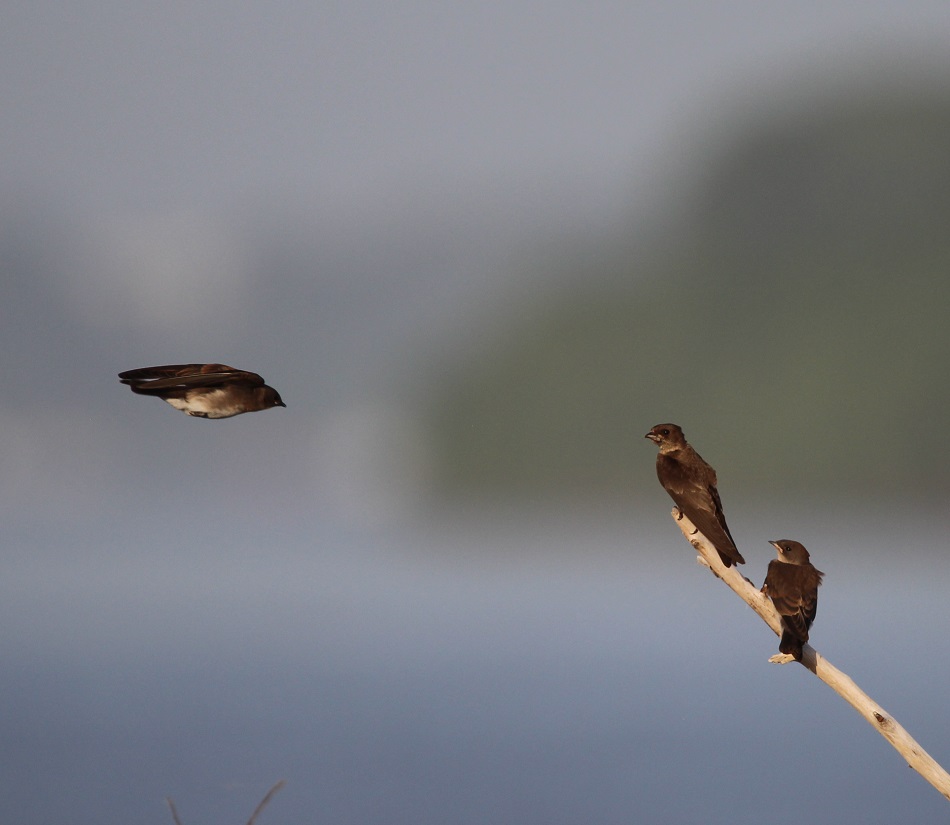
Northern rough-winged swallow
Finally, we made our way to the eastern side of Arkansas, right up next to the mighty Mississippi River, where we camped just a stone’s throw from the Mother of Waters. I’m fairly confident that these are northern rough-winged swallows (Stelgidopteryx serripennis), which were flying acrobatically over the river while hunting for flying insects. We really enjoyed watching them, along with their barn swallow cousins.This is a photo of a barge making its way up the Mississippi, just south of Memphis on the other side of the river from where we were camping. I’m including it because we spent a lot of time just watching these gigantic barges going up and down the river while hauling all kinds of cargo, and there’s also a swallow (dunno what kind) pictured just above the barge, in pursuit of a flying insect.
I kept a list of the different bird species we saw in 2022, and we ended the year with 86 species. As of this writing (late May 2023), we’ve seen nearly 70 species since the beginning of the year. Traveling about the country (although we’ve been only in New Mexico, Arizona, and, briefly, Utah in 2023) helps that number quite a lot, of course, as does keeping an open eye when one is out and about. There’s a lot of diversity out there, and it’s neat to see.





 Tales of The Goddard