The Bear River, at 350 miles long, is the country’s longest river that doesn’t eventually reach an ocean – but it is the largest river that flows into the Great Salt Lake of northern Utah. It starts in northeastern Utah, flows into southwestern Wyoming and southeastern Idaho, then makes its way back into Utah and into the Great Salt Lake.
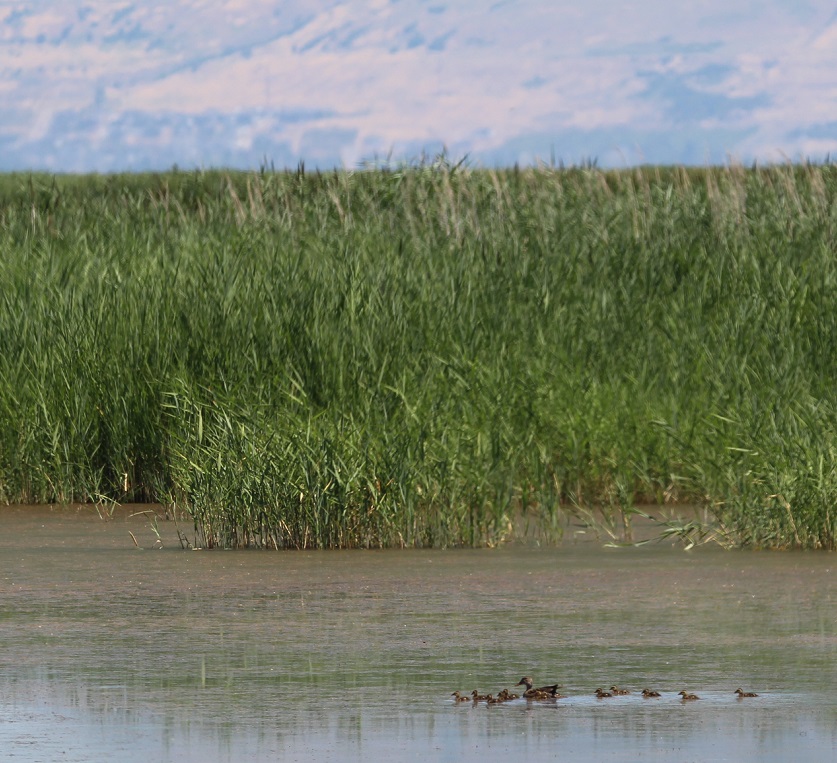
I took this photo looking east from an observation platform along the Bear River, a few miles before it enters the Great Salt Lake. The Wasatch Mountain range, forming the western edge of the Rocky Mountains, is on the horizon; Box Elder Peak (elev. 11,101 feet) and Willard Peak (9,763 feet) are two of the prominent mountains in this part of the Wasatch range. As in many areas of the west, the 2022-2023 snow season was quite robust in the Bear River drainage and provided plenty of water flowing into the lake in mid-July. More on that later, though.
This family of gadwalls (Mareca strepera), a species of duck that, thanks in no small part to the establishement of wildlife refuges, has been growing in numbers since the 1980s, is making its way down the Bear River. Female gadwalls closely resemble female mallard ducks, but their heads and bills are shaped differently. This mom is tending to at least 11 ducklings; gadwalls can lay up to a dozen eggs in one clutch. In the fall months, 500,000 ducks and geese can be found at the refuge during their migration southward. Imagine all of that quackin’ and honkin’!
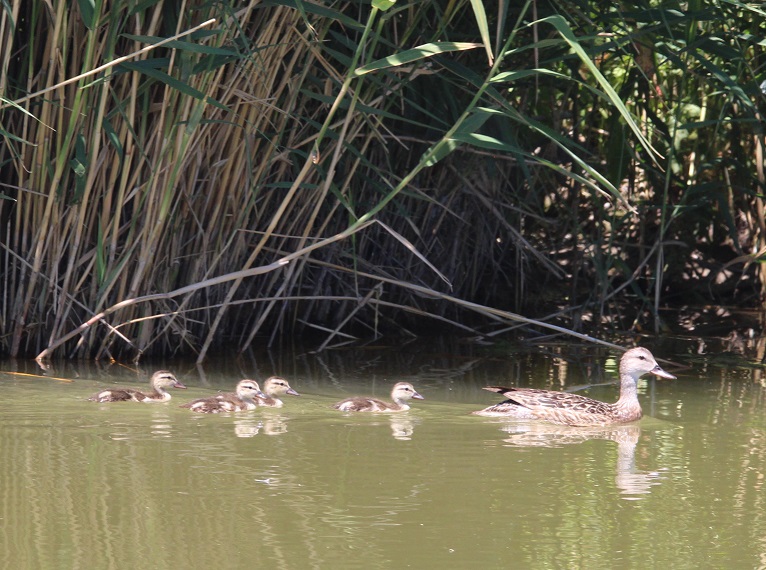
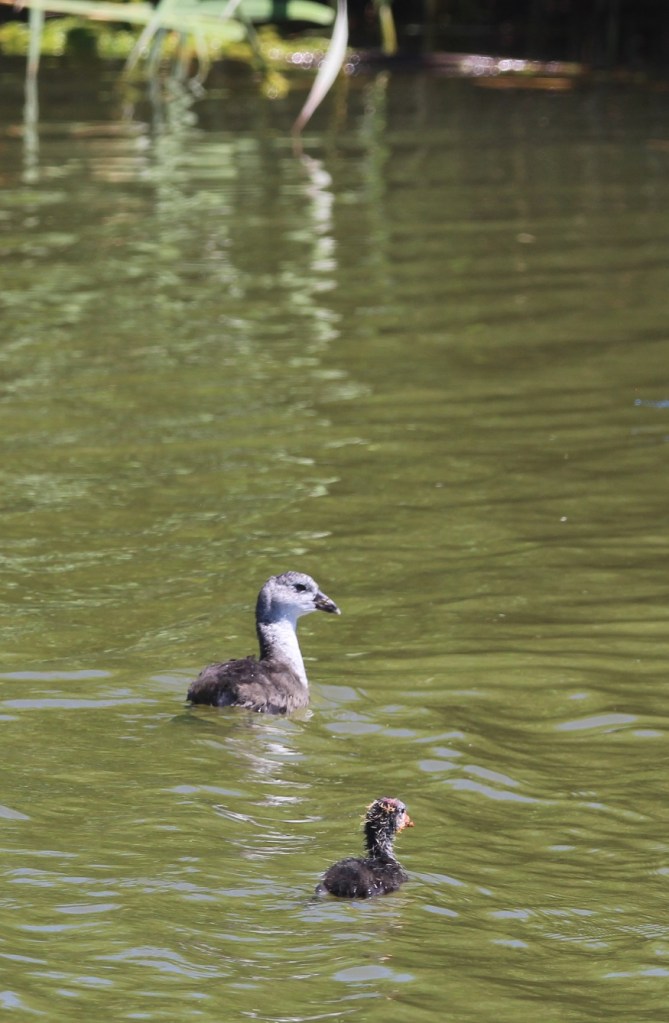
Here’s a closer look at another, and perhaps more reasonably sized, gadwall family. The gadwalls weren’t the only bird species looking after young ones at the Bear River refuge: there were baby waterfowl and shorebirds aplenty.To wit: this western grebe (Aechmophorus occidentalis) and two fledglings (grebelings?). Like many waterfowl, young grebes will often hop on a parent’s back to take a break from paddling. A volunteer at the refuge’s visitor center had suggested that we keep an eye out for the freeloading young grebes, and we were happy to see this family. The plumage of western grebes and that of their closely related cousins, Clark’s grebes, is very dense and their hides were used to make waterproof garments in the 19th century. Thankfully, the popularity of the style dropped and populations of both species, which had declined, soon recovered.More baby waterfowl, this time an American coot (Fulica americana). I had only ever seen black coots before and assumed that the lighter colored ones (like the one at the top of this photo) were females. In fact, both male and female adult coots are black, and so the larger coot here is either mother or father to the cootling but has not yet matured out of its juvenile color pattern. Coots were everywhere in the refuge: I’m going to guess that we saw about 70 kajillion coots that day.
The delta at which the Bear River flows into the Great Salt Lake is where the 74,000-acre Bear River Migratory Bird Refuge was established in 1928. The refuge provides critical breeding and nesting habitat to more than 250 species of birds and other wildlife. Nancy, Gunther and I visited the refuge in mid-July, enjoying a short hike, a 12-mile auto tour, and the company of thousands upon thousands of birds.
We’d seen white-faced ibis (Plegadis chihi) only once before, at St. Vrain State Park in northern Colorado, and that was a flock in flight and so far up in the sky that I thought they were Canada geese until I took a closer look at the photo. There were plenty of these beautiful birds on the ground at Bear River National Wildlife Refuge. They use their distinctive curved bills to dig in the wet dirt around waterways in search of earthworms and other invertebrates. I look forward to getting better pictures of white-faced ibiseses(es) sometime: their purple, green, and bronze plumage is really pretty.
The Bear River Migratory Bird Refuge is located where two of the country’s major migratory flyways, the Pacific and the Central, overlap. Because of its connection to the ecosystem of the Great Salt Lake, the refuge is a critical stopover for migratory birds of all sizes.
Administered by the U.S. Fish & Wildlife Service, the National Wildlife Refuge system includes more than 550 refuges in all 50 states and territories. In all, more than 150 million acres (almost 235,000 square miles, or more than twice the size of Colorado) are protected to support more than 700 bird species and 220 mammal species, along with hundreds of amphibian, reptile, and fish species.
Due to the loss of habitat from population growth, as well as a botulism outbreak, Utah citizens and conservation organizations asked Congress to protect this area, and the national refuge was created in 1928.
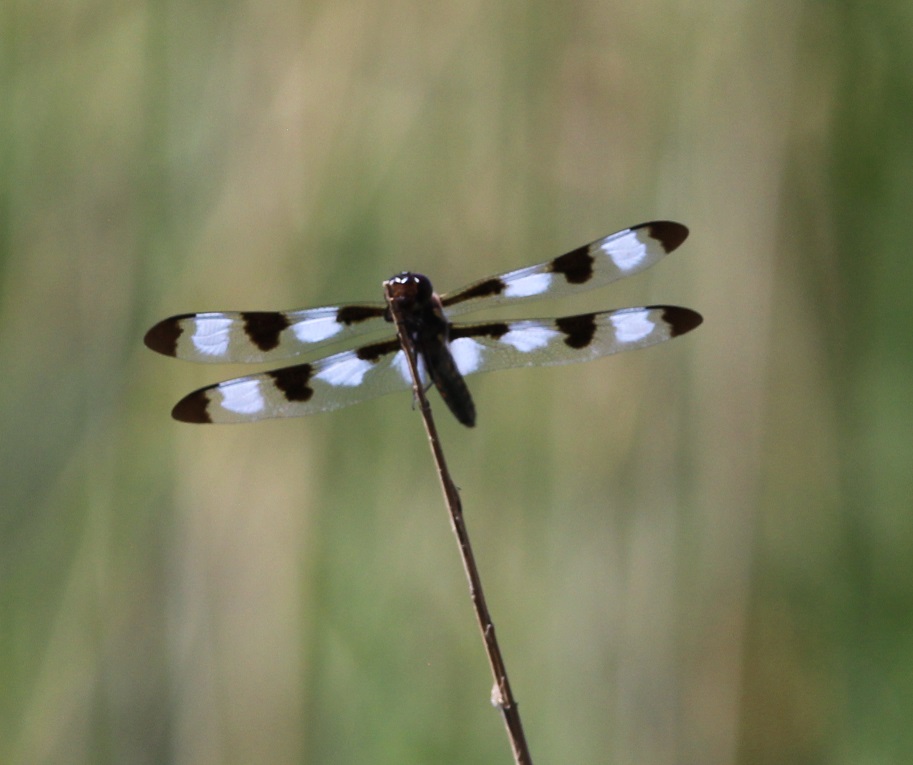
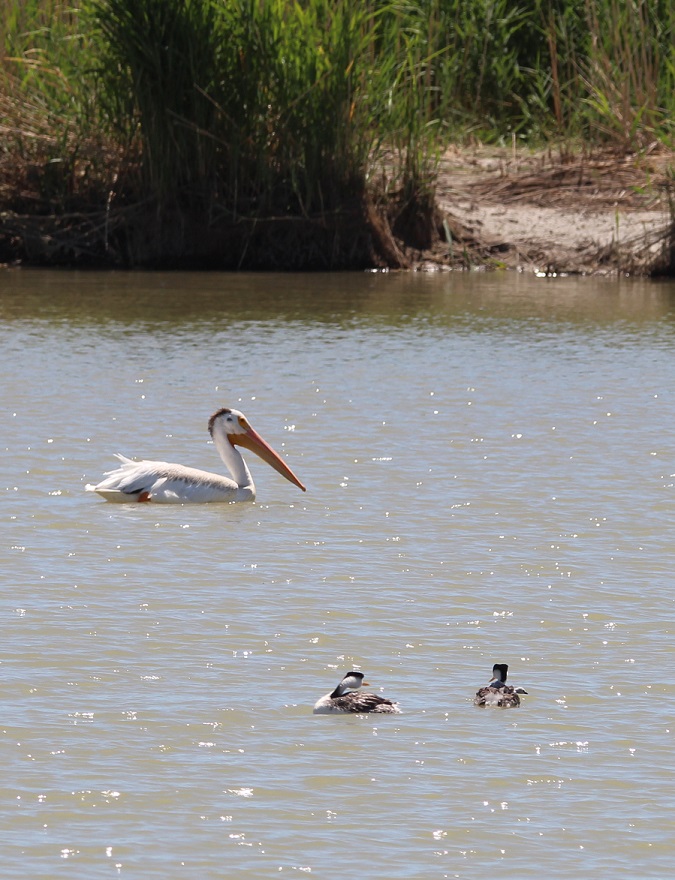
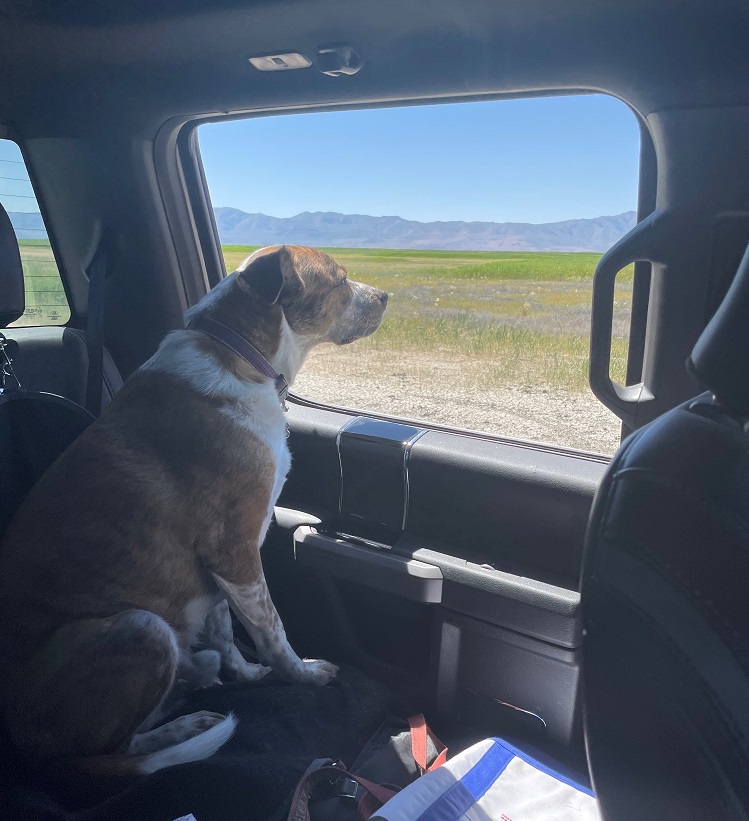
This black-necked stilt (Himantopus mexicanus) was yammering away while on the hunt for something good eat on the shoreline. The refuge is home to 65,000 black-necked stilts in the fall months. This species is closely related to American avocets, and, although it’s rare, the two can create hybridized offspring called “avo-stilts.”Ready for a break from birds? How ’bout a bug? This is a twelve-spotted skimmer (Libellula pulchella), a type of dragonfly. It was resting on a reed in a marsh next to the refuge’s visitor center. This is a very common dragonfly and is found in all 48 of the contiguous states. If you only count 10 spots, that’s okay – they’re also called ten-spotted skimmers. They’re one of the bigger dragonfly species, at up two two inches long and with an even longer wingspan. Insects like this are, of course, a major component of a wildlife ecosystem. Dragonflies eat smaller insects, and they themselves are eaten by birds and reptiles.To wit (again): this house sparrow (Passer domesticus) with a late breakfast on the visitor center’s roof (it looks like it has an unfortunate grasshopper rather than an unfortunate dragonfly in its beak, but you get the idea). The most common birds in the United States – house sparrows, rock pigeons, and European starlings – are all introduced species. None are native to this country, but they did remarkably well for themselves once they got into the wild.Here’s a native sparrow species, the song sparrow (Melospiza melodia). This species is found from Alaska’s Aleutian Islands to the country’s east coast. The coloration of their feathers varies depending on the conditions in the local population’s habitat.The variation in bird species we saw was pretty remarkable. Here are two western grebes pondering an American white pelican (Pelecanus erythrorhynchos), one of the largest birds in North America. We didn’t see many pelicans during our visit, and those we did see were pretty far away. This photo was taken in the delta area of where the Bear River enters the Great Salt Lake.Here’s another big white bird: the snowy egret (Egretta thula). During the breeding season, snowy egrets develop very thin feathers on their necks. These feathers were once highly valued by the fashion industry: in the 1880s, they had a per-ounce value twice that of gold. Naturally, the numbers of snowy egrets dropped precipitously, but conservation efforts, including the establishment of national wildlife refuges, helped restore the population. Check out those yellow feet! This egret was kickin’ it with a small herd of cattle, probably looking for insects and other invertebrates disturbed by the bovines. Back to bugs, briefly. There are about 3,000 known species of dragonflies in the world, and we saw three of them at the wildlife refuge. This one is a blue dasher (Pachydiplax longipennis), and like other dragonflies, is capable of eating hundreds of smaller insects every day.One more dragonfly; this is a variegated meadowhawk (Sympetrum corruptum). This species, native to North America, has been found migrating south to Honduras and as far as eastern Asia.Of the 256 photos I took at the refuge (I’m not kidding), this one is my favorite and it might be my favorite that I’ve taken this year. It’s an American avocet (Recurvirostra americana), and I took this picture after crawling slowly and steathily through a half-mile of stinking wet marshland in an attempt to unobtrusively approach this bird. I’m just kidding iwth you right now: I took this photo from the passenger seat of the Goddard’s six-wheeled towing unit while the avocet was walking down the side of the road. Avocets use their gently curved bill to sweep through shallow water in search of invertebrates. The plumage on their head and neck darkens to this beautiful russet during the summer, and then retreats to white and gray during the winter. They grow to about 18 inches tall. What an elegant bird.Here’s another photo I took from the passenger seat of our pickup. Gunther has enjoyed several auto tours with us this year, and we were happy to have him along at the wildlife refuge. He’s taken a special interest in seeing horses from the back seat.
About the water issue I alluded to at the beginning of this post: while the Bear River seemed to be flowing at or near the capacity of its banks thanks to a great snow season in the Rocky Mountains, the Great Salt Lake is undergoing an historic multi-decade drought that has shrunk the lake to just 37 percent of its former volume. It’s something that’s happening all over the western United States: higher temperatures coupled with decreased annual precipitation levels, exacerbated by growing populations of people, are creating smaller river flows and diminishing bodies of water. What’s happening at the Great Salt Lake specifically is a crisis that, in my mind, isn’t getting nearly enough attention: in addition to the critical wildlife habitat that would be lost, a dry Great Salt Lake bed would create a huge volume of toxic dust directly adjacent to Salt Lake City. It’s a metropolitan area of 1.3 million people, and one that is growing quickly.
The consequences of losing the Great Salt Lake are difficult to imagine, and I don’t even want to consider what life around Salt Lake City would be like. Conservation efforts, meant to reduce the amount of water taken (mostly for agricultural purposes) from the Great Salt Lake’s three tributaries prior to entering the lake, are underway. The Church of Jesus Christ of Latter-day Saints, one of the west’s biggest land- and water-rights holders, has taken the unprecedented step of donating a sizable amount of its water to the lake, and is encouraging its adherents to conserve as much water as they can, but it may be a case of “too little, too late.” The 20,000 acre-feet of water donated by the Mormons, while a significant amount on its own, is enough to replace only about 2 percent of the lake’s lost volume.
We saw 19 different bird species in about four hours while at the refuge. All of those species, and all of the other birds and other animals at the refuge, are dependent on healthy waterways to breed and raise their young – in other words, to continue as a species. I hope that happens, for all of them.








 Tales of The Goddard
Leave a comment