Finding a parking spot for our Ford F-350 pickup, the 22-feet-long and six-wheeled towing unit of The Goddard, is sometimes a challenge. We usually just park on the outskirts of businesses’ parking lots because, unless the parking spots are oversized, we sometimes take up more than one space. When visiting Yellowstone National Park in September, we realized that we needed to get early starts in order to find spaces in the park’s parking lots: we arrived after Labor Day and park rangers assured us that visitation had noticeably dropped, but parking spaces were still at a premium beginning in the late morning hours, So it was when we visited Norris Geyser Basin, located in Yellowstone’s northwest quadrant: we arrived at about 8:30 AM on September 12 and happily found a parking space. It was already getting pretty chilly in mid-September: high temperatures in the basin that week were in the mid-60s Fahrenheit (about 18 degrees Celsius) and pre-dawn low temperatures were in the low to mid-30s Fahrenheit (about 0 degrees Celsius).
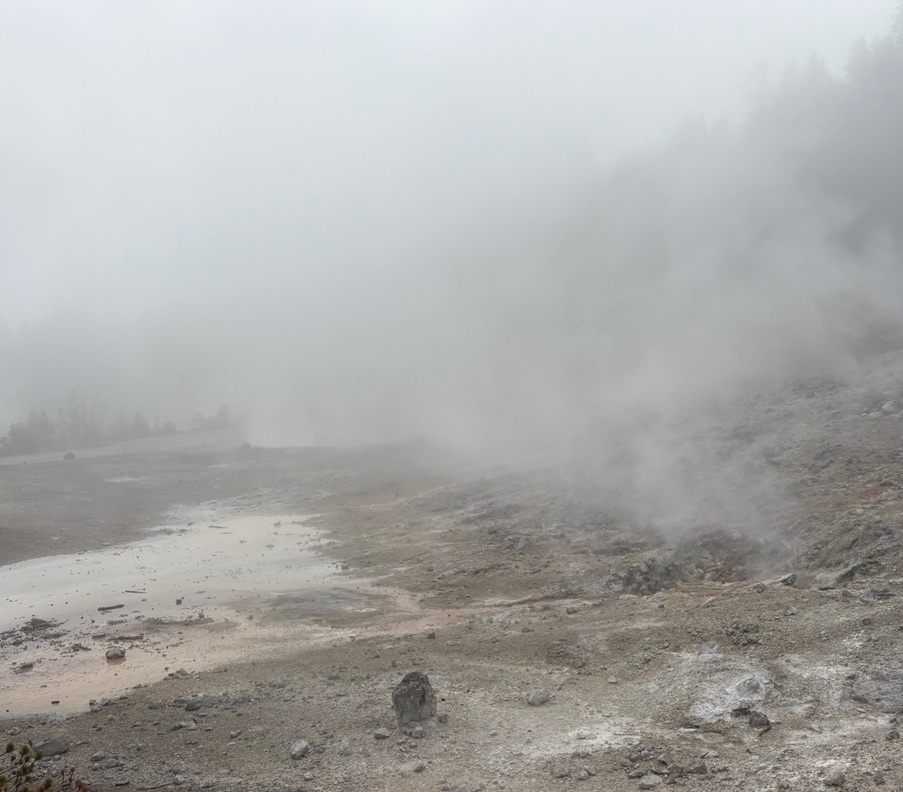
Those cold air temperatures combined with the hot steam rising from abundant geothermal features to create an otherworldly effect; it was extremely foggy, which made it difficult to discern any of the geysers, hot springs, and other features. The day soon warmed up, however, and the features revealed themselves. There are two different loop walks around Norris Geyser Basin: the longer and more forested Back Basin, which we visited later the same day (see that posting for an explanation of the different types of hydrothermal features, which I won’t repeat here), and Porcelain Basin. Here’s a look at some of what we saw in Porcelain Basin, once the air cleared a bit.
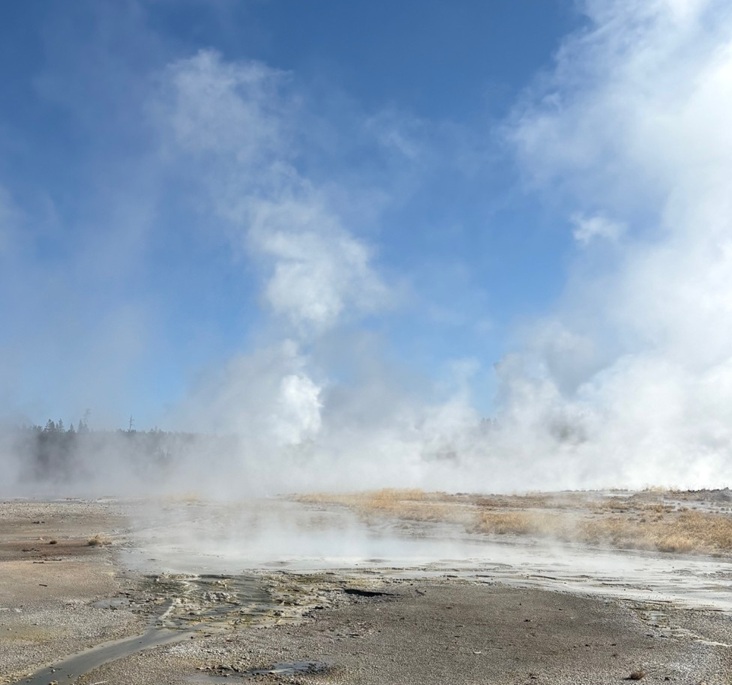
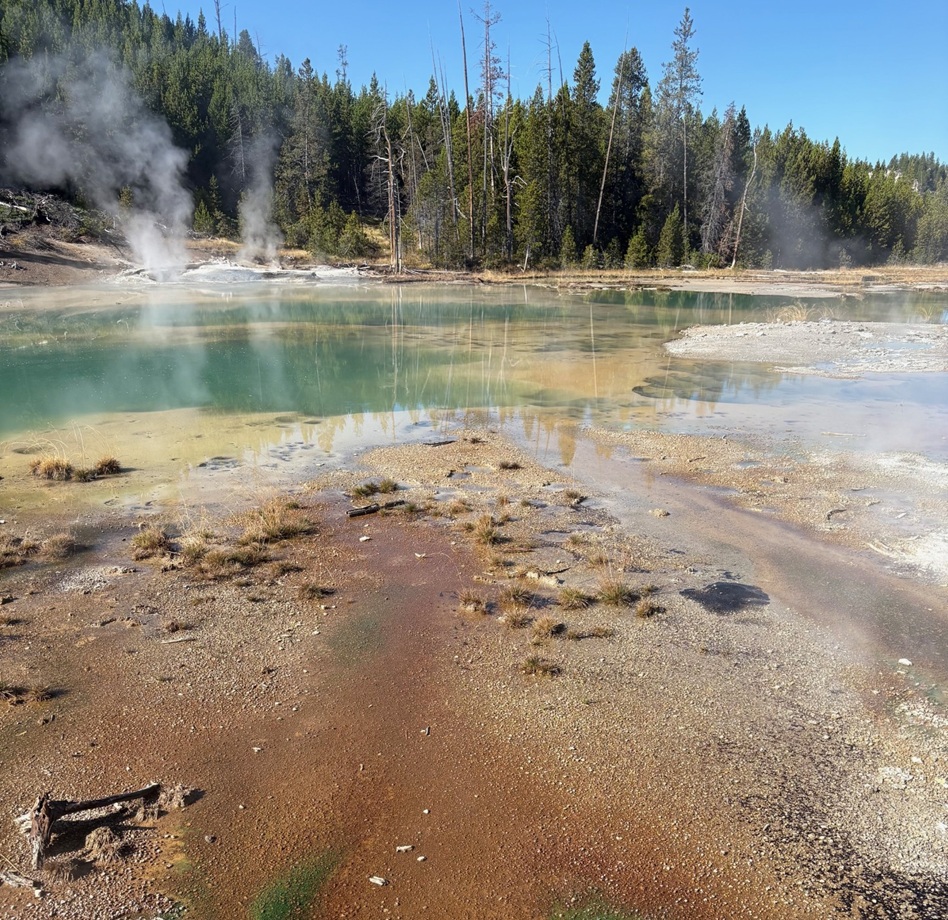
Those are some impressively large logs. This is the north-facing side of the Norris Geyser Basin Museum, designed by architect Herbert Maier (1893-1969) and built between 1929 and 1930. The museum, at 7,560 feet (2,304 meters) in elevation, was our first stop at Norris while we waited for the fog to dissipate. Maier also designed three other buildings in Yellowstone National Park: still-standing museums at Madison and Fishing Bridge, and the Old Faithful Museum of Geothermal Activity. Together, the four structures, built in an architectural style known as “National Park Service Rustic” that attempted to connect manmade buildings with the natural environments in which they were constructed, interpreted the geologic features on the Grand Loop road. Unfortunately, the museum at Old Faithful was demolished in 1971 to accommodate a new visitor center; that structure was itself demolished to make way for the current visitor center that opened in 2010. Maier also designed still-standing buildings in Yosemite National Park in California and Grand Canyon National Park in Arizona, as well as a number of structures in state parks in Texas.This picture, I think, really captures the extraordinary beauty and kaleidoscopic color of Yellowstone National Park. (Not really: it captures the foggy conditions at Porcelain Basin for the first hour or so after our arrival.) This hillside is venting sulfuric acid, gas, and steam, and the colder temperatures on the morning of our visit made the venting look quite pronounced. Norris Geyser Basin is the hottest area in Yellowstone National Park, in which one only needs to dig four miles downward to find magma – rock that’s so hot that it has become liquified (one wouldn’t necessarily want to do that, though). The average surface temperature in the basin is 280.4 degrees F (138 degrees C), and a probe sent 1,086 feet (331 meters) under the ground’s surface registered a temperature of 464 degrees F (240 degrees C). A vent from which gases and steam escape is called a fumarole (from the French fumerolle, which is a domed vented structure built over a stove to allow steam and smoke to escape); a fumarole that vents sulfuric gases (like these in the photo) is called a solfatara, while a fumarole that vents carbon dioxide gases is called a mofetta. A muffuletta is a delicious Italian sandwich popularized in New Orleans, but that’s not important right now.These pools, collectively called Porcelain Springs, give their name to the basin. They’re supposedly very pretty when the sun is shining on them, but I guess we’ll never find out for sure. The white mineral surrounding the bodies of water is called siliceous sinter, also known as geyserite. The silica is brought to the ground surface by the hot water in the pools, and accumulates very slowly – about an inch per century. Relatively new sinter is white; as it ages it turns to a darker gray color. The hydrothermal features in the greater Norris Basin, including both Back Bay and Porcelain basins, contain the highest level of silica in Yellowstone National Park – it’s what contributes the white milkiness (some might say porcelain-like) attribute to these bodies of water. Other minerals, like iron, arsenic, and sulfur, are all abundant as well. The latter contributes a distinct aroma to walks around these basins.This photo, too, is indicative of what we saw while waiting for the fog to go away. As you can see, Porcelain Basin is not a terribly inviting place if the sun isn’t shining. These trees, interestingly, found the conditions in the soil conducive to germinate, grow, and mature into tall pines; the soil conditions later changed because of geothermal activity in Porcelain Basin and made the ground inhospitable to many lifeforms. Most of Norris Geyser Basin is walkable only on boardwalks like this one: the ground is too fragile (and, remember, it’s nearly 300 degrees) for visitors to walk on directly.I took this photo from about the same position as the previous one (the boardwalk is just to the right side of the image), but looking slightly to the left and about half an hour later. You can see the sun was starting to emerge but steam is still rising from Nuphar Lake, which is itself not a geothermally heated body of water – it’s just plain old steam evaporating as the air temperature rises. Nuphar Lake (nuphar is a genus of flowering aquatic plants) has an interesting recent story, however. In 2021 and 2022, the lake’s water level rose by several feet (about one meter). Apparently, a geothermal feature near the lake began sending silica-laden water into the lake rather than into Porcelain Basin, which turned the lake’s water cloudy-white. The water level rose so dramatically that Nuphar Lake threatened to overflow its banks and into Porcelain Basin (which would have been pretty bad, because there are a lot of really pretty features there). By the end of the summer of 2024, though, the water level receded to its previous level and the color of the water returned to its normal clear green. Geologists found that an earthquake that occurred in April 2024 near the lake created a 10-foot-wide (about 3 meters) crater and caused water to stop flowing from the hydrothermal features. The dead trees in the previous photo, and those in the foreground of this photo, were killed by the silica-rich hydrothermal water that had been flowing into Nuphar Lake. That’s one big takeaway from our visit to Yellowstone National Park: nothing’s ever the same, and you can’t count on anything being there on a subsequent visit.Well, well, well … look what decided to finally show up: the sun. This is the same Porcelain Springs body of water that’s in the upper-left corner of the image three photos up. A sunny day does make all the difference – they are very pretty after all. Like porcelain, almost.The steam in Porcelain Basin, made more prominent because of the morning’s cold temperatures, was finally starting to dissipate so that we could see what else the basin had to offer. The sun was already pretty high up in the sky by that point, but it made for an interesting look. No retinas were damaged in the taking of this photo; the steam was a lot denser than it looks in the image.This is Hurricane Vent, which once was a fumarole but has increased in size to include more water action as well as a small waterfall on its side. It was pretty noisy, and interesting to watch.I took this photo just a few steps down the boardwalk from Hurricane Vent. This is looking to the southwest and at Ledge Geyser, which, while it rarely actually erupts, was certainly impressively active and loudly spouting steam from several of its vents during our time in Porcelain Basin. When Ledge does erupt, the geyser sends water more than 80 feet (24 meters) into the air. The Norris Geyser Basin Museum is on the other side of Ledge Geyser and up a hillside in this photo.Here we’re looking northeast from the Porcelain Basin boardwalk and at Constant Geyser. When it erupts, Constant’s spouts of water can reach 20-30 feet (6-9 m) into the air, but last only about 10 seconds. The geyser can go 20 minutes or several hours between eruptions.A few steps down the boardwalk, Whirligig Geyser (on the right) has eruptions that can be heard throughout Porcelain Basin. That green-hued stream on the left is the East Fork of Tantalus Creek.Here’s a closer look at the East Fork of Tantalus Creek. In Greek mythology, Tantalus was one of the (many, many, many) sons of Zeus who, for whichever transgression(s) you might choose to believe, was sentenced to stand in a pool of water under a fruit tree. The fruit was forever just outside his grasp, and, when he bent to get a drink, the water below him always receded. Anyhow, the beautiful green color of this creek comes from the thermophiles, or heat-loving microorganisms, that live in the water, in particular Cyanidioschyzon (I did not, despite how much I would have liked to, make that word up). It’s a genus of algae that thrives in water that’s 100-126 degrees F (38-52 degrees C). The steam from Whirligig Geyser is obscuring them in this photo, but there’s also a population of red-colored thermophiles that is thriving in hotter waters (122-160 degrees F, 50-60 degrees C) closer to Whirligig’s opening. The red coloration comes from the iron oxide that is in the geyser’s outflow. You’ll recall from high-school biology and chemistry classes that the pH scale is used to measure the concentration of hydrogen ions in a chemical. The scale goes from 1 (most acidic) to 14 (most alkaline), with 7 in the middle at neutral. Some of the water features in Norris Geyser Basin have a pH value below 2; they’re nearly as acidic as vinegar. It takes a tough little organism to live in that hot, acidic environment.This body of water, situated near the end of the Porcelain Basin loop, is Crackling Lake, named for the popping sounds made by geysers seen on its shoreline on the left.Here’s a last look at Ledge Geyser. This photo was taken from the other side of the plume of steam from where I took the previous photo of Ledge (note the other folks on the boardwalk looking at Constant, Whirligig, and other geysers to the left-center of the photo). Even though it never erupted, Ledge Geyser was a most impressive hydrothermal feature that made it hard to forget that molten rock was just four miles below our feet.
After a brief respite in the parking lot (and our prime parking spot) for lunch, Nancy and I enjoyed the features of Back Basin. We saw a lot of hydrothermal features that day – fortunately the fog over Porcelain Basin lifted about an hour after our arrival so that we could see them – and my guess is that the next time we visit, we’ll see a difference in a national park in which nothing is ever truly the same.
Works Consulted
Lynne, Bridget Y. “The Geothermal Guide to Yellowstone National Park.” 2017.
National Park Service. “Norris Geyser Basin Trail Guide.” March 2024.
National Park Service interpretive signage at Norris Geyser Basin Museum and at features throughout Porcelain Basin.
Wikipedia, accessed October 2025. If you use Wikipedia, please support it.






 Tales of The Goddard
Leave a comment