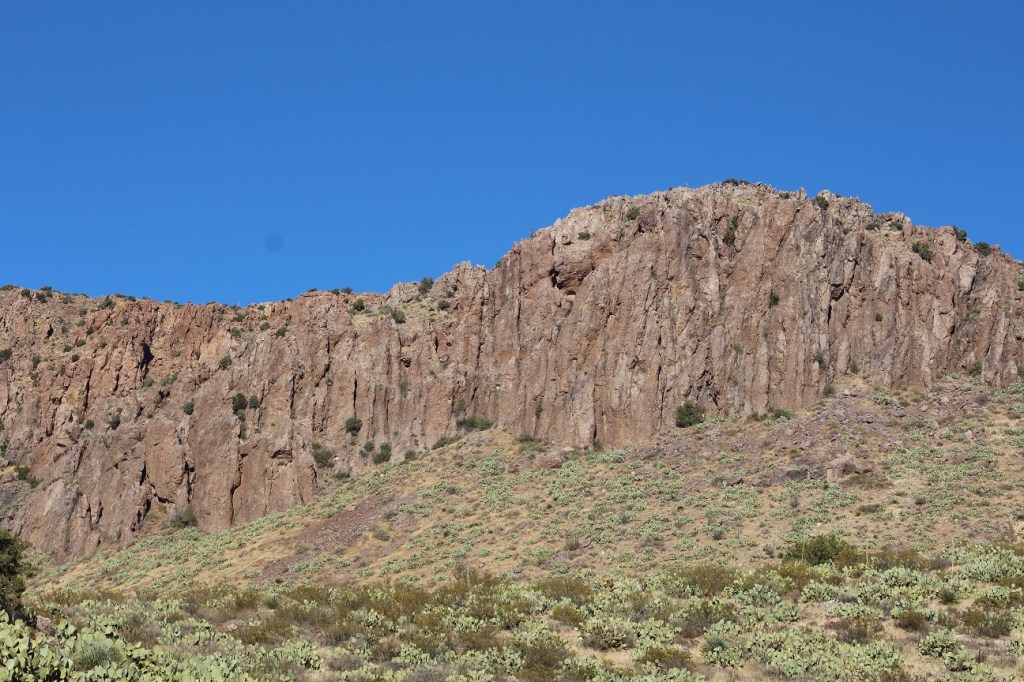
One of the few state or national parks where one is encouraged to bring home natural souvenirs, Rockhound State Park is located about 7 miles southeast of Deming, N.M., along the western flank of the Little Florida Mountains. Nancy and I learned, prior to coming to Deming, that Florida in the case of the mountain range is pronounced “flor-EE-duh,” in the Spanish way, much like the Arkansas River is the “ar-CAN-zus” River in Kansas. The Little Florida Mountains are adjacent to the Florida Mountains, separated by a valley. Rockhound a fairly small park, with only about 1.5 miles of hiking trails in the main part of the park. However, it has great views not only of the Floridas but of the open desert to the west, and you can take home up to 15 pounds of rocks! The park has plenty of rocks for the taking, including jasper, rhyolite, and perlite, and geodes – round rocks that have a solid or partially filled (usually with quartz) cavity – can be found as well. The campground in the park has 29 sites.
True to their name, the Little Florida Mountains are a range about three miles long. Rockhound State Park lies between the Little Floridas and the Florida Mountain range, which is about 12 miles long and has mountains ranging from 5,000 to 7,000 feet in elevation. Volcanic activity from millions of years ago is responsible for the appearance of the mountains, as well as the type of rocks at their base.This is a rock that was in the hiking trail; the photo shows an area about a foot wide. I thought it was a very striking rock (some rocks are more striking than others, I’ve found), and it’s held up to thousands and thousands of footsteps. This is jasper, one of the more common minerals in Rockhound State Park. Jasper is from the quartz family and can be red, yellow, brown, pink, white, or all of the above.Rockhound also has a plethora of prickly pear cactus.Rock hound at Rockhound. I told Gunther he’d have better luck at finding the really good rocks if he looked at the ground rather than at the sky, but what do I know?
I believe there’s a state park in Arkansas (pr. ARR-kan-saw) that allows visitors to take home any diamonds they find, but I think Rockhound is the only other park that encourages its visitors to bring away mineral resources. I brought two specimens back to the Goddard.
This is a small sample of perlite,, which is a natural type of glass that is formed by quickly cooling lava that has a lot of silica in it. Perlite is mined in northern New Mexico, and it’s later heated to 1,600 degrees Fahrenheit when it forms small white balls that are used in construction products, filters, and gardening products (gardeners often add perlite to soil to keep it from compacting too much). The ballpoint pen at right is for scale only; it didn’t come out of a volcano.You might think this is petrified wood, and you’d be wrong. This is a mineral called rhyolite, which is found throughout Rockhound State Park (as opposed to petrified wood, in which Rockhound is sorely lacking). The banded contortions show how lava flowed during volcanic eruptions.
We weren’t in the part of the park that featured geodes just laying around, but we saw some really pretty rocks nonetheless and enjoyed a pleasant hike with Gunther. The views, too, were just beautiful, especially looking to the open spaces of the desert to the west. We also brought home two specimens to add to the Goddard’s growing gem and mineral collection, which now numbers two.
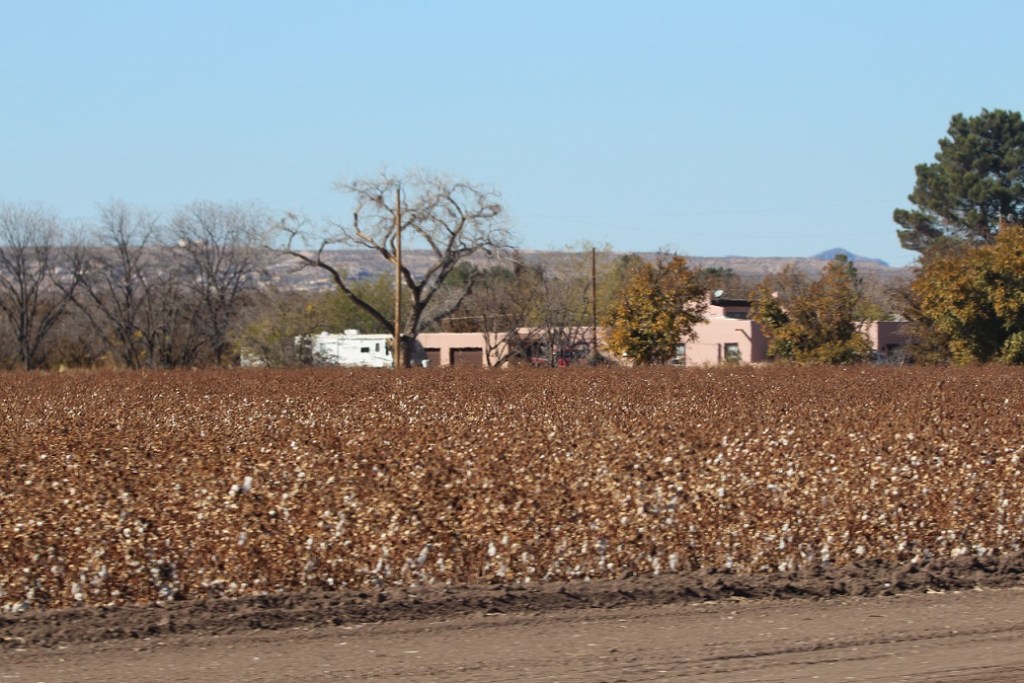
Nancy and I were surprised to see this field while driving near Mesilla, N.M., a small town that borders Las Cruces. It’s cotton. Did you know / did you care that New Mexico produced 71,500 480-lb bales of cotton in the production year that ended May 1, 2021? Where does New Mexico rank among all cotton-producing states? Not very high. Texas led all states with 4.75 million bales in 2020, and then it dropped off quickly: Georgia had 2.18 million, Arkansas had 1.3 million, and Mississippi had 1.2 million. The no. 10 state, North Carolina, had 540,000 bales – 7.5 times as many bales as New Mexico in 2021. Still, it’s kind of neat to see cotton fields in the desert. We’ve since also seen them south of Deming, N.M., just a few miles north of Mexico. (Apologies for the blurry photo; as I wrote, we weren’t expecting to come across a cotton field.)
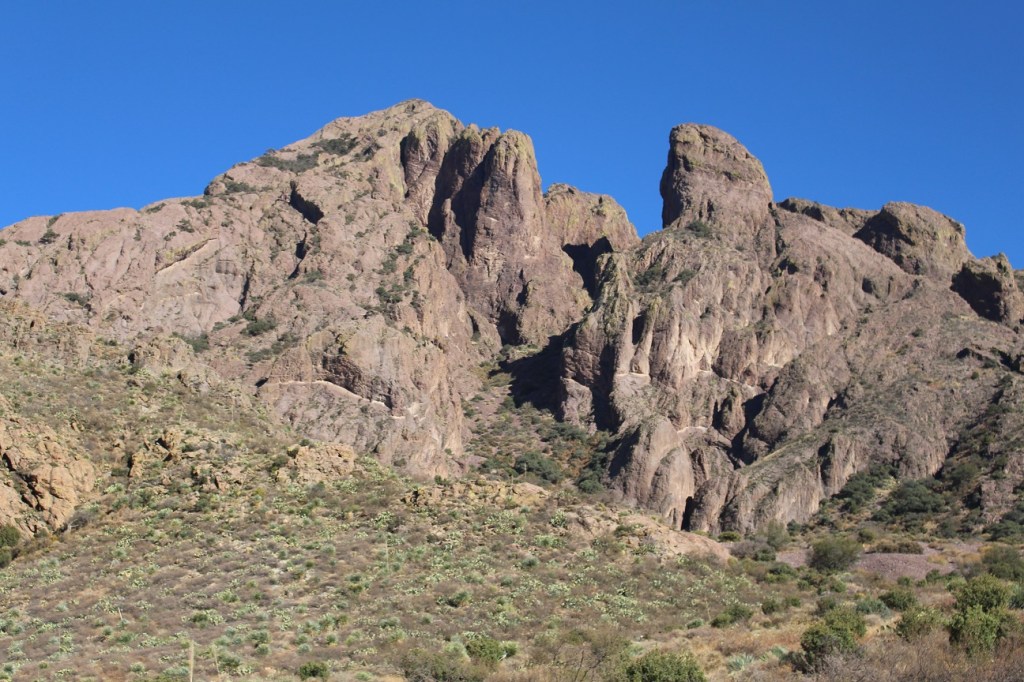
The Organ Mountains, situated 10 miles northeast of Las Cruces, are visible from nearly every part of the city. They’re really distinctive, and, while always beautiful, look their best in the evenings as they catch the setting sun. The range extends north and south for a distance of about 20 miles, and the highest peak reaches 9,006 feet in elevation. The Organ Mountains – Desert Peaks National Monument, in three different regions, spans almost 500,000 acres of BLM-managed land and surrounds the city of Las Cruces. The Desert Peaks part of the monument is west of Las Cruces and includes the Doña Ana Mountains, the Robledo Mountains, and Sierra De Las Uvas, and the Potrillos Mountains 30 miles southwest of Las Cruces. Nancy and Gunther and I visited the Organ Mountains region of the monument in late November and enjoyed a nice 3.6-mile hike – the monument has a total of 48 miles of hiking trails.
The Organ Mountains were formed from a series of volcanic eruptions that started about 36.5 million years ago and ended 500,000 years later. The mountain range was tilted and uplifted through action of the Rio Grande Rift about 18 million years ago. That tilting, and the erosion in the millennia following, resulted in the distinctive look of the mountains.
One of the first features we encountered on the trail was La Cueva (“the cave” in Spanish), at the base of a huge rock face. It started being inhabited by the Jornada Mogollon natives about 5,000 years ago. Excavations in the 1940s and 1970s uncovered fragments of ceramic pots as well as projectile points and stone scrapers. There are 243 known archeological sites in the monument. La Cueva was later used as an outlaw hideout.
This huge rock face (see the people standing outside the cave at the bottom for a sense of scale) is formed from rock that erupted about 36.5 million years ago, forming a rock type called tuff from a moving river of hot gases, ash, and rocks. Dogs aren’t allowed on the trail going to the cave, so we weren’t able to get close to it. Thanks, Gunther!
We both grew up and spent most of our lives in Colorado, so it’s been exciting to learn about all of the animals and plants of the southwestern desert region. Despite the rugged and arid environment of the monument, almost 150 different grasses, ferns, cacti, trees, shrubs, and herbs have been identified in the area.
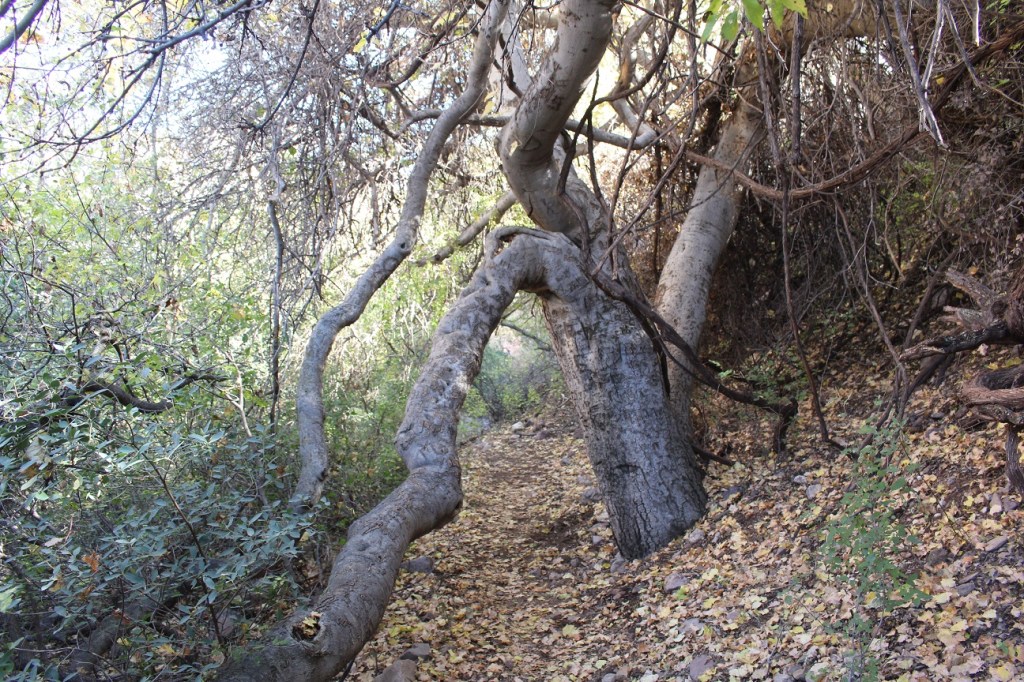
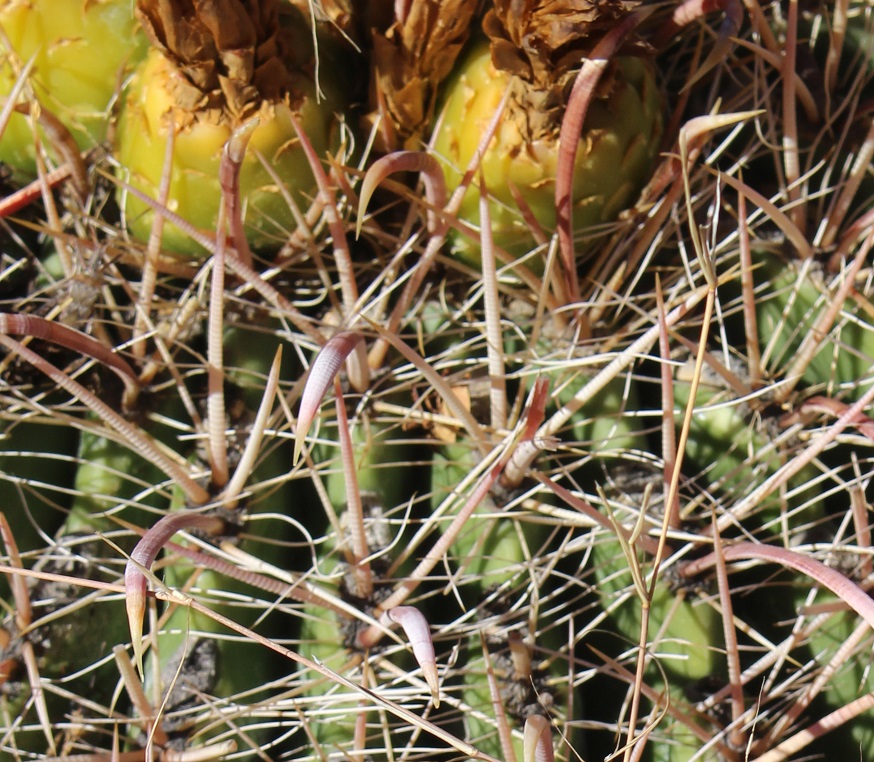
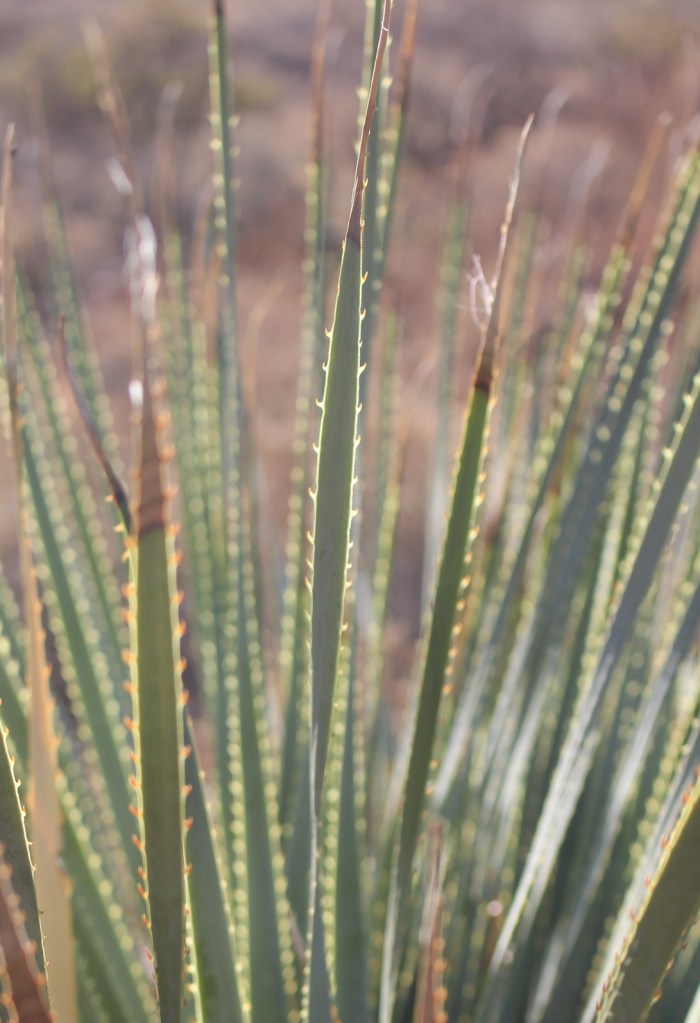
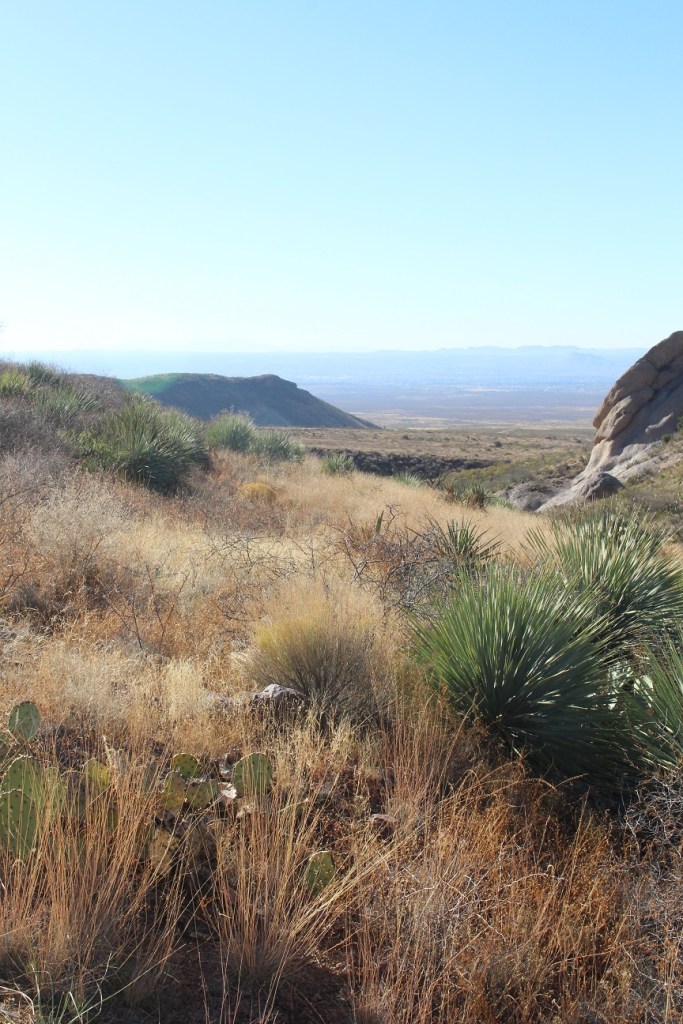
The plant in the foreground is desert spoon. Although it looks like a succulent, it’s classified as a shrub. It’s also known as sotol.The monument is located in a really harsh environment, but there’s a huge variety of plant life. Prickly pear cacti abound, of course, but there are also 15 species of grass. Prior to becoming a monument in 2014, the area was used for many years by ranchers for grazing their cattle.There were some unexpected finds of plant life. A seasonal stream runs near La Cueva, and it supports some decidedly deciduous trees (that look like they still had to work pretty hard to grow).These are the spines of a type of barrel cactus called a fishhook, and you can see how it earned that name. We have seen lots of fishhook cactus in the wild and also in cultivated gardens in New Mexico.On the trail, Nancy, always on the lookout for historic mines, recognized the mound of light-colored rocks in the lower left as a tailings pile. Just a few steps later on the trail, an interpretive sign identified the area as being what remains of the Modoc Mine. The Modoc Mining Company spent a million dollars in 1898 (more than $30 million today) to build the silver and lead mine, a three-story ore mill, and a small townsite. The mine had shafts that tunneled several hundred vertical feet, and a well drilled four hundred feet down supplied water to everything.Here’s a closeup of some desert spoon spines. As with most plant life in the Chihuahua Desert, it’s best to look and not touch. And definitely don’t lick these spoons. The Spanish word for spoon is “cuchara,” which is the name of a spoon-shaped valley in Colorado’s mountains that’s home to a former ski resort also named Cuchara.This is looking west from the monument. The city of Las Cruces is behind the dark ridge on the left. Prickly pear cactus in the left foreground; desert spoons in the right. Spoons, spoons, spoons … everywhere! … And here are some more. Desert spoons send up a flower stalk six to 17 feet tall, but their roots extend only about a foot underground.The Organ Mountains are really interesting to look at – the erosion over millions of years has resulted in some very picturesque rock formations. All of the lighter green plants in front of the mountains are prickly pear cactus.After all of the desert plants we’ve seen, it was nice to encounter this old friend growing alongside the trail. I learned about sideoats grama, and many other range grasses, as a high-school student in Vocational Agriculture class.This pretty grass is splitbeard bluestem, also known as silver bluestem. It was not one of the grasses I learned to identify in high school, so more learning for me now. In late November, of course, all of the grasses had already gone to seed but a few retained their seedheads.This is black grama, which looks very similar to blue grama that grows in Colorado. Because of its quantity and nutritive value, black grama is a very important natural grass for New Mexico’s cattle ranchers. Blue grama is my favorite species of grass (a close second is big bluestem, a relative of the splitbeard bluesteam above), probably because the mature seed heads look like eyelashes. What’s your favorite species of grass, and why is it also blue grama?
I took the grass photos toward the end of our hike. Although it was relatively short, the hike afforded an opportunity to see a huge variety of plants. We didn’t see very much wildife, but the area supports dozens and dozens of native and migratory bird species, including seven species of hummingbirds and 23 species of towhees and sparrows.
Several historic persons of note, including William H. Bonney (“Billy the Kid”) and Geronimo, are known to have passed through what is now the monument. Twenty-two miles of the Butterfield Overland Trail, which, from 1858 to 1861 ran between St. Louis and San Francisco as a forerunner of the Pony Express, passed through the region. Areas of the monument, prior to coming under BLM management, have also been used for bombing practice by the U.S. Air Force and for astronaut training (not at the same time).
We’ll definitely return to the Organ Mountains – Desert Peaks National Monument, and next time we’ll leave Gunther in the Goddard so we can visit some of the features that (understandably) are off-limits to dogs. I’d especially like to see the area in the spring during the wildflower blooming season.
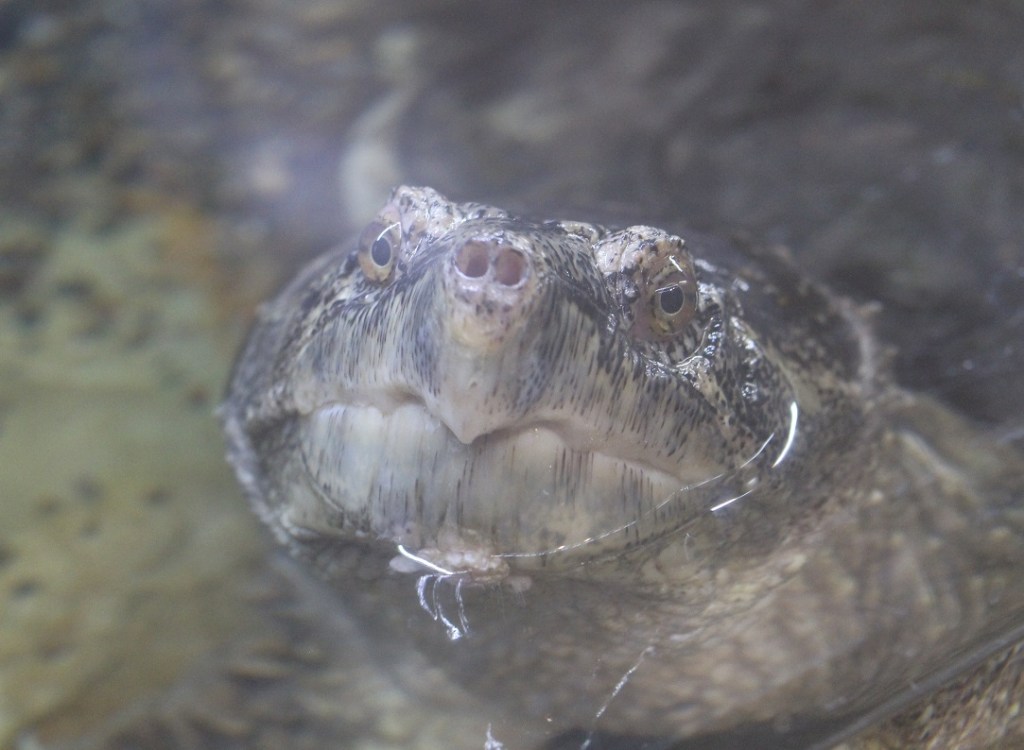
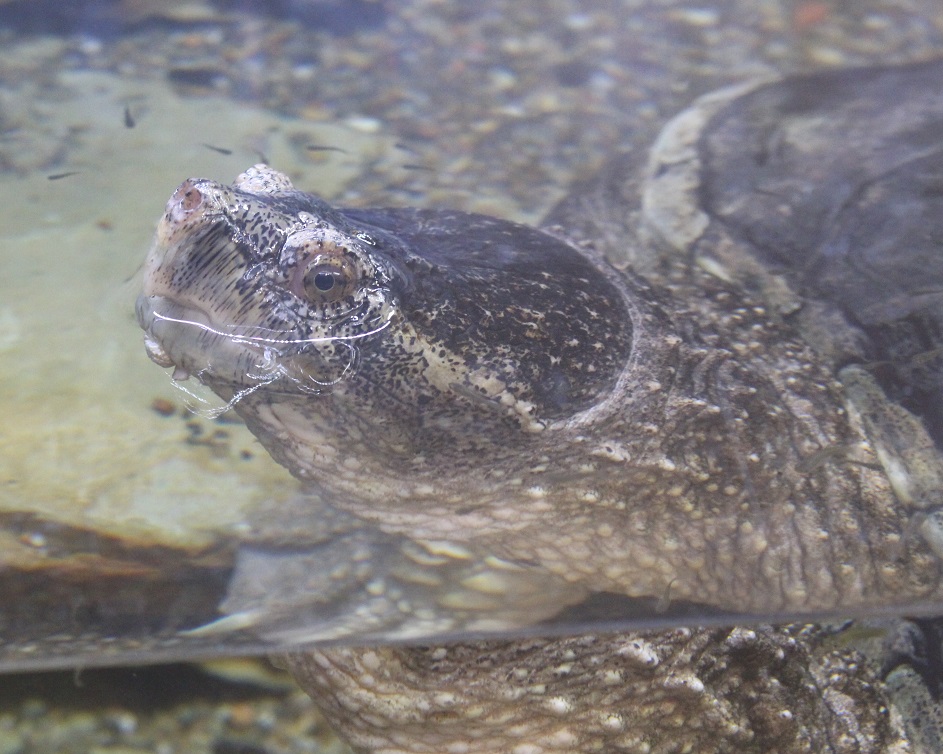
The City of Las Cruces operates two museums that are co-located on Main Street: a natural history museum and an art museum. Nancy and I visited both in late November after strolling through the Farmers and Crafts Market. The Museum of Nature & Science has several very interesting and well-designed permanent exhibits. I think we appreciated the reptilian and amphibian wonders of the Desert Life exhibit the most, and Nancy made friends with a common snapping turtle named Zilla.
One of the first exhibits is this fine cast of a dimetrodon, which is not a dinosaur but a species of animal (it’s more closely related to mammals than reptiles, but it is not an ancestor of modern mammals) that went extinct 40 million years before dinosaurs came on the scene. Fossils of dimetrodon have been found in what is now the Robledo Mountains area northwest of Las Cruces. Theories differ on the purpose of the spined sail along the back, ranging from use as an actual sail while swimming, to assisting with controlling the temperature of the animal, to helping support the back of the animal while it walked in a side-to-side motion.
Most fossils of Dimetrodon species have been found in the southwestern United States, but one species has been unearthed in Germany and another in Canada. They lived about 300 million years ago, and were 6 to 15 feet long. I didn’t know that animals that are more closely related to present-day mammals than to dinosaurs even existed before dinosaurs ruled the Earth, so I learned something just minutes after stepping into the museum.
Here’s a mounted skeleton of a western diamondback rattlesnake. These reptiles can have up to 300 vertebrae, and their rattles are modified scales. They get a new rattle each time they shed their skin, which is three or four times each year. Adult diamondbacks commonly grow to 4 feet in length. This species is responsible for the greatest number of snakebites in the United States, and is found in the southwestern region of the country as well as the northern half of Mexico.
Tyrannosaurus roamed much of the present-day western United States, including the area that’s now New Mexico, up until the day the dinosaurs went extinct about 65 million years ago. The largest specimens are estimated to have been more than 40 feet long and weigh more almost 8 tons. Sharp-eyed tyrannosaurus enthusiasts will recognize this cast as coming from the skull of Stan, one of the more famous fossils for which there is a nearly complete skeleton. Stan was found in 1992 in South Dakota’s celebrated Hell Creek formation; he has a hole in the back of his skull that’s about the size of a Tyrannosaurus tooth, so make of that what you will.Some of the museum’s exhibits featured animals not yet fossilized or skeletonized. Here’s an intense-looking Trans-Pecos rat snake; they are very gentle and non-venomous snakes, and usually don’t attempt to bite. They are natives of the Chihuahuan Desert, and the largest grow to about 5 1/2 feet long.These are Woodhouse’s toads. Kinda grumpy-looking toads, don’t you think? They live in the west-central United States from Texas up north into the Dakotas. They can grow up to about five inches long. One must resist the urge to lick a Woodhouse toad, as they have toxins on their skin to make them taste bad to potential predators. And, I don’t think licking this toad would make it any less grumpy anyway.Finally we come to Zilla, the museum’s common snapping turtle. This species is native only to the Cimarron and Pecos rivers region of northeastern New Mexico, but populations are now being found in the Rio Grande River in the central third of the state. Common snapping turtles are found in the United States north and east of New Mexico to Canada and the Atlantic Coast. Nancy was really taken with Zilla.And who wouldn’t be? Contrary to common belief, common snapping turtles probably aren’t capable of biting off a human finger: humans have more force in their jaws than do common snapping turtles. A non-closely related species, the alligator snapping turtle, is definitely capable of biting off fingers, so you’re probably safe sticking your fingers in front of a common snapping turtle but don’t do it in front of an alligator snapping turtle.According to a staff person at the museum, Zilla is about 25 years old. It’s thought that common snapping turtles can live more than one hundred years in the wild, so who knows how long Zilla will keep going. They keep growing with age and the heaviest one found in the wild weighed about 75 pounds, so they get pretty big.Here’s a study of Zilla’s front left claws. Snapping turtles’ impressive claws are used for digging for food in the rocks and mud and not, as one might think, in swift slashing offensive attacks. They’re turtles.
We enjoyed the visit to the Museum of Nature & Science. We both learned a lot about animals that live in New Mexico (now and tens of millions of years ago), and Nancy left with her heart warmed by meeting Zilla.
The city of Las Cruces, New Mexico, dates back to 1849, when it was founded after being surveyed by the U.S. Army. The land on which the town sits was ceded to the United States as a result of 1848’s Treaty of Guadalupe Hidalgo, which ended the Mexican-American War (1846-1848). The city was named after three crosses that used to be located north of town.
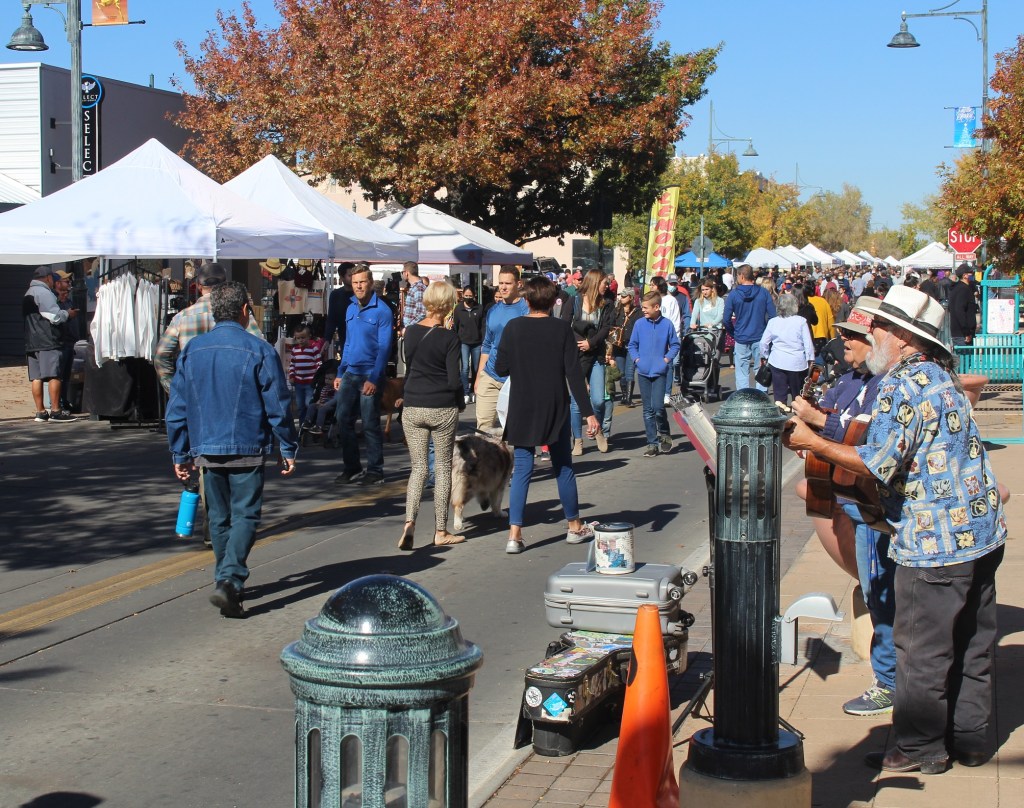
The year 2021 marks the fiftieth anniversary of a farmers market in downtown Las Cruces. The Farmers & Crafts Market of Las Cruces, a nonprofit organization, conducts a market along seven blocks of Main Street each Wednesday and Saturday morning throughout the year. Nancy and I enjoyed visiting the vendors on Saturday, Nov. 27. There are more than a hundred vendors selling everything from fresh tomatoes (we bought some) to pistachios (we bought some) to bread (we bought some) to handcrafted pottery and glassware (we didn’t buy any; we live in a home that moves down the road at 65 MPH every couple of weeks).
There are many permanent vendors at the market, as well as a long list of temporary ones, in addition to entertainers along Main Street.
To be honest there weren’t a lot of people selling actual farm goods, but the growing season, even in southern New Mexico, is nearing its end. I was impressed with all of the good smells (mostly from breakfast burritos) and incredibly vibrant colors of the clothes that some of the people were wearing.
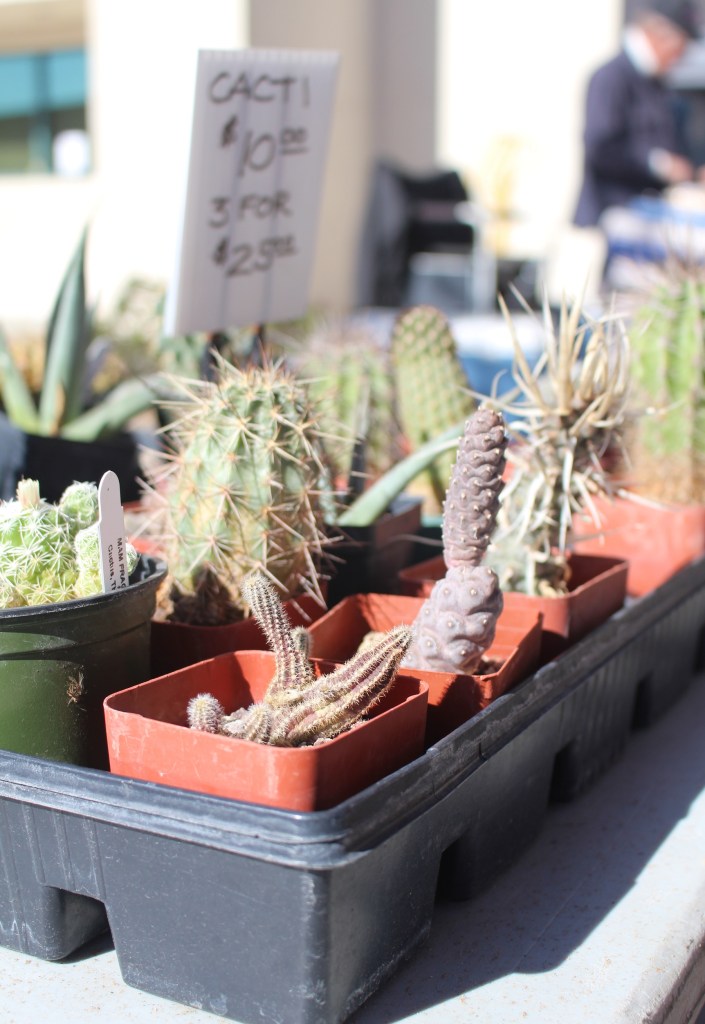
They’re doing amazing things with cacti nowadays. Nancy was buying a pound of pistachios from the out-of-focus man in the upper right when I took this photo. We returned to the market a week later, and Nancy bought another pound of pistachios! From the same man!Chile ristras are not hard to find in New Mexico, especially at farmers markets, but they’re always fun to see. Those are the Organ Mountains in the background.It’s always fun to see old movie theaters in downtown locations: they’re usually very ornate buildings. The Rio Grande Theatre dates to 1926 and is on the National Register of Historic Buildings. The theater (“theatre” if you’re feeling fancy) survived an urban renewal project from the late 1960s and early 1970s that destroyed many of the older buildings in downtown Las Cruces. The Rio Grande still shows movies, and had a slate of holiday-themed films on its schedule when we were there. I don’t know when this Woolworth’s on Main Street was opened, but it’s been closed for many years and now the building serves as a church. The door handle is really, really cool, and I wonder how many ring-bedecked fingers it took to give it that wonderful wear. Nancy and I have noticed many references on billboards and business signs in Las Cruces to something called “refrigerated air.” As far as we can tell, it’s the same as air conditioning.
Joining Nancy and I on our travels are our cat Rusty and our dog Gunther. As you can tell, they’re both full of energy!
Rusty is three years old and appreciates watching all of the people and animals (especially birds) from the ever-changing views through the windows of The Goddard.Gunther, who is two years old, enjoys checking out the dog runs in each of the RV parks and making new dog friends. He’s working on his Frisbee catching skills, and loves playing fetch with his tennis ball. He also likes accompanying Nancy and me on our hikes.
Some folks may be wondering why we call our fifth-wheel trailer The Goddard. Robert Goddard (1882-1945) was an American scientist who developed the world’s first liquid-fueled rocket in 1926. In 1919, he published a paper that proposed using a multi-stage rocket to reach the Moon. Goddard was ridiculed by many for that notion, but mankind did walk on the Moon 50 years later and it wouldn’t have happened without Goddard’s advancements in rocket science. Nancy and I learned about Goddard on a previous trip to Roswell, New Mexico, where Goddard conducted many rocket experiments in the 1930s. The Roswell Museum and Art Center has a reconstruction of Goddard’s laboratory. It’s in recognition of Goddard, and his contributions to science to fulfill his desire for humankind to go places, that we named our new home The Goddard.
Robert Goddard, rocket scientist. (Photo courtesy U.S. Library of Congress)
On the day after Thanksgiving, we visited the New Mexico Farm & Ranch Heritage Museum on the east side of Las Cruces. It’s an impressive museum, with a 24,000-square foot building with permanent and traveling exhibits, and almost 50 acres of outside space devoted to livestock, crop, and farm equipment exhibits. I managed to forget to bring my DSLR camera for our visit, so all of the photos were taken with the camera on my iPhone.
Nancy and I always pronounce the breed of this cow as “HAIR-uh-fehd,” because of the way Lynn Redgrave’s character, from England, pronounced “Hereford” in the TV miniseries “Centennial.” Most Herefords today are polled; the hornless strain was first developed in 1901 from cattle that naturally never developed horns.
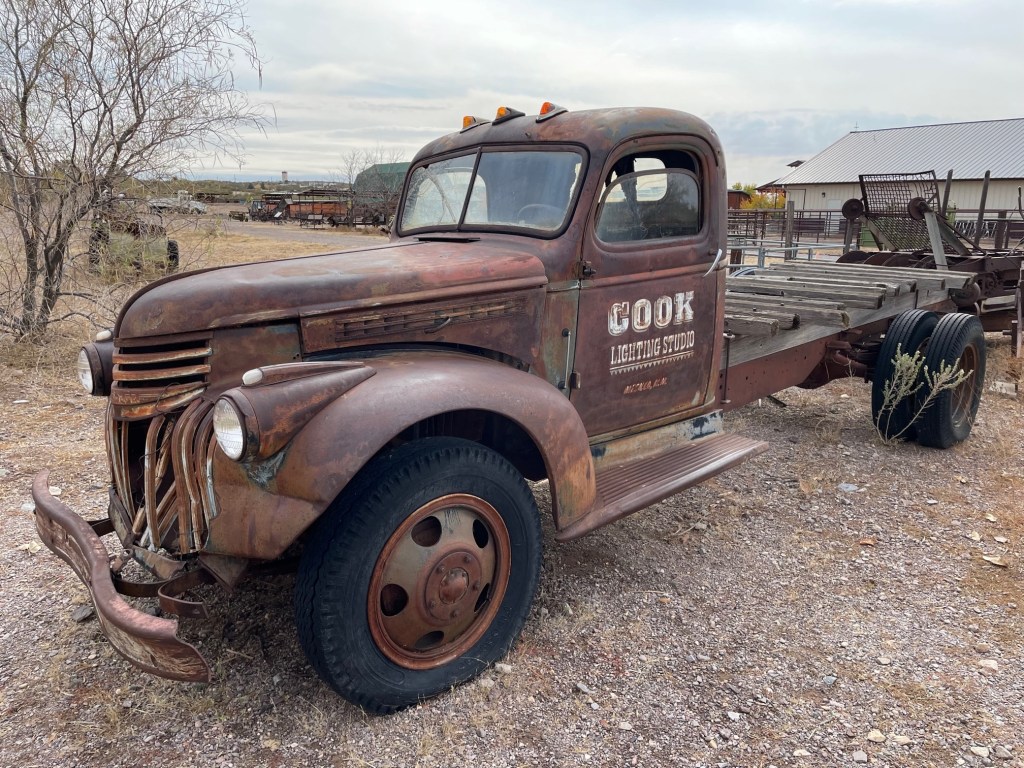
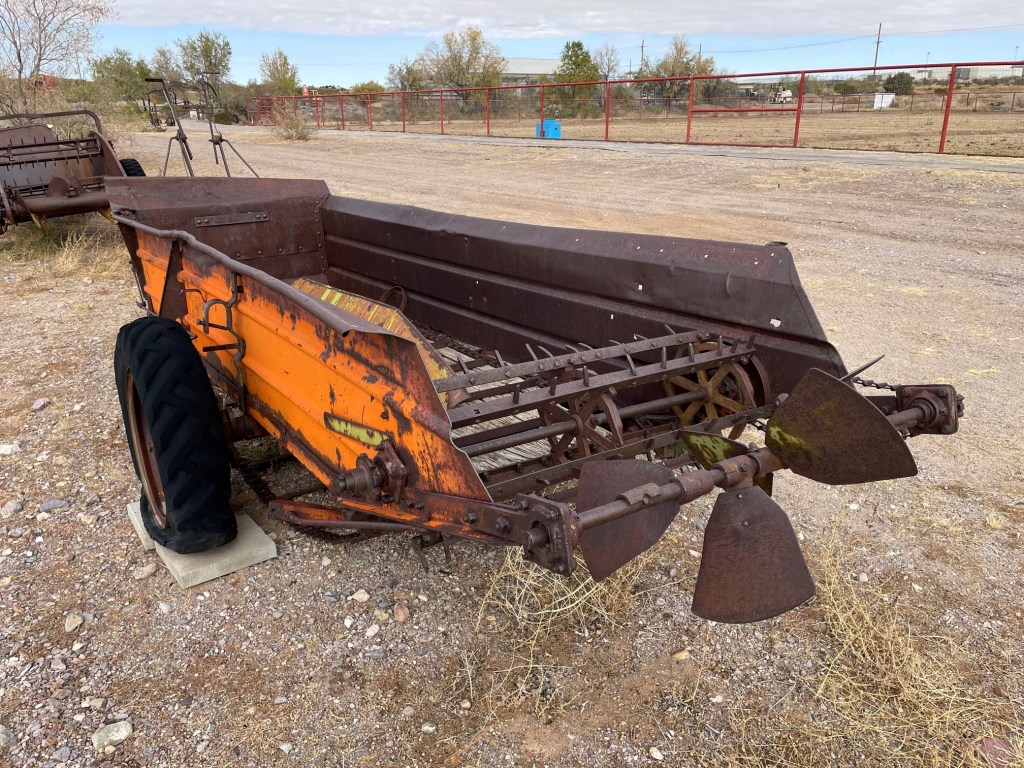
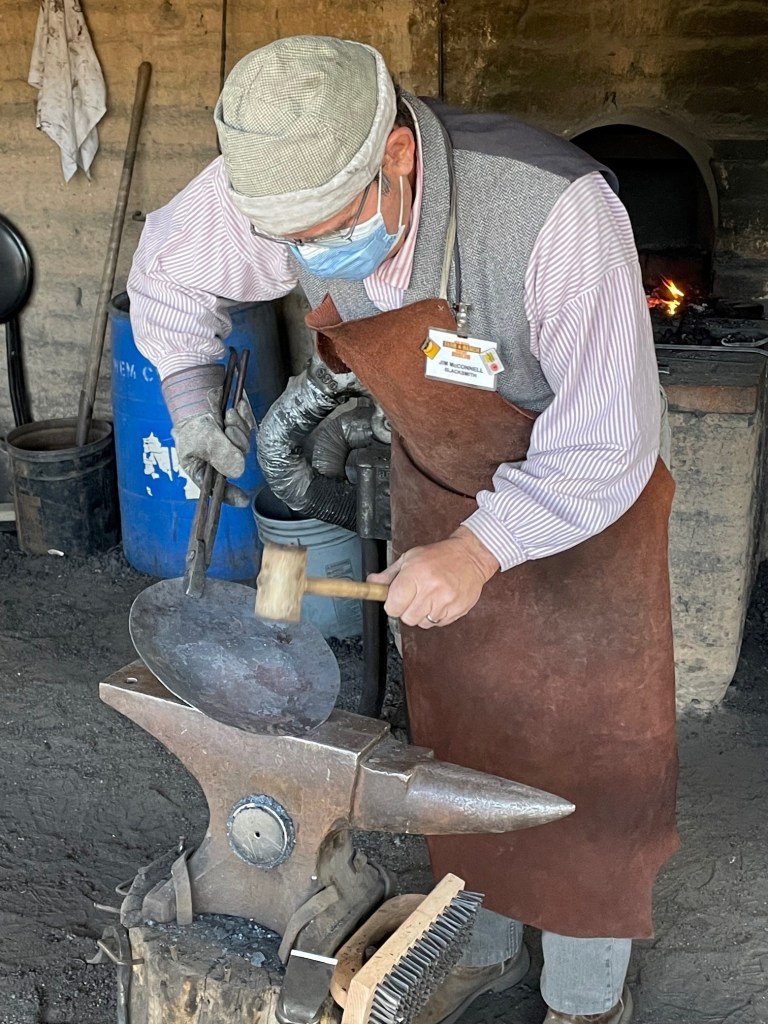
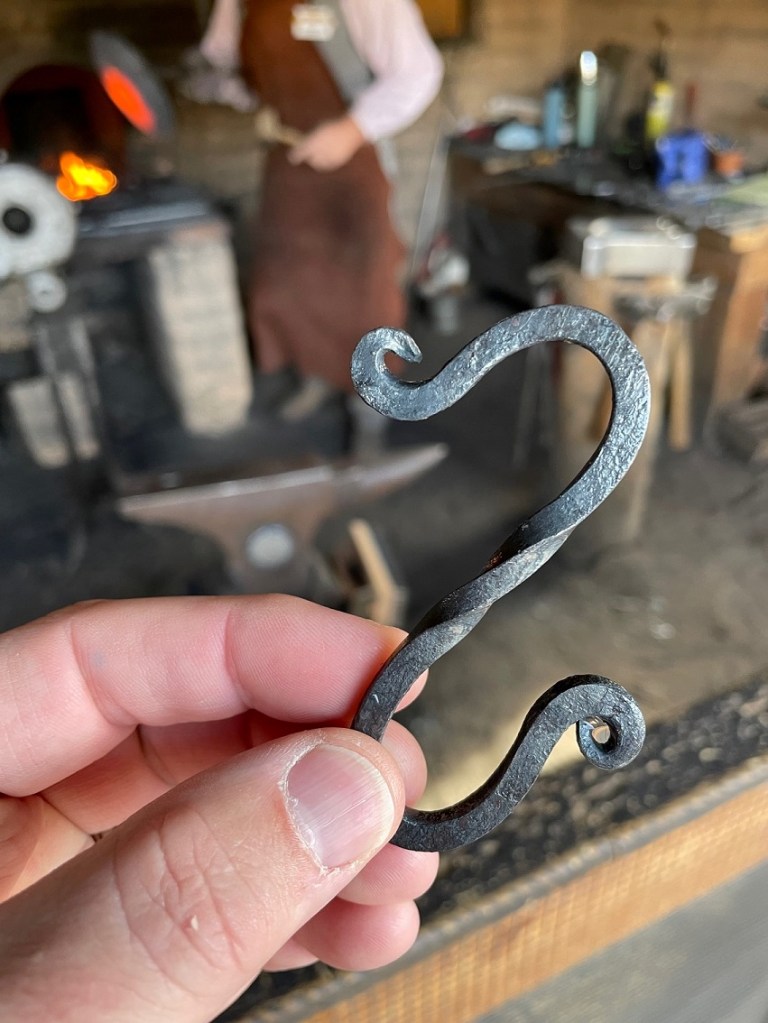
The museum’s pens had a good variety of cattle breeds: joining the Hereford from Great Britain were a couple of Angus, and they also had a Brahman bull, Texas Longhorns, and an important breed that I’d never heard of called Corriente.The Spanish brought the Corriente breed to North America from the Old World in the 1490s and the cattle arrived in the American Southwest in 1598. “Corriente,” which translates to “common” or “cheap,” was one of the foundation breeds for Texas Longhorns, which were brought north into the American West on the great cattle drives beginning in the 1830s. Today the breed is mostly used as rodeo stock.This is a Corriente calf that was just a few days old when we visited. It was laying right next to its mother (not the white Corriente cow pictured above). The museum also has several horses, in addition to sheep and goats.The museum has a huge collection of vehicles, including tractors and trucks, that saw work on New Mexican farms and ranches in the past decades. This is a 1946 1 1/2-ton Chevrolet pickup. It’s an example of Chevrolet’s product line from 1941-1947 that has been called “art deco” by enthusiasts because of the design of the grille and hood.This is a small grove of pistachio trees at the museum. Pistachios are grown in New Mexico, Arizona, and California; the latter state has 99% of the production, but pistachios are very popular as a snack in New Mexico. There are now more than 25,000 farms in New Mexico, producing a value of $3.4 billion in value (30% crops, 70% livestock) each year and making agriculture the #3 industry in the state. New Mexico produced 63,000 tons of chile peppers in 2019, making it the nation’s number-one state for that invaluable resource. Guess which state ranks #5 in onion production in all the land! It’s New Mexico!This is an agave plant, situated outside the museum’s greenhouse, with a flower stalk that I think is about 30 feet tall. Some of the stalks can grow to 40 feet. The stalks are produced at the end of the agave plant’s life; the stalk falls down and spreads its seeds to begin the cycle anew. Agave is used for food and fiber, and I am given to understand that it’s also used in the production of tequila and other mezcals.Of course, one of the highlights of a visit to any agricultural museum is checking out the collection of manure spreaders, and on this opportunity the New Mexico Farm & Ranch Heritage Museum does not disappoint. First developed in 1875, manure spreaders did the work of five people attempting to spread manure by hand. Early manure spreaders, like most implements, were originally pulled by horses until tractors became more available. This magnificent example was made by the J.I. Case company, which was founded in 1842 by Jerome Increase Case as the J.I. Case Threshing Machine Company. The museum has a really impressive collection of vintage equipment, including threshers, hay stackers and balers, harrows and plows, and much more.We enjoyed visiting with Jim McConnell, who was busy in the museum’s blacksmith shop. Here he’s creating the rounded side of a skillet using a rawhide mallet. The smell of the leather mallet, when it struck the red-hot metal, reminded me of being around cattle being branded – which I guess makes sense. Jim was a lot of fun to talk with. He said that blacksmiths were often the most educated people in a rural community, because they had to be knowledgeable about chemistry, physics, and all kinds of math like geometry and algebra.Here’s an “S” hook, used for hanging tools or kitchen pans and utensils, that Jim made that day; Jim is busy heating his skillet (note the color of the metal) for more shaping over the fire in the background. Blacksmiths usually have several projects going at the same time because of the need to wait for the metal to cool down to the correct temperature before continuing. Also note the fancy twist in this hook – great work, Jim!
The Farm & Ranch Heritage Museum is really a lot of fun: there’s plenty to see and learn without even going inside a building, and one can get really close to a wide variety of farm and ranch animals.
The town of Truth or Consequences, pop. 5,753, is situated in south-central New Mexico along the Rio Grande River. Did you know / did you care that until 1950 it was named Hot Springs (there were once about 40 hot springs in and around the town), and changed its name as the result of a radio program contest? “Truth or Consequences” was hosted by Ralph Edwards on NBC radio from 1940-1957, and Edwards said that he’d host a broadcast from any town that agreed to change its name to that of the show.
Nancy had a good point: the state and federal highway departments at the time probably didn’t appreciate having to re-do all of the road signage when Hot Springs changed its name in 1950. The new name has 21 characters and takes up two lines on the signs on Interstate 25. I think the town’s name does not have a capital “o” in “or,” but I doubt the feds want to hear about that typographical error.
We camped at Caballo Lake State Park in mid-November, enjoying a quiet stay in one of the smaller campgrounds at the park. The reservoir is on the Rio Grande River, about 160 miles south of Albuquerque. We were fortunate to be camping next to a very nice retired couple; he worked for the New Mexico Energy, Minerals and Natural Resources Department (EMNRD), which includes the state’s parks, and retired as the superintendent of one of the parks about 15 years ago. They both provided a lot of information about New Mexico state parks in particular and things to do in the state in general.
Caballo is the Spanish word for “horse,” and the Caballo Mountains for which the lake is named are said to resemble the head of a horse. I don’t see it, but they were really, really beautiful anyway, especially at sunset.
A sunset from our campsite at Caballo Lake State Park. This is looking north, not west toward the setting sun; Nancy and I have found that New Mexico’s sunsets often have a 360-degree aspect to them.
The Caballo Mountains are complex because of their geologic history: the oldest granite layers (at the bottom, naturally) date to more than 2 billion years ago during the Proterozoic Eon. That is the time period for which we have the earliest fossil records for life on Earth. The higher sandstone, limestone, and dolomite layers are from the Paleozoic Era, about 500 to 250 million years ago, when this region of New Mexico, and much of the present-day West, was covered by a vast inland tropical sea.
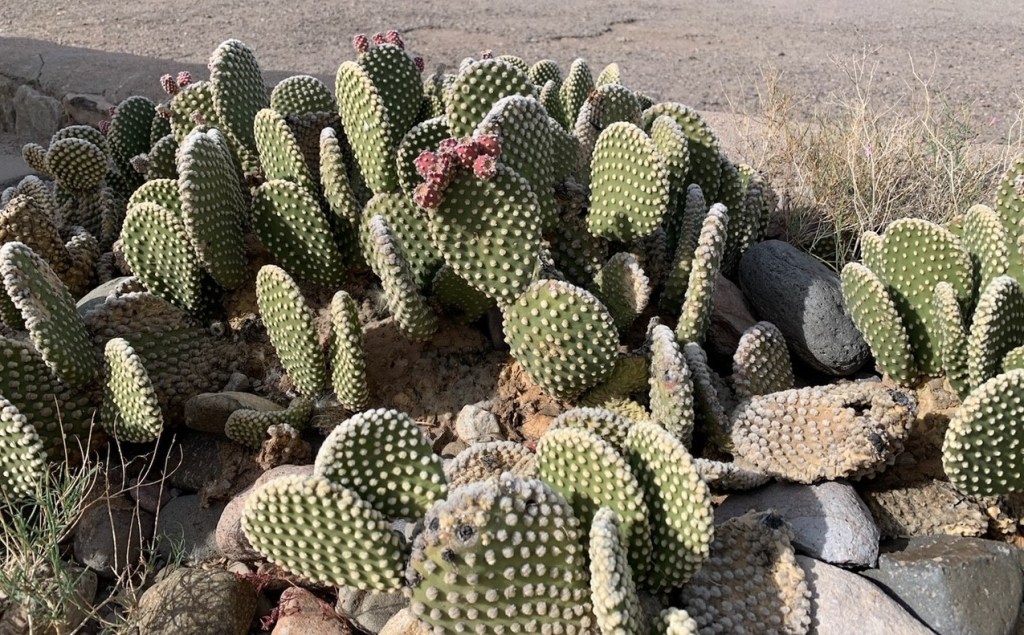
That vast inland tropical sea is long gone now, and the area is now part of North America’s largest desert, the nearly 200,000-square-mile Chihuahan Desert. Nancy took this photo of bunny ears cactus growing near our campsite. While on one of his first walks around the campground, Gunther sniffed a cactus just once, and took great lengths to avoid them thereafter. Some cacti also got barked at.
We took a day trip to Elephant Butte Lake State Park, the largest state park in New Mexico and located about 20 miles north of Caballo Lake, and Truth or Consequences, near Elephant Butte, on Saturday, Nov. 20. One of the buttes around the reservoir is said to look like an elephant; we didn’t see that, either. Elephant Butte Dam was built by the U.S. Bureau of Reclamation and opened in 1916 as the biggest dam of its type in the world. Both Elephant Butte and Caballo reservoirs are now severely depleted of water because of low water in the Rio Grande and its tributaries upstream, but that missing water is especially noticeable at Elephant Butte.
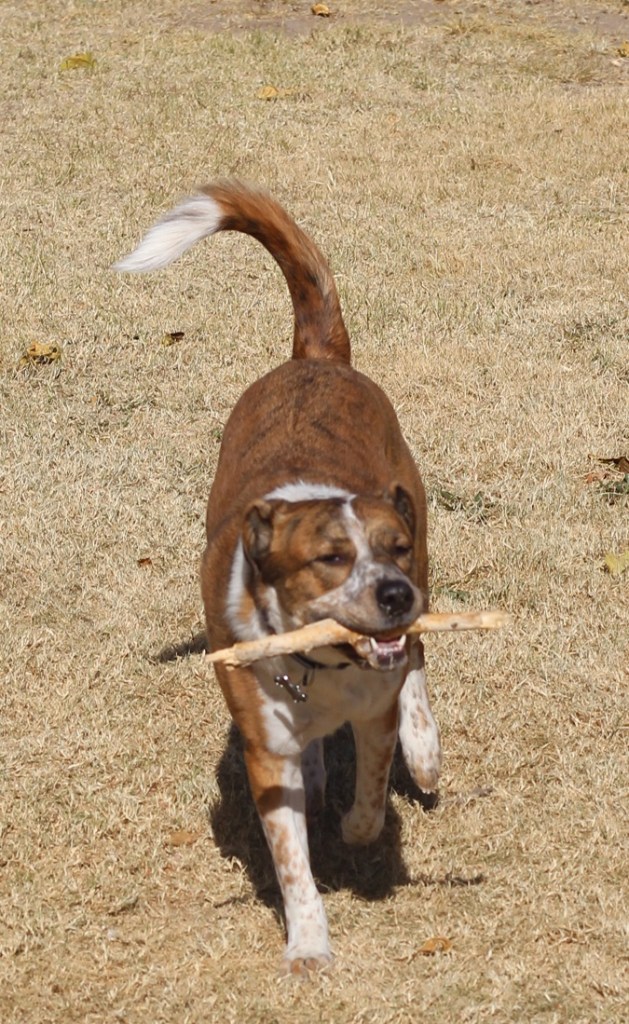
This is the marina at Elephant Butte Lake State Park. The lake is at about 2 percent of capacity, and is really little more than the Rio Grande River. Caballo Lake was at about 6 percent of capacity.Truth or Consequences had a fenced dog park in which we let Gunther run off a little steam. He found a stick. Don’t lose that stick, Gunther – do you think they grow on trees?He had a pretty good time!
There were hundreds if not thousands of sandhill cranes flying over the lake while we were at Caballo, and it was a lot of fun to listen to their calls.
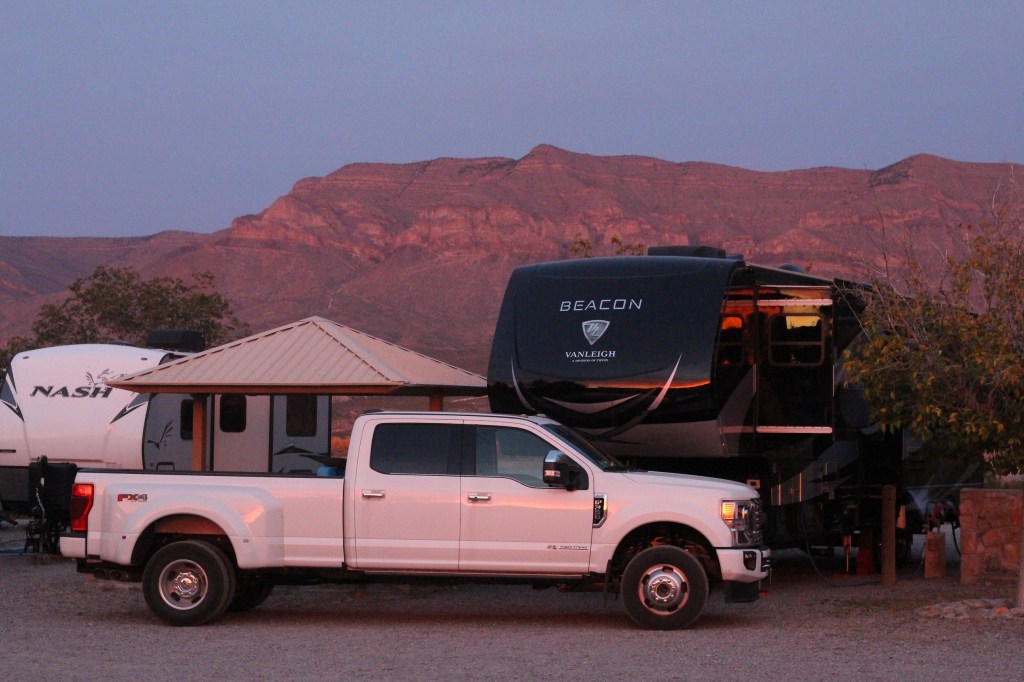
Here’s the Goddard with the sun setting on the Caballo Mountains in the background …… and here’s that sunset. Our stay at Caballo Lake State Park was very relaxing, and I’m glad we stopped there for a few days. The weather was great for the most part, and the skies at night, when clear, provided really nice stargazing.
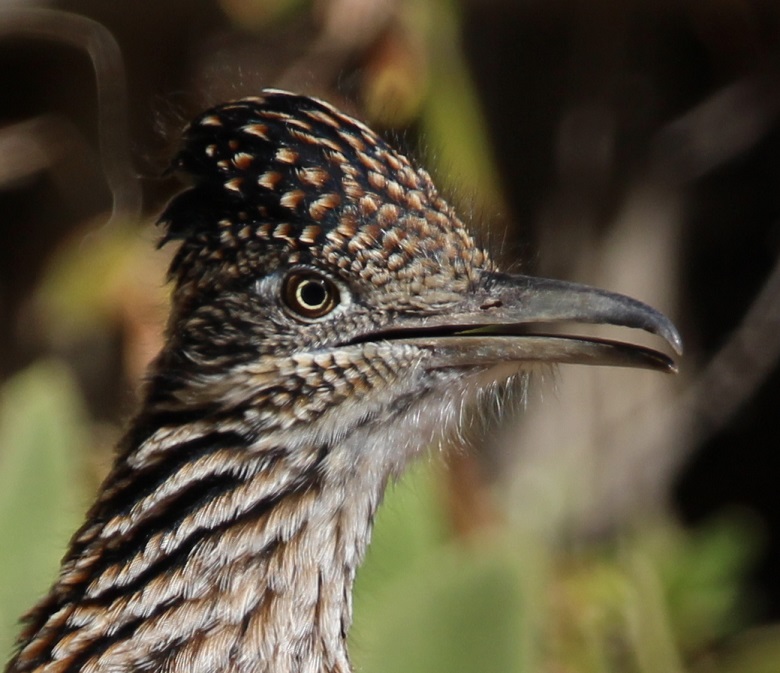
The opportunity to photograph another roadrunner presented itself while we were at the Albuquerque Botanic Garden on Sunday, Nov. 14. The garden has a display of vintage farm equipment next to its exhibit on old-timey farmsteads, and this greater roadrunner (as we now know, the state bird of New Mexico) was hanging out among the implements. He/she spent a couple of minutes in full view. I really like the coloration on that snappy head crest.
Many, many species of birds serve as powerful reminders that dinosaurs still walk among us in a way, but roadrunners must be near the top of that list.I think Rico (what could his/her name be, other than “Rico”?) was looking up at a wooden fence here, perhaps looking for grasshoppers. Although they can fly, roadrunners greatly prefer to run. And run they do, at speeds of up to 20 mph.I am greatly amused by photos of birds looking directly at the camera, and I hope that you are too. Thanks for entertaining us for a couple of minutes, Rico!























 Tales of The Goddard